- The paper introduces a self-consistent covariant spin-GW method that overcomes the sign problem in large-scale Hubbard model computations.
- It quantitatively maps phase diagrams showcasing a d-wave superconducting dome and competing AF and CDW orders in cuprates.
- Numerical results confirm mean-field scaling and detailed Fermi surface evolution, aligning closely with experimental observations.
Nonperturbative Spin-Fluctuation Mechanism for d-wave Superconductivity in Cuprates: A Covariant Spin-GW Approach
Introduction
The theoretical origin of high-temperature superconductivity in cuprates remains a central unresolved problem in condensed matter physics. These materials exhibit a complex phase diagram with intertwined orders, featuring antiferromagnetic (AF) Mott insulating behavior at half-filling, pseudogap and strange metal regimes at finite doping, and a prominent d-wave superconducting (SC) dome at low temperatures. Despite the extensive application of the two-dimensional Hubbard and t-J models as minimal platforms for these phenomena, computational limitations—particularly the fermion sign problem in QMC approaches and finite-size constraints in DMRG—have precluded quantitative agreement with experiment across the full phase diagram, especially in the thermodynamic limit and strong coupling regimes. Mean-field methods, FLEX, and approximate GW schemes, while satisfying conservation laws, break down when U/t is large, and often fail to reproduce the sum rules and correct collective excitation spectra.
This work introduces a self-consistent, nonperturbative framework for the Hubbard model based on a covariant spin-GW method. By fully implementing the Ward-Takahashi identities and the fluctuation-dissipation theorem, and by retaining all SU(2) spin symmetry, this method achieves reliable results for single-particle and two-particle observables at strong coupling and low temperature, free from the sign problem. The resultant phase diagrams, order parameter evolution, and Fermi surface topology are quantitatively benchmarked and systematically compared to various experiments in cuprate superconductors.
The study focuses on the 2D t-t′-U Hubbard Hamiltonian with up to 64×64 lattices:
H^=−ij,σ∑tijc^iσ†c^jσ+Ui∑n^i↑n^i↓−μiσ∑n^iσ
The nonperturbative approach centers on a 4-Nambu spin-GW scheme, explicitly constructed to respect all conservation laws and symmetry constraints. The interaction is recast via Fierz transformations, introducing dynamical spin bosonic fields, and solved using self-consistent equations for both the single-particle Green's function G~ and dynamically screened effective interaction W. The resulting framework avoids the sign problem, preserves SU(2) spin symmetry, and is computationally feasible at scales necessary to extract the thermodynamic-limit phase behavior.
Within this formalism, the t0-wave SC order parameter and two-particle correlators are computed directly via the covariance method, enabling a rigorous identification of transition lines (by divergence of susceptibilities) and stable SC solutions (by nonzero t1), cross-validating the phase diagram.
Numerical Results and Phase Diagram
The central numerical result is a comprehensive phase diagram for the 2D Hubbard model at fixed lattice size (up to t2), with t3 and varying t4, covering both hole- and electron-doped regimes. The phase boundaries for AF order, t5-wave SC, CDW instability, and pseudogap/strange metal regions are determined through divergence criteria in the respective correlation functions.
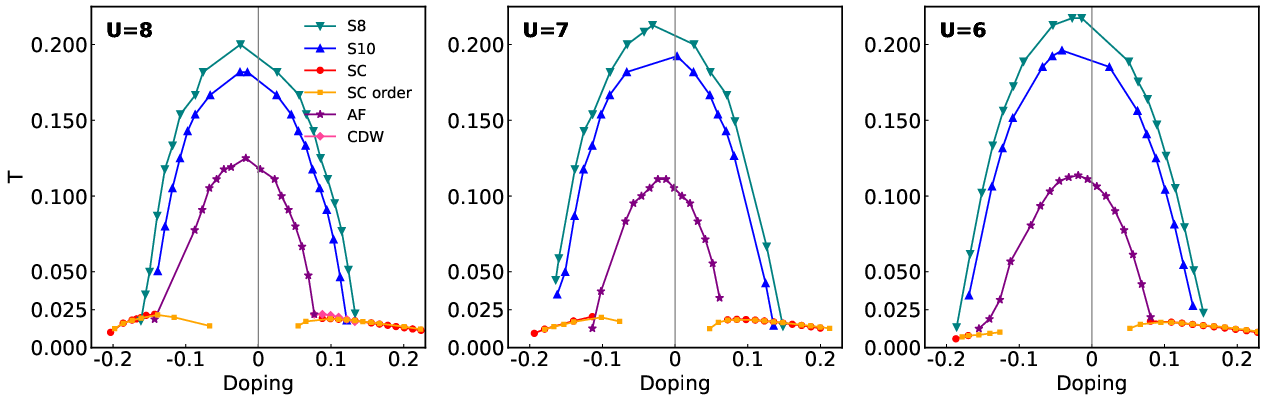
Figure 1: Numerical phase diagram of the Hubbard model at different t6 values, t7, t8. Phase boundaries: SC (stable t9), AF (divergent J0), and CDW (divergent charge correlation).
The J1-wave SC region exhibits a dome-shaped phase boundary in carrier density versus temperature, closely matching the experimental superconducting dome and peaking near optimal doping. Both methods for identifying J2—divergence of SC susceptibility and appearance of stable J3—agree away from the AF region; near AF order, the boundary must be refined due to competition between magnetism and superconductivity. Notably, the inclusion of spin fluctuations (but not SC order parameter fluctuations) leads to a BCS-like transition consistent with mean-field critical exponents.
The variation of the J4-wave order parameter J5 as a function of doping for fixed J6, J7 at several temperatures demonstrates the dome structure, including the expected suppression with thermal fluctuations and reduced amplitude away from optimal doping.
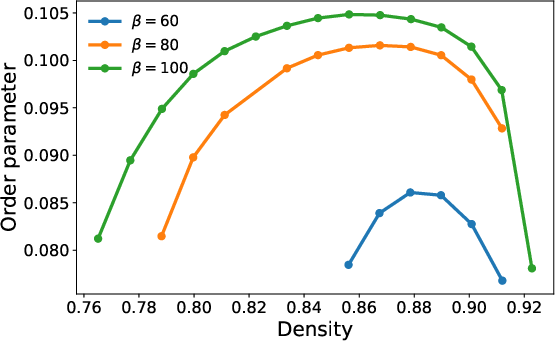
Figure 2: Doping dependence of J8 in the hole-doped regime for J9, U/t0, U/t1 at different U/t2.
Charge density wave (CDW) order is found to compete with superconductivity, particularly in the underdoped region at large U/t3; for U/t4 or U/t5, SC emerges at higher U/t6 than CDW, while CDW order is suppressed in the electron-doped side.
The approach identifies the Fermi surface via peaks in U/t7, which provides a robust signature in the absence of analytic continuation.
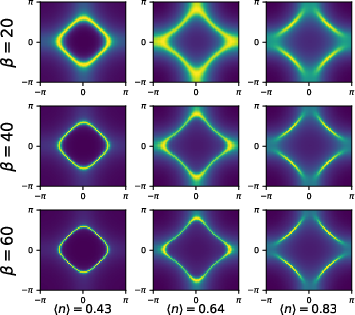
Figure 3: Evolution of U/t8 on a U/t9 lattice, t0, t1 across hole doping and temperature. Three columns: different dopings; three rows: different inverse temperatures t2.
The numerical results reproduce the experimental crossover from Fermi liquid (hole pockets, convex Fermi surface), to strange metal (concave, arcs), to pseudogap (disconnected Fermi segments) regimes as doping increases. These features are manifest above the superconducting dome and align qualitatively with ARPES findings in cuprate compounds.
Finite-Temperature Scaling and Thermodynamic Limit
A detailed finite-size scaling analysis confirms that the computed t3-wave SC transition exhibits mean-field (BCS-type) universality. The critical exponents t4, t5, and the scaling of t6 with t7 are validated by the data.
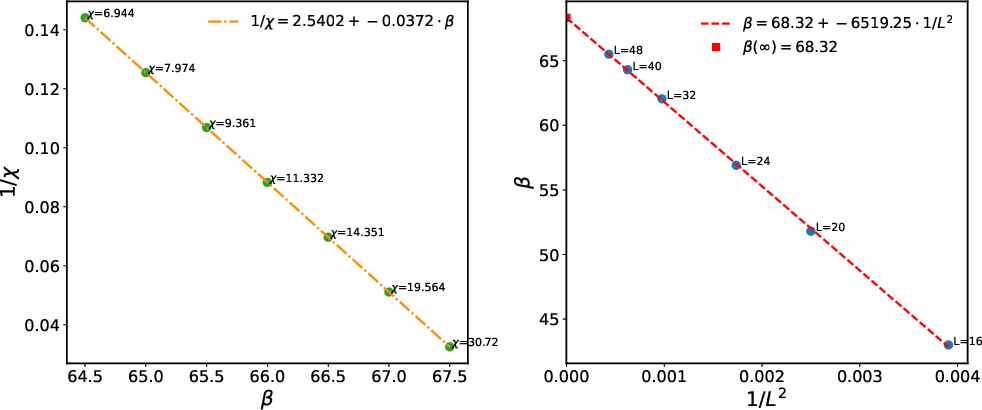
Figure 4: (Left) t8-wave SC correlation function vs. temperature. (Right) Finite-size scaling analysis of t9 using the correlation-length ratio method for t′0, t′1, t′2, showing BCS-like universality.
Estimates for the physical t′3 scale are extracted using t′4–t′5 eV; the resulting maximum t′6 corresponds to 80–125 K, in agreement with experimental cuprate phase diagrams. The calculated N\'eel temperature at t′7 is similarly consistent with observed AF ordering.
Interplay with Other Competing Orders
Analysis of real-space anomalous Green's function t′8 confirms the dominant t′9 structure, with negligible extended-U0 components.
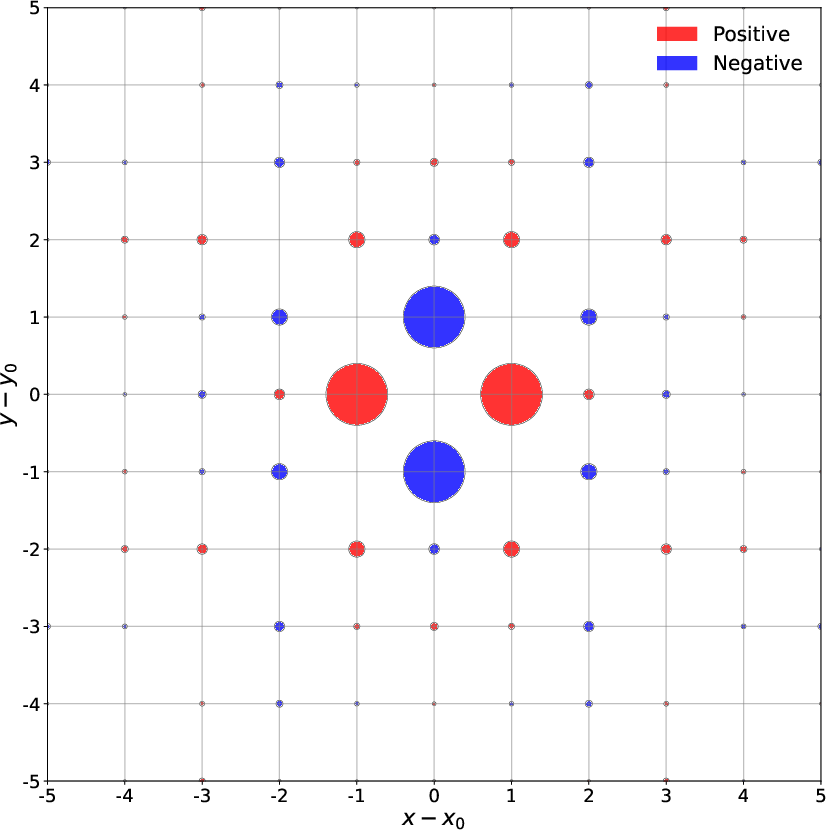
Figure 5: Real-space map of U1 for U2, U3, U4, U5. Circle radius denotes the magnitude of the SC order.
Phase diagrams for alternative U6 and U7 combinations validate the robustness and symmetry expectations: e.g., at U8, U9, the diagram is particle-hole symmetric, and stable H^=−ij,σ∑tijc^iσ†c^jσ+Ui∑n^i↑n^i↓−μiσ∑n^iσ0-wave order exists even for modest next-nearest hopping.
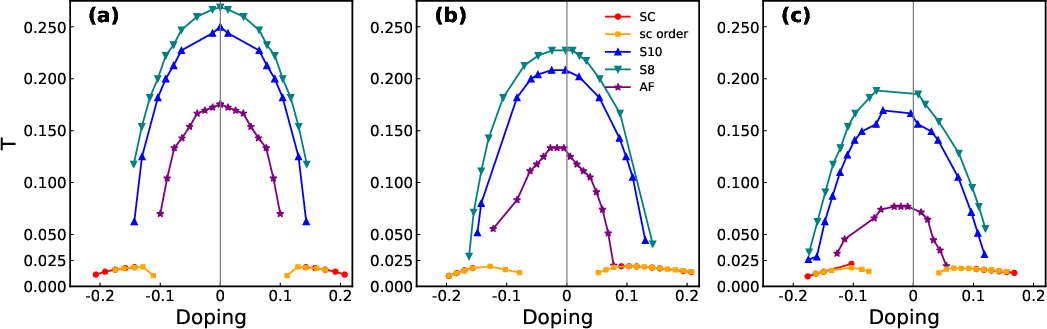
Figure 6: Phase diagrams at H^=−ij,σ∑tijc^iσ†c^jσ+Ui∑n^i↑n^i↓−μiσ∑n^iσ1, H^=−ij,σ∑tijc^iσ†c^jσ+Ui∑n^i↑n^i↓−μiσ∑n^iσ2; H^=−ij,σ∑tijc^iσ†c^jσ+Ui∑n^i↑n^i↓−μiσ∑n^iσ3, H^=−ij,σ∑tijc^iσ†c^jσ+Ui∑n^i↑n^i↓−μiσ∑n^iσ4; H^=−ij,σ∑tijc^iσ†c^jσ+Ui∑n^i↑n^i↓−μiσ∑n^iσ5, H^=−ij,σ∑tijc^iσ†c^jσ+Ui∑n^i↑n^i↓−μiσ∑n^iσ6, confirming symmetrical and parameter-robust H^=−ij,σ∑tijc^iσ†c^jσ+Ui∑n^i↑n^i↓−μiσ∑n^iσ7-wave SC order.
Implications, Limitations, and Future Directions
This covariant spin-GW approach systematically captures the effect of spin fluctuations, which are demonstrated to be the dominant pairing mechanism responsible for H^=−ij,σ∑tijc^iσ†c^jσ+Ui∑n^i↑n^i↓−μiσ∑n^iσ8-wave SC in the Hubbard model. The results make strong claims that, under the enforcement of conservation laws and sum rules, this class of nonperturbative many-body theory yields transition temperatures, AF and CDW boundaries, and Fermi surface evolution in quantitative agreement with experiment and previous large-scale numerics.
However, the omission of SC order parameter field fluctuations implies that the reported H^=−ij,σ∑tijc^iσ†c^jσ+Ui∑n^i↑n^i↓−μiσ∑n^iσ9 values correspond to the mean-field, BCS-type transition temperature. Empirically, the physical G~0 is known to be renormalized downwards by G~1 in real cuprates due to thermal phase fluctuations. The extension to post-GW schemes—which incorporate order parameter fluctuations and allow direct computation of spectral functions (e.g., gaps, pseudogap) for comparison with ARPES—remains an open avenue. There is also the prospect of systematic benchmarking with state-of-the-art tensor network and DMRG calculations on wider systems, as well as further clarification of the interplay between G~2-wave SC and intertwined orders (stripe, CDW, pair-density waves).
Conclusion
This work presents a covariant spin-GW solution to the Hubbard model that is nonperturbative, symmetry-respecting, and computationally tractable for large 2D lattices. The resulting phase diagram, order parameter behavior, and Fermi surface evolution sharply reflect known experimental features of cuprate superconductors, with AF, CDW, pseudogap/strange metal, and G~3-wave SC phases reproduced and quantitatively characterized. Spin fluctuations—treated exactly within this formalism—are confirmed as the dominant driver of G~4-wave superconductivity, offering a benchmark for future studies of correlated electron systems and a pathway to comprehensive theoretical descriptions including spectral properties and fluctuation phenomena.
Reference: "Cuprate d-wave superconductivity based on Non perturbative many body theory for spin fluctuation" (2607.04168)