Advancing axion detection: Photon regeneration in high-sensitivity Penning trap experiments
Published 5 Jul 2026 in hep-ph | (2607.04155v1)
Abstract: The axion, a hypothetical particle proposed to solve the strong CP problem and considered a viable candidate for dark matter, has prompted extensive experimental efforts for its detection. This study presents a novel approach combining photon regeneration techniques ("light-shining-through-a-wall") with high-sensitivity Penning trap technologies to enhance the search for axions. Penning traps offer significant advantages, including precise electromagnetic field measurement, strong magnetic fields, and single-particle detection capabilities. By integrating these traps with resonantly enhanced photon regeneration using microwave cavities, our proposed method significantly increases sensitivity to axion-photon couplings. Preliminary calculations demonstrate an unprecedented achievable sensitivity, reaching an axion-photon coupling constant limit of gaγγ≤7.10×10<sup>−8GeV</sup><sup>−1 in just one day, specifically targeting axion energies below 1 MHz. This experimental setup presents a robust and controlled platform, circumventing astrophysical uncertainties, and represents a substantial advancement in laboratory searches for axions and our understanding of dark matter.
The paper presents a resonantly enhanced photon regeneration method using a dual-cavity setup with Penning trap-based quantum sensing to convert and detect axions.
It details a high-sensitivity experimental strategy leveraging a microwave cavity and controlled magnetic fields to achieve sub‑nV/m sensitivity and set limits of gₐγγ ≤ 7.10×10⁻⁸ GeV⁻¹.
The study integrates light-shining-through-a-wall techniques with quantum nondemolition methods, advancing model-independent dark matter searches.
Resonantly Enhanced Axion Detection via Photon Regeneration in Penning Trap Cavities
Introduction and Motivation
The axion, originally conceived as a solution to the strong CP problem in QCD, remains among the leading candidates for dark matter. Its hypothesized feeble coupling to photons via the Primakoff effect underpins most laboratory-based searches—efforts that are increasingly crucial given the inherent astrophysical uncertainties in indirect constraints. The study systematically advances this experimental frontier by exploiting photon regeneration ("light-shining-through-a-wall", LSW) in a resonantly enhanced setting, integrating a high-sensitivity Penning trap for single-particle RF field detection. This paradigm circumvents model dependencies and enhances laboratory sensitivity, directly probing unexplored regions of low-mass axionlike particle (ALP) parameter space.
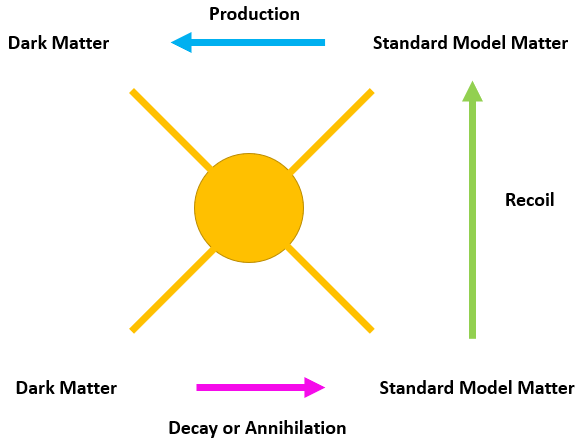
Figure 1: Dark matter detections are carried out in three complementary ways.
Experimental Strategy: Photon Regeneration with Penning Trap Readout
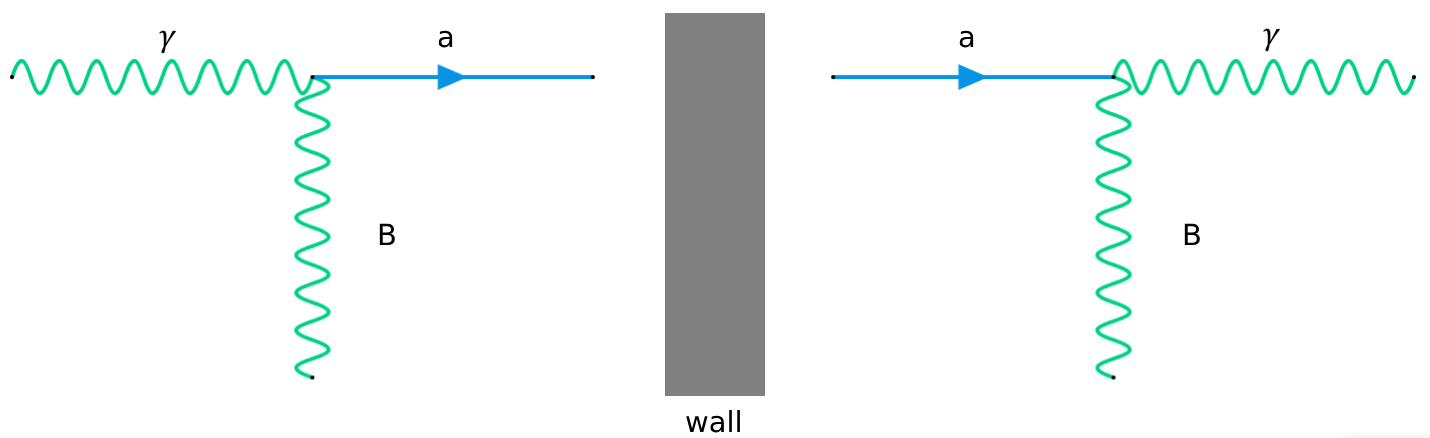
Three complementary strategies for dark matter detection exist: indirect detection via astrophysical by-products, direct detection with rare event searches, and production in high-energy colliders Figure 1. Laboratory LSW techniques, in particular, offer a model-independent control environment. In the proposed scheme, incident RF photons in a microwave cavity undergo Primakoff conversion to axions in a strong static magnetic field. These axions traverse an electromagnetic barrier wall and are then regenerated as photons in a second high-sensitivity Penning trap-based cavity resonator.
Figure 2: The schematic of the photon regeneration method.
This dual-cavity photon regeneration configuration ensures that any detected RF photon in the readout cavity must originate from axion-photon conversion, eliminating electromagnetic backgrounds and yielding a strictly controlled experimental signature.
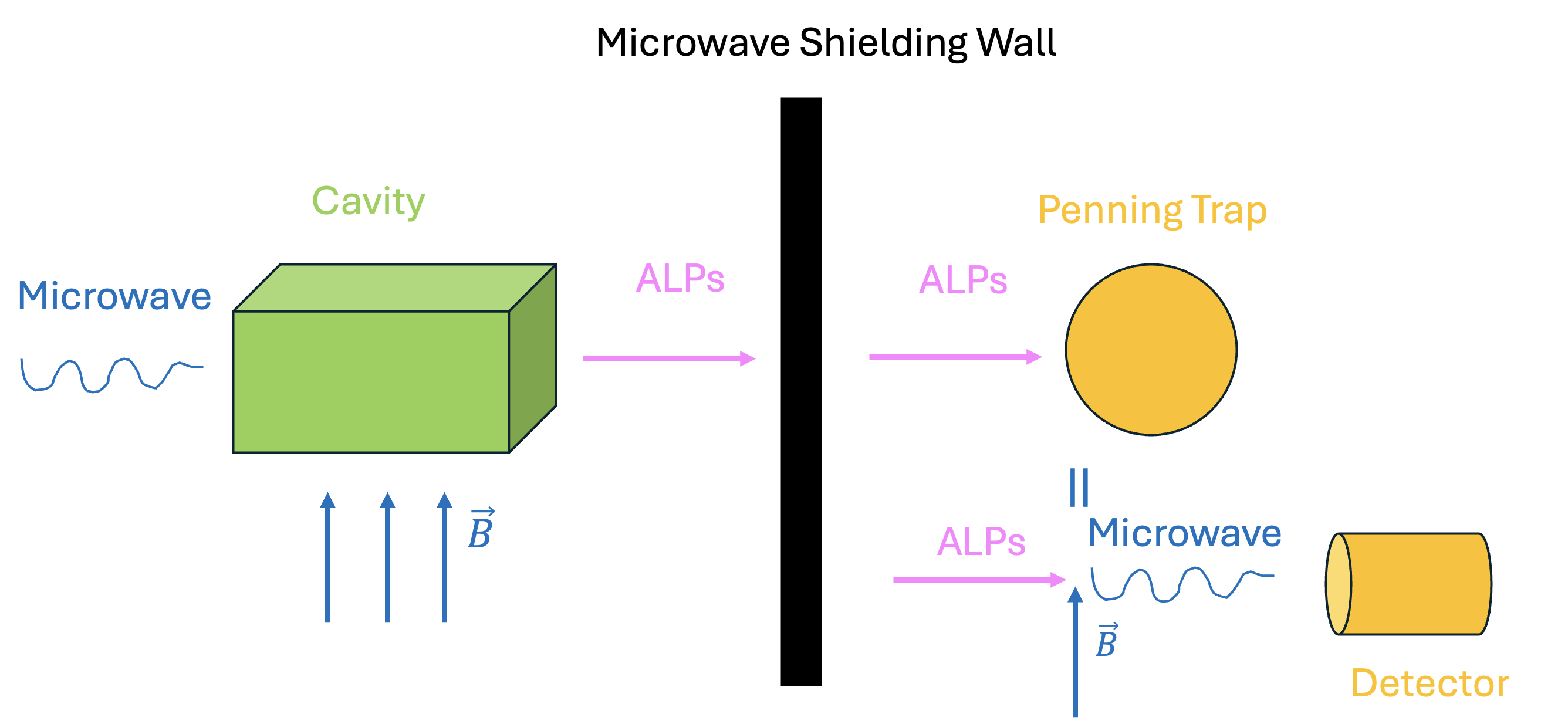
Figure 3: The experimental setup. A Microwave cavity to enhance the interaction between photons and the magnetic field is on the left. A Penning trap to increase the sensitivity of axion detection is on the right.
Key elements include:
A resonant microwave cavity for efficient photon-axion conversion under high Bext.
A Penning trap-based detection region for RF-photon regeneration and ultra-sensitive RF field measurement.
Synchronous RF field measurement in the Penning trap via spin-phonon quantum nondemolition methods, with demonstrated sensitivity below 1nV/m/Hz.
Theoretical Modeling and Sensitivity Estimates
Photon-Axion Conversion Formalism
Photon-to-axion conversion in the cavity is governed by the Primakoff amplitude, with conversion probability scaling as Pγ→a∝gaγγ2Bext2lz2, with lz the cavity interaction length. The number of axions produced per unit time is determined by the resonator quality factor Q, input power P, mode frequency f101, and geometric factors.
Given the regime ma≪Eγ (axion mass much less than photon energy), the conversion efficiency simplifies, allowing straightforward optimization of geometric and power-coupling parameters.
RF Field Detection with Penning Trap
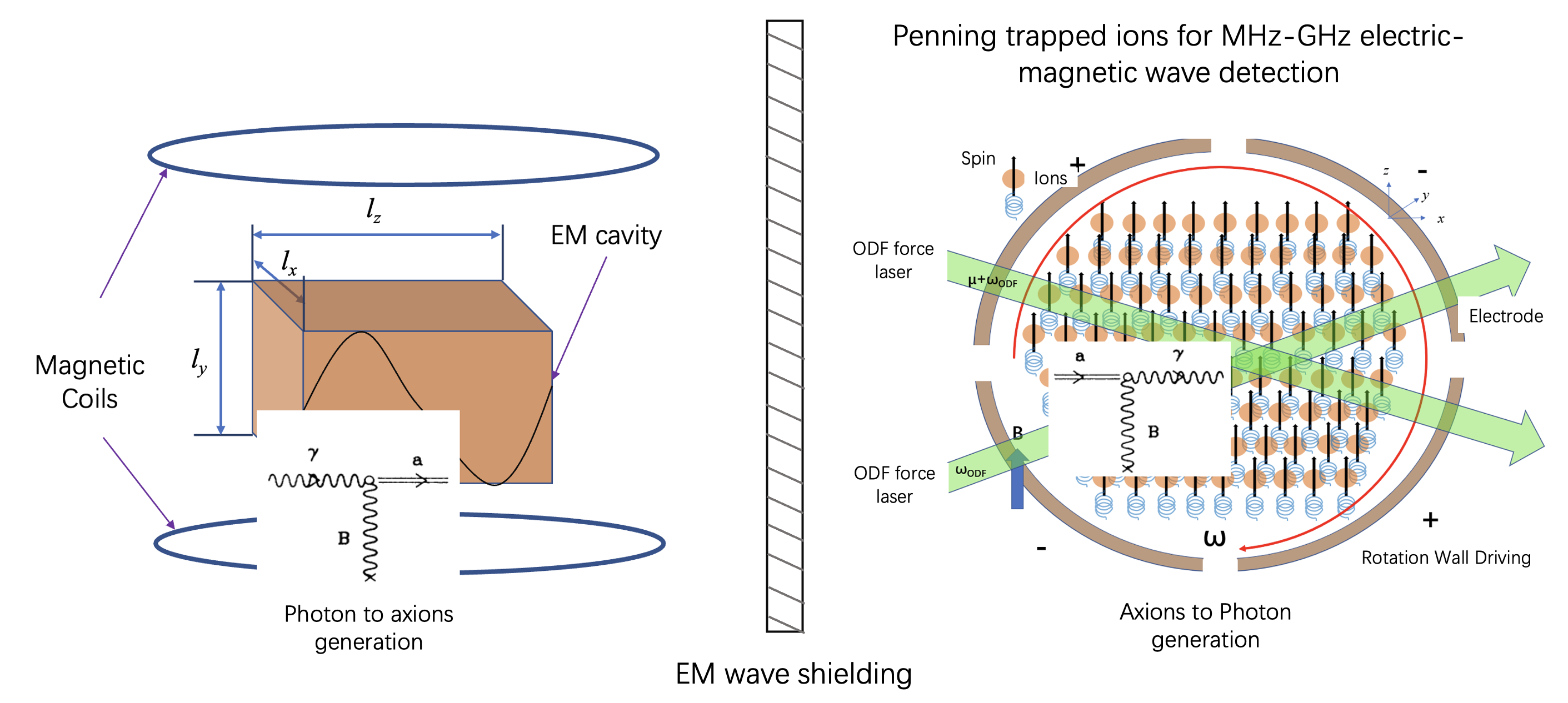
Penning trap arrays confine 2D planar ion crystals in strong (T-scale) magnetic fields. The center-of-mass (COM) vibration of the ions provides a quantum oscillator, the amplitude of which can be coupled to the spin of the ions via an Optical Dipole Force (ODF). This enables quantum-enhanced metrological detection of weak RF fields induced by axion-photon conversions, taking advantage of large ion numbers and long coherence times.
Figure 4: The experimental details of axion detection. ODF: Optical Dipole Force; EM: Electromagnetic.
Spin-phonon entanglement sequences (Ramsey-type protocols) allow QND amplitude measurement of the COM motion, with the ability to resolve displacement amplitudes equivalent to single-quantum electric field sensitivity [2021sciencepenning].
Experimental Parameters and Results
Explicit parameter choices include a 15cm×10cm×20cm cavity (1nV/m/Hz0, 1nV/m/Hz1 W), 1nV/m/Hz2 T in the detection region, and 1nV/m/Hz3 T at the generation site. With field sensitivity 1nV/m/Hz4, the calculated one-day sensitivity achieves:
1nV/m/Hz5
specifically for axion masses below 1nV/m/Hz6 (1nV/m/Hz7 MHz photon energies). This sensitivity in a table-top setting presents a robust advance relative to prior LSW and axion radio projects, particularly in the low-mass domain where Rydberg-based approaches [rydbergaxion2024] suffer declining efficiency. Notably, the Penning trap system obviates the need for separate large-aperture magnets: the confining 1nV/m/Hz8-field serves double duty for both ion trap operation and axion detection.
Implications and Outlook
The proposed integration of photon regeneration and Penning trap quantum sensing opens a new regime for laboratory axion searches. The approach is expressly orthogonal to astrophysically based constraints, free of associated systematic uncertainties. The demonstrated sensitivity in this regime not only probes uncharted 1nV/m/Hz9 parameter space, but also sets a foundation for further improvements via increases in trapped ion number, longer integration times, and enhanced Pγ→a∝gaγγ2Bext2lz20-factor engineering.
Practically, Penning trap architectures support ongoing progress in high-fidelity quantum control, scalable ion-trap computation, and AMO-based quantum sensing, allowing immediate translation of technical advances into dark matter detection protocols. The energy reach (sub-MHz to GHz) is especially well-suited to the "axion radio" concept, complementing higher-mass searches (ADMX, CAST, NA64) and collider constraints. Theoretically, the scheme is extendable to general bosonic dark sector searches, including vector portal models and emergent hidden photon scenarios.
Conclusion
This work presents a rigorously engineered experiment exploiting resonantly enhanced photon regeneration and quantum-enhanced Penning trap readout, achieving a strong numerical bound of Pγ→a∝gaγγ2Bext2lz21 in one day for low-mass axions. The architecture is highly modular, robust to systematic error, and readily upgradable, positioning it as a leading platform for model-independent laboratory dark matter searches and for the next generation of quantum-enabled dark sector experiments.