- The paper demonstrates that the color-singlet Hilbert space forms a unique irreducible module of a master bilocal Lie algebra.
- It establishes finite-N trace relations, Casimir constraints, and partition function character identities within a unified operator-algebraic framework.
- The approach leverages Howe duality and oscillator realizations to map vector and matrix models to precise algebraic structures, impacting holographic reductions.
Finite-N Operator Algebras and the Hilbert Space of Bilocal Holography
Overview
This work provides a comprehensive operator-algebraic and representation-theoretic framework for the Hilbert spaces of finite-N bilocal holography, extending prior constructions (Koch et al., 24 Feb 2026). By focusing on the operator content rather than solely on invariant theory, the authors establish that the color-singlet Hilbert space of vector and matrix models at finite N is a single irreducible module of a "master" bilocal Lie algebra. This description unifies finite-N trace relations, Casimir constraints, and partition function character formulae within a precise algebraic structure, leading to significant reinterpretations of the Hilbert space reductions seen in collective field/holographic approaches.
Dual Pair Structure and Master Algebras
At the core of this formulation is the recognition that the oscillator Fock space F for a vector model supports two commuting actions: one from the color group G (e.g., O(N), Sp(N), U(N)), and another from a bilocal algebra generated by color-singlet quadratic operators. Employing Howe duality, these generate a reductive dual pair, ensuring that upon singlet projection with respect to G, the resulting Hilbert space N0 corresponds to a unique irreducible representation of the emergent (master) Lie algebra N1.
The master algebra is determined by the interplay between oscillator statistics and the symmetry of the color-contraction tensor. This relation is summarized as follows:
| Theory |
Symmetry of N2 |
Bilocal Algebra |
Irrep Type |
| N3 bosons |
Symmetric |
N4 |
Lowest-weight |
| N5 fermions |
Antisymmetric |
N6 |
Highest-weight |
| N7 bosons |
Antisymmetric |
N8 |
Orthogonal-type |
| N9 fermions |
Symmetric |
N0 |
Symplectic-type |
| N1 |
Rectangular (mixed) |
Unitary-type |
Rectangular Young Tableau |
This structure ensures that, instead of a freely generated bilocal Fock space, the physical Hilbert space is always the specific irrep defined by the oscillator construction and singlet condition—finite-N2 trace identities emerge as polynomial constraints internal to this representation.
Finite-N3 Constraints, Casimirs, and Trace Relations
A principal consequence of identifying the finite-N4 Hilbert space as a master algebra irrep is that all finite-N5 trace relations become explicit representation-theoretic identities, particularly fixing the quadratic and higher Casimirs of the algebra. For instance, in the N6 bosonic case, the quadratic relation takes the form:
N7
More generally, the value of N8 appears as the weight specifying the irrep, determining Casimir eigenvalues and null-state structure. These relations delimit the allowed spectrum, ensuring that Hilbert spaces remain finite (for fermions) or are subject to nonlinear algebraic constraints (for bosons), as manifest in explicit state-counting for small N9.
Irreducible Representations: Structural Implications
Through explicit oscillator realizations, the authors demonstrate that the singlet Hilbert space for any vector model maps to a well-characterized module of the master algebra:
- N0 fermions: The color-singlet sector forms a finite-dimensional highest-weight module of N1, generated by antisymmetric bilocals.
- N2 fermions: The singlet sector is a lowest-weight irrep of N3, with the Fock vacuum as the lowest-weight vector.
In each example, repeatedly acting with bilocal creation operators ultimately yields linear dependences specified by the finite-N4 structure. At the representation-theoretic level, these become identical to the standard relations in the corresponding Lie algebras (e.g., Gelfand invariants, Pfaffian/Casimir constraints).
Partition Functions and Characters
The identification of the Hilbert space with a single irrep enables an elegant formula for traces and partition functions: any thermal trace or partition function with a Cartan Hamiltonian amounts directly to the character of the corresponding representation. Explicitly,
N5
where N6 is the character of the irrep, and N7 is the vacuum energy. Analytical expressions for these characters are provided for all relevant cases (e.g., unitary Schur polynomials for N8 fermions, orthogonal/symplectic group determinants for N9 and F0). The partition function thus manifests the finite-F1 Hilbert space truncation, with saturation to the dimension of the finite module at high temperature, and the precise spectrum encoded by the choice of F2, and statistics.
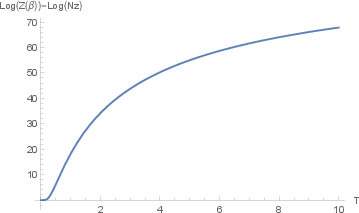
Figure 1: A representative finite-F3 partition function, where subtraction by the normalization factor isolates the temperature-dependent character contribution for F4, F5.
Implications and Potential Extensions
The explicit algebraic characterization of the singlet Hilbert space as a Lie algebra irrep not only clarifies the mechanism of finite-F6 reductions in collective field holography but also streamlines computations of physical observables such as entropy, degeneracies, and thermal behavior. Notably:
- Fermionic singlet sectors are finite-dimensional due to highest-weight truncation.
- Bosonic models retain infinite-dimensionality but are algebraically constrained.
- The exchange between orthogonal and symplectic master algebras in F7 models underscores the nontrivial effects of both statistics and group structure.
Furthermore, because partition functions and entropy growth are reduced to questions about the asymptotics of group characters, this framework provides a systematic approach to large-F8 and double-scaling analyses directly within the algebraic/combinatorial context.
Potential extensions include making connections to the Hironaka decomposition of invariants, incorporating more general color invariants, and exploring how these finite-F9 structures map to nonperturbative phenomena in the dual higher-spin gravity theory (e.g., finite-entropy states in the bulk).
Conclusion
This paper offers a unified and mathematically robust operator-algebraic perspective on finite-G0 bilocal holography, reframing Hilbert space reductions as irreducibility constraints in master bilocal algebras. By connecting trace relations, Casimir identities, and partition functions within this conceptual structure, it provides both a technical toolkit for explicit calculations and a foundation for further investigations into the nonperturbative organization of holographic models at finite G1.