- The paper introduces a sparse query-based fusion paradigm that leverages 4D radar and cameras for surround-view 3D object detection.
- It employs Velocity-Consistency Sampling and Adaptive Modality Gating to refine features and ensure robust detection under adverse conditions.
- The framework achieves state-of-the-art metrics with reduced computational overhead, enabling real-time performance in autonomous driving applications.
Sparse4D-Radar: Efficient, Robust Surround-View 3D Object Detection via 4D Radar-Camera Fusion
Motivation and Context
Sparse4D-Radar addresses core limitations in current surround-view perception systems for autonomous driving. Existing radar-camera fusion schemes are typically constrained to front-view sensing and exhibit poor scalability when expanded to full 360° coverage due to dense BEV grid-based strategies, leading to prohibitive computational overhead. While 4D imaging radar possesses advantages in robustness, velocity measurement, and spatial fidelity, its stochastic sparsity remains challenging for object detection. Sparse4D-Radar introduces a sparse query-based paradigm, specifically tailored for efficient multi-modal interaction in surround-view scenarios, integrating both 4D radar and camera information.
Architectural Overview
The overall framework processes multi-view images and 4D radar point clouds using dedicated encoders, extracting multi-scale features which are further refined using cascaded decoder blocks. At the core lies the Deformable Fusion module, engineered for high-quality feature aggregation across modalities. The system further introduces two plug-and-play components:
- Velocity-Consistency Sampling (VCS): Enforces motion-aware feature refinement by leveraging explicit velocity measurements from 4D radar, enhancing spatial alignment and suppressing ghost points using dynamic velocity similarity scoring.
- Adaptive Modality Gating (AMG): Implements a gating mechanism to dynamically weight the contributions of camera and radar features based on real-time reliability, improving robustness in adverse conditions.
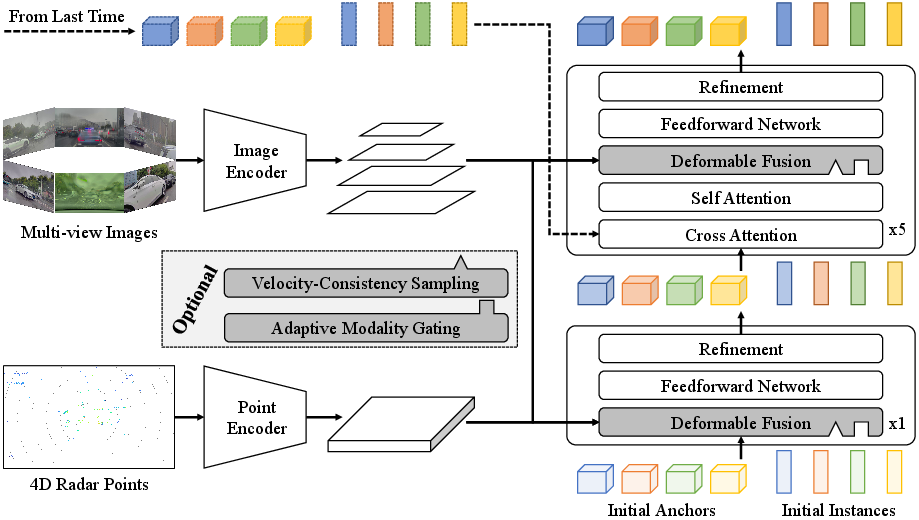
Figure 1: The Sparse4D-Radar surround-view fusion architecture, highlighting the sparse query-based interaction, deformable fusion module, and the VCS/AMG components.
The Deformable Fusion module executes feature integration in four stages:
- Keypoint Generation: For each anchor, a set of fixed and learned 3D keypoints is produced to guide spatial sampling.
- Feature Sampling: Keypoints are projected onto PV and BEV spaces; multi-view/multi-scale feature maps are sampled via bilinear interpolation.
- Hierarchy Fusion: Features across views, scales, and keypoints are adaptively weighted using learnable parameters dependent on instance features, anchor embedding, and modality-specific sensor encoding.
- Multimodal Fusion: Aggregated camera and radar features are concatenated and linearly transformed, updating instance representations for downstream detection.
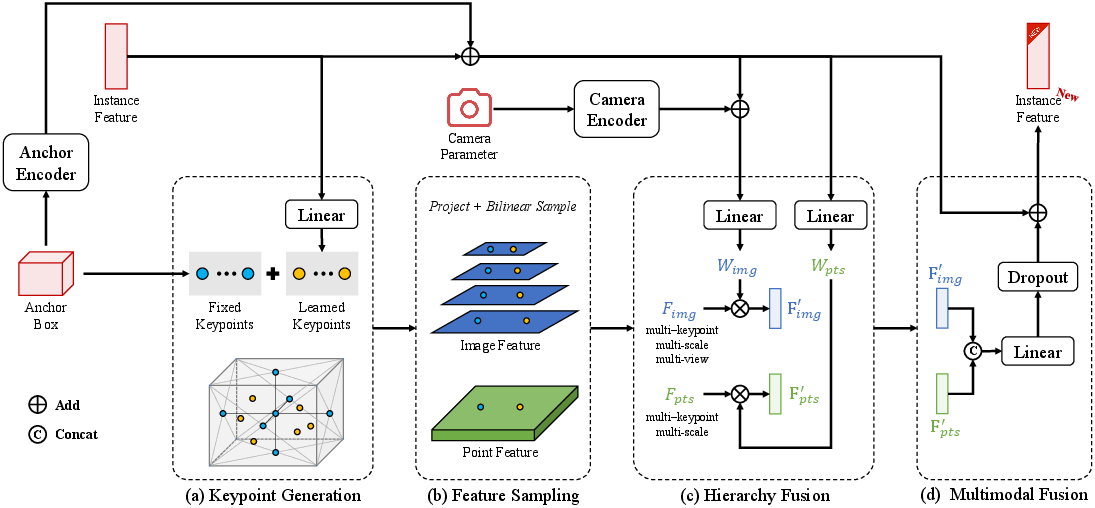
Figure 2: The Deformable Fusion module, detailing keypoint generation, feature sampling, hierarchy fusion, and multimodal integration logic.
Specialized Modules: Velocity-Consistency and Adaptive Gating
VCS utilizes ball query-based neighborhood retrieval to compare anchor and radar point velocities, encoding similarity via a shared-weight velocity encoder. The resulting similarity scores recalibrate feature aggregation, favoring motion-consistent data and suppressing non-physical artifacts.
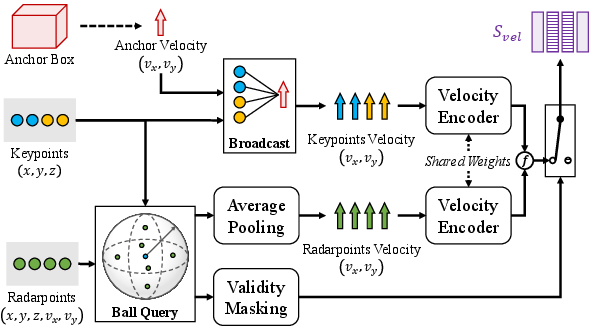
Figure 3: Velocity-Consistency Sampling module workflow, enhancing spatial and motion fidelity.
AMG applies a dynamically computed gating vector to weighted fusion of modalities. It relies on the reliability of modality-specific features, enabling adaptive reliance on robust geometric radar information during image degradation (e.g., rain, nighttime).
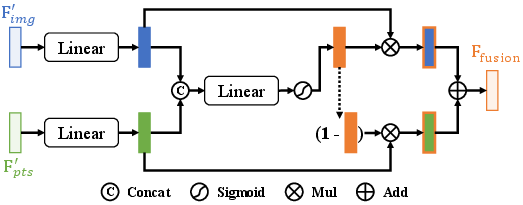
Figure 4: Adaptive Modality Gating module, facilitating runtime reliability-based fusion.
Experimental Benchmarking and Results
Evaluation was conducted on the OmniHD-Scenes dataset—a comprehensive multi-sensor benchmark for surround-view perception. Sparse4D-Radar achieves substantial improvements in all detection metrics over state-of-the-art fusion architectures. Notably, the Sparse4D-Radar-Base model delivers 47.01% mAP and 57.25% ODS at 11.5 FPS; Sparse4D-Radar-Acc achieves 47.57% mAP, 58.35% ODS, and 8.7 FPS. Both configurations surpass highly competitive radar-camera and LiDAR-based baselines, especially under adverse weather and nighttime conditions (ODS: 58.58% for Base, 58.61% for Acc).
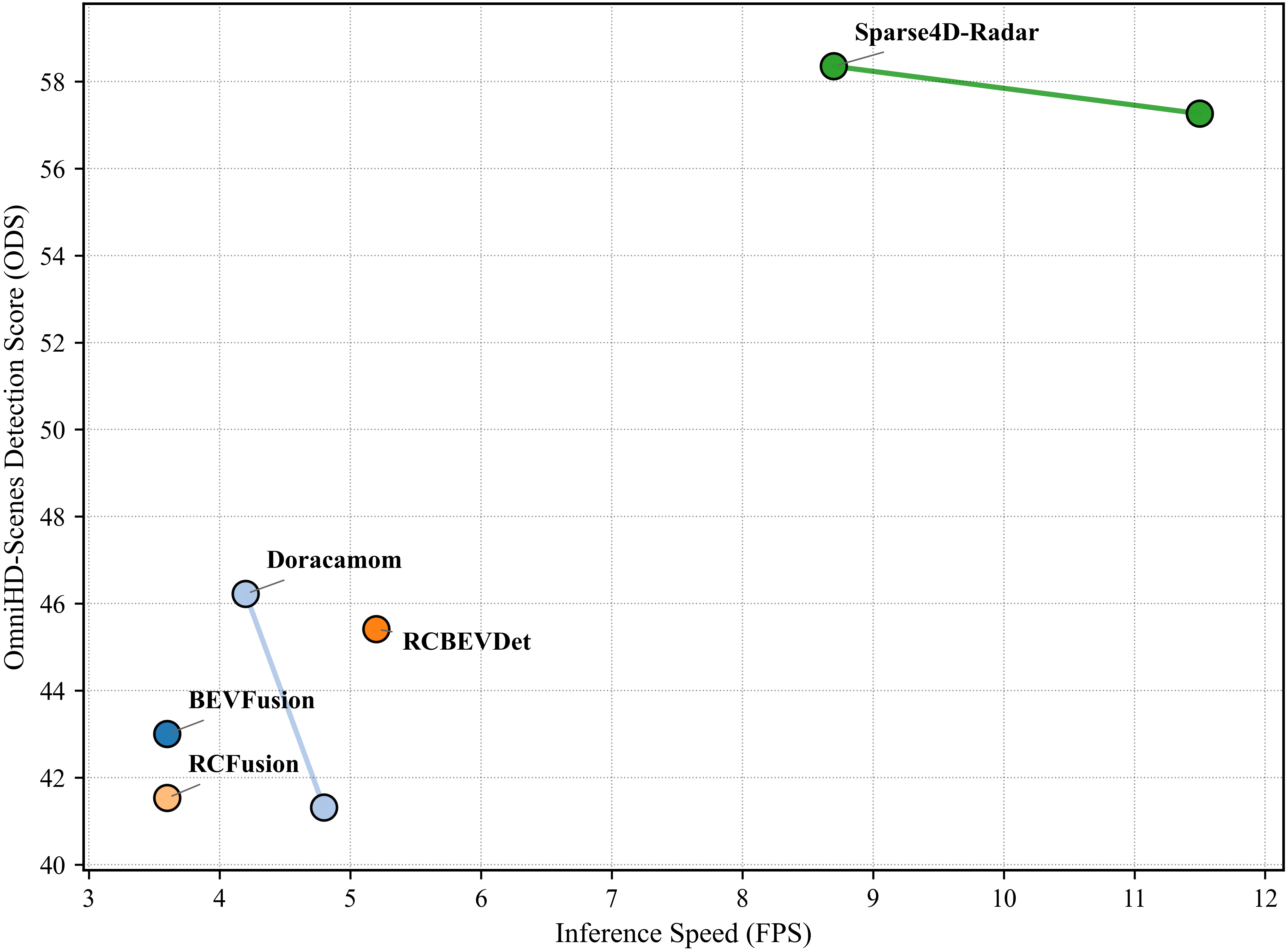
Figure 5: Performance–efficiency trade-off across methods; Sparse4D-Radar demonstrates leading accuracy at real-time speeds.
Sparse4D-Radar demonstrates particularly strong velocity estimation, achieving significantly lower mAVE compared to all prior work, attributed to optimal handling of dynamic cues in the sparse fusion architecture.
Computational efficiency is a highlight, with FLOPs and parameter counts substantially reduced compared to dense BEV methods (Sparse4D-Radar-Base: 472.06G FLOPs, 53.47M params), rendering the system highly suitable for on-board real-time deployment.
Ablation Studies
Systematic ablation reveals synergistic gains from VCS and AMG modules. VCS improves ODS and reduces orientation/velocity errors; AMG further contributes to robustness. PointPillars is selected as the radar backbone, offering optimal accuracy-speed trade-offs. Feature sampling strategies and fusion mechanisms are validated, with AMG and VCS outperforming attention-based baselines.
Qualitative Evaluation
Visualization across environmental scenarios confirms superior localization and fewer false positives/missed detections, notably under challenging nighttime and rain conditions. Sparse4D-Radar leverages multimodal synergy to maintain high-fidelity perception.
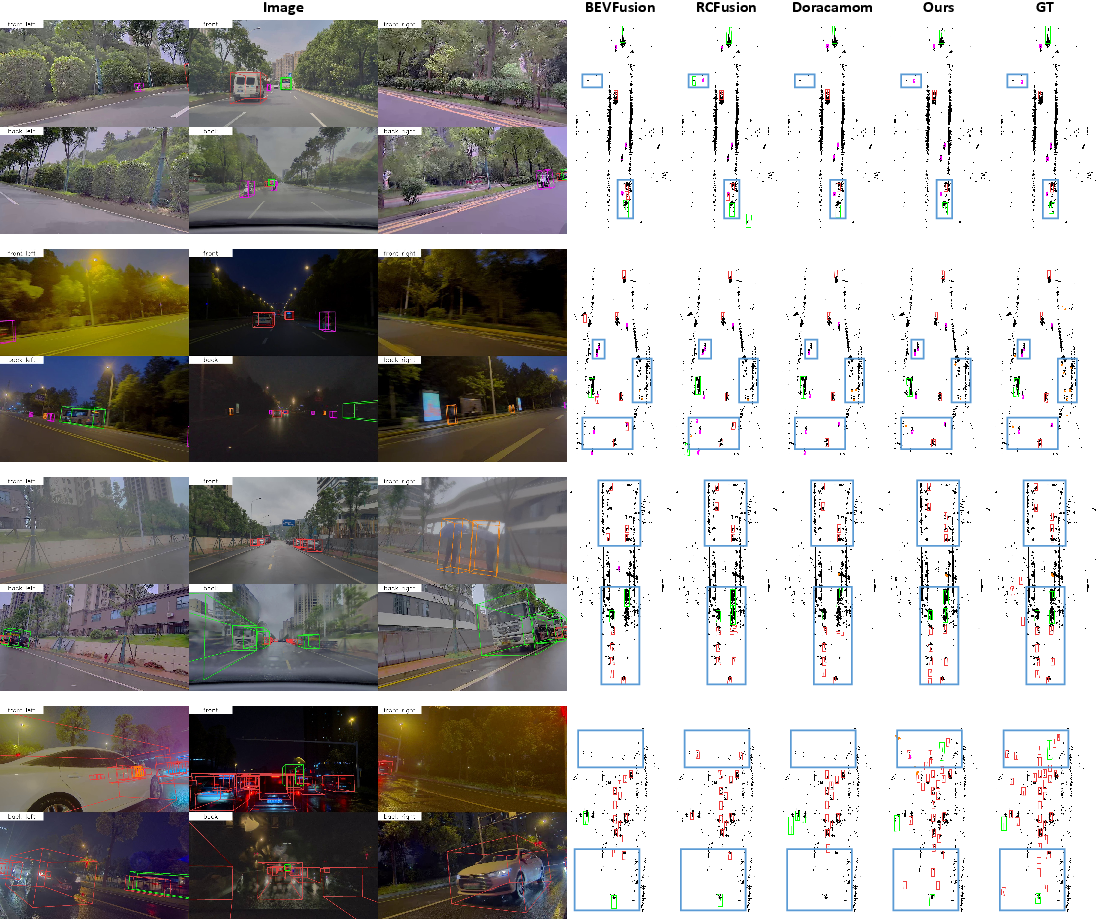
Figure 6: 3D bounding box projections and BEV analysis across multiple conditions, showing enhanced robustness and accuracy.
Implications and Future Directions
Sparse4D-Radar demonstrates that sparse query-based fusion, augmented by motion-consistency and adaptive gating modules, can significantly elevate the accuracy and robustness of surround-view 3D object detection using radar-camera configurations. The reduced reliance on dense BEV grids, coupled with hardware-efficient design, enables practical, real-time deployment in resource-constrained autonomous platforms.
Theoretically, this architecture advances the state-of-the-art in multi-modal interaction—optimally leveraging spatial and physical cues (velocity, robustness) unique to 4D radar. Practically, Sparse4D-Radar bridges performance gaps with LiDAR-based systems, offering scalable alternatives with comparable accuracy. Limitations in radar feature extraction and computational trade-offs suggest future work in more specialized radar encoding architectures and further reduction of module overhead.
Conclusion
Sparse4D-Radar establishes a new benchmark for surround-view radar-camera fusion, achieving state-of-the-art detection accuracy, environmental robustness, and real-time efficiency. Its architectural developments—including deformable fusion, velocity-consistency refinement, and adaptive modality gating—redefine the landscape of efficient 3D perception in autonomous driving, with implications for broader multimodal sensing applications and theoretical exploration of sparse fusion paradigms.