- The paper introduces the first explicit L1 optimal control solution for continuous-time stochastic positive systems under multiplicative noise, achieving deterministic-certainty equivalence.
- It develops a robust state-feedback control strategy and a positivity-preserving simulation algorithm that maintain nonnegative state trajectories even with Itô diffusion.
- The method is validated in high-frequency trading, yielding a 28% improvement in the value function, underscoring its practical impact in finance and resource management.
L1 Optimal Control for Stochastic Positive Systems with Multiplicative Uncertainty
Problem Setting and Theoretical Foundations
The paper addresses the explicit solution of L1 optimal control problems for continuous-time stochastic positive systems with multiplicative Itô noise and linear, element-wise input constraints (2607.03952). The focus is on systems where the state remains strictly nonnegative, ensuring physical interpretability in resource allocation, finance, and related domains. The dynamics are given by:
dx(t)=f(x(t),u(t))dt+n=1∑NFnx(t)dwn(t),x(0)∈R+L,
where f(x,u)=Ax+∑m=1MBmum, and the control input um is restricted by ∣um(t)∣≤emx(t). The multiplicative noise is modeled via diagonal matrices Fn.
Theoretical contribution starts with the proof of forward invariance of the positive orthant for this class of stochastic systems, under Metzler-type drift constraints. The analysis generalizes deterministic Lyapunov positivity results to Itô diffusions with diagonal multiplicative noise, establishing that solutions remain strictly nonnegative almost surely.
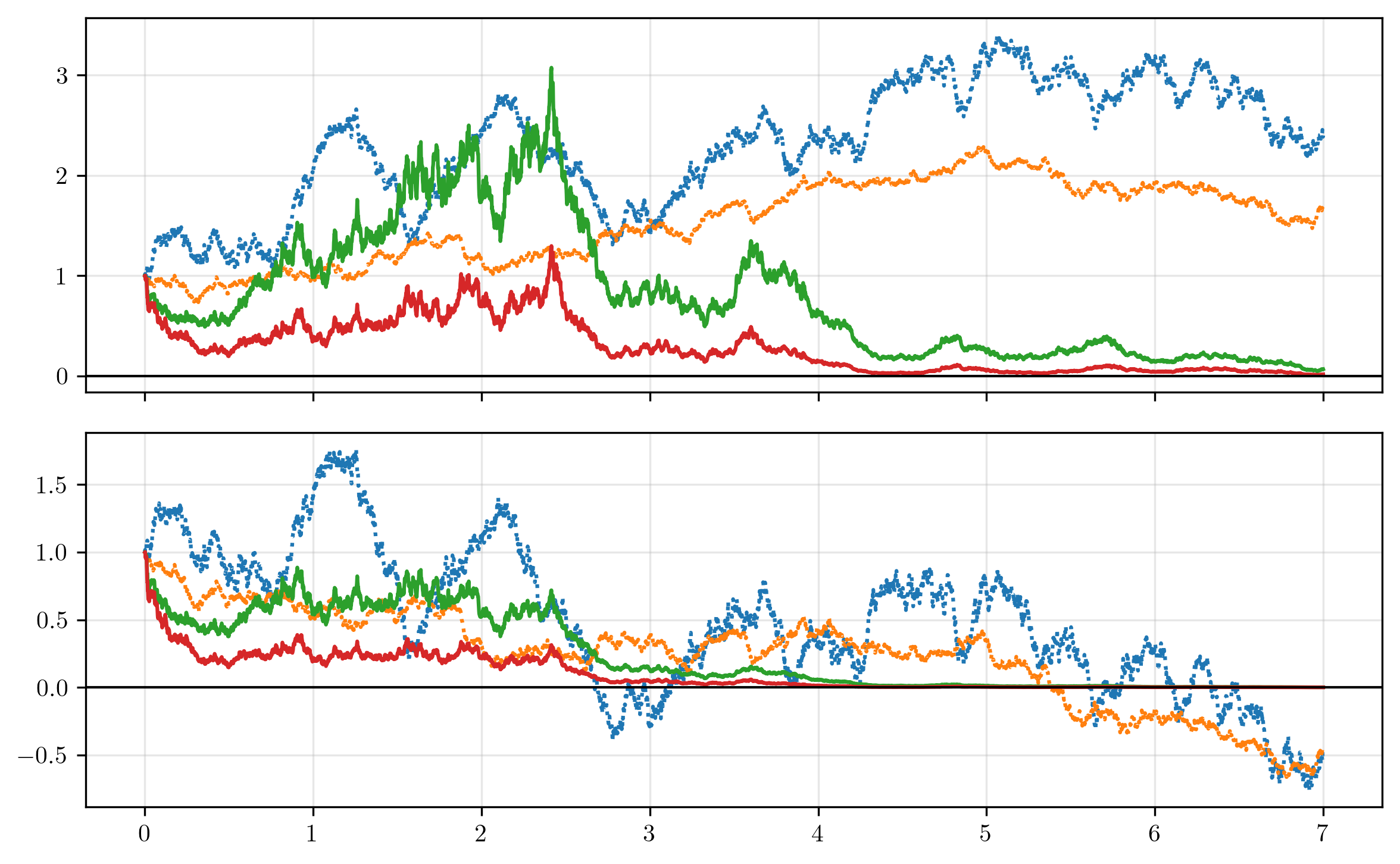
Figure 1: Time evolution of stochastic systems with additive versus multiplicative noise, illustrating preservation versus loss of positivity.
Explicit Solution to the Stochastic L1 Optimal Control Problem
The core optimal control formulation considers minimization of a linear cost comprising state and control penalties:
u∈UminE[∫0T(q⊤x(t)+m=1∑Mrm⊤um(t))dt],
subject to the aforementioned stochastic positive system and state/input constraints.
The paper develops both finite-horizon and discounted infinite-horizon solutions. The novelty and central result is that, due to the linear structure of the value function, the optimal feedback and value function for the stochastic problem coincide exactly with those of the corresponding deterministic linear regulator (LR) problem:
- For the finite-horizon problem, the value function is J(t,x)=p⊤(t)x, where L10 solves a backward vector ODE.
- For the infinite-horizon discounted problem, L11 solves a vector-valued algebraic equation.
The optimal control is a state-feedback with switching structure:
L12
for admissible indices, with additional set-valuedness on singular arcs. Importantly, the solution is robust with respect to the multiplicative noise intensity: the optimal feedback does not depend on the diffusion coefficients.
Positivity-Preserving Simulation
The positivity of the continuous-time system is not preserved by classical discretization methods (e.g., Euler–Maruyama), as they can produce negative iterates due to unbounded Gaussian increments. The authors develop a specifically tailored positivity-preserving simulation algorithm based on the Doleans-Dade exponential for geometric Brownian motion, generalized for the multivariate case. This algorithm leverages variable transformations and time-stepping of a modified linear ODE system, ensuring theoretical invariance properties carry over to the numerical setting.
Applications: High-Frequency Trading Example
A numerical example in high-frequency trading illustrates the theory. The model involves the allocation of capital to 50 assets, where the state encodes nonnegative capital per asset, trading incurs linear costs, and price evolution is subject to multiplicative stochastic shocks. Locally optimal trading actions are given by switching feedback, timing risk-on/risk-off allocation per asset, and constrained by liquidity:
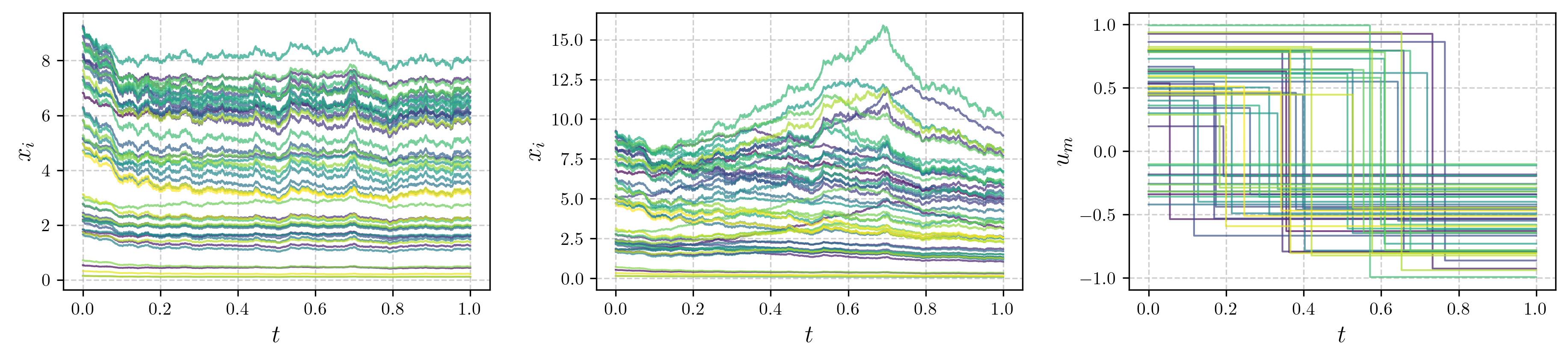
Figure 2: (Left) Capital allocation under passive control; (Middle) under optimal switching control; (Right) timeline of switching control signals.
Empirically, optimal feedback yields a value function improvement of approximately 28% over passive strategies in typical simulated market regimes (from L13 to L14 in the reported case). Notably, the value function is invariant to the noise intensity, formalizing nominal-robust performance in highly stochastic markets.
Theoretical and Practical Implications
This work establishes the first explicit solution for stochastic L15 optimal control in positive systems with multiplicative uncertainty, bridging the gap between deterministic L16 optimal control and classical LQG/LQR under stochasticity. The results contrast strongly with quadratic costs, where noise typically shifts or modifies the Riccati equation and optimal feedback policy. Here, the linear cost structure annihilates the second-order (noise-dependent) term in the Hamilton-Jacobi-Bellman equation, yielding deterministic-certainty equivalence.
The robustness of the solution carries significant practical implications for systems management in uncertain environments, especially where positivity and resource constraints are inherent (e.g., finance, epidemiology, supply chain).
Directions for Future Research
Potential future research directions include:
- Extension to alternative noise structures (e.g., non-diagonal or state-dependent volatility) while preserving positivity,
- Adapting structural results to positive systems with time delays, jumps, or Markov switching,
- Broadening the class of cost functions to include mixed L17 penalties or time-varying weights,
- Applications to large-scale networked systems and distributed optimal control under uncertainty.
Conclusion
The paper delivers explicit L18 optimal control design for continuous-time stochastic positive systems with multiplicative noise. It establishes robust policy/value function equivalence to the deterministic LR problem, rigorously proves invariance and feasibility properties, and provides an efficient positivity-preserving simulation approach. These contributions advance both the theory and practice of positive systems control under uncertainty, with direct applicability in finance and engineering domains.