- The paper introduces generalized Clifford circuits that efficiently disentangle the Haldane phase in qutrit systems, demonstrating optimal entanglement removal.
- It employs a generalized Kramers–Wannier transformation within a CAMPS-based DMRG framework to achieve lower ground-state energy errors and reduced bipartite entropy.
- The study analytically proves the optimality of the Clifford disentangler for the AKLT state and reveals hidden symmetry breaking in transformed spin models.
Disentangling the Haldane Phase with Generalized Clifford Circuits
The paper "Disentangling Haldane Phase by Generalized Clifford Circuits" (2607.03939) analyzes the application of generalized Clifford circuits to efficiently disentangle the Haldane phase in spin-1 (qutrit) systems. The approach leverages the algebraic structure of qutrit Clifford circuits to implement a generalized Kramers–Wannier (KW) transformation. Within the Clifford-circuit-augmented matrix product states (CAMPS) variational ansatz, this transformation enables exact removal of entanglement in prototypical symmetry-protected topological (SPT) phases such as the Affleck-Kennedy-Lieb-Tasaki (AKLT) state, as well as in more generic phases described by the bilinear-biquadratic (BLBQ) and Heisenberg models.
Generalized Pauli and Clifford Structures in Qutrit Spin Chains
The construction begins with a rigorous formalism for qutrit (spin-1) Pauli and Clifford groups. The local Hilbert space H3 is defined through X and Z generators acting as the analogues of shift and phase operators, with nontrivial commutation ZX=ωXZ for ω=e2πi/3. For N-site chains, the generalized N-qutrit Pauli group PN(3) and the Clifford group ClN(3) as its normalizer, serve as the gate set for generalized Clifford circuits.
Crucially, the Clifford group for qutrits is efficiently generated from local X, X0, the single-qutrit Fourier (X1), phase (X2), and the two-site SUM gate X3, a natural generalization of CNOT. The disentanglement problem is symmetrized by quotienting out local unitaries, resulting in a complete classification of 90 inequivalent two-qutrit Clifford entanglers, via an isomorphism to the double coset space X4.
The core technical construct is the application of the generalized KW duality to qutrit spin chains,
X5
This sequential Clifford circuit is shown to transform local operators and Hamiltonians as prescribed by the duality, mapping nearest-neighbor terms into multi-local forms. Despite the increase in locality for Hamiltonian support, critical entanglement features are drastically simplified.
Concretely, CAMPS-based Density Matrix Renormalization Group (DMRG) simulations with this KW transformation produce lower ground-state energy errors and reduced bipartite entanglement entropy at fixed bond dimension, compared to standard DMRG. This is shown for the X6 clock model, the trivial and dimerized phases, and in the critical region of the Heisenberg/BLBQ chains.
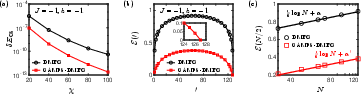
Figure 1: The CAMPS-based DMRG results for the X7 clock model, indicating entanglement reduction and improved energy convergence with Clifford disentanglers.
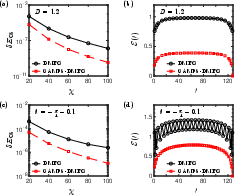
Figure 2: The CAMPS-based DMRG results for the Heisenberg and BLBQ models in trivial and dimerized phases, showing systematic entanglement suppression near boundaries after Clifford-based disentangling.
A rigorous constraint is analytically demonstrated: for Hamiltonians commuting with X8 and possessing unique ground states, the KW transformation yields exact product states across the X9 cut, i.e., Z0. A locality-preservation lemma further classifies when bulk Hamiltonian terms retain short-range support after duality.
Analytic Clifford Disentangling of the AKLT State
A central result is the analytic demonstration that the Clifford KW circuit is the optimal disentangler for the AKLT state, when iteratively minimized left-to-right. The tensor structure is classified into Z1-canonical form, and propagation of canonical forms under SUM gates is established, showing that the circuit always reduces the entanglement Schmidt spectrum maximally among all 90 Clifford equivalence classes.
Strongly, the entanglement gap between the optimal circuit and the next-best Clifford circuit is substantial (Z2 in entropy), demonstrating the robustness of the KW approach (see Figure 3):
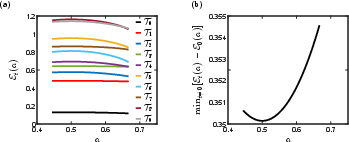
Figure 3: Entanglement spectra of the Clifford equivalence classes, with type-Z3 (including the KW transformation) achieving strict minimum across parameter range.
Furthermore, after complete Clifford disentangling, boundaries fully decouple, removing topological entanglement. In the bulk, the minimal entangling circuit is shown to be the identity, reaffirming the importance of starting disentanglement from model boundaries.
Symmetry Analysis and Hidden Symmetry Breaking
Clifford duality alters the symmetry landscape. For the KW-transformed Heisenberg and BLBQ models, the only nontrivial on-site product symmetry is generated by Z4, which induces a Z5 SSB not manifest in the original description. A detailed algebraic analysis classifies all such symmetries, accounting for both bulk and boundary effects.
For the AKLT state after KW transformation, the boundary expectation values of Z6 reveal the spontaneous symmetry breaking, and the correlation functions asymptote to fixed values reflecting hidden long-range order. The action of symmetry operators on edge spinors is computed, demonstrating that Z7 flips edge qubit states while the rightmost boundary symmetry Z8 acts as virtual Z9 rotations.
Comparisons are drawn to the non-Clifford Kennedy–Tasaki (KT) transformation, which reveals a ZX=ωXZ0 SSB but does not admit efficient Clifford-circuit implementation.
Implications and Future Directions
This work establishes that generalized Clifford circuits, via KW duality, provide a highly efficient and analytically tractable disentangler for SPT phases, including the Haldane phase and its critical extensions. The constructive approach enables:
- Exact removal of topological entanglement in nontrivial SPT phases with strictly finite-depth Clifford circuits.
- Dramatic reduction of computational overhead for tensor network algorithms targeting SPT or critical chains, potentially improving simulations in higher dimensions.
- A new analytic route to topological order and hidden symmetry breaking, as encoded in the post-duality local symmetry structure.
Further generalizations to qudit (ZX=ωXZ1-level) Clifford circuits and higher-dimensional models, as well as to models with non-trivial anyonic or non-invertible symmetries, are natural next steps. Moreover, the strict Clifford framework opens the prospect for quantum circuit implementations and potentially quantum error-correcting code interpretations of the Haldane phase.
Conclusion
By leveraging the algebraic properties of generalized Clifford circuits in qutrit systems, the paper systematically constructs and proves the optimality of Clifford KW duality as a disentangler for the Haldane and related topological/critical phases. This advances both our theoretical understanding of SPT entanglement structure and our practical toolkit for quantum many-body simulation, with significant implications for both condensed matter theory and quantum information science.