- The paper presents a novel framework for matter-wave induced transparency, demonstrating controlled suppression of Feshbach resonances via amplitude-modulated light shifts.
- It employs a multi-channel Hamiltonian model and multichannel quantum defect theory to validate coherent interference and accurately extract experimental parameters.
- Experimental observations reveal asymmetric Fano line shapes and the formation of bound states in the continuum, paving the way for lossless quantum gas control.
Matter-Wave Induced Transparency: Theoretical Framework and Experimental Observations
Introduction
The phenomenon of matter-wave induced transparency (MWIT) as detailed in "Matter-wave Induced Transparency" (2607.03820) extends the paradigm of quantum interference effects such as electromagnetically induced transparency (EIT) into the domain of collisional matter-wave physics. Leveraging precisely engineered atom-molecule couplings via amplitude-modulated light shifts in ultracold cesium, the study demonstrates coherent interference in atomic collision channels with an accompanying suppression of inelastic loss analogous to EIT's transparency window in optical media. The paper presents a comprehensive combination of experimental protocol, effective Hamiltonian modeling, multichannel quantum defect theory (MQDT), and mean-field coupled-mode analysis for a detailed characterization of MWIT.
Experimental Protocol and System Preparation
The experiment is conducted with a nearly pure 133Cs Bose–Einstein condensate (N∼1×10⁵) in the ∣6S1/2,F=3,mF=3⟩ state, confined in a crossed optical dipole trap. The primary interactions are tuned with a bias magnetic field configured for broad Feshbach resonance control. The induced transparency process relies on the dynamical modulation of the AC Stark shift using a laser with two modulated frequency components, generating time-dependent mixing between the open channel and multiple closed-channel molecular states.
Effective Hamiltonian and Coupled-Channel Model
The underlying physics is captured by a three-channel Hamiltonian involving a free-atom state ∣a⟩ and two closed-channel Feshbach molecular states ∣m1⟩ and ∣m2⟩. The modulation protocol involves two tones (ωI,ωII), and after a unitary transformation and application of the Jacobi–Anger expansion, the system is expressed in the Floquet picture. In the ideal configuration, only indirect couplings mediated through molecular channels are retained, resulting in an effective Λ-type three-level structure:
Heff=ℏ(0Ω01eff/20 (Ω01eff)∗/2ΔΩ12eff/2 0(Ω12eff)∗/2δ)
The modulation-renormalized couplings are weighted by Bessel functions that stem from the amplitude modulation depths, and the system supports a dark (non-decaying) state when δ=0 and the decay of N∼1×1050 is negligible. This configuration is directly analogous to optical EIT, now realized in matter-wave collisions.
Scattering Properties and Loss Suppression
A detailed scattering analysis is presented via stationary coupled Schrödinger equations and further validated microscopically using MQDT. The imaginary part of the scattering length encapsulates inelastic processes (loss), and transparency emerges as a consequence of destructive interference between two molecular resonance pathways. At the two-photon-like resonance (i.e., N∼1×1051), the resonant Feshbach loss is suppressed and the scattering length approaches the background value, demonstrating complete control over collisional properties via coherent modulation.
Asymmetric Fano Line Shapes and Parameter Extraction
Loss spectra as a function of magnetic field and modulation frequency are parameterized by fits to a sum of Fano profiles, reflecting interference between multiple resonances. For realistic configurations with weak direct N∼1×1052 coupling or finite decay rates, lineshapes become asymmetric, and the transparency window shifts and broadens—analyzed both experimentally and through the extended coupled-channel formalism.
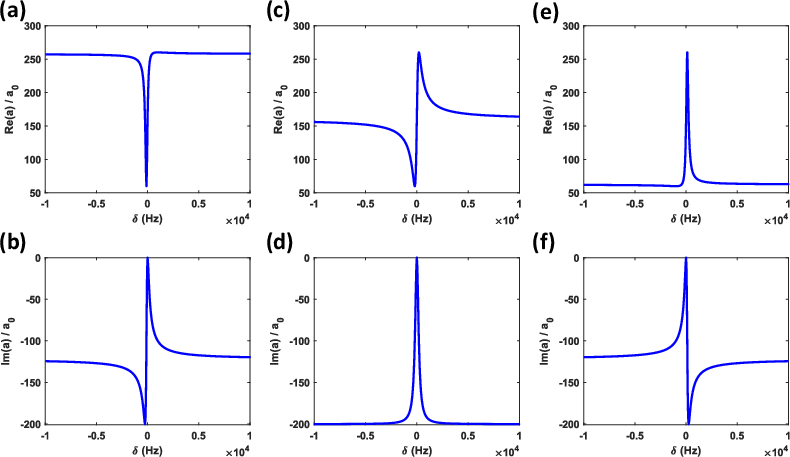
Figure 1: Complex scattering length as a function of detuning N∼1×1053 for various fixed N∼1×1054 values, with dark-state condition leading to loss suppression at N∼1×1055.
Observation and Characterization of Bound States in the Continuum
The interference of molecular resonances with carefully engineered coupling strengths enables the formation of Friedrich–Wintgen-type bound states in the continuum (BICs), corresponding to the disappearance of a Fano resonance in both the real and imaginary part of the scattering length. These BICs are mapped experimentally via magnetic field and frequency scans that show a complete suppression (disappearance) of the characteristic Fano branch over finite parameter windows.
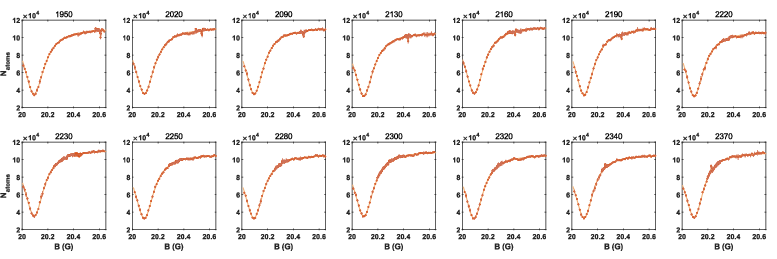
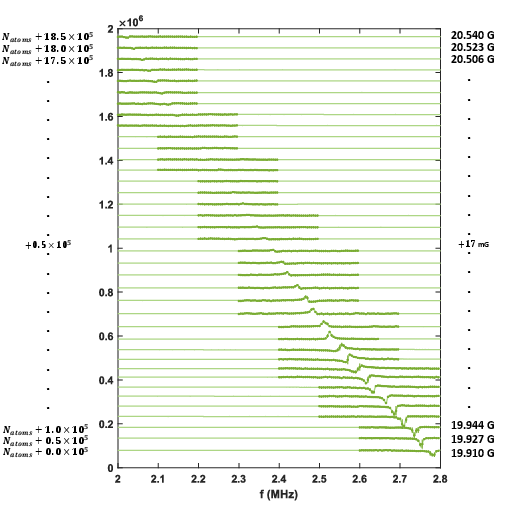
Figure 2: Numerical demonstration of BIC formation—disappearance of a resonance branch at specific detuning values in the real part of the scattering length.

Figure 3: Experimental observation of BICs—atom-loss measurements exhibit a strongly suppressed Fano branch corresponding to the BIC condition.
Multichannel Quantum Defect Theory Validation
The authors employ MQDT to rigorously connect the phenomenological complex-parameter approach to a fully unitary multichannel scattering treatment. By including auxiliary open channels and fitting the resulting N∼1×1056-matrix component N∼1×1057, the complex scattering length is retrieved with high accuracy, thereby microscopically justifying the effective, non-Hermitian model with decay.
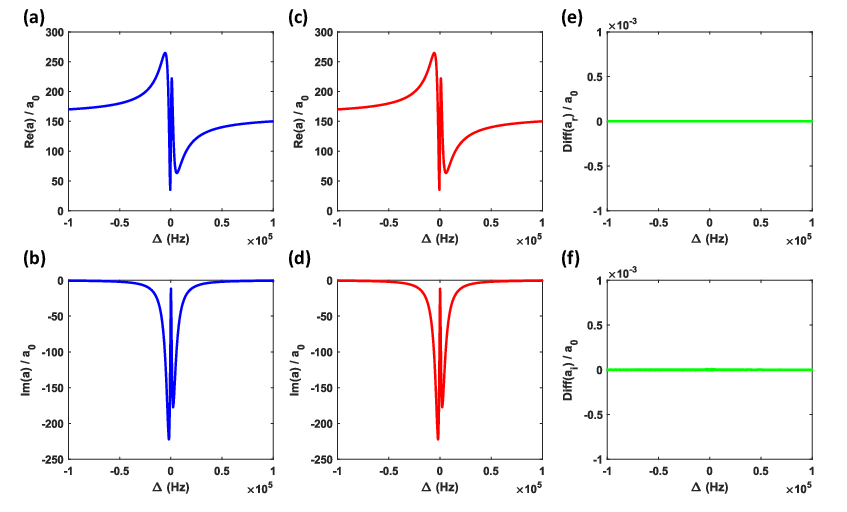
Figure 4: Comparison of complex scattering length from MQDT and phenomenological theory, illustrating precise agreement across parameter regimes.
Mean-Field and Dynamical Considerations
The mean-field treatment yields coupled Gross–Pitaevskii–type equations for atomic and molecular condensates, supporting coherent atom–molecule oscillations and dynamical evolution. In the adiabatic regime, elimination of the molecular degrees of freedom recovers the effective (complex) scattering length with modulation-tunable nonlinearities. The general framework enables the future investigation of many-body effects and non-Markovian decoherence in modulated BEC environments.
Extraction and Scaling of Experimental Parameters
A comprehensive methodology for extracting key parameters—modulation amplitudes, magnetic moments, coupling strengths—is detailed, combining direct measurement, fits to resonance positions, and comparison with full coupled-channel simulations. The transparency width is shown to scale as N∼1×1058 in the appropriate regime, with all parameters calibrated and verified experimentally.
(Figure 5)
Figure 5: Experimental scaling of the transparency window as a function of modulation amplitude.
Implications and Future Prospects
The demonstration of matter-wave induced transparency unlocks coherent control over atomic scattering and collisional loss, paving the way for lossless interacting quantum gases and engineered many-body dynamics. The modularity of the Floquet-engineered coupling scheme is well suited to the generation of tunable quantum simulations, non-linear matter-wave optics, and new protocols for the suppression of inelastic loss in strongly correlated or molecular quantum systems. The formal derivations and robust experimental mapping allow for generalization to heteronuclear species, optical Feshbach resonance paradigms, and multi-resonance interference scenarios. Anticipated developments include slow-matter-wave and storage protocols, quantum-enhanced interferometry leveraging dark molecular states, non-trivial topological band engineering via modulation, and real-time feedback control of collisional interactions in nonequilibrium quantum systems.
Conclusion
This work provides a rigorous experimental and theoretical characterization of matter-wave induced transparency, establishing a direct analogy to optical EIT in the context of atomic collisions. Through a synergy of amplitude-modulated AC Stark shifts, effective Hamiltonian engineering, quantum defect theory, and mean-field analysis, the study enables complete suppression of Feshbach losses and coherent control of matter-wave scattering. The research delineates conditions for the emergence of BICs and asymmetric interference, and supplies an exhaustive framework for further explorations in ultracold quantum control and nonlinear atom optics.