- The paper introduces a comprehensive Darcy-type law for viscoplastic fluids that unifies yield-dominated and shear-thinning regimes.
- It employs direct numerical simulation with adaptive meshing to validate scaling laws linking pressure gradients to fluid rheology and porous topology.
- Findings highlight a universal master curve for macroscopic pressure, enabling improved predictions in geophysical and industrial applications.
Theoretical Framework and Scope
This paper presents a significant extension to the generalized Darcy-type law for viscoplastic (yield-stress) fluid transport in porous media, building upon a previous framework [Chaparian, Phys. Rev. Fluids 10(9):093301, 2025]. The study shifts focus from the idealized Bingham model to practical Herschel-Bulkley rheology, encompassing fluids with both yield stress and pronounced shear-thinning behavior (i.e., n<1 in the constitutive law). Additionally, the analysis is generalized from simple, idealized pore structures to a wider spectrum of porous media topologies, addressing how microstructure influences macroscopic transport properties.
The analysis revolves around dimensionless formulation, utilizing the Bingham number B (ratio of yield stress to characteristic viscous stress), the solid fraction ϕ (representing volumetric obstruction), and the power-law index n as principal parameters. The flow equations are solved via direct numerical simulation (DNS) using a high-fidelity augmented Lagrangian method with anisotropic adaptive meshing, enabling statistically robust predictions across a landscape of randomly generated porous media with varying porosities and topologies.
Regime Decomposition: Rheological and Topological Scalings
High Bingham Number (Yield/Plastic) Limit
In the plastic regime (B→∞), the energy balance is dominated by plastic dissipation, yielding a macro-scale pressure gradient that is independent of the fluid's viscous shear-thinning properties. The critical pressure gradient for flow onset exhibits a universal dependence on geometric obstruction:
(LΔP)∞=π1−ϕϕB,
demonstrating direct proportionality to B and scaling exclusively with the ratio of obstructed to void volumes, regardless of pore topology. This independence is validated both numerically and theoretically, confirming the robustness of the percolation-based scaling previously derived [Chaparian, 2024].
Low Bingham Number (Power-law Asymptote)
For B→0, the Herschel-Bulkley model (contrary to the Bingham regime) produces a macroscopic response dominated by power-law (shear-thinning) fluid dynamics. The derived scaling follows:
(LΔP)(0,n)∼(LΔP)(0,1)(n+1)/2
where (ΔP/L)(0,1) is the Newtonian limit for the given medium. Castañeda's variational upper bound [castaneda2023variational] and the Al-Fariss & Pinder model [alfariss1987flow] are critically compared with DNS, revealing that, although the scalings generally overpredict the pressure gradient, they capture the correct qualitative behavior (Figure 1).
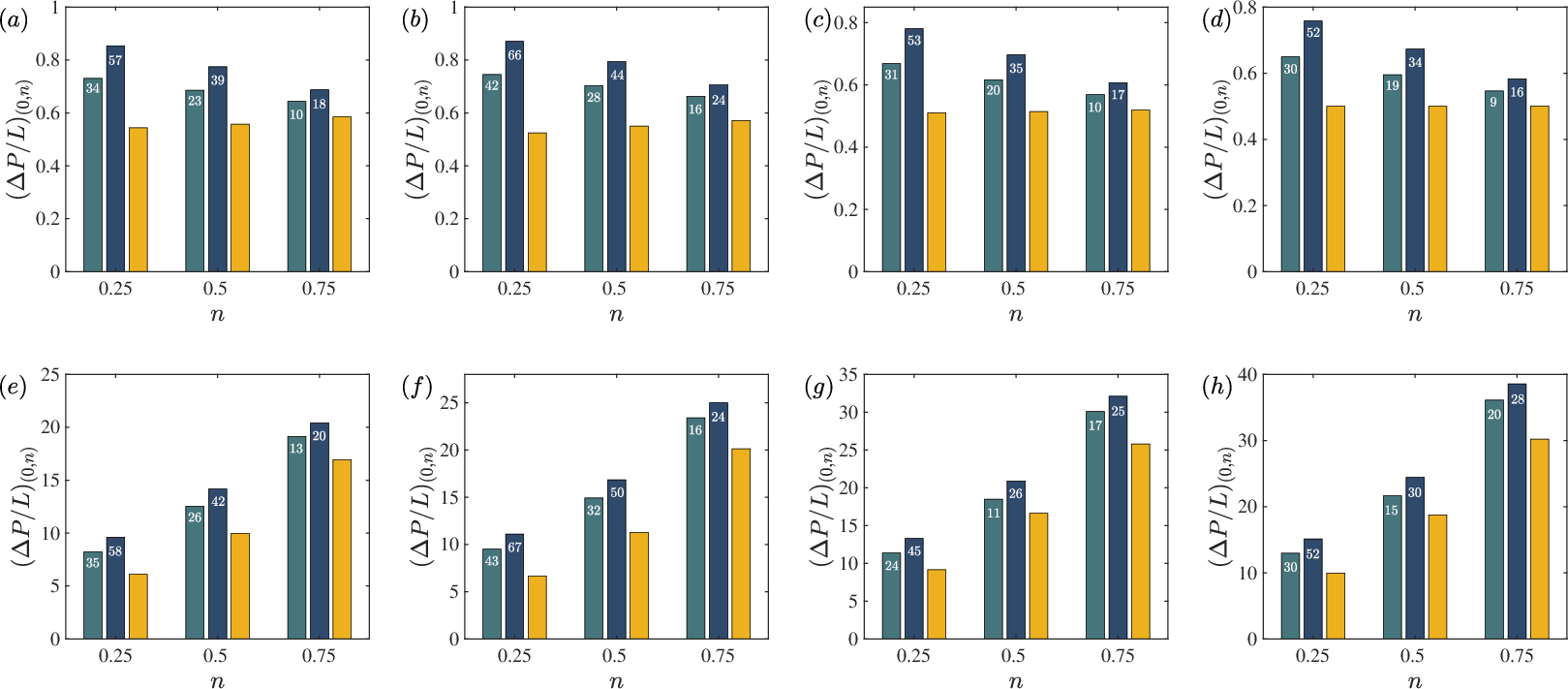
Figure 1: Comparison of predicted and DNS-determined macroscopic pressure gradients for power-law fluids at B0 in multiple random porous media topologies.
Comprehensive DNS ensemble analysis demonstrates that when normalized by B1, the macro-scale pressure gradient data collapse onto a topology- and porosity-independent master curve parameterized only by B2:
B3
with B4 fitted to DNS (Figure 2). The pre-factor B5 effectively corrects earlier theoretical estimates and highlights the universality of the rheological influence in this regime.
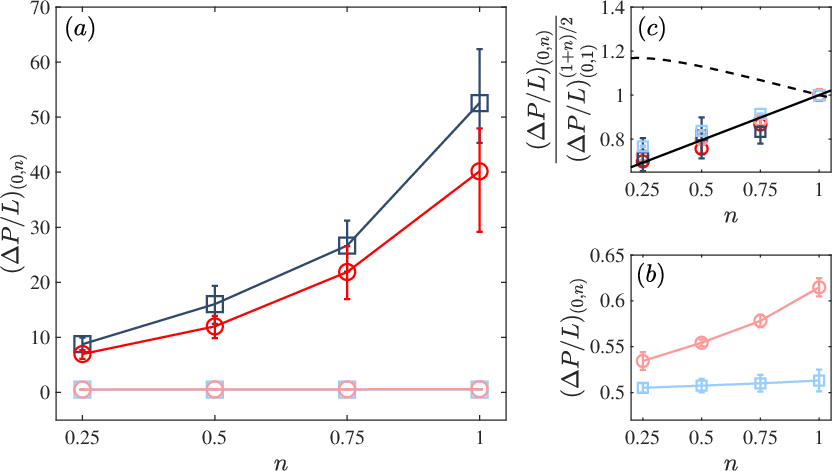
Figure 2: Ensemble-averaged computed macro-scale pressure gradient for various B6 and B7, illustrating the collapse of normalized data to a master curve.
Influence of Porous Medium Topology
Topology enters the Darcy-type law exclusively through B8, the Newtonian pressure gradient, which itself is primarily a function of porosity and the obstacle geometry. For randomly packed square obstacles, a fitting function of the form
B9
is validated, with coefficients determined by DNS (Figure 3). Comparisons between circular and square obstacle media confirm that the geometric effect is significant at high solid fractions, but diminishes in dilute cases, confirming expectations based on drag anisotropy in 2D Stokes flows.
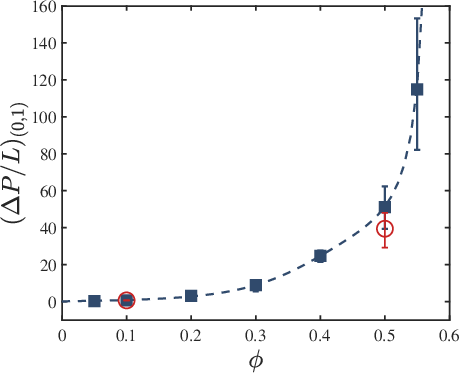
Figure 3: Newtonian pressure gradient versus solid fraction for square and circular obstacle media, showing both topology-dependent and asymptotic behaviors.
Unified Darcy-type Law
Combining the two limiting regimes yields a composite macroscopic law applicable across all ϕ0 and ϕ1:
ϕ2
or, for square-obstacle random media using the fitted Newtonian law,
ϕ3
Performance of the law is comprehensively validated against DNS for Herschel-Bulkley flows (e.g., ϕ4) over broad ranges of ϕ5 and ϕ6, showing quantitative agreement (Figure 4). The impact of shear-thinning becomes increasingly pronounced with decreasing ϕ7 and increasing ϕ8, while the high-ϕ9 asymptote converges regardless of viscous exponent, reaffirming the independence of the yield onset with respect to power-law rheology.
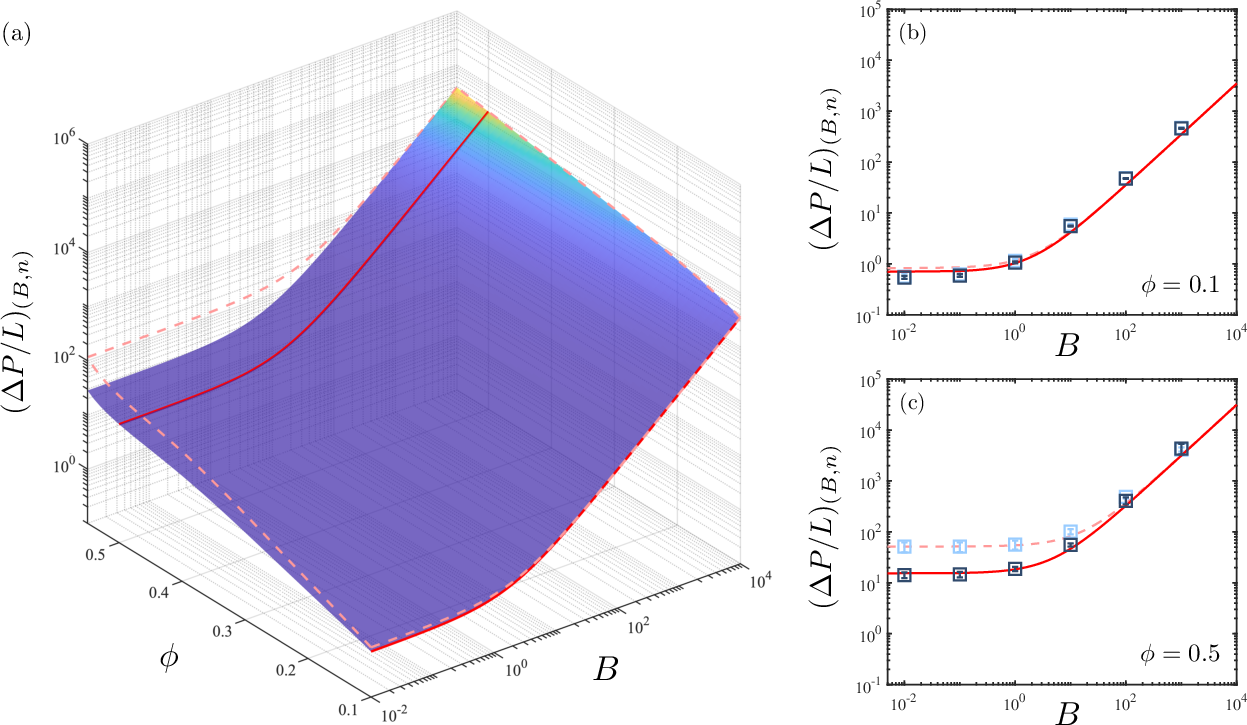
Figure 4: Comparison of DNS ensemble data and the full Darcy-type law for Herschel-Bulkley fluids in random square-obstacle media for n0 over various n1.
Implications and Future Directions
This work provides a parameter-free, macroscopically predictive law for steady-state Herschel-Bulkley (and, by extension, Bingham) fluid flow through arbitrary random porous media. The separation of rheological (via n2, n3) and geometric/topological (via n4) effects enables targeted interpretation and design, relevant to geophysical, biological, and industrial flows, including enhanced oil recovery, biological tissue perfusion, and filtration with cementitious suspensions.
The approach sets the stage for systematic extension to three-dimensional media, transient and non-steady-state effects, as well as potential coupling with thixotropic, time-dependent, and multi-phase systems. Validation against experimental realizations, particularly in complex and anisotropic pore architectures, will be essential for broad adoption. Coupling with machine learning frameworks to rapidly estimate n5 for arbitrary microstructures may further facilitate practical upscaling.
Conclusion
The present study establishes and validates a comprehensive, theoretically-grounded Darcy-type law for viscoplastic yielding fluids that unifies low-n6 power-law and high-n7 yield/plastic asymptotes with explicit topology dependence. Extensive DNS reveal that the role of pore geometry is isolated to the Newtonian limit, while yield-stress and shear-thinning effects superimpose via universal scalings, enabling accurate flow prediction in real-world heterogeneous porous systems. The findings provide a solid framework for further extensions to complex rheologies and more intricate geometries.