- The paper demonstrates how small geometric perturbations break arithmetic symmetry, triggering a transition from Poisson to GOE spectral statistics.
- It employs advanced boundary integral methods and contour integral techniques to compute up to 7.8x10^5 eigenvalues with high precision.
- The study reveals non-uniform relaxation in spectral features and confirms semiclassical scaling in eigenfunction localization within hyperbolic billiards.
Emergence of Quantum Chaos in Perturbed Hyperbolic Billiards
Introduction and Motivation
The study investigates the interplay between arithmetic symmetry and the emergence of quantum chaos by examining the transition from Poisson-like to Random Matrix Theory (RMT)-type spectral statistics in hyperbolic triangle billiards. The paradigm system is the Schmit triangle in the Poincaré disk—an arithmetic hyperbolic triangle with angles (π/8,π/2,π/3)—which exhibits Poissonian quantum statistics despite being classically chaotic. Small, area-preserving geometric perturbations break arithmeticity while preserving local hyperbolic instability. The work combines high-precision computations of long consecutive Dirichlet eigenvalue sequences and eigenfunctions, leveraging advanced boundary integral methods and spectral analysis, to elucidate the arithmetic-to-GOE crossover in spectral and eigenfunction statistics.
Geometry and Classical Dynamics
The billiard domains are defined as triangles in the Poincaré disk, with angles
(α1,α2,α3)=(8π+ε, 2π−ε, 3π)
for perturbation parameter ϵ. These preserve constant hyperbolic area, so all observed quantum effects can be unambiguously attributed to broken arithmetic structure rather than trivial geometric scaling.
The classical dynamics is strongly chaotic for all perturbations, with maximal Lyapunov exponent λmax≃1 throughout phase space. The billiard map is implemented exactly in the Poincaré disk using geodesic arcs, with specular reflections at the geodesic boundary.
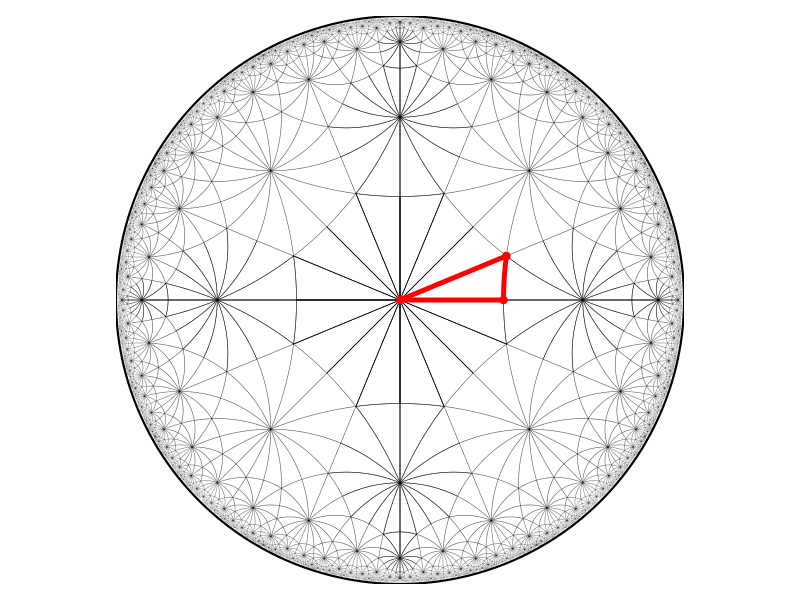
Figure 1: Finite-depth reflection tessellation of the Schmit triangle in the Poincaré disk, highlighting the fundamental domain and its group-generated tiling.
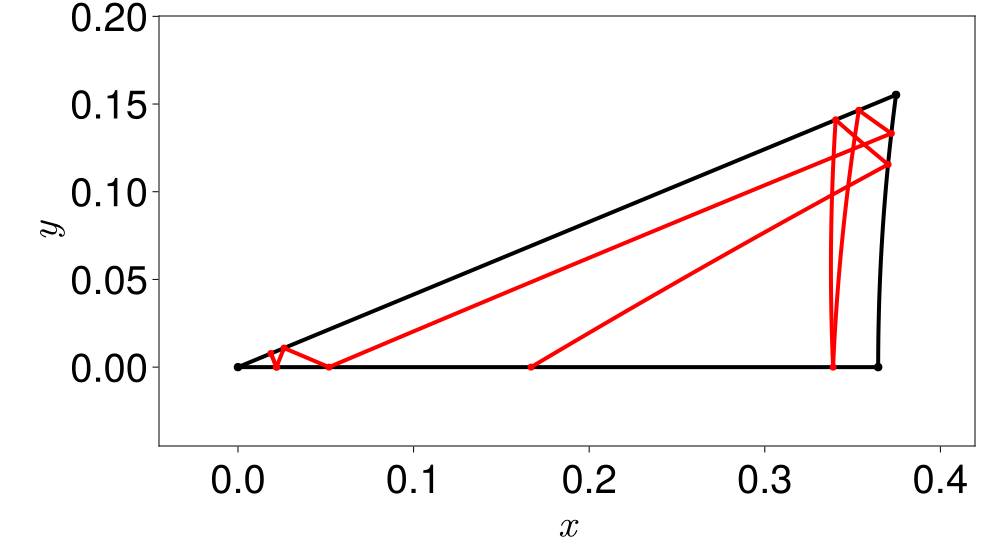
Figure 2: Typical classical geodesic trajectory in the Schmit triangle, demonstrating strongly chaotic behavior and multiple reflections.
Quantum Problem and Numerical Implementation
The quantum system is defined by the Laplace–Beltrami operator with Dirichlet boundary conditions. A robust boundary integral method is implemented, based on analytic Kress splitting adapted to the hyperbolic metric, to discretize the double-layer kernels. Eigenvalues are computed via contour integral methods (Beyn's algorithm), with high-precision adaptive special function evaluation for Legendre Qν functions. This allows computation of up to 7.8×10⁵ consecutive eigenvalues for the smallest perturbations.
Spectral completeness is stringently verified by comparing the numerical counting function against the Weyl law.
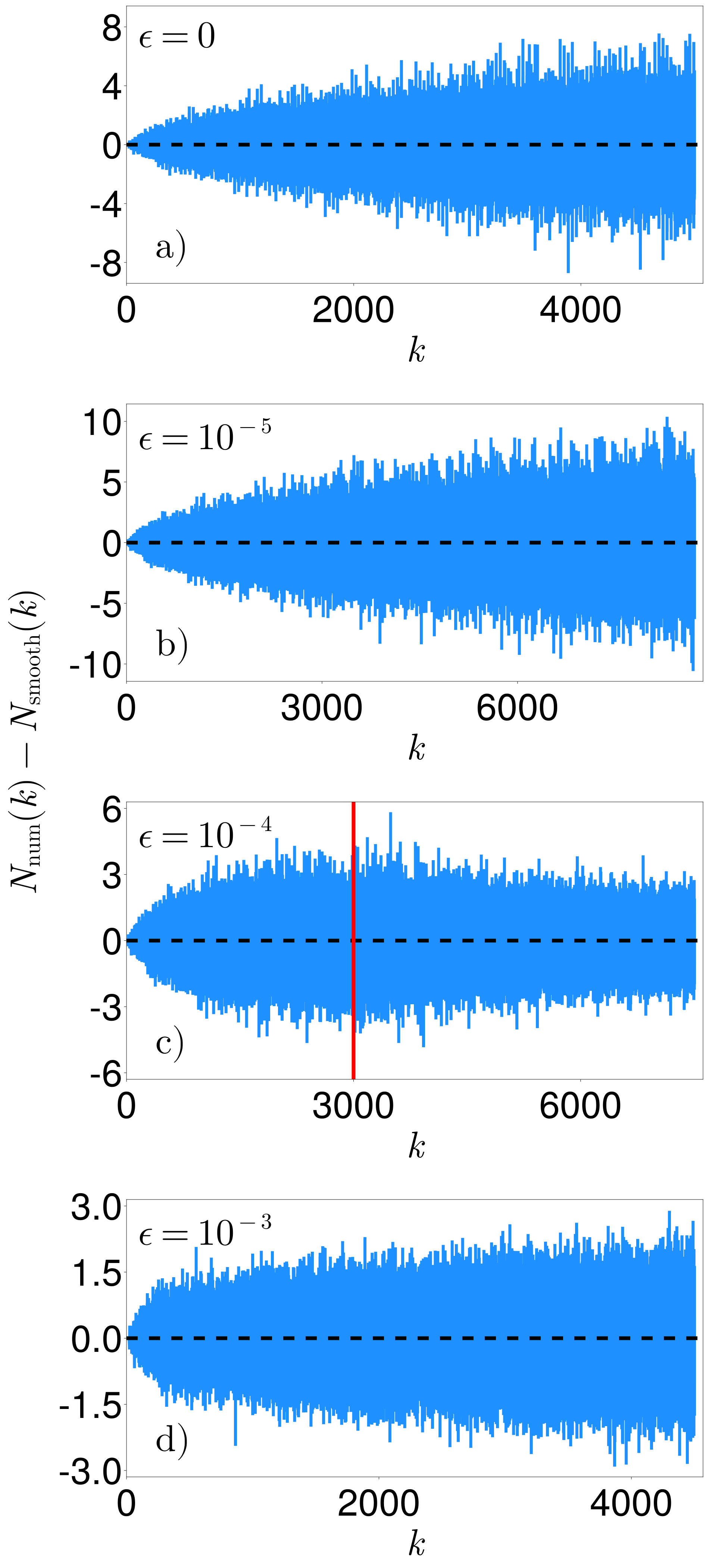
Figure 3: Deviations of numerical eigenvalue counting function from Weyl's law, confirming completeness and reliability of computed spectra.
Spectral Statistics and the Arithmetic-to-GOE Crossover
Nearest-Neighbor Spacing Distributions
Spectral statistics are universally unfolded with the Weyl law, supporting systematic comparison across different perturbations and spectral windows. The nearest-neighbor level spacing distribution (NNLS) is the primary short-range diagnostic.
- For the unperturbed (ϵ=0) Schmit triangle, the NNLS is close to Poisson over the computed range.
- For strong perturbations (ϵ=10−3), the NNLS rapidly approaches the GOE Wigner surmise.
- For weak perturbations (ϵ=10−5), the NNLS remains close to Poisson for thousands of levels before a slow, non-uniform deformation of repulsion and tail emerges, with no single-parameter fit.
Detailed analysis distinguishes the relaxation of small-s structure from large-(α1,α2,α3)=(8π+ε, 2π−ε, 3π)0 tail: the standard Brody fit is inadequate, while a two-parameter generalized-gamma (GG) fit captures independent evolution of level repulsion and tail. However, the GG distribution is diagnostic, not universal.
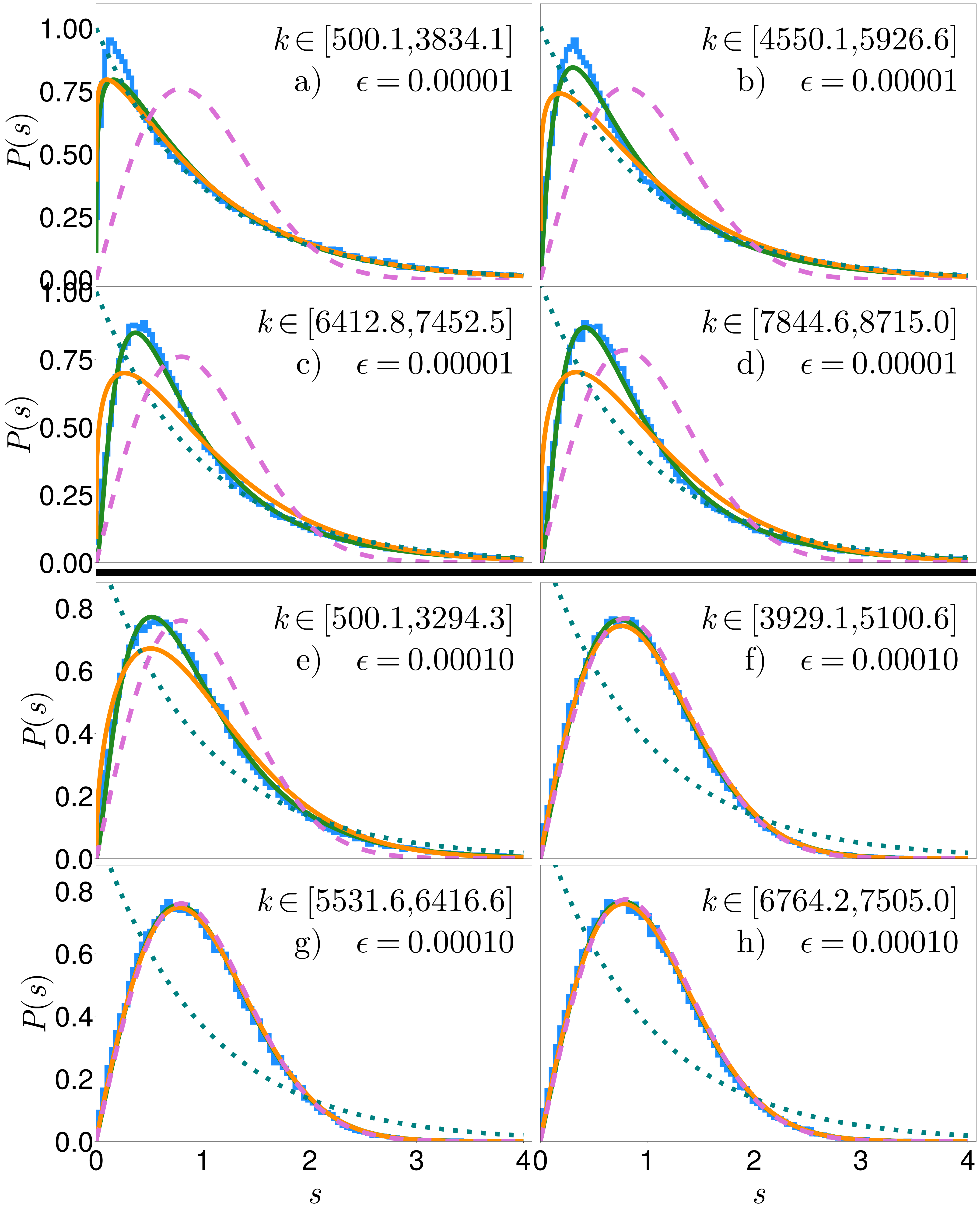
Figure 4: NNLS distributions for (α1,α2,α3)=(8π+ε, 2π−ε, 3π)1 and (α1,α2,α3)=(8π+ε, 2π−ε, 3π)2 in various spectral windows, demonstrating slow approach to GOE.
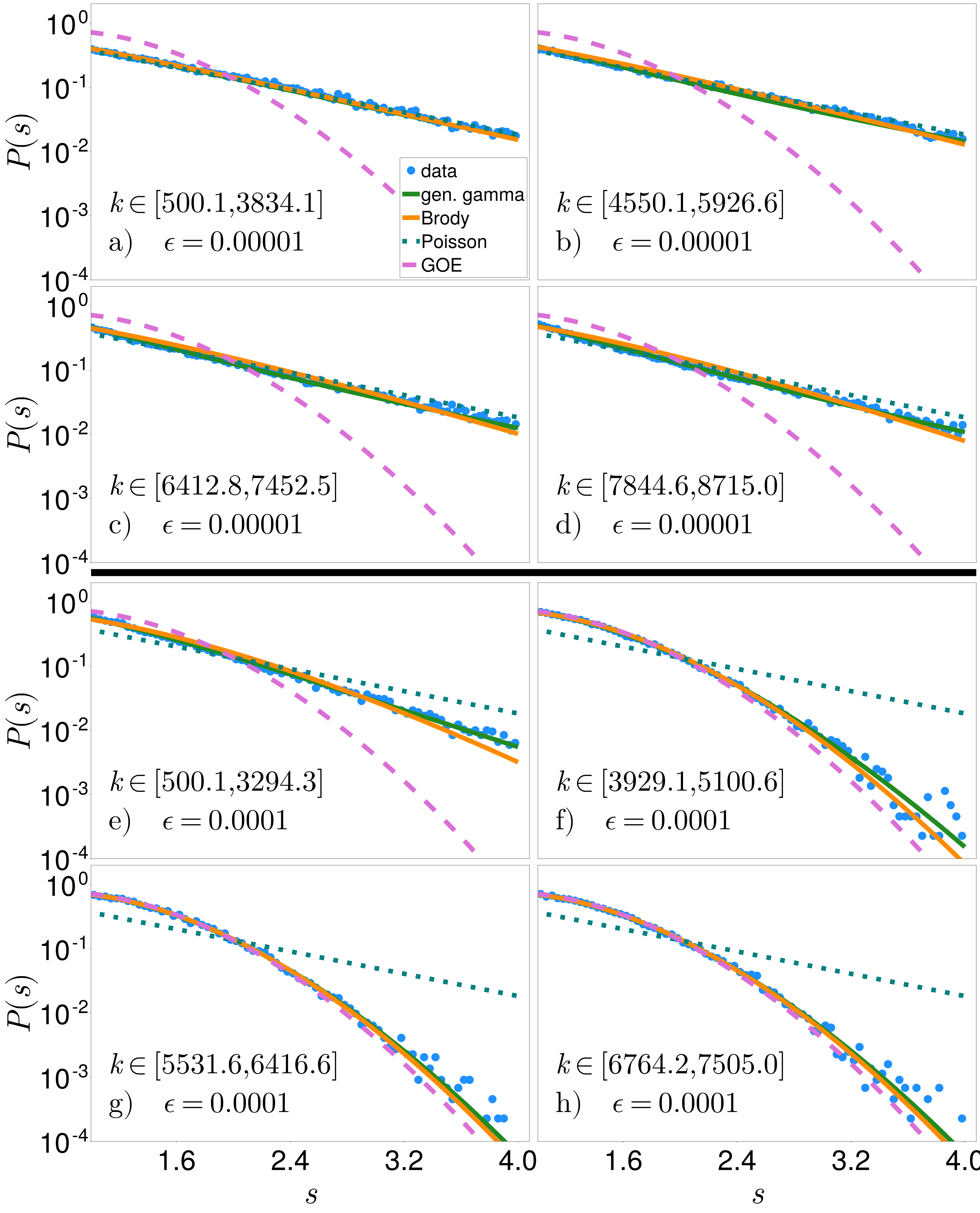
Figure 5: Log-scale NNLS for the same, highlighting the delayed tail relaxation.
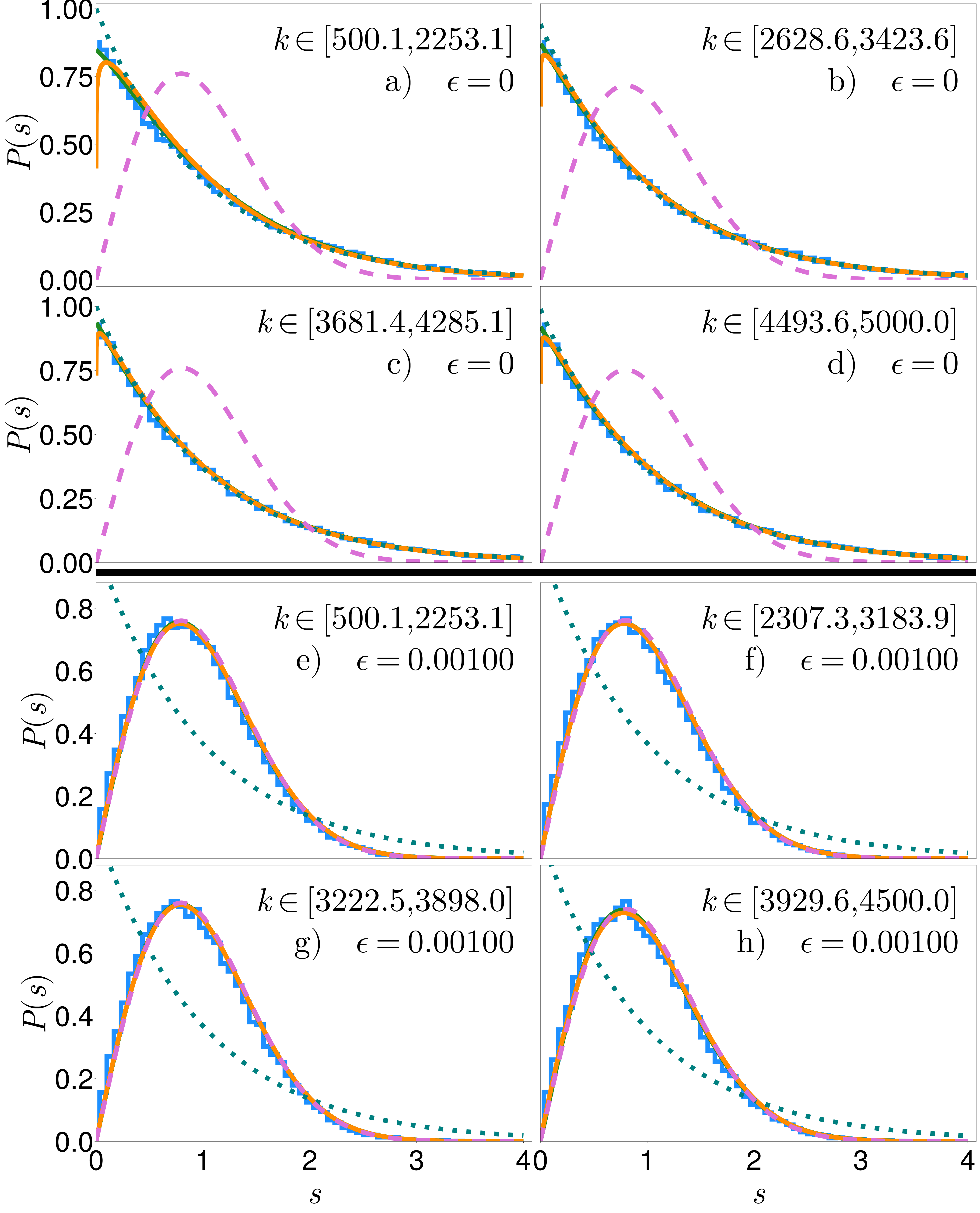
Figure 6: NNLS for unperturbed and strongly perturbed triangles, contrasting sustained Poissonian and rapid GOE behavior.
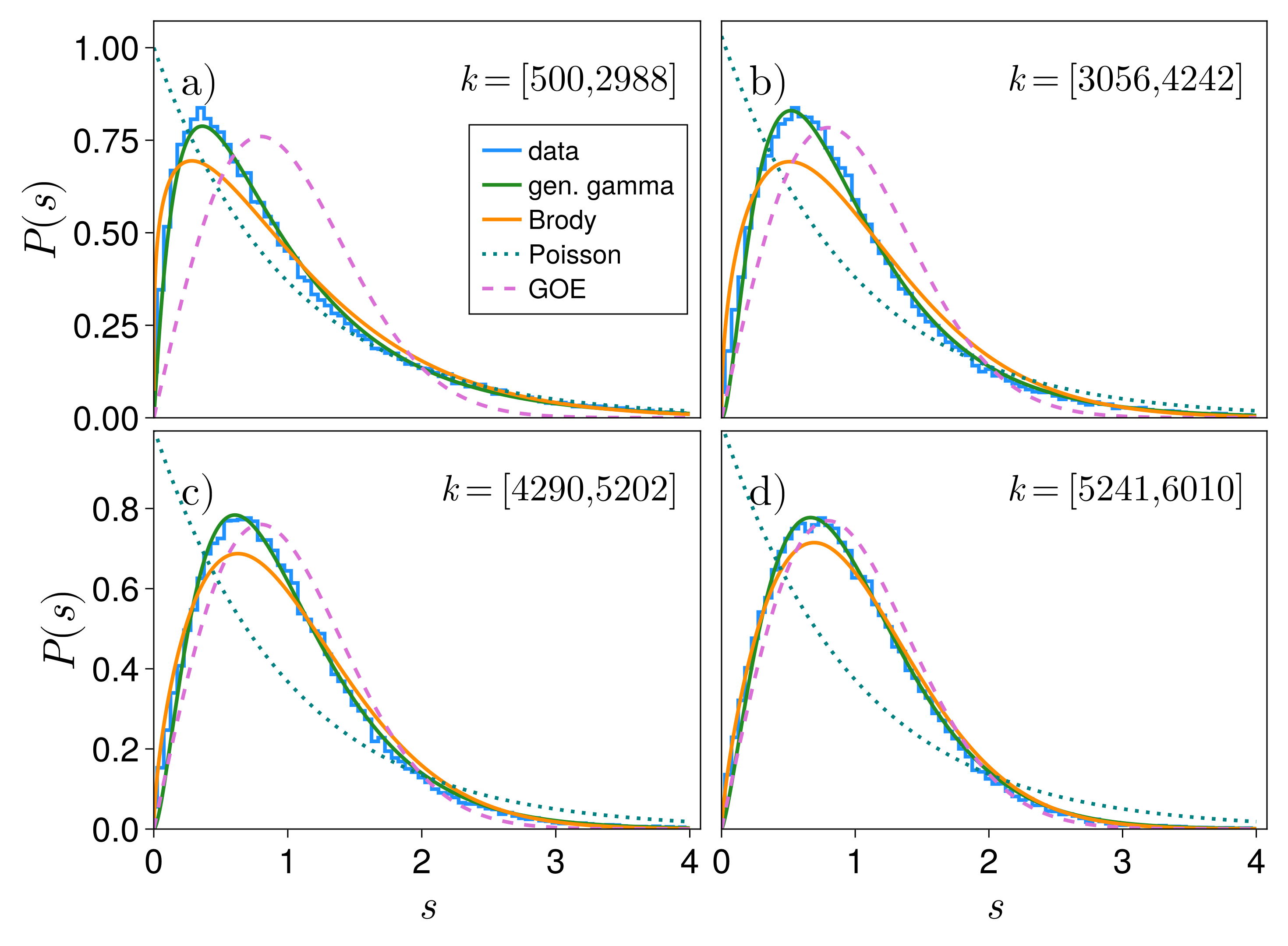
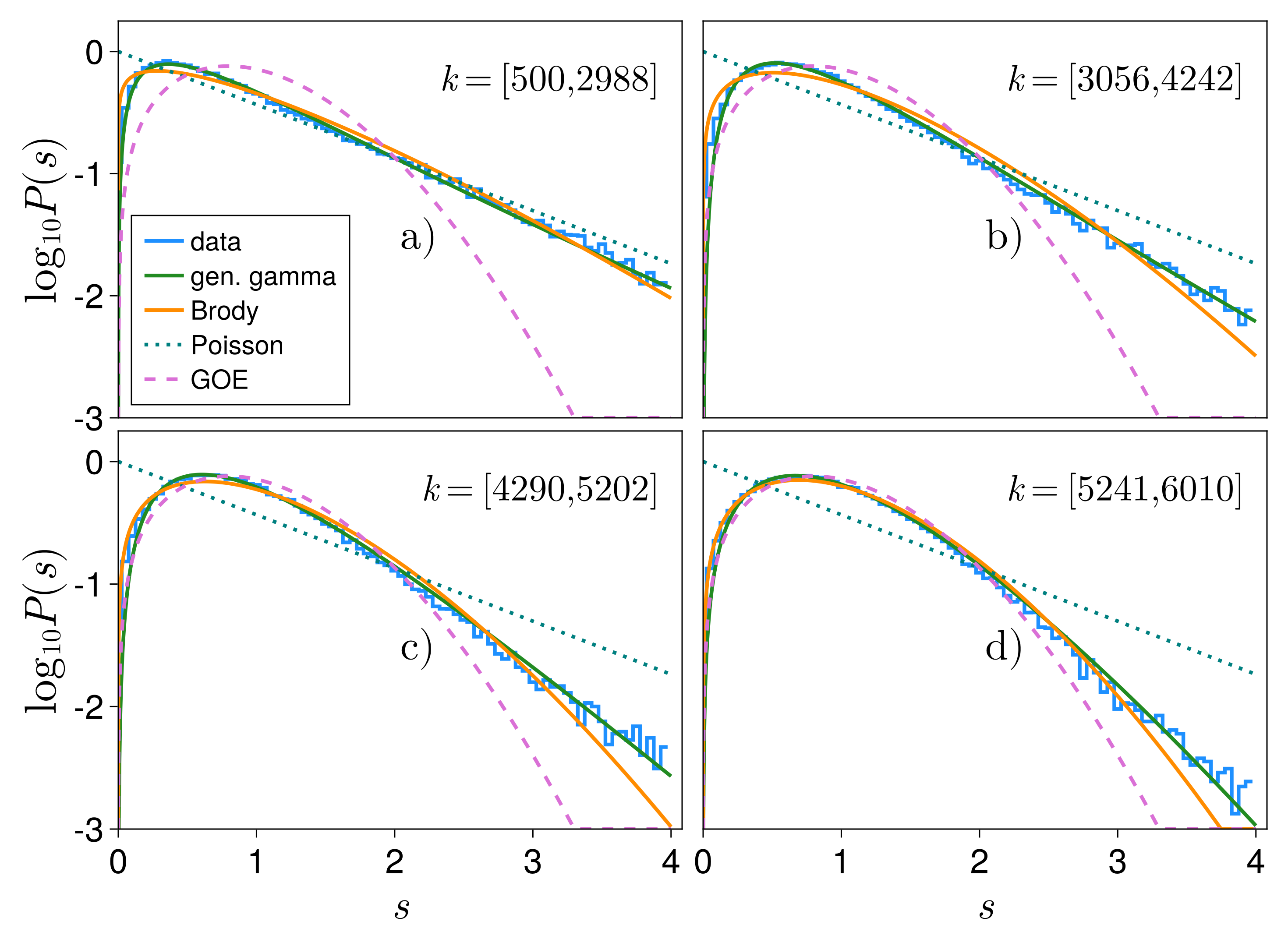
Figure 7: NNLS for intermediate perturbation (α1,α2,α3)=(8π+ε, 2π−ε, 3π)3; GG fit effectively captures the evolving bulk and tail.
Block-GOE Model Diagnostic
For the weakest perturbation, a block-GOE crossover model is employed. The empirical spectrum mimics a superposition of (α1,α2,α3)=(8π+ε, 2π−ε, 3π)4 weakly coupled GOE subspectra, with coupling parameter (α1,α2,α3)=(8π+ε, 2π−ε, 3π)5 drifting upward with energy but remaining far from the fully coupled limit for accessible (α1,α2,α3)=(8π+ε, 2π−ε, 3π)6.
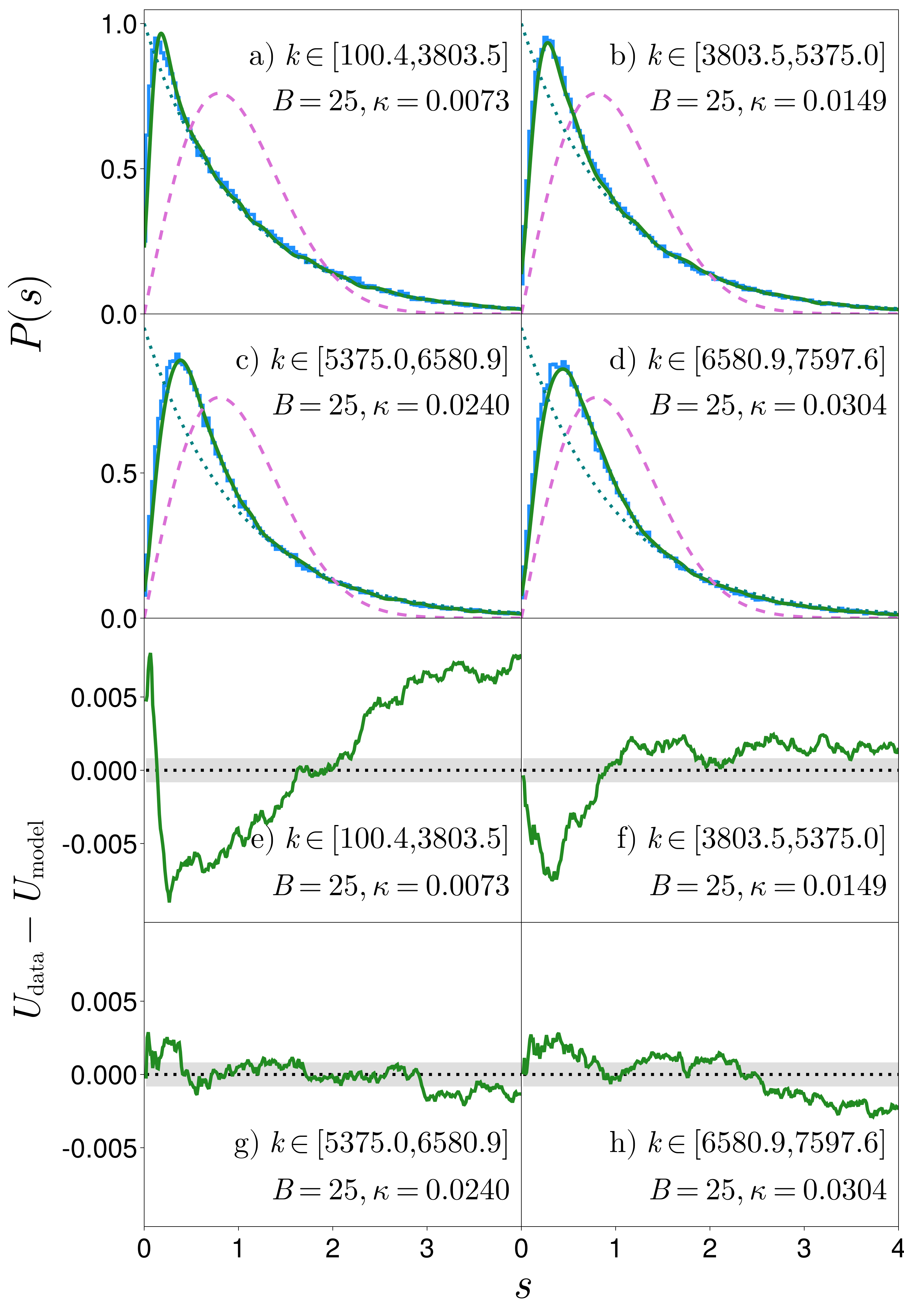
Figure 8: Block-GOE fitting for (α1,α2,α3)=(8π+ε, 2π−ε, 3π)7, illustrating persistent block structure deep within the computed spectrum.
Global and Long-range Correlators
The sliding-window average gap ratio (α1,α2,α3)=(8π+ε, 2π−ε, 3π)8 and spectral rigidity (α1,α2,α3)=(8π+ε, 2π−ε, 3π)9 consolidate the crossover picture. Both demonstrate that the transition scale for GOE statistics is strongly perturbation-dependent and occurs only at higher wavenumbers as ϵ0.
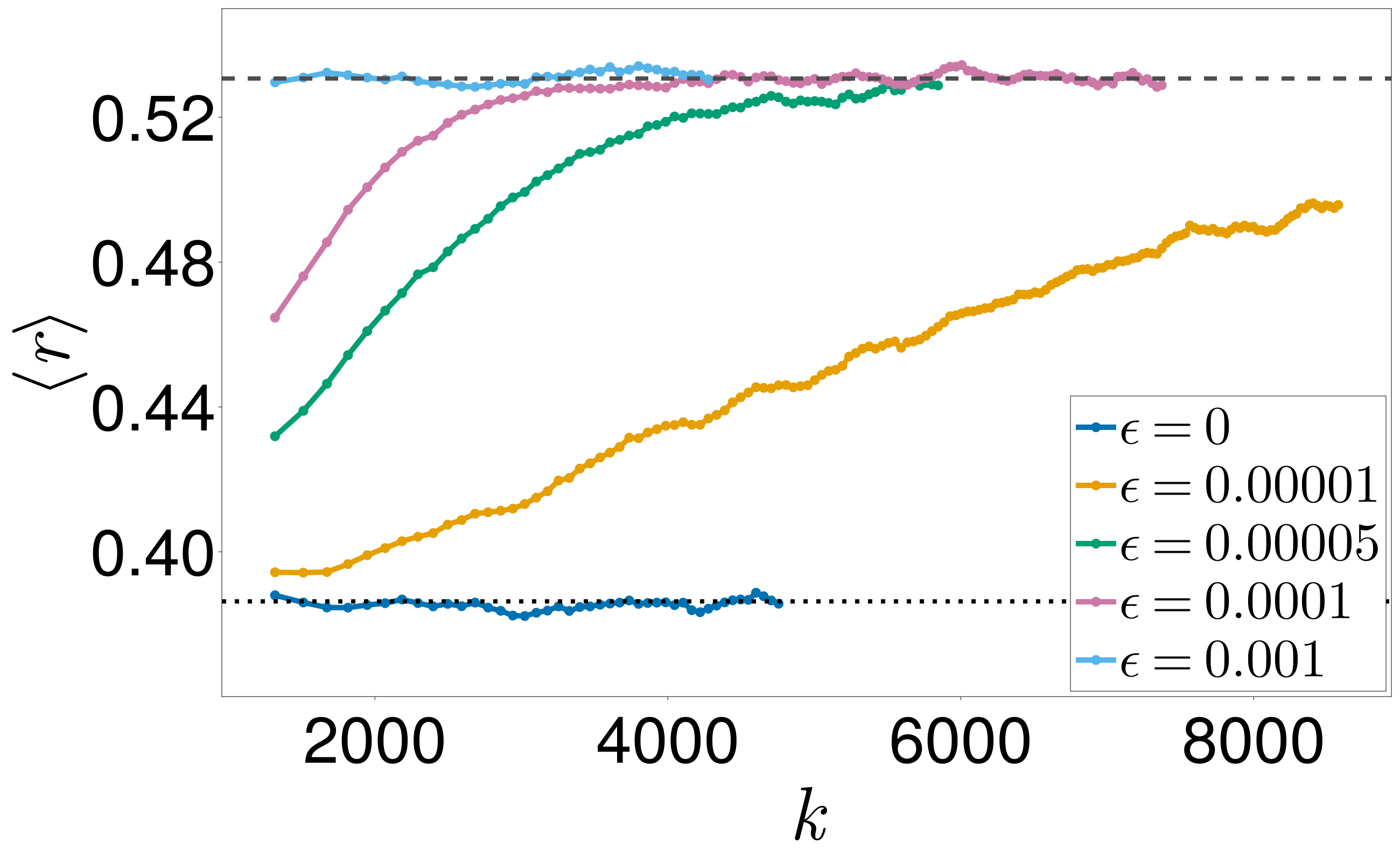
Figure 9: Sliding-window average gap ratio for different perturbations, tracking evolution from Poisson to GOE.
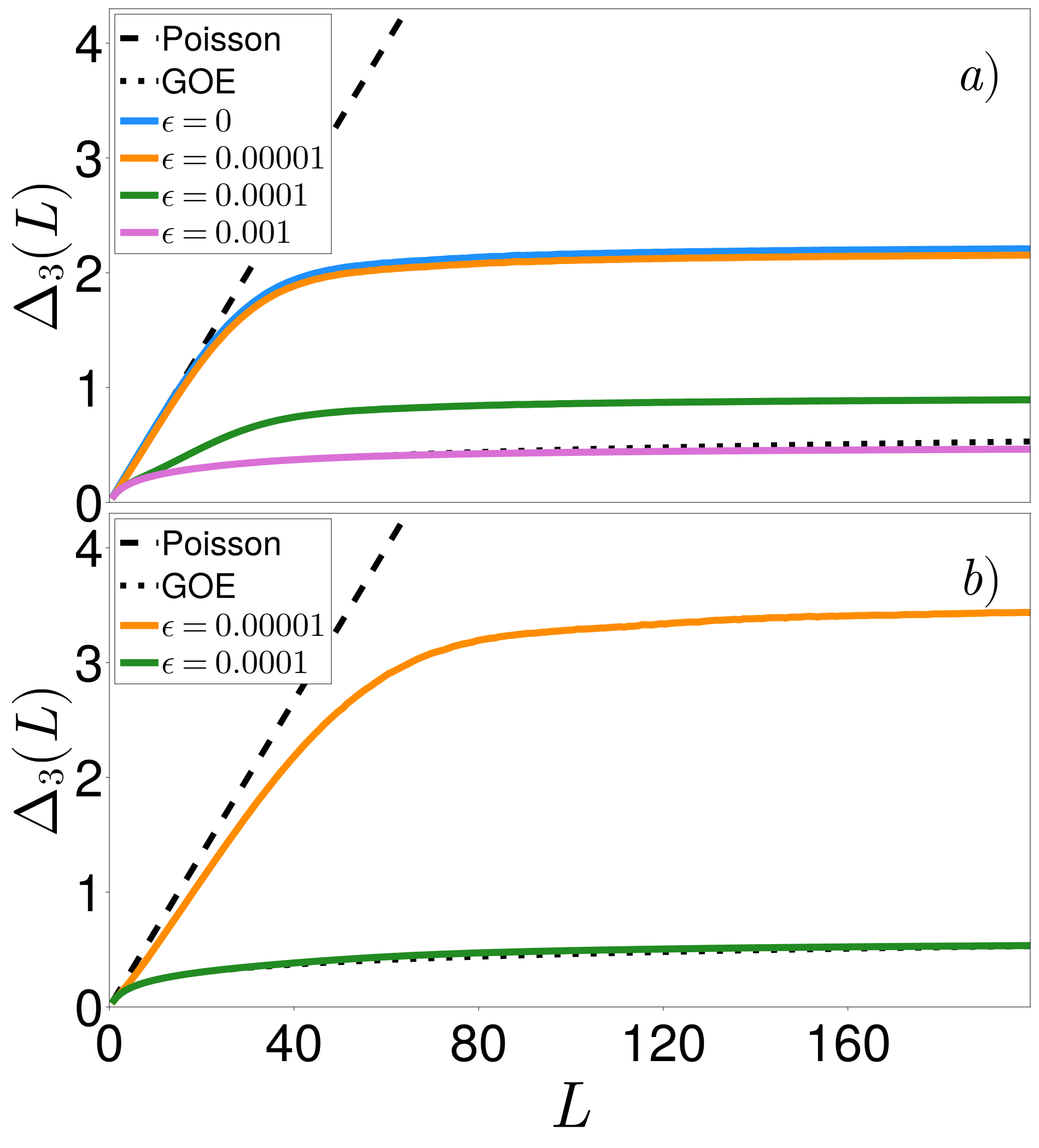
Figure 10: Spectral rigidity ϵ1, highlighting perturbation-dependent saturation and crossover.
Spectral form factors confirm the convergence: small perturbations retain arithmetic plateau at ϵ2 for large ϵ3, while large perturbations rapidly approach the RMT prediction.
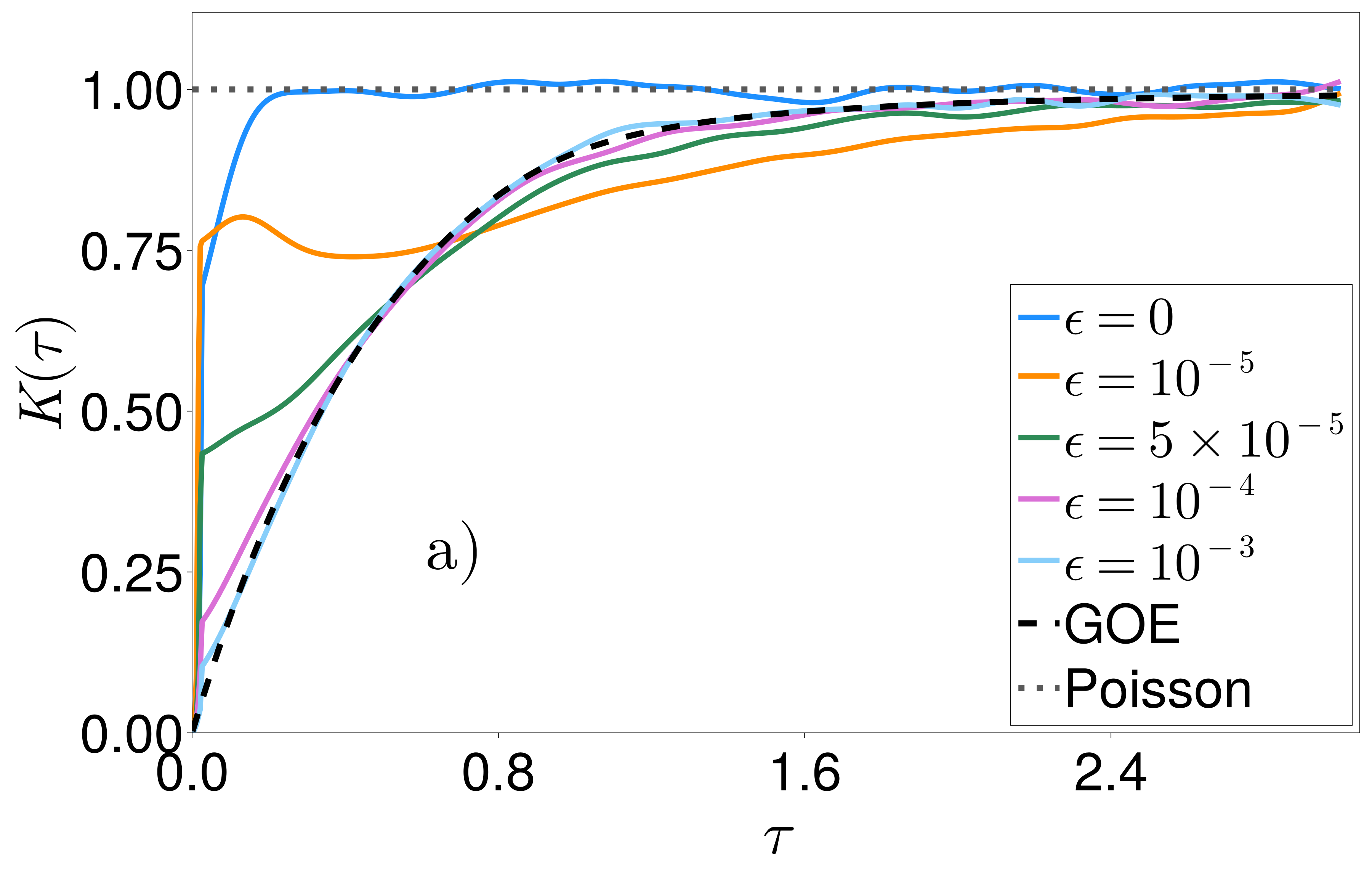
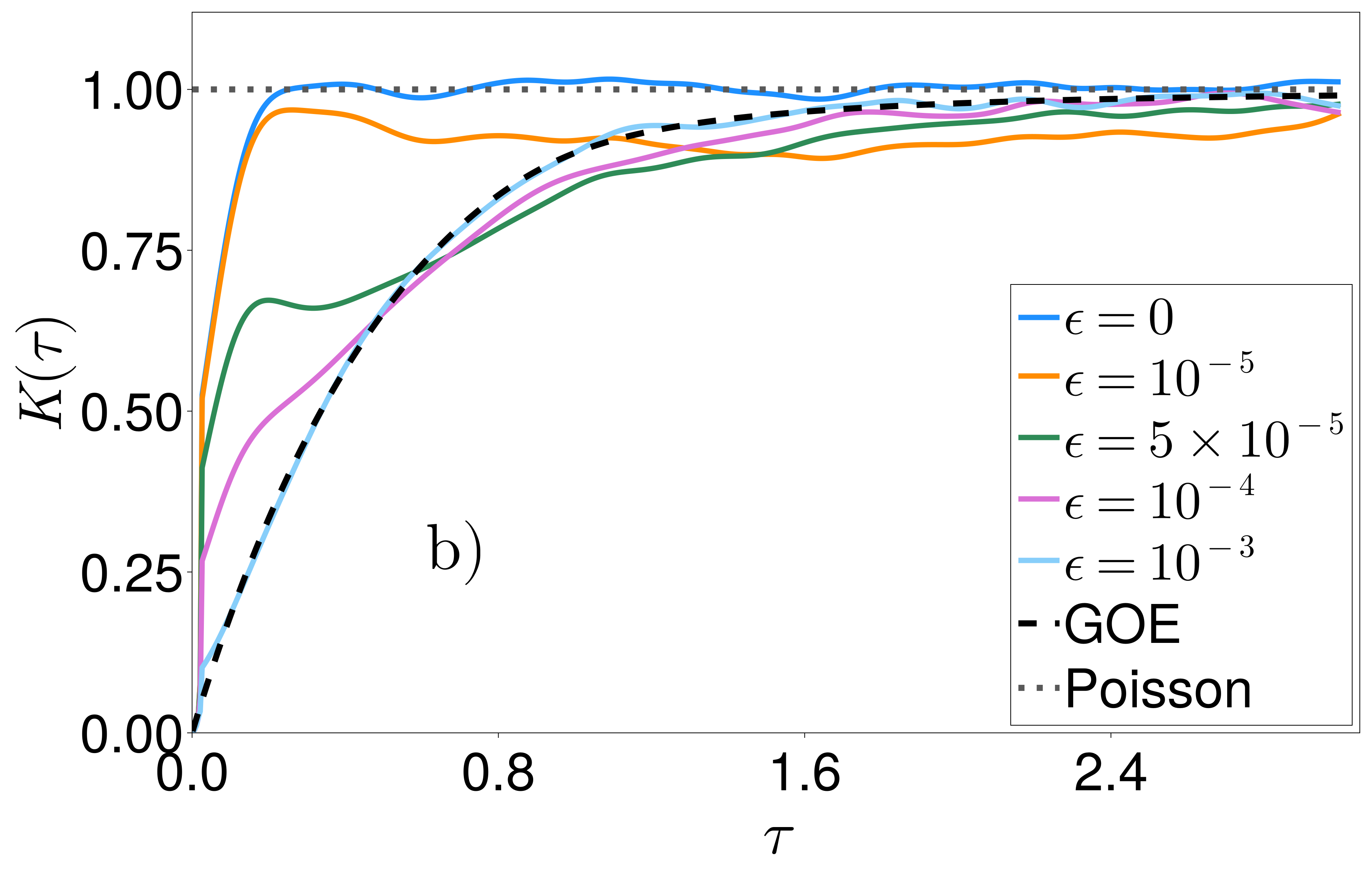
Figure 11: Window-averaged spectral form factor for each perturbation, compared to Poisson and GOE predictions.
Eigenfunction Localization and Semiclassical Scaling
Phase-space localization is assessed through the entropy of Poincaré-Husimi (PH) boundary representations. For each spectral window, the distribution of the normalized localization measure ϵ4 is well fitted by a Beta distribution. The standard deviation ϵ5 of ϵ6 is found to decay as a power law in ϵ7 once the GOE regime is achieved, with exponent ϵ8–ϵ9; this matches independently observed semiclassical scaling in other uniformly hyperbolic systems and is robust across perturbations, provided arithmetic memory is lost.
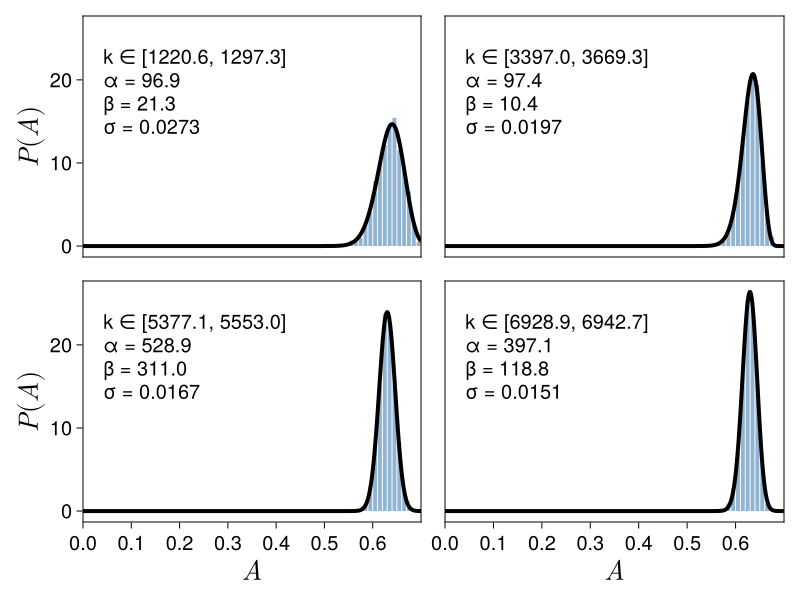
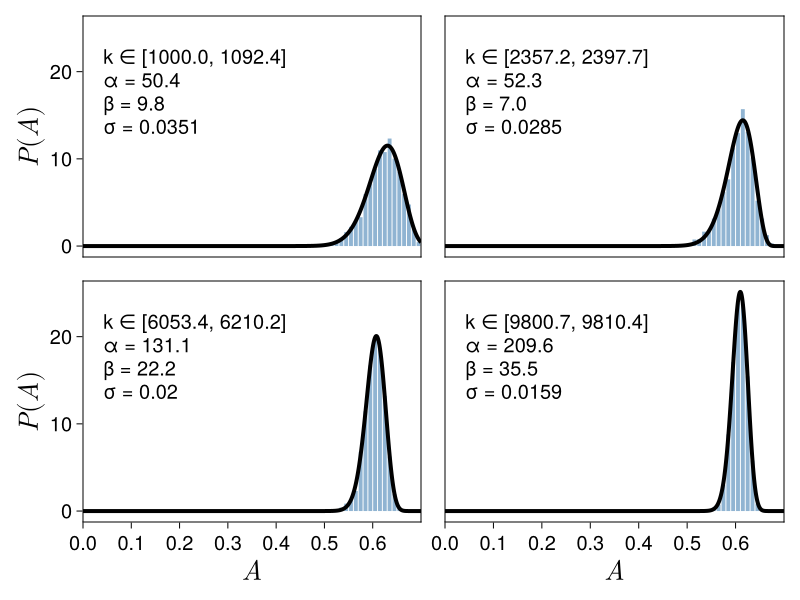
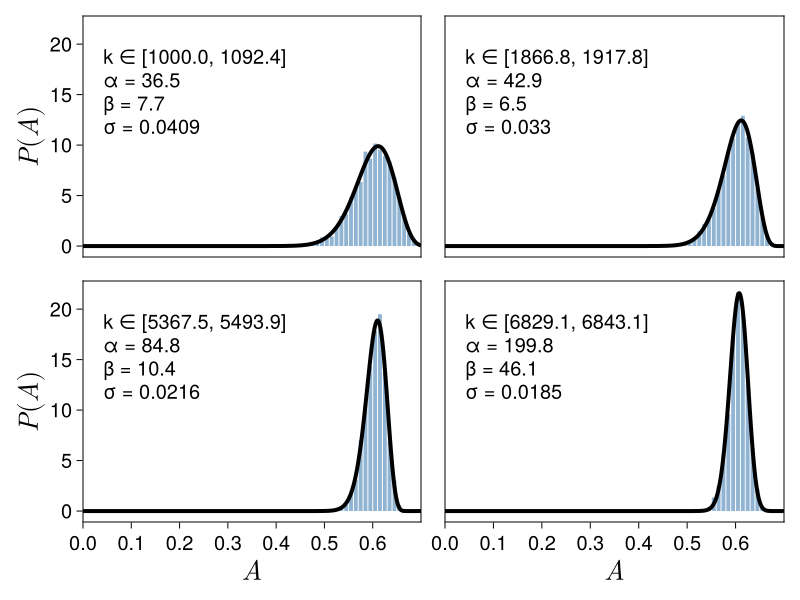
Figure 12: Empirical λmax≃10 in spectral windows for typical λmax≃11, with fitted Beta distributions.
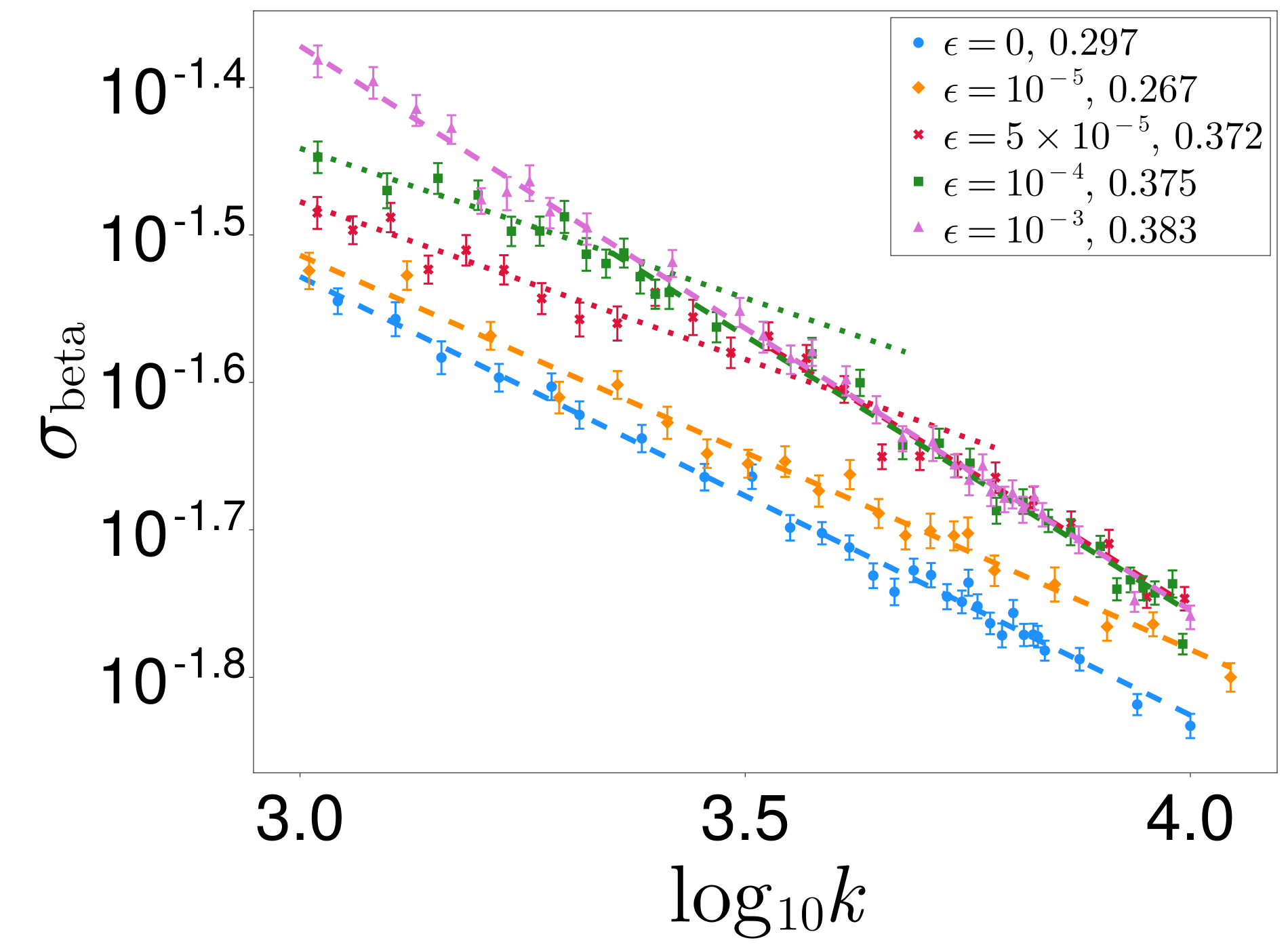
Figure 13: Power-law decay of localization fluctuation width λmax≃12 versus λmax≃13 across the crossover, with post-crossover collapse.
Numerical Validation of Methods
Comprehensive benchmarking against model problems (hyperbolic circle) validates the boundary integral discretization and special function evaluation in the high-frequency regime.
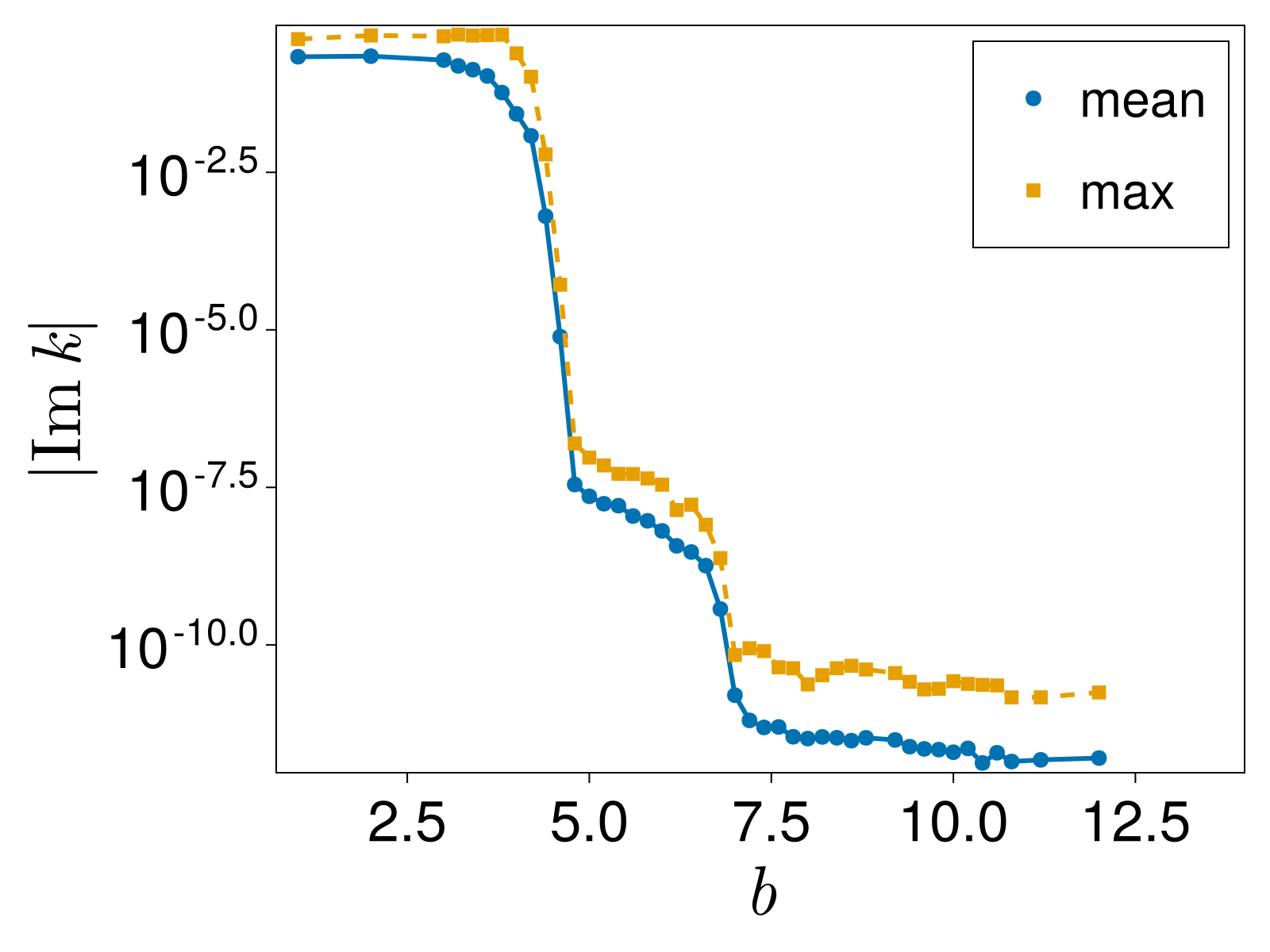
Figure 14: Accuracy of computed eigenvalues as a function of points-per-wavelength discretization.
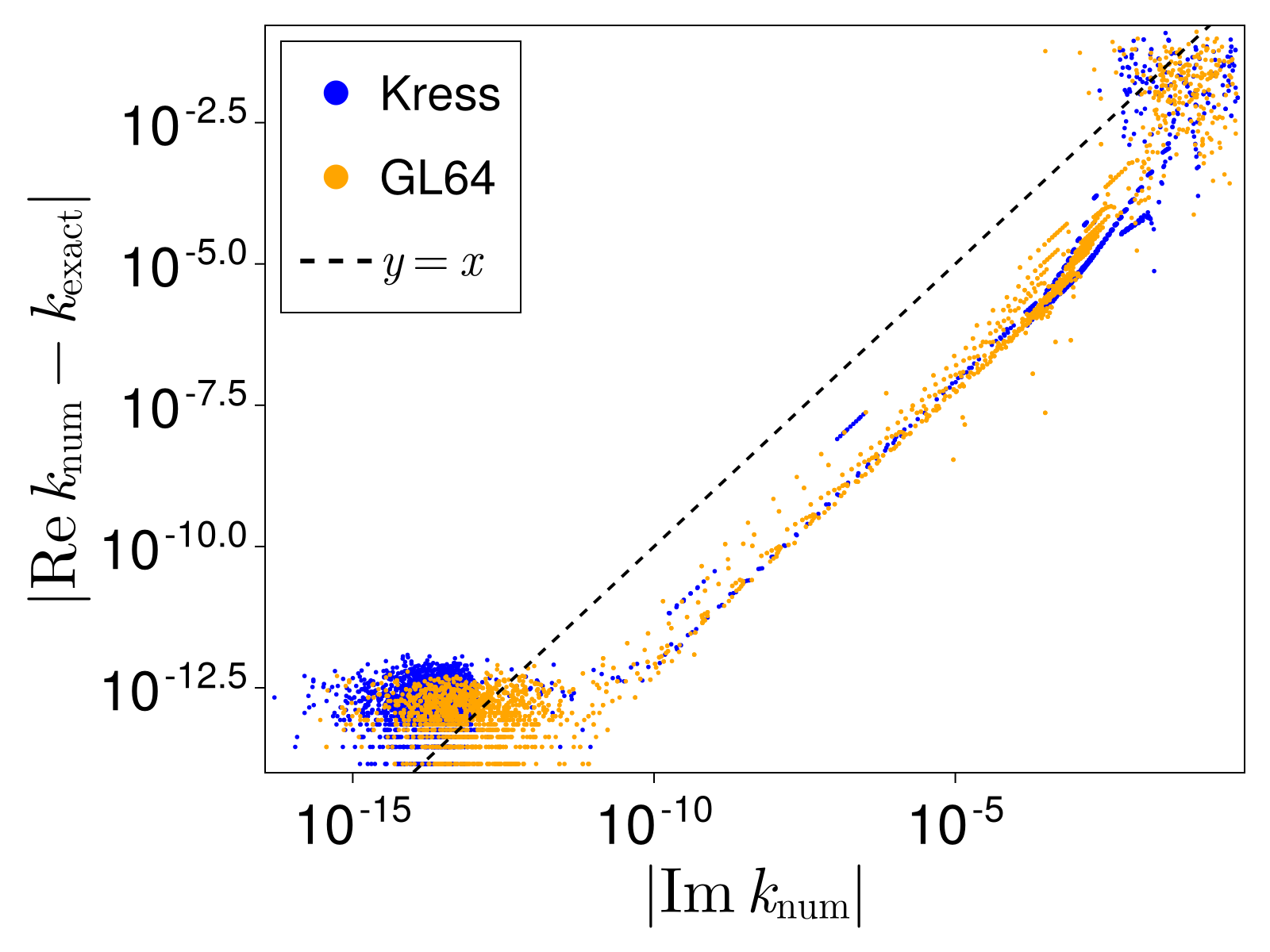
Figure 15: Validation of numerical methods by comparison with analytic eigenvalues for the hyperbolic circle billiard.
Implications and Future Perspectives
The results definitively demonstrate that breaking arithmetic symmetry induces a perturbation- and energy-scale-dependent crossover from arithmetic quantum chaos (Poisson-like statistics) to universal GOE statistics in quantum spectra and eigenfunction statistics. The transition is inherently non-uniform: different features of the spectrum (level repulsion vs. tail, short- vs. long-range) relax at different rates, and no single-parameter interpolation fully captures this crossover.
The emergence of power-law suppression of eigenfunction localization, invariant across perturbations in the GOE regime, reinforces the semiclassical universality of self-averaging in chaotic billiards once all trace of arithmeticity is lost.
This work establishes the necessity of large, consecutive high-precision spectral datasets for robustly resolving slow crossovers in quantum billiards and sets the stage for further study of universality in higher genus surfaces, more complex perturbative mechanisms, and connections to symmetry breaking in nonbilliard quantum systems. Future avenues include exploring many-body analogs, deeper relations to symmetry-breaking random matrix ensembles, and implications for quantum ergodicity and scarring phenomena.
Conclusion
This study provides an authoritative and exhaustive characterization of the perturbation-induced transition from arithmetic to universal quantum chaos in hyperbolic billiards (2607.03786). Through large-scale, precision computations, the analysis elucidates the nonuniform, perturbation-dependent nature of the crossover in both spectral and eigenfunction statistics, firmly connecting geometric and arithmetic symmetry breaking to the onset of universal RMT phenomenology in negative curvature. The techniques and diagnostics developed here are of broad utility for future research into symmetry, chaos, and localization in quantum systems with non-Euclidean geometry.