- The paper shows that while SRE coarsely indicates phase transitions, the Pauli spectrum reliably captures fine exchanges of non-local string order in SPT systems.
- It employs large-scale exact enumeration and MPS-based sampling to accurately measure operator-space diagnostics across quantum phase transitions.
- Findings reveal that non-invertible dualities and operator-based approaches complement traditional entanglement measures for classifying both gapped and gapless SPT phases.
Pauli Spectrum and Stabilizer Rényi Entropy in Gapless SPT Phases
Introduction
This paper provides a rigorous analysis of the stabilizer Rényi entropy (SRE) and the Pauli spectrum as probes of both gapped and gapless symmetry-protected topological (SPT) phases in one-dimensional quantum systems (2607.03762). The study challenges conventional entanglement-based diagnostics by focusing on quantum "magic" and non-stabilizerness, investigating the complementary roles these quantities play in identifying phase transitions and the underlying structure of SPT order. The main result is the demonstration that while SRE serves as a coarse indicator of phase transitions, the Pauli spectrum captures fine-grained phenomena such as the exchange of non-local string order sectors, especially at transitions between SPT phases.
Stabilizer Rényi Entropy and Pauli Spectrum: Definitions and Measurement
The SRE quantifies the "distance" of a pure quantum state from the manifold of stabilizer states, serving as a robust measure of non-stabilizerness or quantum magic. Explicitly, for a state ∣ψ⟩ on N qubits, the Pauli spectrum is the probability distribution
pψ(σ)=2N∣⟨ψ∣σ∣ψ⟩∣2
over all 4N tensor-product Pauli strings σ. The SRE is then defined as the Rényi entropy of this distribution (typically with α=2),
Mα(∣ψ⟩)=1−α1log(σ∑pψ(σ)α)−Nlog2.
Crucially, stabilizer states exhibit vanishing SRE, while generic quantum states yield nonzero values. The measurement of SRE and the Pauli spectrum in this work leverages large-scale exact enumeration (small systems) and matrix product state (MPS)-based perfect Pauli-string sampling algorithms (large systems), ensuring both comprehensive operator-space resolution and accuracy in thermodynamic sampling.
Cluster SPT Models: Duality and Pauli Spectrum Crossing
The one-dimensional cluster SPT model, governed by
H=−(1−h)∑iZi−1XiZi+1−h∑iXi,
exhibits a Z2o×Z2e symmetry and realizes a topological-to-trivial phase transition at h=1/2. In the stabilizer basis, the ground state is a stabilizer state at N0 and a product state at N1, related by a global Clifford transformation N2. The SRE is symmetric across the transition point and vanishes in both limits due to the Clifford equivalence, while manifesting a peak near the transition that signals phase mixing but does not distinguish SPT from trivial phases.
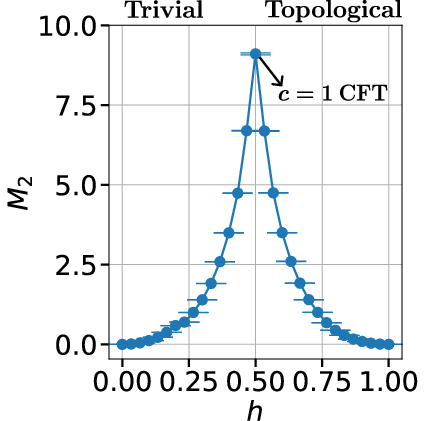
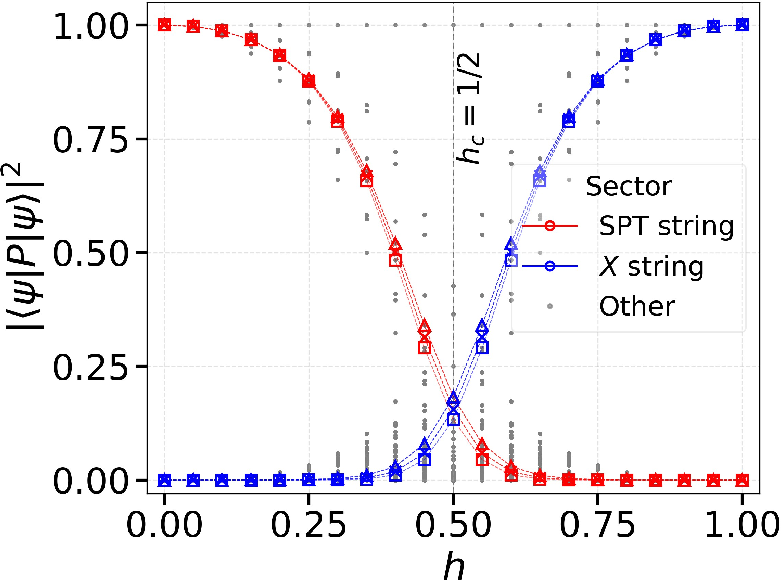
Figure 1: (a) N3 SRE as a function of N4, peaking at the transition. (b) Pauli spectrum for N5, displaying a crossing of dominant string order sectors at the transition.
Conversely, the Pauli spectrum provides explicit information on the operator content of the wave function. As N6 is tuned, non-local string order operators associated with SPT order exchange dominance with locally ordered operators (i.e. N7 strings), with the crossing precisely marking the SPT phase transition. The symmetry of the spectrum is dictated by the self-duality of the Hamiltonian generated by N8.
Cluster Ising Model: Symmetry-Enriched Criticality
The generalized cluster Ising model,
N9
with the constraint pψ(σ)=2N∣⟨ψ∣σ∣ψ⟩∣20, interpolates between cluster SPT, trivial paramagnet, and Ising antiferromagnets. The associated phase diagram includes symmetry-enriched Ising CFT lines and multicritical Lifshitz points. The SRE in this model again peaks around phase boundaries—self-dual under a Clifford map pψ(σ)=2N∣⟨ψ∣σ∣ψ⟩∣21—but is insensitive to the distinction between topologically distinct Ising criticalities.
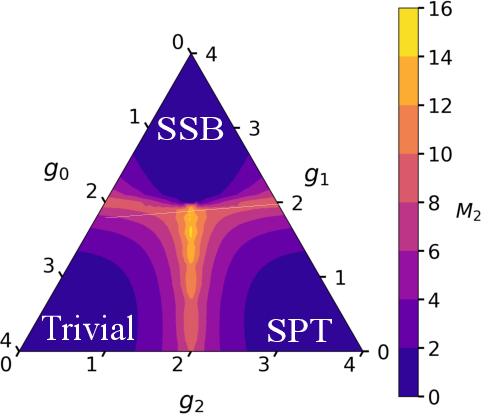
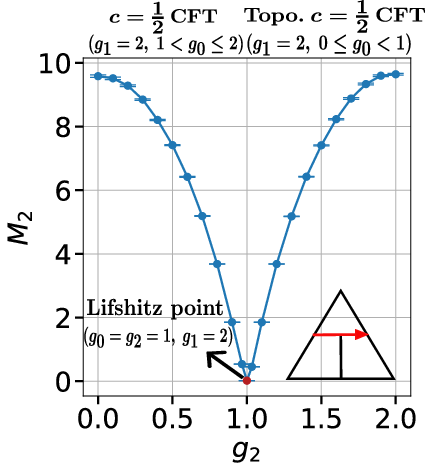
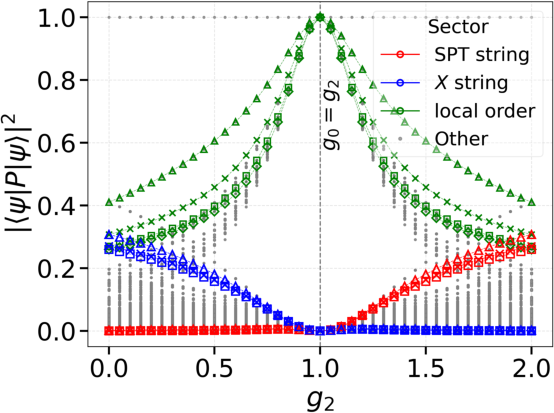
Figure 2: (a) pψ(σ)=2N∣⟨ψ∣σ∣ψ⟩∣22 phase diagram of the cluster Ising model. (b) pψ(σ)=2N∣⟨ψ∣σ∣ψ⟩∣23 along pψ(σ)=2N∣⟨ψ∣σ∣ψ⟩∣24, showing symmetry about the self-dual line. (c) Pauli spectrum across topological Ising transitions, visualizing the competition between SPT non-local and SSB local order parameters.
In contrast, the Pauli spectrum reveals a crossing structure between non-local string order (SPT-related) and local order (SSB-related) operators, directly tracking the exchange of symmetry sectors that define different SPT and SSB phases. The scaling behavior of the spectrum encodes the scaling dimension of these operators at criticality.
Intrinsically Gapless SPT: Non-Invertible Kramers-Wannier Duality
The analysis extends to an intrinsically gapless SPT (igSPT) model constructed via a non-invertible Kennedy-Tasaki (KT) duality on a coupled XX+Ising chain:
pψ(σ)=2N∣⟨ψ∣σ∣ψ⟩∣25
This Hamiltonian exhibits a pψ(σ)=2N∣⟨ψ∣σ∣ψ⟩∣26 symmetry, and the duality structure is provided not by a local unitary but by a non-invertible Kramers-Wannier type map. Despite the absence of an invertible SPT entangler, the Pauli spectrum once again shows pronounced crossing behavior between SPT and trivial order sectors at the self-dual point pψ(σ)=2N∣⟨ψ∣σ∣ψ⟩∣27.
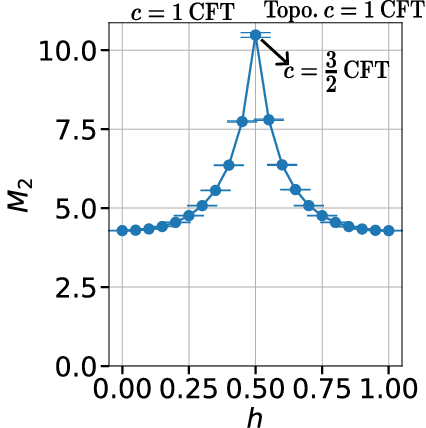
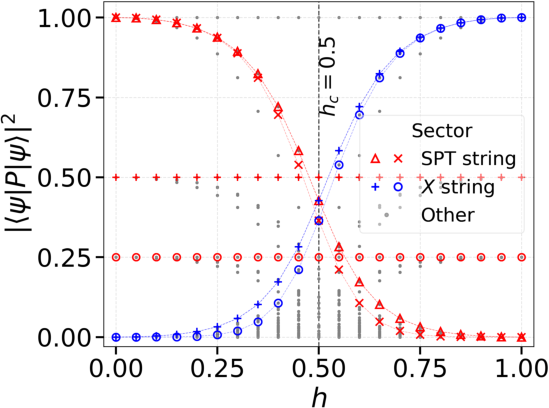
Figure 3: (a) pψ(σ)=2N∣⟨ψ∣σ∣ψ⟩∣28 as a function of pψ(σ)=2N∣⟨ψ∣σ∣ψ⟩∣29 in the igSPT model, peaking sharply at the self-dual point. (b) Pauli spectrum, exhibiting switching between SPT and trivial string order dominance as 4N0 is varied.
The spectrum mapping is justified by operator algebra: for even parity symmetry sectors, non-unitary Clifford transformations map SPT-related string order operators into trivial ones and vice versa, explaining the crossing structure observable only via the full Pauli spectrum. The SRE for this model is strictly nonzero everywhere due to the absence of a stabilizer limit.
Numerical Robustness and Sampling Details
The paper incorporates comprehensive numerical checks, including the convergence of the SRE as a function of the sample number and MPS bond dimension, confirming the reliability of both SRE and Pauli spectrum calculations across system sizes and parameter regimes.
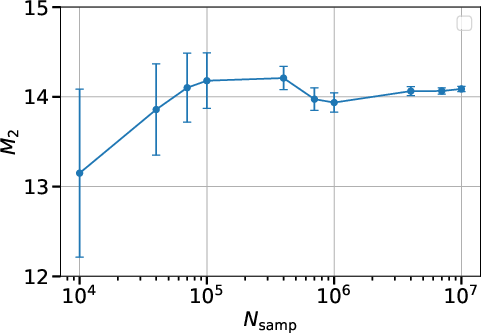
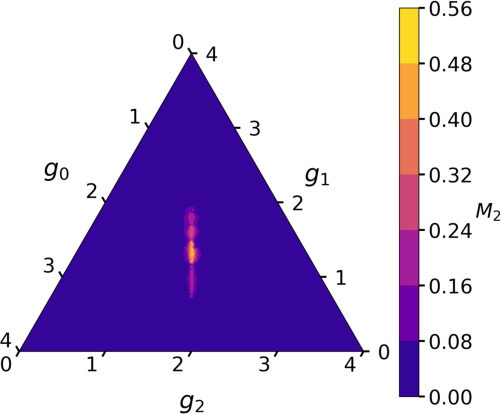
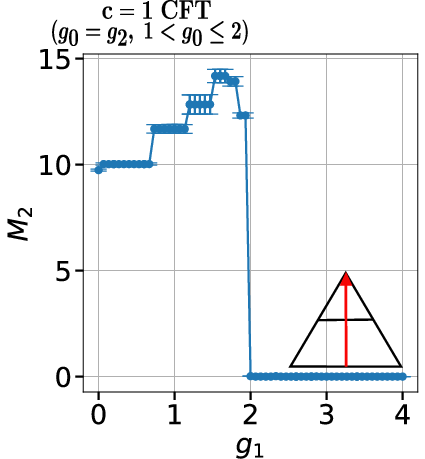
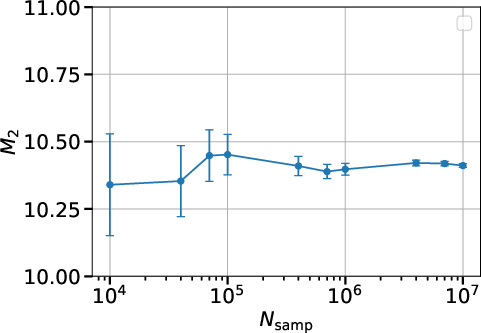
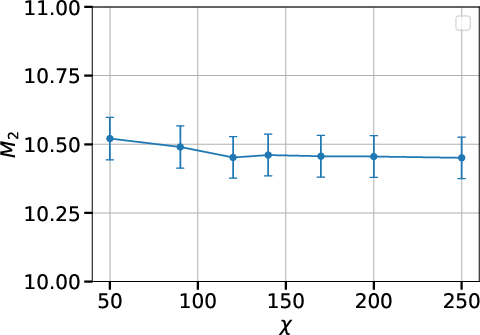
Figure 4: Numerical convergence analysis of 4N1 under various sampling and bond dimension choices in both stabilizer and igSPT models.
Theoretical and Practical Implications
This research establishes that the SRE, while sensitive to criticality, lacks the operator-resolution needed to classify SPT phases. The Pauli spectrum, in contrast, encodes the exchange of symmetry sectors, whether associated with local unitary dualities or more exotic non-invertible dualities (e.g., KW-type in igSPT), thus providing a finer-grained diagnostic for phase structure and operator content in both gapped and gapless SPTs.
From a practical viewpoint, these findings validate the use of operator-space diagnostics—especially the Pauli spectrum, easily accessible via classical post-processing or hybrid quantum-classical algorithms—as complementary probes to entanglement-based measures in the study of complex quantum matter.
Theoretically, the identification of non-invertible dualities governing Pauli spectrum rearrangement in igSPT phases opens avenues for new classifications of quantum phases and may prompt the development of operator-based topological invariants. Future work could expand to higher-dimensional SPTs, interacting criticality, or experimental realizations with quantum simulators capable of direct Pauli measurement.
Conclusion
The paper demonstrates that while stabilizer Rényi entropy provides a coarse but universal signal of phase transitions in SPT systems, it is insensitive to the finer aspects of SPT structure. The Pauli spectrum, on the other hand, robustly identifies the exchange of dominant string order sectors at SPT transitions, irrespective of whether the underlying duality is generated by Clifford unitaries or non-invertible mappings. This result underscores the complementary nature of "quantum magic" diagnostics and reaffirms the importance of operator-space analysis in topological quantum matter.