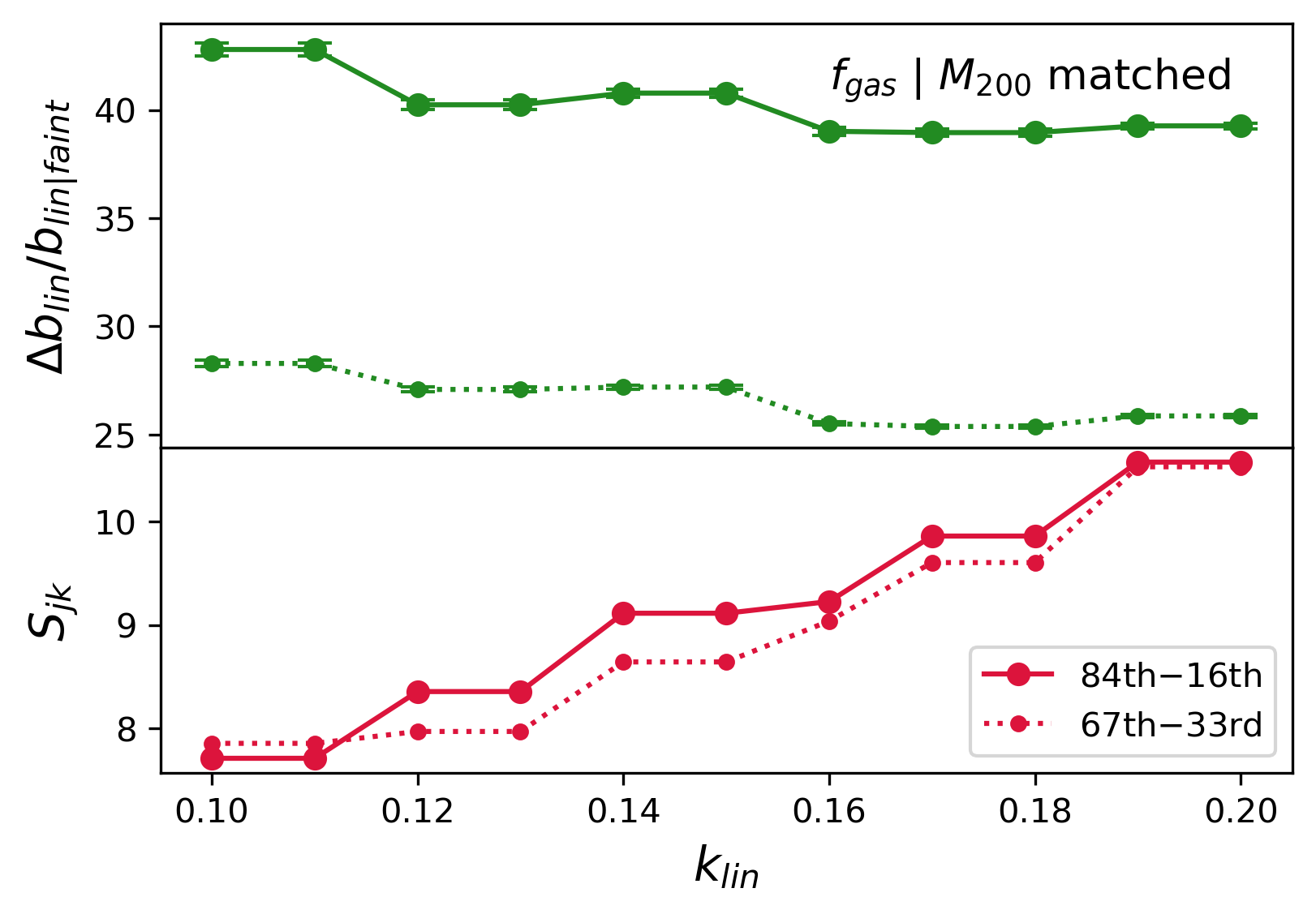
- The paper reveals that X-ray-bright groups and gas-rich halos exhibit up to 17–39% higher large-scale bias compared to their fainter counterparts.
- It employs the Magneticum hydrodynamical simulation with detailed X-ray luminosity and gas fraction modeling to assess assembly bias at group scales.
- The study finds that differences in halo formation times and baryon retention, influenced by AGN feedback, largely drive the observed clustering variations.
Baryonic Assembly Bias in X-ray-selected Groups and Clusters: Magneticum Simulation Insights
Introduction
The study addresses the secondary dependence of large-scale clustering (assembly bias) in galaxy groups and clusters on baryonic properties—specifically X-ray luminosity and gas fraction—at fixed halo mass, utilizing the Magneticum cosmological hydrodynamical simulations. The central motivation is to understand how non-gravitational physics, such as AGN feedback and gas accretion history, imprint on observable scaling relations and clustering, and thereby test the validity of using X-ray-selected samples for cosmological inference.
Simulation Framework and Methodology
Magneticum employs advanced SPH including metallicity-dependent cooling, chemical enrichment, and AGN feedback. The primary analysis uses the 352 h−1 cMpc "Box2/hr" volume, resolving down to 1012.5M⊙, and considers the X-ray luminosity and gas fraction of halos within R200. X-ray luminosities are computed via the PHOX pipeline using rest-frame $0.5-2.0$ keV emission from gas, with detailed modelling of element abundances and foreground absorption.
Halo samples are percentile-split in narrow bins of M200 based on LX or fgas, yielding mass-matched "X-ray-bright" and "X-ray-faint," as well as "gas-rich" and "gas-poor" samples. Clustering is quantified by the large-scale, scale-independent halo bias blin estimated from the halo-matter cross-power spectrum, with internal uncertainties from jackknife resampling. Additional splits by formation time (z50) are used to assess physical causality.
Clustering Dependence on X-ray Luminosity
Strong assembly bias is detected in the clustering of X-ray-selected halos. For the 84th--16th percentile split, X-ray-bright groups feature a Δblin=0.17±0.03 higher bias—1012.5M⊙017% enhancement over faint systems, at 1012.5M⊙1 significance. This effect is robust to subtler percentile thresholds.
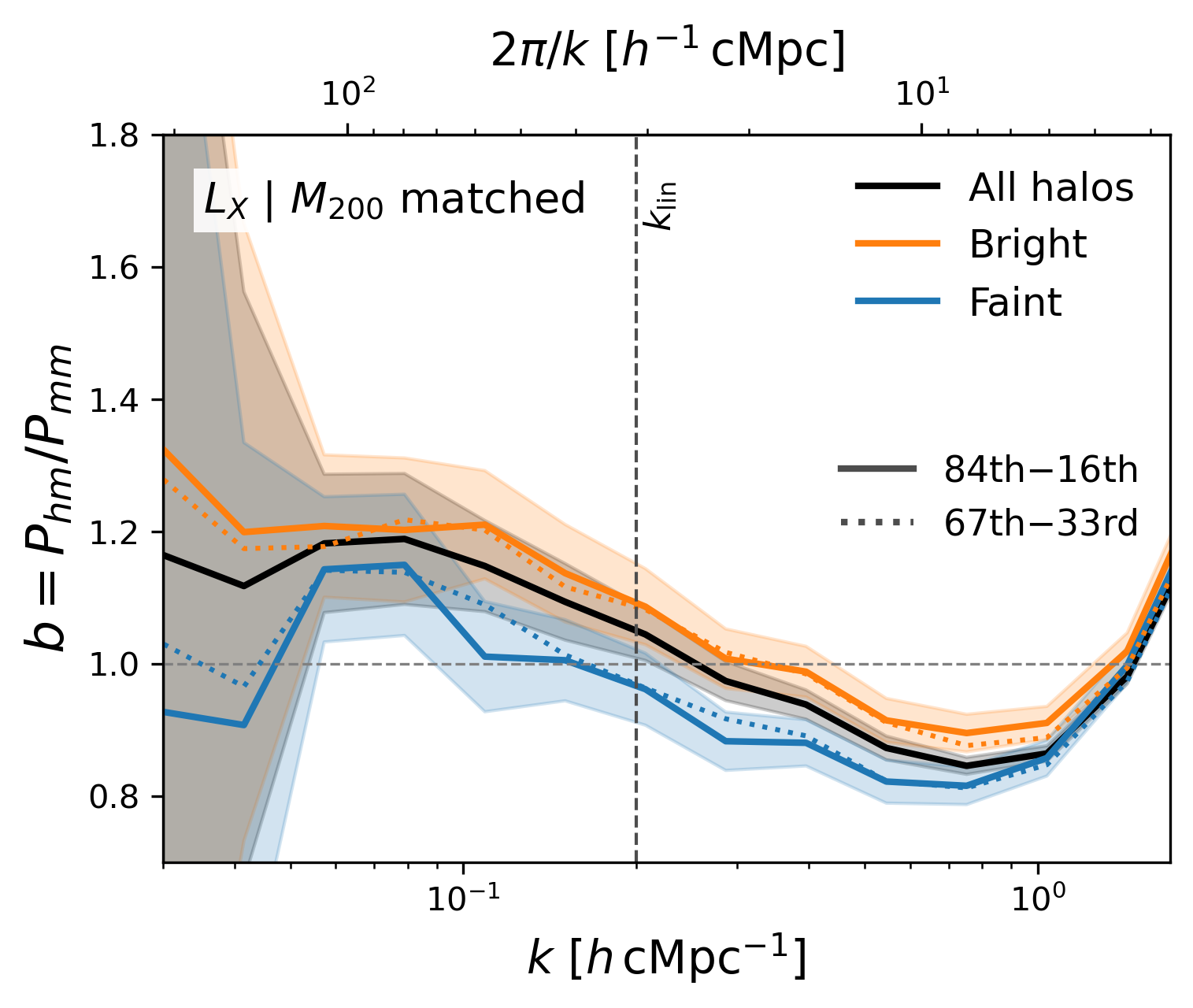
Figure 1: Scale-dependent bias for the full halo sample (black), and for X-ray-bright (orange) and X-ray-faint (blue) subsamples. A consistent, significant enhancement of bias is evident for X-ray-bright groups.
At fixed 1012.5M⊙2, the differential clustering is most pronounced in the 1012.5M⊙3 ("group") regime, with effects of order 10--30%. For more massive cluster halos, the effect becomes negligible. The enhanced bias of X-ray-bright systems persists across the full range of linear scales, indicating a genuine large-scale environmental signature. Comparison with standard halo bias calibrations [tinker_large-scale_2010] shows that X-ray-bright systems follow the baseline, while faint systems are systematically underbiased.
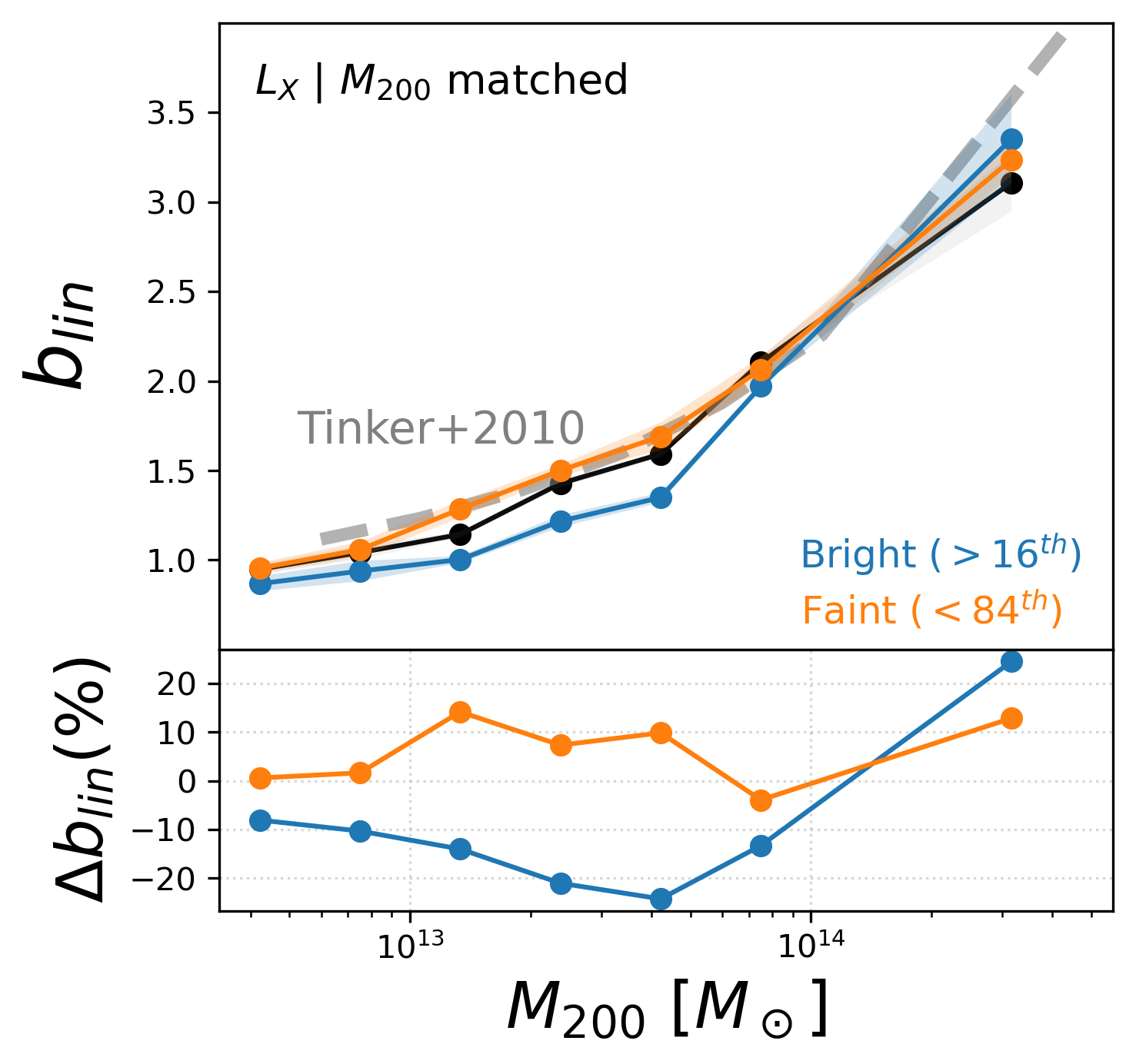
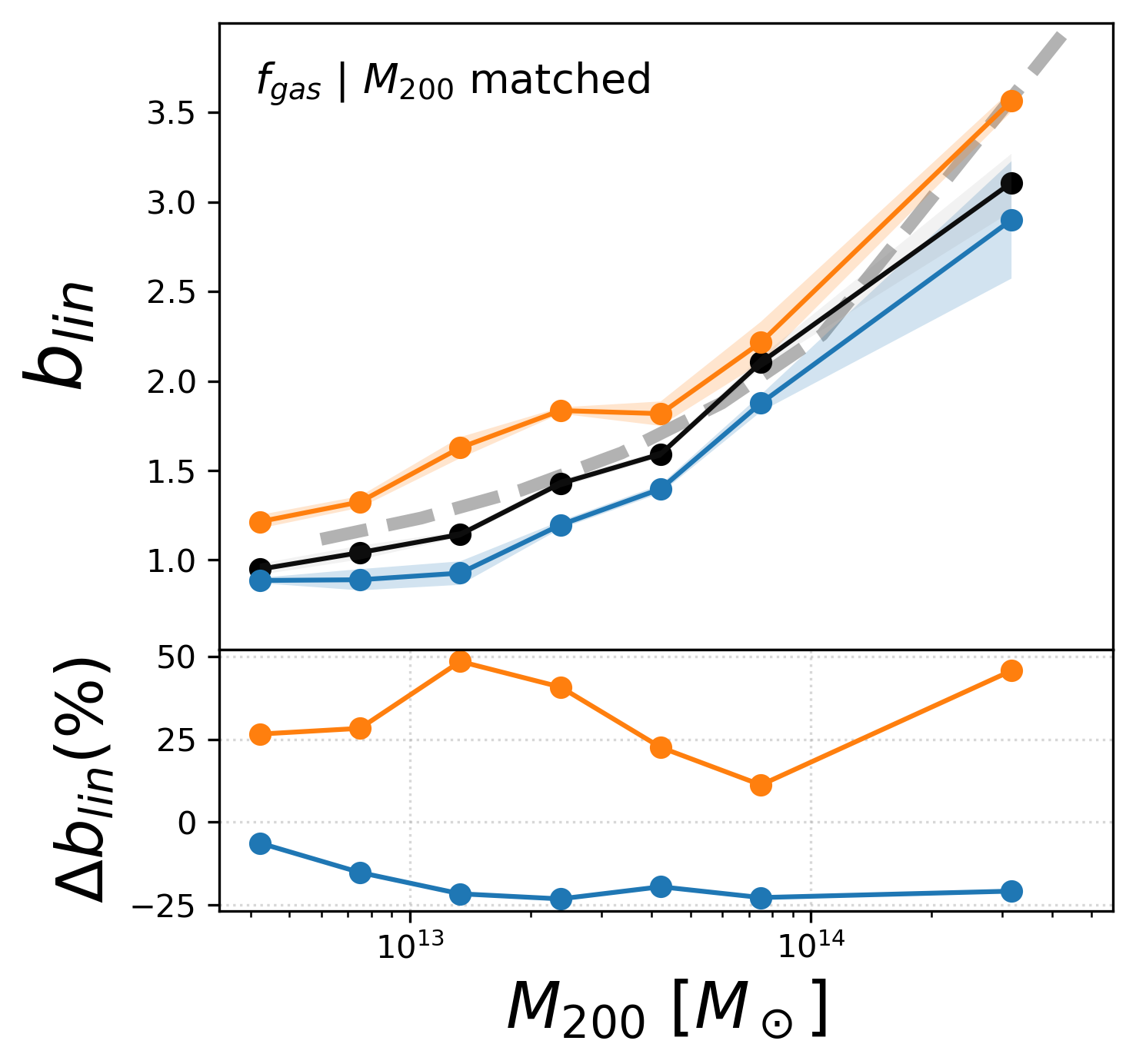
Figure 2: Mean halo bias as a function of 1012.5M⊙4, with X-ray-bright (orange) and faint (blue) halos revealing strong divergence at group masses.
Clustering Dependence on Gas Fraction
An even stronger assembly bias manifests when splitting by gas fraction. Gas-rich halos display a 1012.5M⊙539% higher large-scale bias (1012.5M⊙6 at 84th--16th percentile), with high statistical significance (1012.5M⊙7). This enhancement dominates at group scales, implying that baryon retention—more so than thermodynamic state—directly correlates with large-scale environment.
Figure 2: (Panel b) shows the clustering separation for gas fraction-selected samples, illustrating the stronger signal versus the X-ray-luminosity split.
Redshift Evolution of the Signal
The gas-fraction-dependent clustering enhancement is established by 1012.5M⊙8 and remains stable to 1012.5M⊙9, indicating an early and persistent link between baryon retention and environment. In contrast, the R2000-dependent assembly bias emerges appreciably only at R2001, reflecting the delayed coupling of thermodynamic state with halo assembly history.
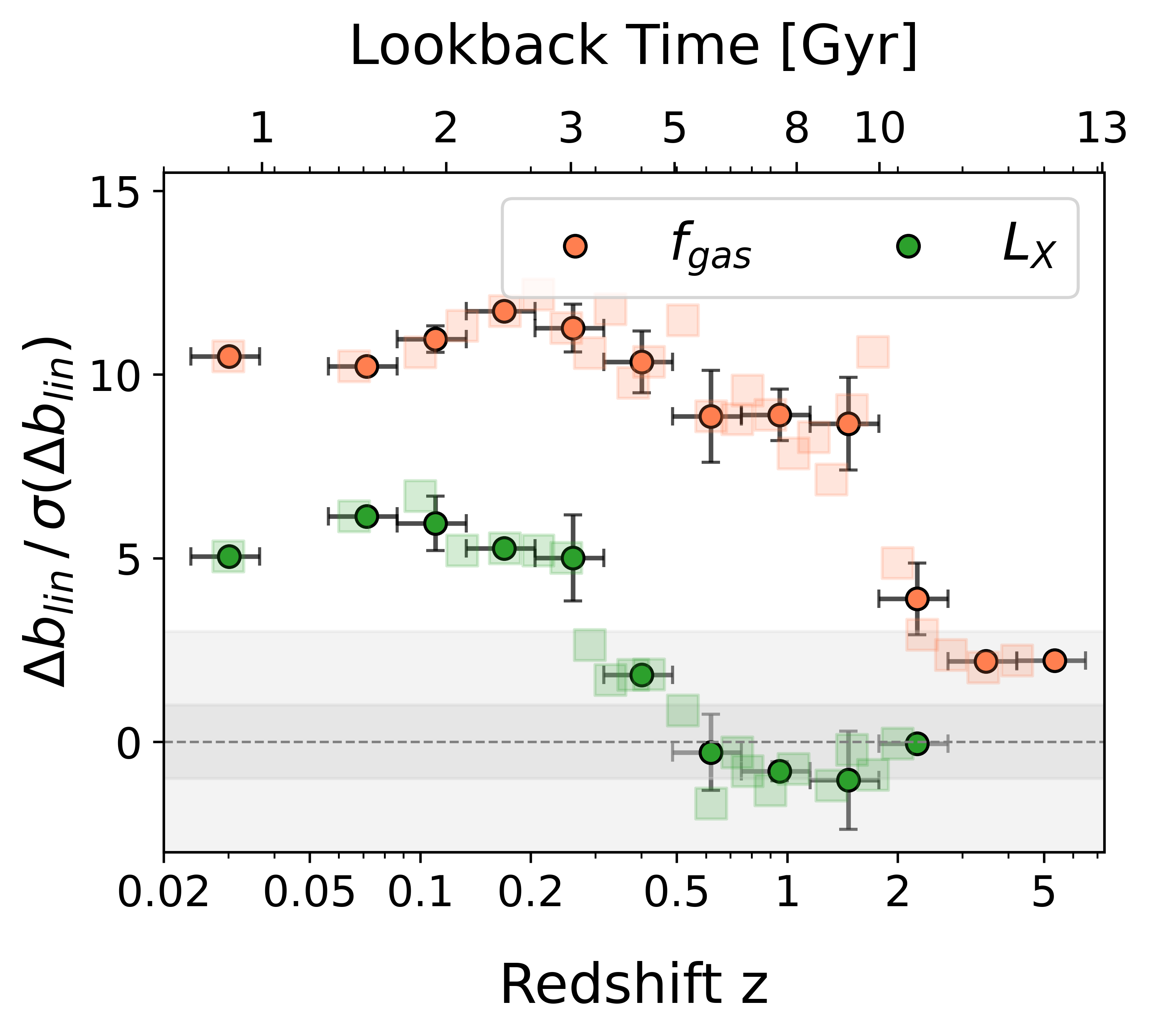
Figure 3: Significance of large-scale bias as a function of redshift. Clustering difference by gas fraction is persistent, whereas X-ray luminosity-dependent bias rises sharply at late epochs.
These findings imply that while baryonic assembly bias is set early via gas accretion, X-ray luminosity becomes a reliable tracer only after halos reach a mature thermodynamic state.
When simultaneously matching halos by both mass and formation time, the large-scale bias differences in R2002 and R2003 sub-samples drop below R2004. This demonstrates that in Magneticum, assembly bias in X-ray and gas properties can largely be attributed to differences in halo formation epoch, with residuals at small (nonlinear) scales possibly due to variations in recent accretion, concentration, or feedback efficiency.
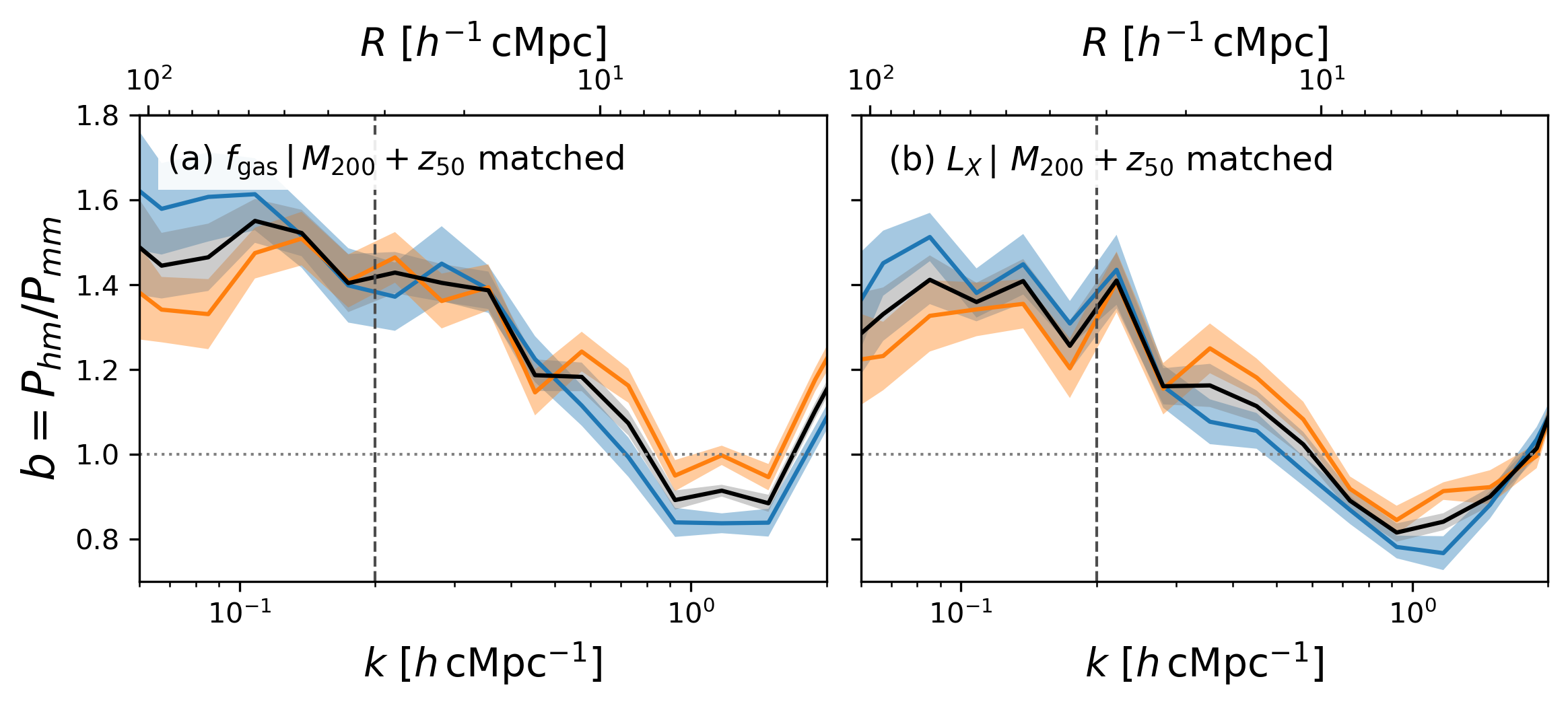
Figure 4: Scale-dependent bias for samples split by mass and formation time, showing substantial suppression of the assembly bias signal.
Physical Interpretation
The secondary clustering dependence of X-ray luminosity and gas content on large-scale environment arises from the co-evolution of baryon retention, AGN feedback, and assembly history. At high R2005, rapid accretion renders R2006 sensitive to environment, but R2007 remains a poor proxy until the ICM becomes both sufficiently hot and dense. At low R2008, AGN feedback and reduced infall tightly couple R2009 to assembly history.
Group-scale halos are most sensitive to these processes—AGN feedback efficiently expels gas, making $0.5-2.0$0 and $0.5-2.0$1 strongly environment-dependent, in contrast to more massive clusters where deeper potentials moderate baryonic effects and subgrid physics become less differentiating [dolag_encyclopedia_2025, marini_impact_2025].
Observational and Cosmological Implications
These results have several practical and theoretical implications:
Conclusion
The Magneticum simulation demonstrates that baryonic assembly bias, manifested primarily through gas content, and secondarily through X-ray luminosity, is a significant feature of group-scale halos. This secondary dependence of clustering is driven by differences in assembly history, as encoded in formation time, and modulated by AGN feedback and gas accretion efficiency. The enhanced bias is most significant for groups, persists over cosmic time for gas fraction, and emerges late for X-ray luminosity. These findings must be quantitatively integrated into survey modeling and cosmological analyses of X-ray and tSZ-selected group and cluster samples. Future simulation–observation synergy, using robust forward-modelled selection functions, will be paramount for precision cosmology using the large-scale structure traced by baryonic properties.
References
- Marini et al., "Baryonic assembly bias in X-ray-selected galaxy groups and clusters: insights from the Magneticum simulation," (2607.03746)
- Tinker et al., "The Large-scale Bias of Dark Matter Halos," [tinker_large-scale_2010]
- Dolag et al., "Encyclopedia Magneticum," [dolag_encyclopedia_2025]
- Marini et al., "The impact of assembly history on the X-ray detectability of halos," [marini_impact_2025]
- Costello et al., "FLAMINGO: Tracing the co-evolution of hot gas and black holes," [costello_flamingo_2025]
- Cui et al., "Hyenas: the assembly and evolution of galaxy groups," [cui_hyenas_2024]
- Grandis et al., "The SRG/eROSITA All-Sky Survey: Dark Energy Survey year 3 weak gravitational lensing," [grandis_srgerosita_2024]
- Popesso et al., "The hot gas mass fraction in halos. From Milky Way-like groups to massive clusters," [popesso_hot_2024]
- Van Daalen et al., "The effects of galaxy formation on the matter power spectrum," [van_daalen_effects_2011]
This essay provides a technical overview, highlights quantitative results and claims, and contextualizes the work within simulation and cosmological survey applications, with figures integrated at key points for clarity.