- The paper presents a modular framework that diagnoses conversational breakdowns and selects targeted interventions for enhanced multi-user collaboration.
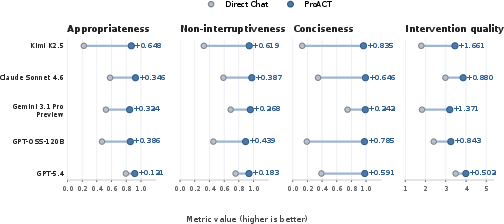
- Experimental results show substantial gains in appropriateness, non-interruptiveness, and conciseness across various LLM backbones compared to a Direct Chat baseline.
- The work discusses both the practical improvements in group productivity and the potential risks of altering social dynamics through proactive AI interventions.
ProACT: Breakdown-Aware Proactive LLM Agents for Multi-User Collaboration
Motivation and Scope
Traditional LLM-based conversational agents in collaborative environments are predominantly passive—they only respond to direct user queries, lacking initiative in group problem solving. This passivity introduces limitations in multi-user contexts marked by evolving goals, ambiguous intent attribution, and frequent, subtle breakdowns in collaboration. The paper "ProACT: Towards Breakdown-Aware Proactive Agent in Multi-User Collaboration" (2607.03730) formulates and addresses the core challenge of transforming LLM-based agents from reactive assistants to proactive, contextually aware participants in group collaborations.
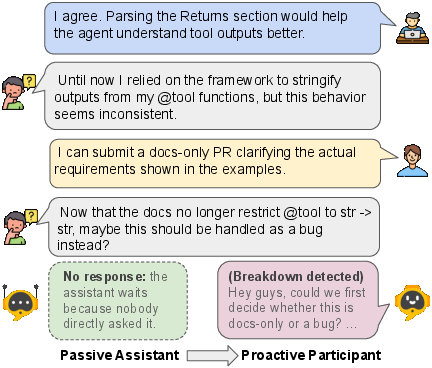
Figure 1: Agent role transition from passive assistance to proactive multi-user collaboration participation.
ProACT Framework Architecture
ProACT is a modular decision pipeline, grounded in collaborative planning, common ground dynamics, and coordination work theories. Its operation proceeds in three tightly coupled stages:
- Breakdown Diagnosis: At each conversational turn, ProACT analyzes the speaker-attributed dialogue history, identifying if a breakdown (such as conflict, uncertainty, underspecification, or participation imbalance) is obstructing progress.
- Intervention Decision: ProACT applies normative constraints to determine whether to remain silent or intervene. Silence is favored when human-initiated repair is ongoing, the issue is low-stakes, or agent interjection would be redundant or disruptive.
- Skill-Guided Action Selection: When intervention is justified, ProACT routes the diagnosed breakdown to a targeted “skill” module. Skills are lightweight protocolized routines such as clarification requests, conflict mediation, constraint reminders, loop-breaking, and participation balancing. Each skill defines explicit trigger conditions, diagnostic cues, response format, and social constraints to ensure a concise and context-grounded intervention.
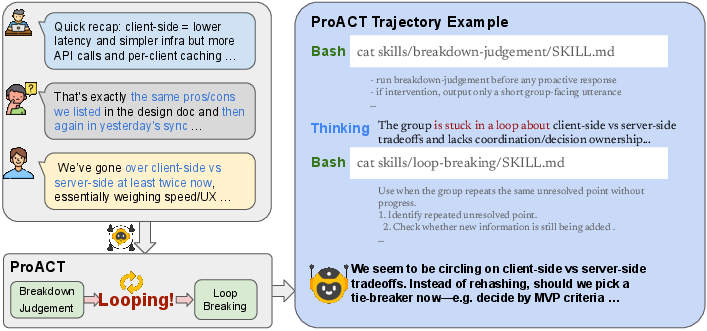
Figure 2: ProACT trajectory example showing loop detection and targeted intervention.
Proactive Collaboration Evaluation Benchmark
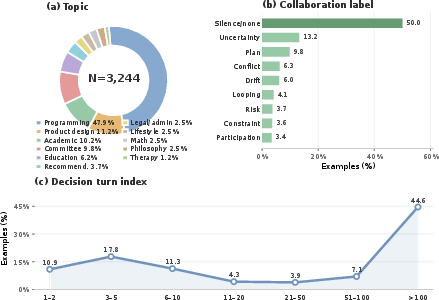
The authors introduce the first benchmark for proactive multi-user collaboration agent evaluation, constructed from real GitHub issues, group meeting transcripts, and synthetic BEAM-derived scenarios. The dataset comprises 3,244 turn-level decision points, covering a diverse range of settings including project planning, logistics, consensus formation, and education.
The benchmark's central evaluation targets not only whether an agent intervenes, but also the appropriateness, timing, conciseness, and quality of such interventions, using four metrics:
Experimental Evaluation and Results
Experiments involved five LLM backbones: GPT-5.4, Kimi K2.5, Claude Sonnet 4.6, Gemini 3.1 Pro Preview, and GPT-OSS-120B. ProACT was compared against a Direct Chat baseline, in which the agent always responds without contextual breakdown awareness.
Key results:
Further, ProACT demonstrated a marked reduction in unnecessary responses, favoring silence when the group was progressing autonomously. On turns labeled as silence in ground-truth, ProACT responded only 39.3% of the time versus 100% for Direct Chat, which directly increased appropriateness from 65.2% to 89.6% for GPT-5.4.
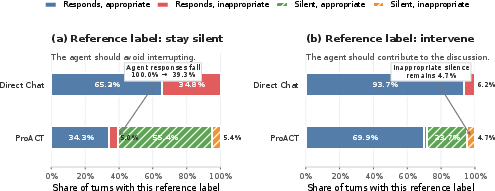
Figure 5: Participation timing breakdown—ProACT substantially reduces unnecessary utterances.
Qualitative error analysis revealed that most “misses” were conservative abstentions made when the system judged that the human group was self-repairing, although a small fraction (4.7%) of missed interventions coincided with genuinely unresolved coordination failures.
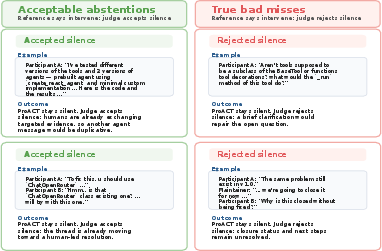
Figure 6: Selected examples where ProACT abstained; many are judged as contextually justified silences.
Topic- and turn-wise breakdowns indicate that quality improvement is particularly significant in social planning and later-stage conversations (e.g., committees: +1.33, academic collab: +1.24 on quality score), and that quality gains accumulate with longer multi-turn context.
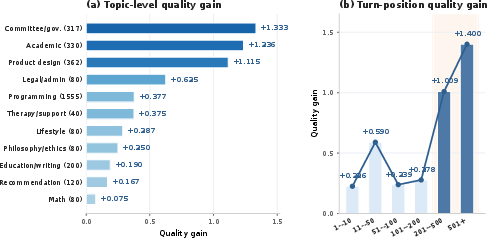
Figure 7: GPT-5.4 intervention quality improvement by topic and conversation stage.
Theoretical and Practical Implications
This work demonstrates that fine-grained, interactionally-aware decision-making—operationalized via structured breakdown detection and skill routing—substantially elevates agent contribution in multi-user settings. Key theoretical implications include:
- Separation of action timing and content: Fine-grained diagnosis not only ensures the agent's “what to say” is collaborative but equally vital is the “when to say” decision.
- Modularity and extensibility: Decomposition into explicit skill modules enables targeted future expansion for new collaborative phenomena and downstream applications.
- Potential for group-level influence and new social dynamics: By altering agent participation patterns, ProACT can affect group flow, trust, and consensus formation, demanding further study in live deployments.
Practical implications are broad. ProACT is likely to improve group productivity and coordination efficiency in high-stakes project management, collaborative design, and mediated decision-making, where inappropriate or mistimed LLM interventions risk undermining human agency and group process. The framework's modularity makes it adaptable for deployment in conversational tools, collaborative IDEs, and enterprise communication platforms.
However, the authors highlight critical risks: inappropriate agent assertiveness may gradually shift social power, alter deliberative patterns, or even facilitate manipulative group steering if misaligned. These observations suggest future research on agent transparency, user contestability, and robust monitoring in organizational and high-stakes societal contexts.
Conclusion
ProACT sets a new direction for LLM-based agents in collaborative multi-user settings, offering a principled, modular, and empirically validated approach to proactive participation. The decomposition of intervention timing and skill-based action selection results in agents that are less intrusive, contextually appropriate, and substantially more effective at supporting group progress. This work lays a foundation for the next generation of collaborative AI, with wide-ranging implications for digital facilitators, group support systems, and human-AI co-creation environments (2607.03730).