- The paper introduces a novel framework using Lipschitz neural networks to learn robust Control Lyapunov Functions and stabilize nonlinear systems under disturbances.
- It leverages high-order Taylor-based branch-and-bound algorithms for formal verification, drastically reducing verification time and scaling to deeper networks.
- Empirical results demonstrate significantly larger certified invariant regions and improved closed-loop performance compared to traditional methods like LQR.
Learning Robust Control Lyapunov Functions through Lipschitz Neural Networks
Overview
The paper "Learning Robust Control Lyapunov Functions through Lipschitz Neural Networks" (2607.03713) develops a framework for the synthesis and verification of robust Control Lyapunov Functions (RCLFs) and stabilizing controllers for continuous-time nonlinear systems subjected to state-dependent bounded disturbances. The central innovation is the deployment of Lipschitz Neural Networks (LNNs) to parameterize both the Lyapunov function and the controller, leveraging analyzable bounds on higher-order derivatives for tractable, GPU-accelerated verification via a high-order branch-and-bound (BnB) algorithm. This approach enables rigorous formal certification of nonlinear stability properties with significantly improved computational efficiency and scalability relative to prior methods.
Robust Control Lyapunov Functions
The system under consideration is
x˙=f(x,u)+Gd(t,x)
with x∈X⊂Rnx, u∈U⊂Rnu, and additive disturbance d(t,x) bounded as ∥d(t,x)∥2≤ϵ(x) where ϵ is Lipschitz in x. The goal is to learn a state-feedback controller π(x) using neural function approximators that guarantees robust stabilization—ensuring forward invariance and uniform ultimate boundedness (UUB) of the closed-loop state.
A neural RCLF Vθ1 and controller πθ2 are jointly optimized to satisfy discrete relaxations of the following:
- Positive Definiteness: x∈X⊂Rnx0 for x∈X⊂Rnx1.
- Decrease Condition: x∈X⊂Rnx2 for x∈X⊂Rnx3 uniformly across all admissible disturbances.
- Inclusion of Ball: Guaranteeing x∈X⊂Rnx4 for some radius x∈X⊂Rnx5.
The loss function promotes satisfaction of these properties across sample batches. Notably, the training leverages LNNs with prescribed Lipschitz constants, regularizing the networks and facilitating analytical derivative bounds. Post-training, the attainably largest certified forward-invariant region is identified.
Lipschitz Neural Networks and Hessian/Third-Order Bounds
The LNN architecture ensures a global Lipschitz bound via spectral normalization, orthogonal, or sandwich layers (see [miyato2018spectral], [trockman2021orthogonalizing], [wang2023direct]). Critically, the paper derives explicit, layer-wise computable spectral norm upper-bounds for the Jacobian, Hessian, and third-order derivatives of the LNNs.
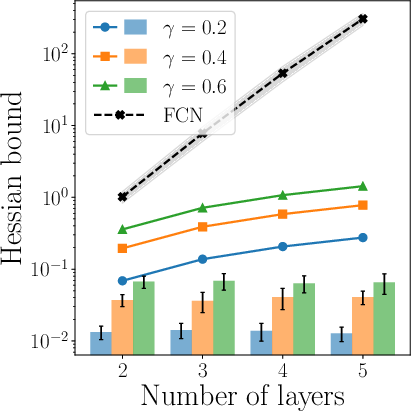
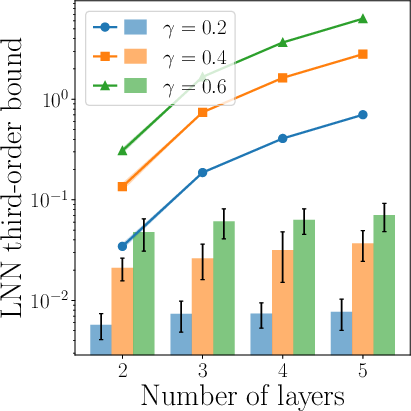
Figure 1: Spectral norm upper bounds for the Hessian of LNNs versus unconstrained fully connected networks, demonstrating improved scaling with network depth.
This analytic tractability enables the subsequent use of high-order Taylor expansions for rigorous bound propagation within verification.
High-Order Branch-and-Bound Verification
The principal technical advance is the high-order (up to third-order) Taylor-based BnB verification scheme. For any target certificate property, such as x∈X⊂Rnx6 or x∈X⊂Rnx7, the state domain is recursively partitioned, and high-order Taylor bounds (using global Hessian and third-order spectral norm bounds, with closed-form layer-wise aggregation) are used to efficiently prune infeasible regions. The algorithm is implemented to leverage batch evaluation on GPUs for maximal scalability.
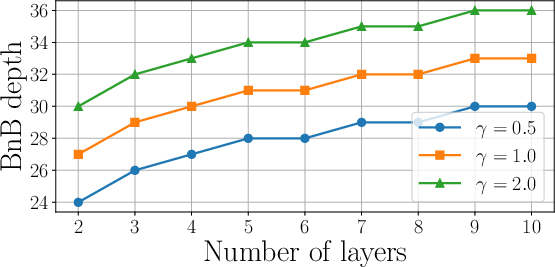
Figure 2: Growth of BnB tree depth with respect to network depth and Lipschitz constant, illustrating the impact of high-order bounds on tractability.
Compared to CPU-based SMT tools (e.g., dReal) or linear/MILP-based neural verification, the high-order BnB approach drastically accelerates certification, particularly for deeper networks and higher-dimensional systems.
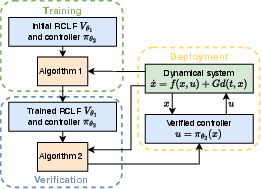
Figure 3: Full control design workflow—joint training, formal verification, and deployment—illustrating the integration of LNNs and GPU-parallelized BnB.
Empirical Results
Comprehensive experiments are conducted on six nonlinear systems: inverted pendulum, unicycle path following, third-order system, cartpole, 2D quadrotor, and SCARA arm. The policy/CLF networks use LNNs with explicit Lipschitz constraints. The key metrics are the volume of the verified forward-invariant region, verification time, and closed-loop performance.
The framework achieves:
- Order-of-magnitude reduction in verification time compared to dReal and bound-propagation tools (see Table 1 in the paper).
- Certification for larger/deeper networks and higher state dimensions than previously feasible.
- Strictly superior verified region sizes and improved closed-loop performance compared to LQR and prior neural CLF baselines.
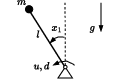
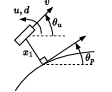
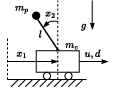
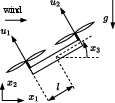
Figure 4: Inverted pendulum example—learned x∈X⊂Rnx8 level sets and comparison of certified regions from different methods.
Numerical Findings and Robust Claims
A representative selection of strong claims and numerical results includes:
- GPU-based BnB algorithm achieves at least an order-of-magnitude speedup (3–4 orders in large systems) over CPU-based SMT (dReal) and x∈X⊂Rnx9-u∈U⊂Rnu0-CROWN verifiers, enabling verification of LNNs with up to 8 states in minutes (see Table 1).
- The high-order bounds alleviate the intractability of zeroth-order interval methods: For SCARA arm (u∈U⊂Rnu1), positive definiteness is verified in u∈U⊂Rnu2150s (GPU), while the zeroth-order interval baseline (no high-order terms) fails after u∈U⊂Rnu312 hours.
- Certified invariant region sizes are substantially larger: Across all evaluated systems, the RCLF approach certifies forward-invariant regions at least 2–10u∈U⊂Rnu4 larger (relative to state-space volume) than those produced by LQR or prior neural CLF methods.
Theoretical Implications and Extensions
By leveraging LNNs' controllable Lipschitz constants, the approach sidesteps the over-conservatism of existing neural verification (which cannot exploit derivative information) and substantially extends the landscape of nonlinear systems admitting rigorous, data-driven Lyapunov certification. The architecture also allows for straightforward scaling of RCLF outputs to match desired Lipschitz constraints, without loss of generality. The mathematical characterization of the Hessian and third-order bounds is analytic and global (layer-wise), further generalizable to parametric and structured uncertainties.
A significant caveat—directly acknowledged—is the exponential scaling of BnB with state dimension; while mitigated via high-order bounds and parallelization, formal certification of ultra-high-dimensional, large-scale systems remains an open challenge.
Future Directions
Key avenues for future research include:
- Advancing dimension-reduction techniques and leveraging decentralized/decomposable system structure to mitigate curse-of-dimensionality in verification.
- Extending the high-order BnB methodology to additional properties (e.g., input-to-state robustness, safety sets) and alternative function classes, such as bi-Lipschitz architectures.
- Integrating uncertainty quantification from machine learning-based system identification directly into the certified control loop.
Conclusion
The presented framework establishes a tractable, formally certifiable pipeline for data-driven robust CLF and feedback synthesis on nonlinear systems, grounded in the analytic properties of LNNs and GPU-parallelized high-order verification. The results demonstrate marked computational and functional gains over prior methodologies and chart a clear path toward scalable, trustworthy neural control design in the presence of structured uncertainty and disturbances.