- The paper presents a novel graph-augmented framework that integrates LLM-driven planning with topology-aware pruning to generate coherent related work sections.
- Its multi-stage process employs thematic clustering, chain-of-thought extraction, and argument-counterargument planning to accurately model complex inter-paper relationships.
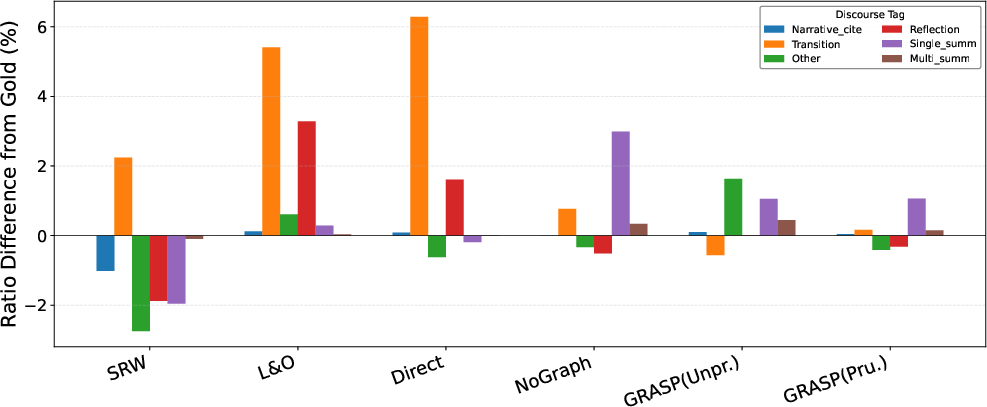
- Empirical results demonstrate superior discourse fidelity and citation modeling, setting a new benchmark for automated survey generation.
Introduction and Motivation
"GRASP: Graph-Reasoning Aided Survey Planning for High-Fidelity Related Work Generation" (2607.03709) addresses the persistent challenges in automating related work section (RWS) generation by proposing a graph-augmented framework that incorporates both fine-grained and global reasoning about inter-paper relationships. The exponential growth of scientific literature, coupled with increasing document complexity and field specialization, amplifies the need for automation in literature review synthesis. While prior works leverage LLMs for extracting or generating paper summaries, they fail to maintain coherence and capture intricate paper-to-paper relationships critical for high-quality scholarly context. GRASP remedies these limitations by tightly integrating graph-based methods with LLM planning to explicitly model and utilize the rich relationships among cited works.
GRASP Framework Overview
GRASP introduces a multi-stage, graph-centric pipeline that structures and leverages both intra- and inter-paper relationships in producing fluent, high-fidelity RWS.
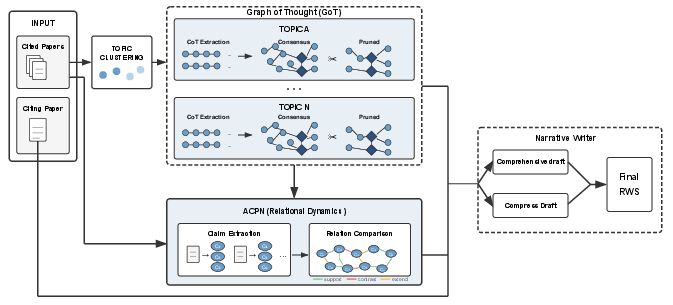
Figure 1: The GRASP pipeline from cited paper partitioning, through Chain of Thought extraction, consensus Graph of Thoughts (GoT) construction and pruning, to Argument-Counterargument Planning Network (ACPN)-guided RWS generation.
Initially, cited papers are partitioned into thematic clusters using LLM-driven clustering. For each cluster, chain-of-thought (CoT) extraction identifies the sequential reasoning steps underlying each paper’s core contributions, which are used to construct topic-specific graphs. Inter-paper consensus is captured by node merging, producing cross-paper consensus nodes where semantically similar ideas exist. The resulting Graph of Thoughts (GoT) encodes both sequential and consensus relationships. To combat graph noise and redundancy, GoT is pruned using a Steiner Tree-based criterion, ensuring the preservation of only high-centrality and consensus relationships critical for summary-level synthesis.
At a higher semantic level, the Argument-Counterargument Planning Network (ACPN) is instantiated as a directed graph whose edges capture argumentative relations (support, contrast, neutral) between each paper pair, based on extracted core claims and GoT content overlap. ACPN allows the system to explicitly surface contrasts, agreements, or neutral stances among cited works.
The RWS Writer module combines these two graph layers, serializes graph structures, and orchestrates a multi-step drafting process (comprehensive, compressed, and final), which preserves graph fidelity, removes redundancy, and ensures fluent academic prose.
Graph of Thoughts Construction and Pruning
GRASP’s GoT layer draws on recent advancements in LLM-driven CoT extraction but extends beyond local reasoning by merging nodes across papers that express semantically overlapping contributions, experiments, or findings (Figure 2).
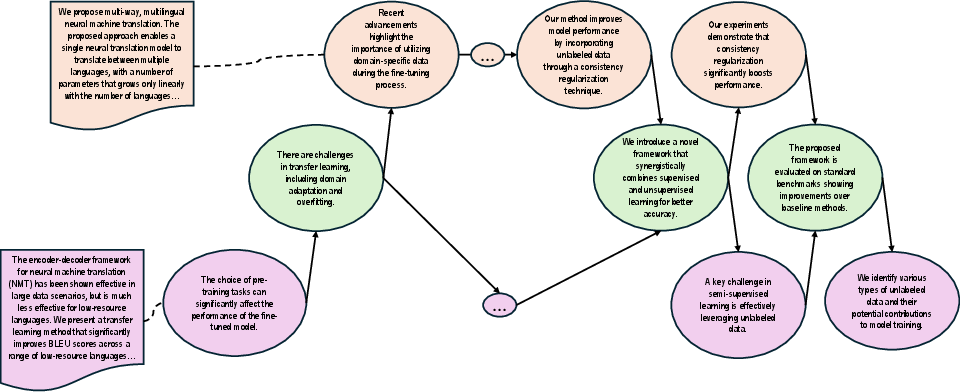
Figure 2: GoT excerpt illustrating node merging across neural machine translation papers, where consensus nodes explicitly summarize shared methodologies.
Topic partitioning of cited papers ensures scalability and maintains discourse cohesion when handling large bibliographies. Consensus node merging aggressively identifies even loosely overlapping ideas, yielding a graph with both intra-paper sequential edges and multi-paper consensus edges.
The raw GoT contains surplus detail inappropriate for high-level literature overview. Application of topology-aware pruning, formulated as an approximation to the Steiner Tree problem, ensures that only nodes critical for connecting consensus and high-centrality (by betweenness) nodes are retained. Empirically, this step is crucial for removing paper-specific minutiae, ensuring the downstream Writer yields concise, synthesis-oriented RWS rather than verbose, concatenated summaries.
Argument-Counterargument Planning and Relation Modeling
The ACPN layer abstracts beyond the GoT’s fine-grained content. First, LLMs extract core claims from each paper (distinct from section-level CoT steps), constituting the paper’s contributional backbone. Paper pairs are then classified (via both claims and structural GoT evidence) into support, contrast, or neutral relations. These argument graphs guide rhetorical moves in the RWS: drawing explicit attention to supporting evidence chains, surfacing competing methodologies, or organizing groups of neutral or background works.
By decoupling intra-paper content modeling (GoT) from inter-paper argumentative structure (ACPN), GRASP enables a Writer LLM to generate transition-rich, discourse-balanced related work that reflects both the thematic topology and argumentative landscape of prior literature.
RWS Writer and Text Generation Strategy
The Writer module serializes both graphs and guides the LLM through a three-step process:
- Comprehensive draft: Exhaustively covers all GoT nodes and ACPN relationships to maximize information coverage.
- Semantic compression: Collapses redundancy, compresses structure, and optimizes for information density.
- Final merging: Synthesizes the precision and coverage of earlier drafts, yielding fluent, balanced, and structurally faithful output.
Normalization and verification steps post-process citations to ensure academic formatting and mitigate hallucinated references.
Evaluation and Results
GRASP is evaluated on the OARelatedWork dataset (1,350 target papers with available cited texts), with baselines including citation feature-based, multi-agent reading, and direct LLM generation approaches. Evaluation emphasizes citation-oriented and discourse-aware metrics: discourse role ratio, per-citation dominant/reference status, citation intent (using MultiCite), and citation grouping and ordering (edge Jaccard, Kendall’s τ).
Key empirical findings:
Implications and Future Directions
Practically, GRASP establishes a formal methodology for high-fidelity, structure-aware related work automation suitable for augmenting literature review workflows, survey-article drafting, and citation recommendation systems. Theoretically, the work makes explicit the importance of dual-layered graph modeling—fine-grained GoT for content, coarse-grained ACPN for argument structure—in meeting community expectations for scholarly synthesis.
GRASP’s techniques, especially aggressive cross-paper node merging and Steiner-tree topology pruning, transfer directly to related multi-document tasks (e.g., survey generation, review recommendation) and offer an approach for scaling LLM planning beyond context-window constraints. The explicit argumentative relation modeling has implications for citation analysis, scholarly discourse parsing, and knowledge graph construction.
Future avenues include:
- Scalability to settings with incomplete or non-standardized cited paper corpora (e.g., partial PDFs, preprints).
- Integration of more robust semantic similarity/entailment models for node merging to further enrich GoT consensus representations.
- Relaxation of hard topic partitioning toward soft or overlapping clusters.
- Dynamic user-guided RWS construction, supporting interactive refinement or custom discourse balance.
Conclusion
GRASP achieves high-fidelity, concise, and discourse-structured related work generation by leveraging a two-layer graph formalism coupled with LLM planning. It yields strong improvements over baselines in discourse adherence, citation modeling, and textual quality, validating the integration of combinatorial graph algorithms and neural generation strategies for scientific multi-document synthesis. The approach sets a technical precedent for structure-aware, semantically nuanced automation of scholarly writing tasks.