- The paper presents a rigorous many-body analysis demonstrating that triplet-triplet multiexciton states are quantum superpositions rather than localized exciton pairs.
- It employs the PPP Hamiltonian and MRSDCI to accurately capture higher-order electron correlations and elucidate the intricate configuration mixing in acene oligomers.
- The findings imply that effective intrachain triplet separation is hindered, emphasizing the need for intermolecular design strategies in next-generation optoelectronic devices.
Introduction and Physical Context
This paper provides a comprehensive many-body correlated-electron analysis of triplet-triplet (1(T1T1)) multiexciton states in polypentacene (PPc) and finite pentacene oligomers, focusing on the conceptual framework required to understand singlet fission (SF) and triplet separation in conjugated acenes. Traditional interpretations of SF in acene oligomers have relied on the notion that strongly bound, localized 1(T1T1) pairs inhibit intramolecular triplet diffusion, potentially limiting yield in photovoltaic and optoelectronic applications. This work challenges that paradigm by demonstrating that all multiexciton states in PPc and its oligomers should be regarded as quantum superpositions of many configurations, not localized pairs, and develops the rigorous microscopic framework required to describe these correlated states.
Theoretical and Computational Framework
The authors employ the Pariser-Parr-Pople (PPP) Hamiltonian, a semi-empirical π-electron model including long-range Coulomb interactions and transferable hopping parameters, to treat the electronic structure of acene oligomers. The electronic wavefunctions are obtained via multiple-reference singles and doubles configuration interaction (MRSDCI), which systematically incorporates higher-order electron correlations up to quadruple excitations and guarantees an accurate account of strong correlation effects in large π-conjugated molecules. The use of a molecular exciton basis—Frenkel, inter-monomer charge-transfer, and triplet-pair (1(T1T10)) configurations—enables direct visualization and analysis of delocalized and mixed-excitation character in the computed eigenstates.
Quantum Superposition Nature of 11(T12T13) States
A principal finding of the work is the absence of eigenstates corresponding to a single localized triplet pair at any specific intermonomer separation. Instead, all 14(T15T16) eigenstates are quantum mechanical superpositions of configurations spanning all possible intertriplet distances. This is in direct contradiction to earlier assumptions that the triplet pair can be meaningfully regarded as a well-bound, localized object.
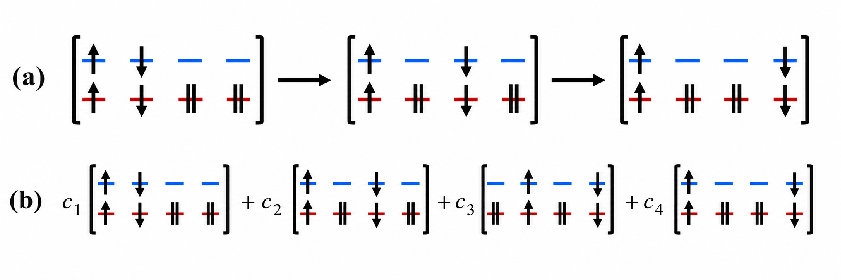
Figure 1: Schematics contrasting localized and quantum-superposed conceptualizations of the 17(T18T19) eigenstates in a tetrapentacene chain.
This superposition leads to a quasi-degenerate manifold of 10(T11T12) states—13C14 in number for an 15-mer—lying narrowly spaced in energy around, or just below, the lowest optical S16 excitons. The energy spacings between these multiexciton states are extremely small, rendering any notion of a "binding energy" for the triplet pair physically meaningless in this context.
Microscopic Origin and Characterization of Excited States
The authors' analysis of ground-state absorption spectra in 3Pc and 4Pc elucidates the composition of optically accessible singlet excited states (S17–S18), each dominated by distinct classes of many-electron exciton configurations. The lowest-energy absorptions (S19) are predominantly Frenkel states with weak intermonomer charge transfer, while higher bands (S10–S11) have increasing charge-transfer and multi-monomer character.
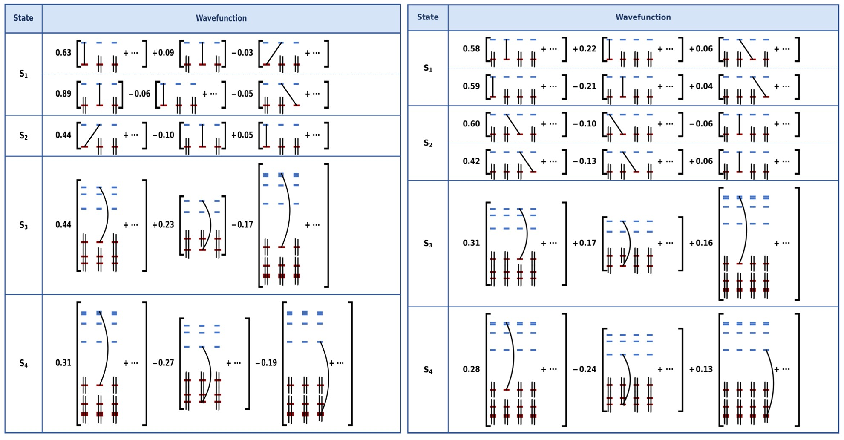
Figure 2: Normalized exciton basis wavefunctions for ground-state absorption final states in 3Pc (left) and 4Pc (right), highlighting the degree of delocalization and configuration mixing.
For the 12(T13T14) sector, detailed wavefunction analysis shows that each eigenstate is a coherent superposition, with the relative contributions from different triplet-separation configurations dictated by symmetry and oligomer geometry, but no state consists purely of a "maximally separated" (or localized) triplet pair.
Reinterpretation of Transient Absorption and Triplet Binding
The persistent transient absorption (TA) features near 710 nm, commonly attributed to nearest-neighbor triplet-pair absorptions and interpreted as evidence for large triplet binding energies, arise instead from the significant nearest-neighbor configuration amplitude present in all 15(T16T17) eigenstates due to their delocalized superposition character. Thus, the observed plateau in TA intensity as a function of chain length does not indicate a strong binding that precludes triplet diffusion but is a natural consequence of the correlated electronic structure.
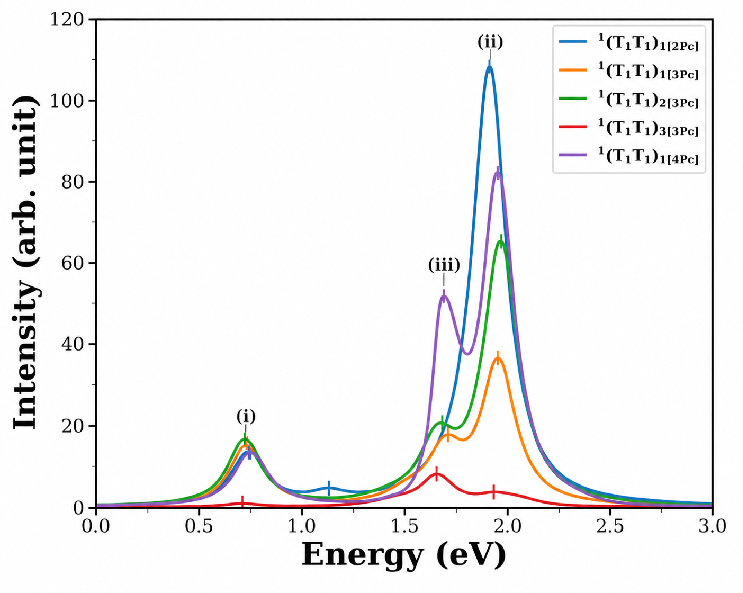
Figure 3: Calculated ESA spectra from triplet-pair eigenstates, showing that peaks due to nearest-neighbor configuration persist with increasing chain length.
Moreover, the computations predict that even in the long-chain (polymer) limit, the relevant 18(T19T10) states remain energetically and compositionally similar to those found in oligomers (11); this is due to the short-range nature of intermonomer hopping and the weak intermonomer charge-transfer amplitude, which limits further delocalization as the chain extends. The persistent lack of isolated, distant triplet-pair eigenstates in the spectrum precludes efficient intrachain triplet separation and is consistent with experimental observations of negligible triplet diffusion in PPc and PTc solutions.
Implications and Future Directions
The theoretical results invalidate the widespread picture of strongly bound, localized 12(T13T14) states in polypentacene and reinterpret the spectroscopic evidence for triplet binding. The findings imply that efficient triplet separation in the acene polymer family is not attainable by simply extending conjugation and that the electronic structure fundamentally favors a quasi-localized, delocalized superposition of configurations rather than genuine separation. Achieving high triplet yields for solar and optoelectronic applications in these systems will thus require leveraging intermolecular, not just intramolecular, effects—for example, exploiting interchain couplings in the solid state, as indicated by distinct behavior in PTc films.
The study highlights the critical importance of treating electron correlation and configuration mixing explicitly in theoretical modeling of SF and other correlated phenomena in organic semiconductors. It also points toward the necessity of tailored molecular design—for instance, employing terminal modifications or interchain electronic structure engineering—to induce energetically distinct, spatially separated triplet-pair eigenstates for devices requiring long-lived, mobile triplets.
Conclusion
This work rigorously establishes that triplet-triplet multiexciton eigenstates in polypentacene and oligopentacene cannot be described in terms of localized, strongly bound triplet pairs. Instead, these states form quasi-degenerate, fully quantum-delocalized superpositions, with no significant triplet-triplet binding energy in the sense previously assumed in the literature. As a result, intrachain triplet separation is precluded except in very special architectures or via intermolecular interactions. The paper provides a template for future theoretical and experimental investigations into singlet fission and strongly correlated excitation phenomena in 15-conjugated organic materials, with direct consequences for the design of next-generation solar energy conversion and optoelectronic devices.