- The paper demonstrates that a single, scale-invariant dissipation mechanism cannot reproduce the multiwavelength variability, necessitating a two-zone model.
- It employs a conical, magnetically dominated jet model calibrated using SED, core-shift astrometry, and PSD analysis to match observational data from Mrk 501.
- The revised model attributes high-energy variability to blob merging in the inner jet, indicating a transition to reconnection-driven processes near the black hole.
Scale-Dependent Dissipation Mechanisms of Blazar Jets: Unified Spectro-Timing-Astrometric Modelling of Mrk 501
Introduction and Motivation
The paper "Different dissipation mechanisms of jet underlying variability in blazars" (2607.03689) provides a comprehensive framework to probe the connection between radio jet structure, broadband spectral properties, and multiwavelength variability in blazars, with a focus on Mrk 501. The study integrates core-shift astrometry, spectral energy distribution (SED) fitting, and power spectral density (PSD) analysis via an advanced multi-zone jet model. A primary objective is to determine whether a single, scale-invariant dissipation mechanism can consistently explain blazar observables, or if nontrivial stratified dissipation physics is required across different jet scales.
Baseline Model and Observational Constraints
The authors adopt a conical, magnetically dominated jet model in which dissipation occurs stochastically in localized "blobs" distributed along the jet. The spatial distributions of blob occurrence, magnetic field, and particle injection, parameterized by power laws, are set to ensure conservation of magnetic power and to reproduce both the flat radio continuum and core-shift relations typical of blazars.
The model is calibrated using Mrk 501's multiwavelength SED and VLBI radio core-shift measurements, spanning GHz bands. Core-shift astrometry tightly locates the radio-emitting surfaces as a function of observing frequency, constraining local jet densities and magnetic fields. With a suitable parameter set, the model reproduces the observed core-shift relation and the flat radio continuum across the GHz range without the need for radial discontinuities.
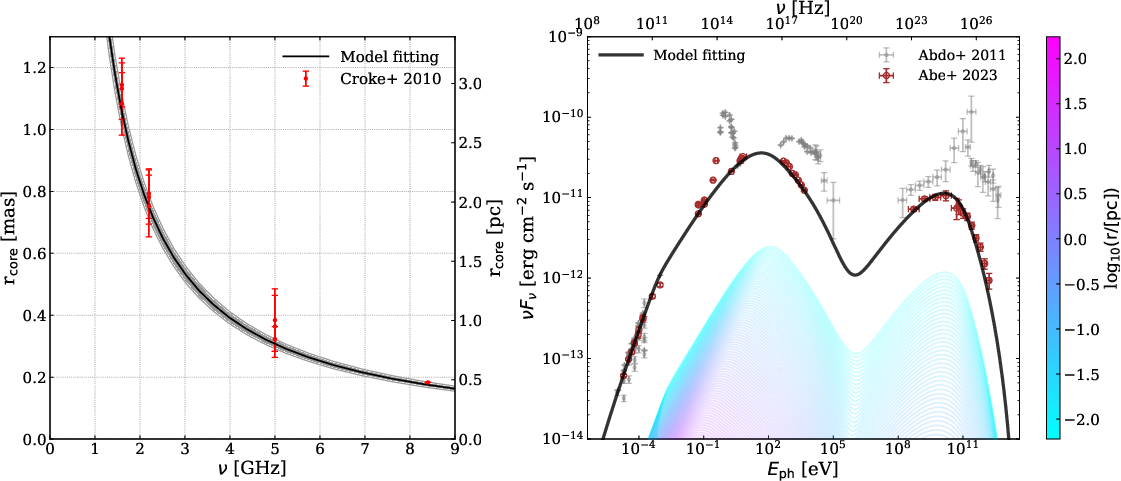
Figure 1: The core-shift relation and multi-epoch SED for Mrk 501, highlighting model agreement with radio astrometry and time-averaged broadband emission.
Multiwavelength Variability: Power Spectrum Analysis
PSD analysis of multi-epoch data across radio, optical, X-ray, and TeV energies reveals that variability amplitudes (in normalized PSD units) increase with frequency. The baseline model, with a single radial prescription for blob generation (scaling as p(r)∝r−αblob), predicts the opposite trend: progressively more dissipation events occur closer to the black hole, which smooths the high-frequency light curves, dampening variability. This leads to systematic underprediction of observed PSD amplitudes in high-frequency radio, optical, X-ray, and gamma-ray bands.
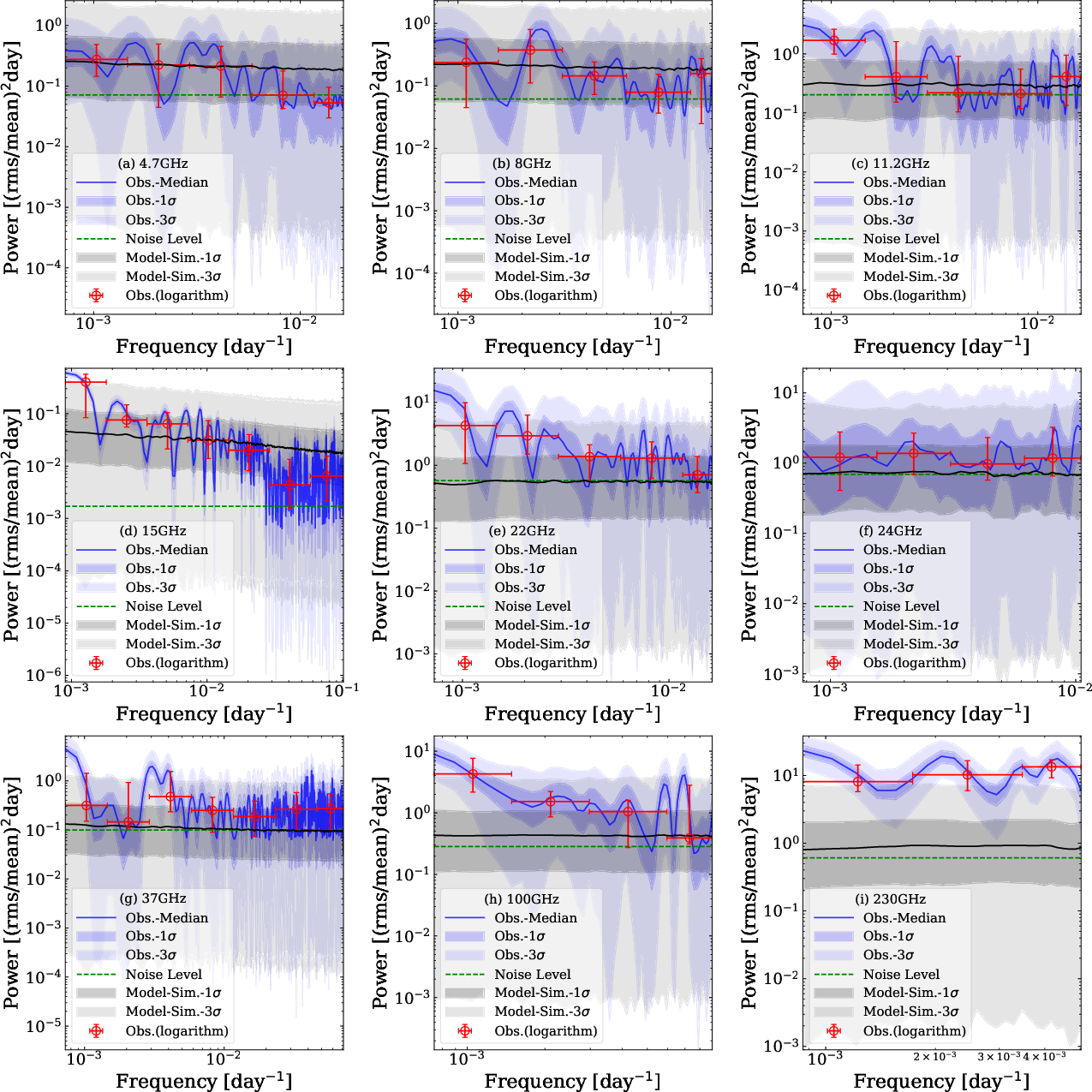
Figure 2: Model and observed multi-frequency PSDs; the baseline model fails to account for the strong variability in high-frequency bands.
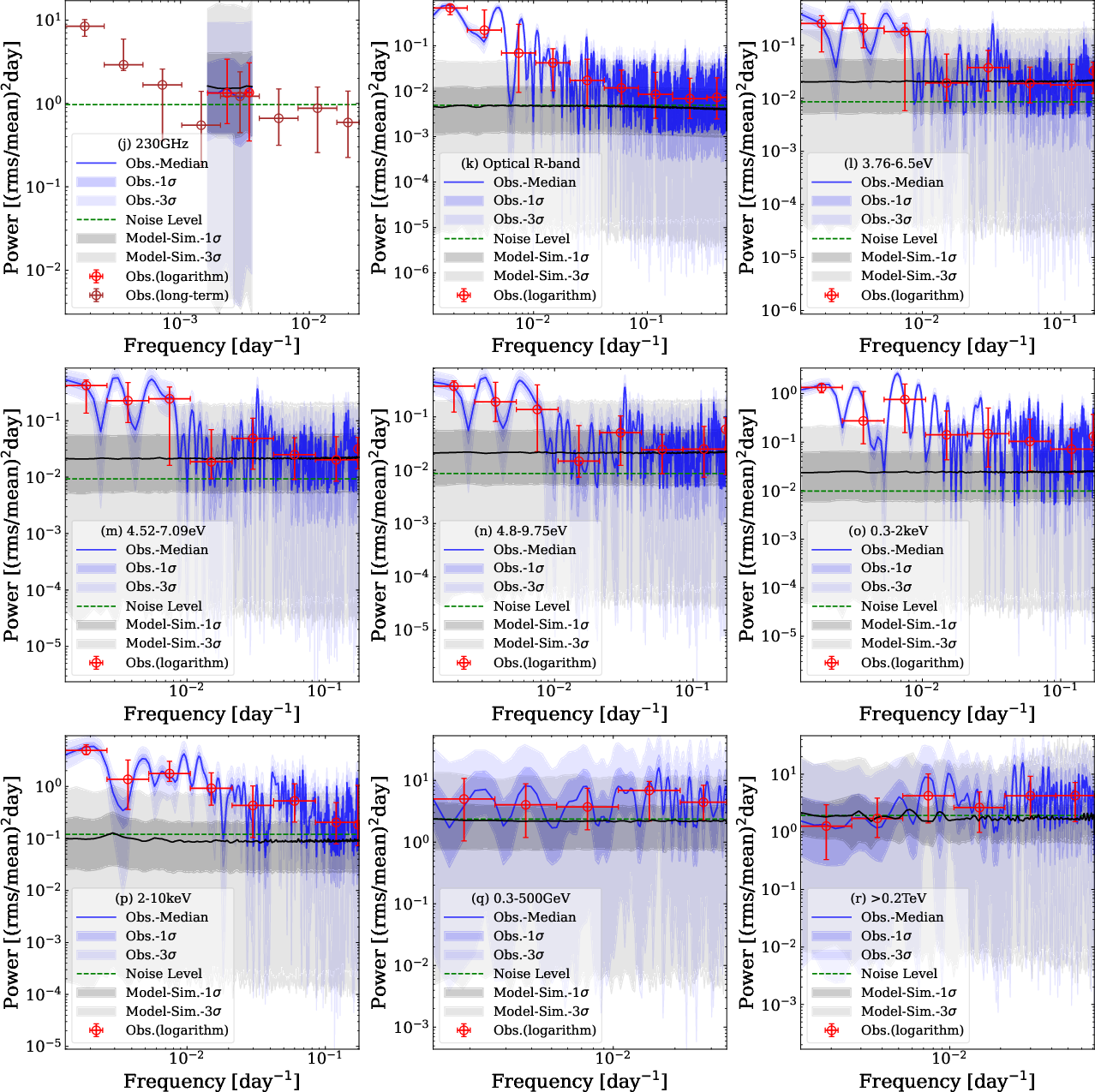
Figure 3: Additional comparison of observed and modeled PSDs in infrared/optical to TeV gamma-ray bands, highlighting persistent underprediction of the observed variability by the baseline model.
Modified Model: Scale-Dependent Dissipation and Blob Merging
To reconcile model and data, the authors introduce a two-zone prescription: dissipation parameters differ in the inner jet (r≲0.1pc) versus outer regions. Specifically, they drastically reduce the effective number of independently radiating blobs in the inner jet (strongly suppressing local N˙r), while increasing the typical blob size and duration—achievable, for instance, if small blobs merge into larger entities before radiating. This prescription elevates the achievable variability amplitude at high frequencies while preserving the SED and core-shift results for the parsec-scale, outer jet.
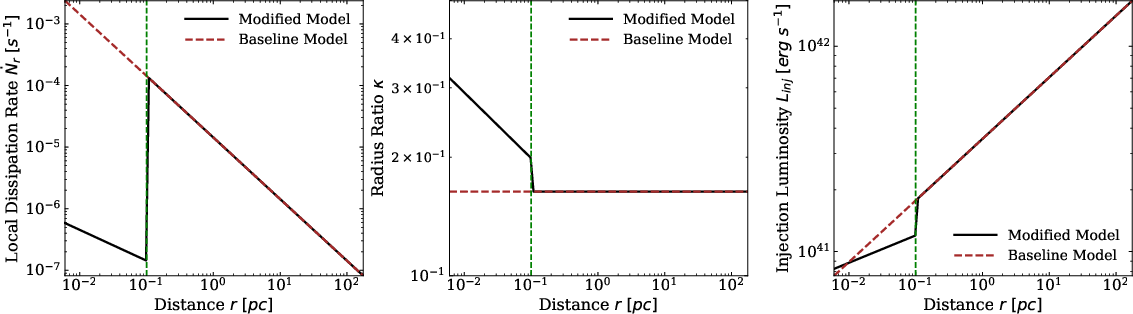
Figure 4: Radial profiles of modified model parameters, showing the sharp reduction of dissipation rate in the inner jet relative to the outer region.
The revised model, under these conditions, matches the observed PSD amplitudes from radio through TeV energies while leaving the time-averaged SED and radio core astrometry unaffected.
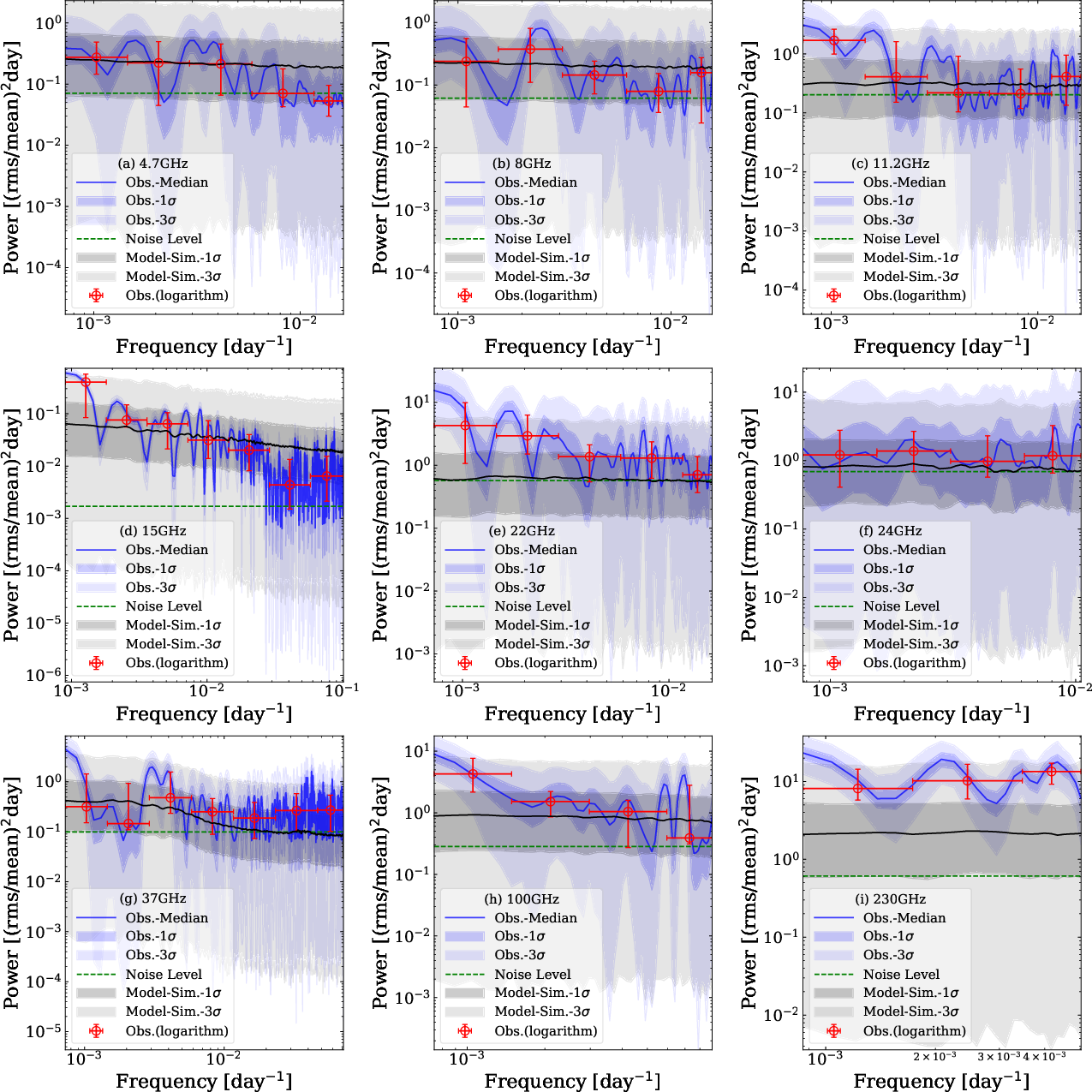
Figure 5: Multiwavelength PSDs after introducing the blob-merging/scale-dependent dissipation prescription, showing agreement with observations across all targeted bands.
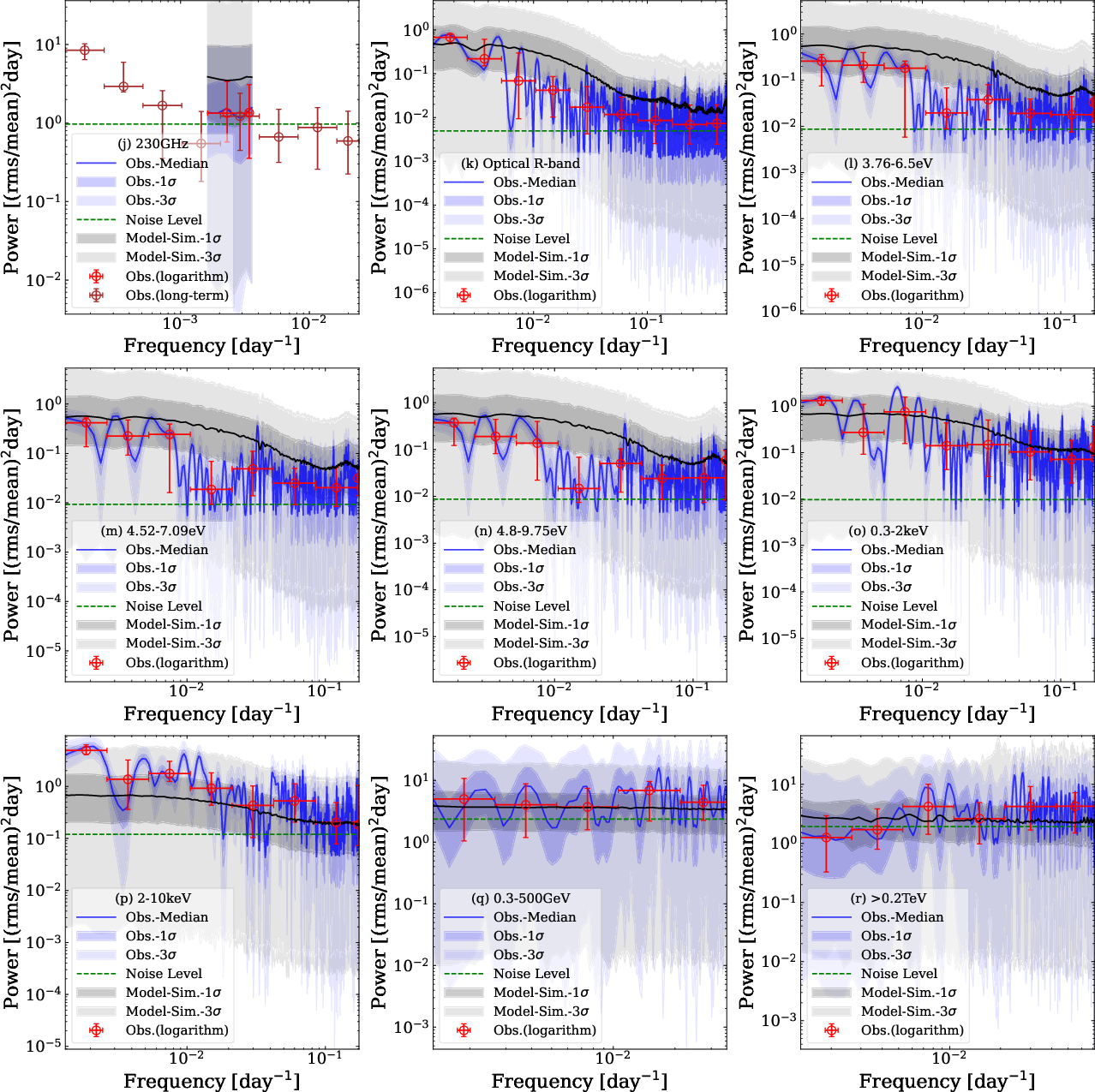
Figure 6: Continued PSD comparison confirming broad-band consistency of the revised dissipation model.
Physical Interpretation and Theoretical Implications
The requirement for scale-dependent dissipation points to different dominant physical processes at distinct jet radii. In the inner jet, a highly magnetized regime conducive to rapid magnetic reconnection is plausible, consistent with plasmoid-dominated reconnection and efficient coalescence (as expected near a Blandford-Znajek powered black hole jet). This regime favors the formation of a few large, energetic, and persistent plasmoids (here, "blobs"), resulting in strong, stochastic variability at high photon energies.
In contrast, farther downstream, magnetic energy is converted to kinetic form, effective magnetization drops, and reconnection/merging is less efficient, resulting in a larger number of shorter-lived, smaller-scale dissipation events—consistent with PSD amplitudes observed at GHz radio frequencies. The transition between these regimes emerges at parsec or sub-parsec scales, with significant implications for jet composition, stability, and radiative efficiency.
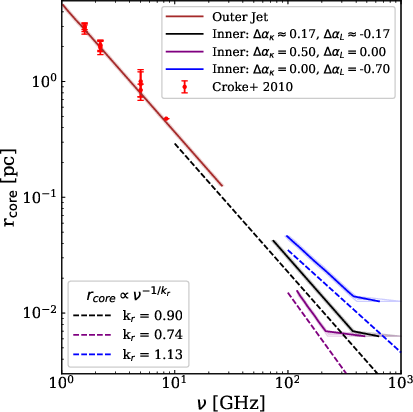
Figure 7: Core-shift relations in the parsec and sub-parsec jet, illustrating model sensitivity to inner-jet parameterizations and the diagnostic potential of high-frequency astrometry.
Observational and Methodological Systematics
The authors carefully address observational systematics—irregular sampling, windowing, and measurement noise—by forward-modeling their Monte Carlo light curves through the same cadence and error model as the real data. They demonstrate that for low-intrinsic-variability cases, observational noise dominates the PSD, but in the presence of strong stochastic signals (as in the inner-jet-updated model), the intrinsic variability profile is preserved.
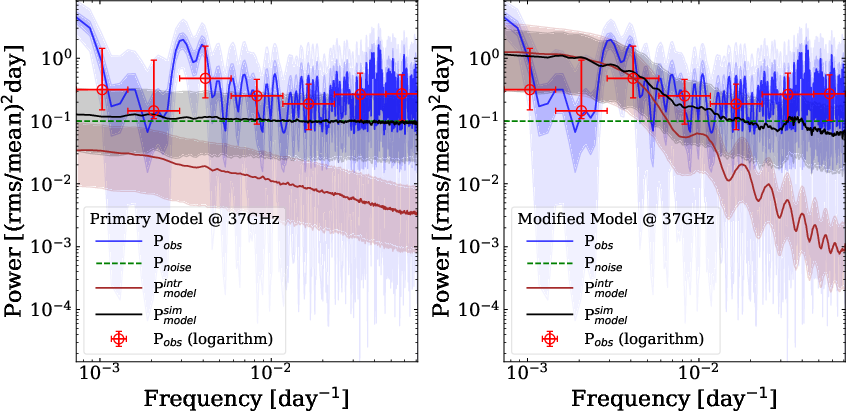
Figure 8: Demonstration of the effects of sampling and noise on modeled PSDs, showcased for 37 GHz light curves.
They additionally confirm the minimal impact of the inner-jet parameter adjustments on both the SED and radio core-shift predictions, ensuring that the model remains robust to all simultaneous multi-band constraints.
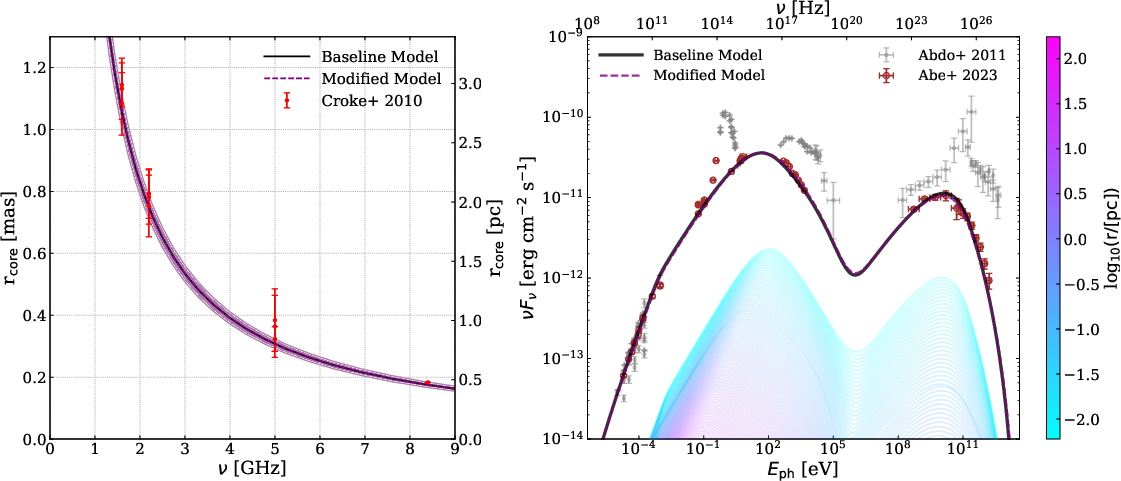
Figure 9: SED and core-shift relations before and after model modification, highlighting minimal SED/core-shift change with inner-jet dissipation adjustments.
Implications and Future Prospects
This study empirically establishes that neither time-averaged radio/SED properties nor radio core-shift astrometry alone uniquely constrain jet dissipation physics; rather, only by jointly analyzing spatial, spectral, and temporal observables can the scale-dependent stratification of jet dissipation be isolated. The results challenge the sufficiency of stationary, steady-state, scale-invariant jet models and motivate the inclusion of scale-dependent reconnection or shock physics.
The findings strongly support a magnetic reconnection origin for high-energy variability in blazars. They predict a distinct observational signature: a pronounced change in the number and properties of radiating blobs at ∼0.1pc from the core. Future high-cadence, multiwavelength light curves, and high-frequency radio astrometry (millimeter/sub-mm VLBI) can further test and refine these dissipation models, offering potential direct measurements of inner-jet stratification and dissipation transitions.
Conclusion
Through rigorous integration of radio core-shift, SED, and multiwavelength variability constraints, the authors present strong evidence for scale-dependent dissipation mechanisms in blazar jets. A single, monotonically varying physical prescription for jet dissipation is incompatible with the full suite of observables. Instead, the data require a transition from numerous, weak, short-lived dissipation sites in the parsec-scale outer jet to a regime of fewer, larger, and longer-lived blobs in the highly magnetized, sub-parsec inner jet, plausibly due to plasmoid merging in reconnection layers. This hybrid spectro-timing-astrometric approach provides a paradigm for future jet modeling and motivates further high-resolution, high-cadence multiwavelength campaigns.