- The paper uses detailed relativistic hydrodynamic simulations to show that prolonged fallback energy injection fundamentally alters TDE jet evolution.
- It reveals that continuous energy input produces broader shocks and lower post-shock energy densities, resulting in delayed, fainter radio peaks.
- The study demonstrates that fallback-powered jets can explain the diverse radio observations of TDEs, challenging impulsive afterglow models.
Dynamics and Radio Emission of Fallback-Powered Tidal Disruption Event Jets
Motivation and Background
Tidal Disruption Events (TDEs), resulting from the destruction of stars by supermassive black holes (SMBHs), frequently exhibit nonthermal radio emission interpreted as synchrotron afterglows from outflows impacting the circumnuclear medium (CNM). Canonical modeling of these afterglows employs the impulsive Blandford-McKee (BM) solution, appropriate for Gamma-Ray Bursts (GRBs) due to their brief central engine activity. However, the temporal characteristics of TDE engines, governed by fallback accretion, yield prolonged energy injection spanning weeks to months. This sustained input fundamentally alters the blast wave dynamics and the resultant radio emission, as quantified via relativistic hydrodynamic (RHD) simulations with microphysical synchrotron prescriptions in this study (2607.03548).
Hydrodynamic Modeling and External Density Profiles
The circumnuclear gas distribution is highly stratified, as demonstrated for MBH=106 and 107M⊙ in Figure 1, and lacks simple analytic self-similar solutions due to inner density flattening and an r−2 transition at large radii. The jet luminosity histories are either based on fallback rates from hydrodynamical simulations or idealizations featuring plateaus followed by t−5/3 fallback decay, with all scenarios normalized to fixed Eiso to isolate injection-time effects.
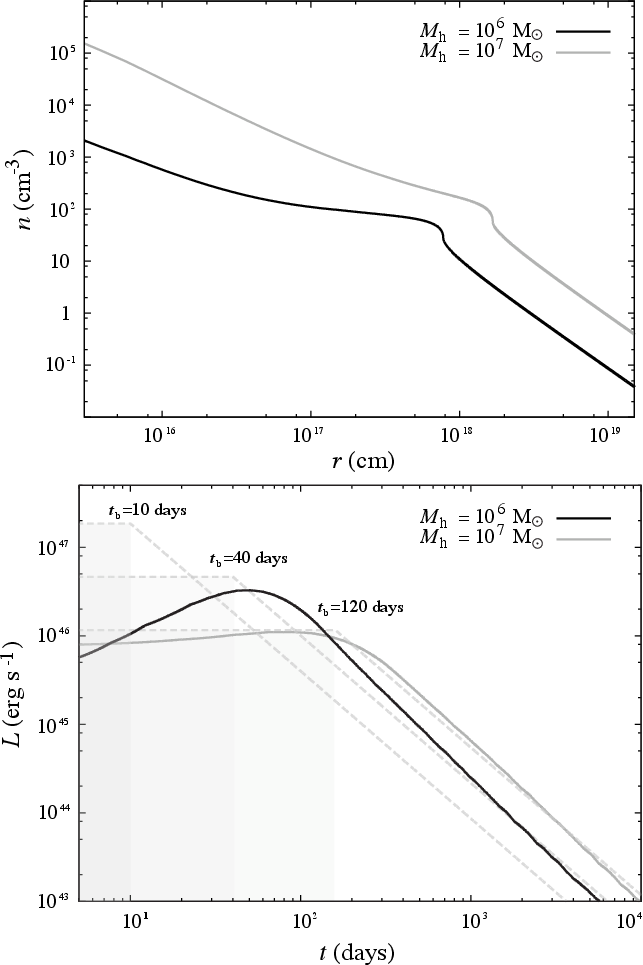
Figure 1: Radial stratification of the circumnuclear medium and the fallback-powered jet luminosity histories for 106 and 107M⊙ SMBHs.
One-dimensional Relativistic Jet Evolution
Continuous energy injection results in broader and more gradual forward shock structures than impulsive BM counterparts for otherwise identical Eiso. Density slices of RHD simulations Figure 2 exhibit initially wide shocked shells, lacking the thin structure imposed by impulsive shutdown.
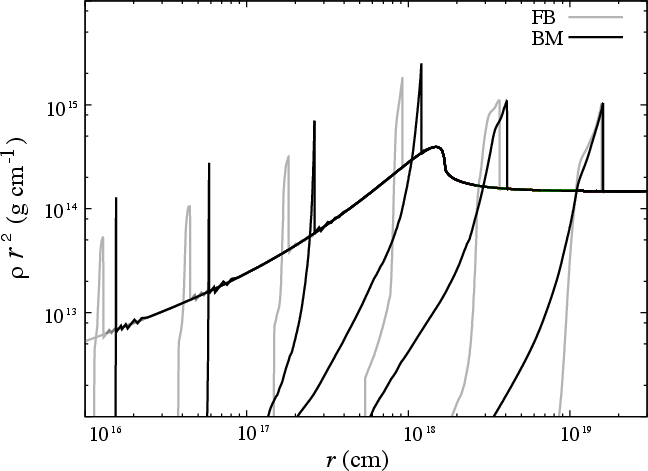
Figure 2: Temporal comparison of radial density profiles between powered and impulsive blast waves; the continuously powered variant forms broader shocks and accrues energy more gradually.
The shock-averaged propagation speed ⟨βsh⟩ Figure 3 is lower during active energy input, directly suppressing post-shock energy densities and magnetic field strengths—key determinants of the nonthermal luminosity.
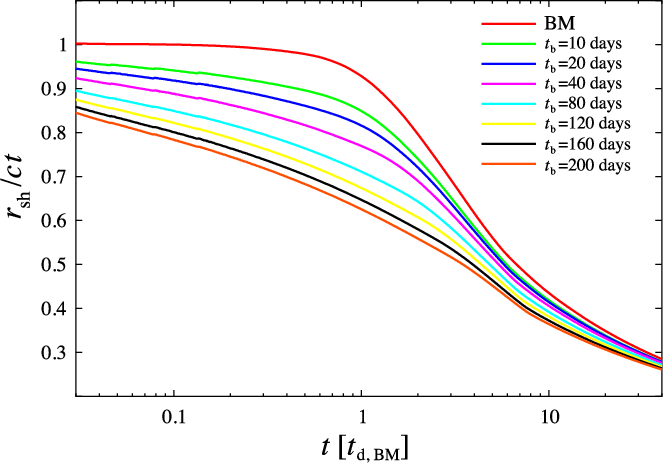
Figure 3: Mean forward shock velocity evolution; longer engine durations yield consistently slower shocks until energy injection ceases.
Radio Emission: Departure from the Impulsive Paradigm
The reduced shock velocities and lower energy densities drive systematically fainter and later-peaking radio emission, as demonstrated in Figure 4 for 1D models.
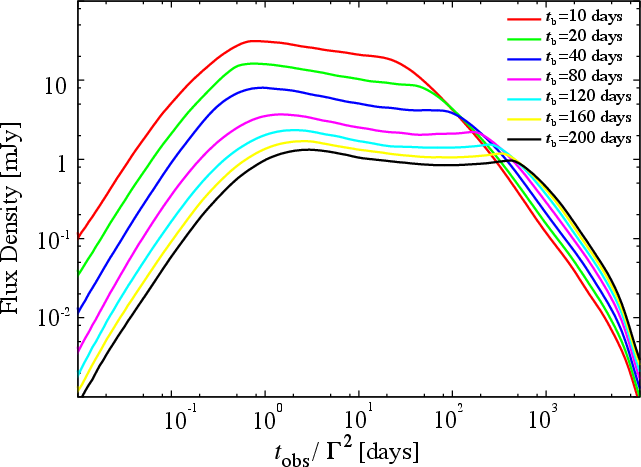
Figure 4: 4.86 GHz radio light curves for an array of engine durations, showing peak luminosity suppression and temporal delays for extended engines.
The critical dimensionless variable is the ratio of the engine activity time tb to the BM-frame deceleration time 107M⊙0. The simulations reveal that only for 107M⊙1 does the impulsive solution become a valid late-time approximation Figure 5, while for realistic TDE parameters, fallback lasts a significant fraction of 107M⊙2, imprinting central engine memory onto afterglow observables well after accretion diminishes.
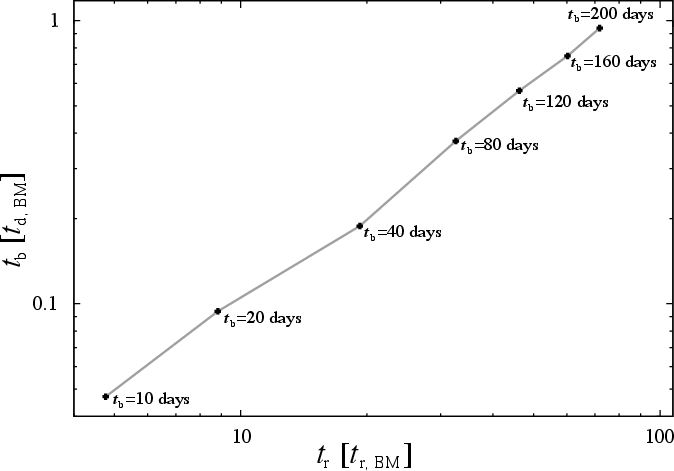
Figure 5: Relation between normalized radio peak time and energy injection timescale; the impulsive approximation is recovered only for short-duration engines.
Robustness against variations in CNM density is established; even across order-of-magnitude changes Figure 6, the delayed and suppressed radio signatures persist due to the dominance of fallback-driven dynamics.
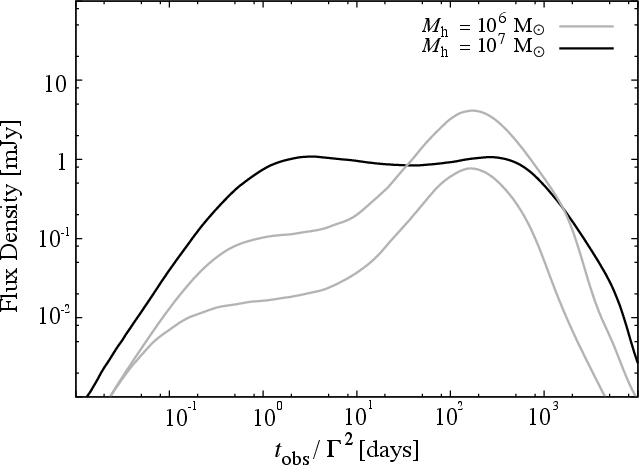
Figure 6: Impact of different fallback and external density profiles on simulated 1D radio light curves; the delay from sustained injection is generic.
Multidimensional Jet Structure and Angular Emission
Two-dimensional simulations capture the key features of fallback-powered jets: internal recollimation shocks, cocoon inflation, and weak lateral expansion consistent with stratified environmental collimation Figure 7.
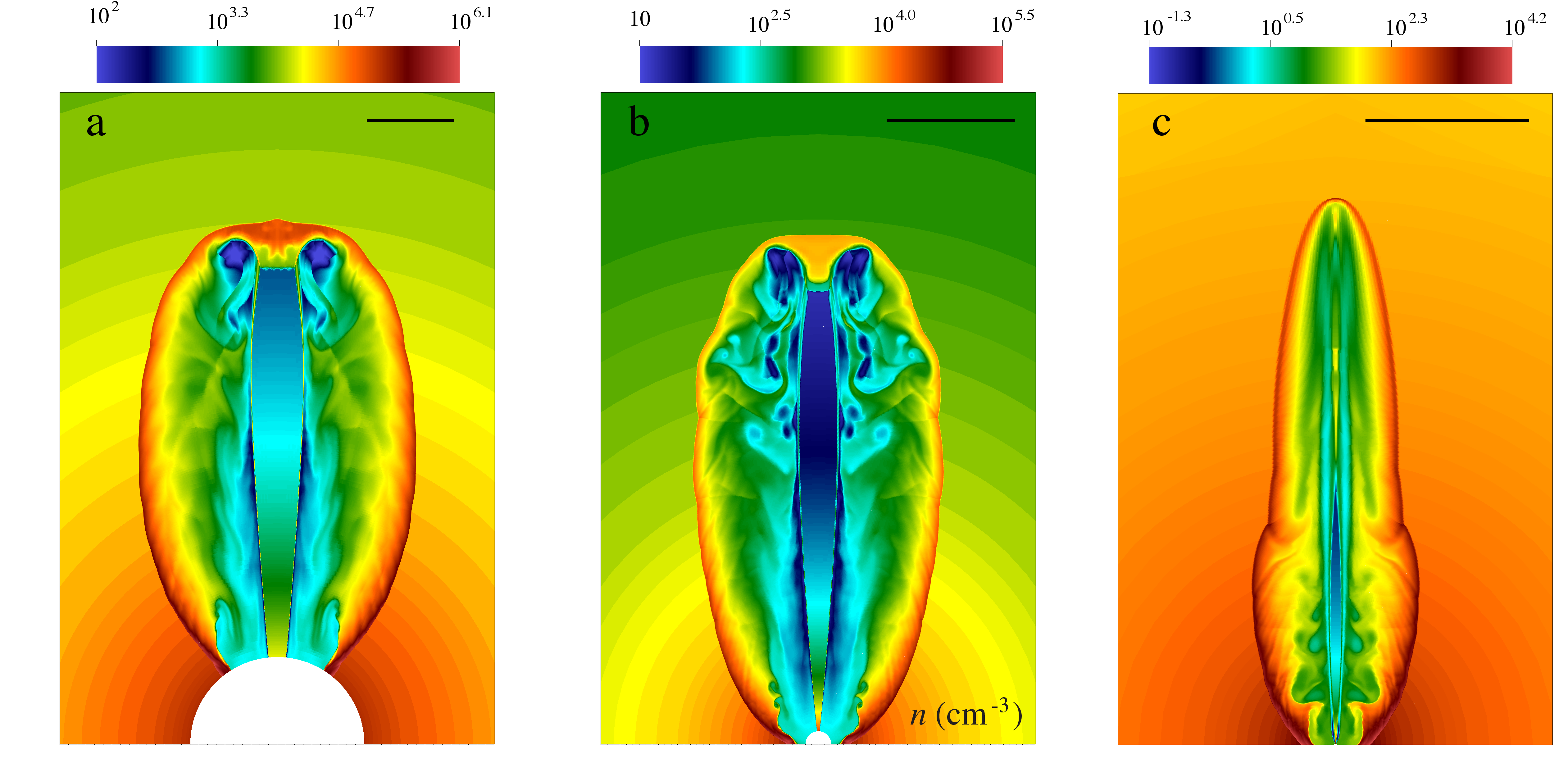
Figure 7: Snapshots of jet-cocoon and shock morphology at successively later epochs in a powered TDE jet simulation.
The 2D energy-angle profiles Figure 8 show that most isotropic-equivalent energy remains locked in a narrow core, even as the lower-energy sheath expands gradually.
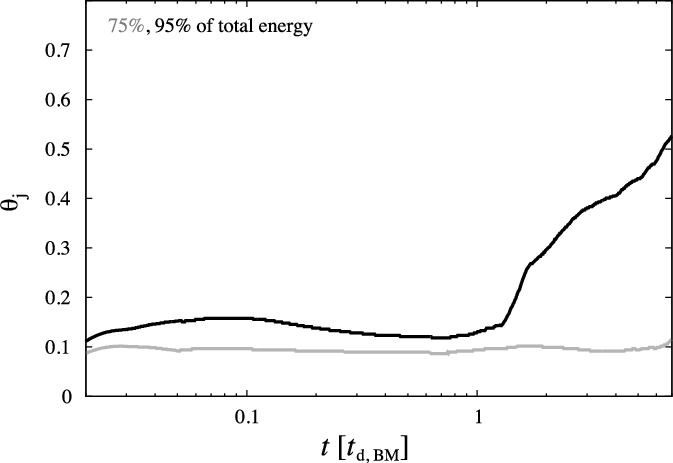
Figure 8: Jet opening angle evolution; 75% energy contours remain nearly fixed, signifying limited lateral spread during early evolution.
On-axis emission is well captured by 1D modeling Figure 9, but the off-axis flux is highly sensitive to the reduced beaming and lateral transport. Unlike BM predictions, even modest viewing angles see steep flux suppression and peak delays Figure 10.
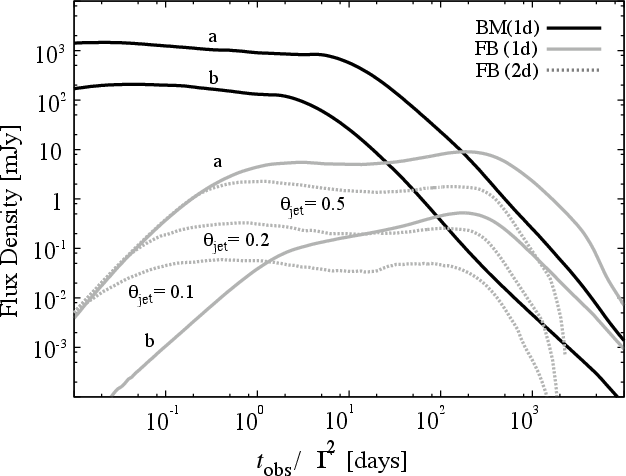
Figure 9: Comparison of on-axis radio light curves for multidimensional vs. 1D runs across energies and jet opening angles; 2D structure introduces surface and collimation corrections.
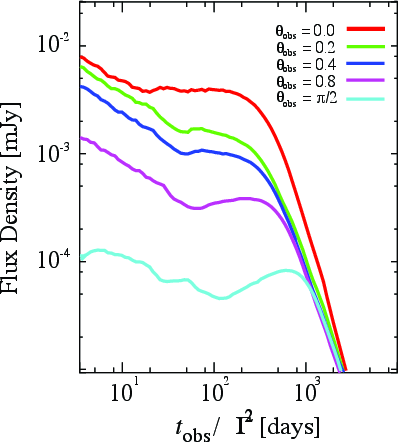
*Figure 10: Off-axis radio light curves for fallback-powered jets; Doppler beaming and lateral expansion are both reduced, yielding dramatic suppression at large 107M⊙3. *
The effect is attributable both to the lower 107M⊙4 of the flow during the radio-bright phase and the absence of rapid sideways expansion that would otherwise redistribute energy and compensate for off-axis viewing.
Population Context and Observational Consequences
Fallback-powered jets may reconcile the observed wide dispersion of TDE radio luminosities with a unified relativistic outflow scenario. Models computed for fiducial black hole parameters yield radio light curves commensurate with both "jetted" and "sub-energetic" TDE samples solely by varying observer angle, environmental density, and fallback timescale.
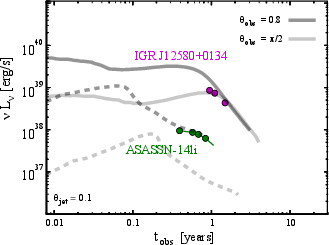
Figure 11: Comparison between fallback-powered jet models and observed radio light curves of early TDEs; both bright and faint events are encompassed by the parameter range.
The off-axis suppression implies that current radio non-detections are insufficient to tightly constrain the true fraction of TDEs producing relativistic jets—significantly more should be present but their afterglows may be systematically misclassified or missed.
The model suggests that much of the diversity observed in the TDE radio population, including faint events previously attributed to non-relativistic or failed jets, is consistent with fallback-powered jets subjected to variable viewing and environmental conditions.
Conclusion
Fallback-powered energy injection fundamentally alters the dynamical and radiative evolution of TDE jets relative to impulsive explosions of equal energy. The shock dynamics, afterglow peak time and brightness, relativistic beaming efficiency, and lateral expansion are all suppressed, especially for off-axis observers. Consequently, inference of jet production efficiencies, event rates, and black hole demographics derived from impulsive afterglow scalings require systematic revision in the TDE regime.
Future theoretical efforts must fully couple engine, environmental, and observational parameter spaces, incorporating synchrotron self-absorption and longer-term multi-stage outflow processes to interpret the expanding TDE radio sample. Observationally, only deep and late-time follow-up can probe the true demographics of relativistic TDE jets, as many afterglows should remain below impulsive-model detection thresholds except in the most favorable lines of sight.
This work establishes a physically consistent framework—rooted in hydrodynamic memory of sustained central engine activity—for interpreting TDE afterglows and reveals strong selection effects underlying current radio surveys. As wide-field time-domain capabilities improve, the fallback-powered paradigm will be critical for unveiling the true scope and mechanism of SMBH jet production in stellar disruptions.

