- The paper introduces a novel Newton–KAM framework that computes invariant tori and their bifurcations through simultaneous parameterization of the torus embedding and normal bundles.
- It employs pseudo-arclength continuation and Fourier discretization to achieve quadratic convergence and high-precision results, verified up to 211-digit arithmetic.
- The work paves the way for rigorous bifurcation analysis in high-dimensional dissipative systems, with applications ranging from turbulence to hyperchaos.
Numerical Computation of Quasiperiodic Reducible Saddle-Node Bifurcations via the Parameterization Method
Introduction
This work presents a systematic and numerically robust methodology for computing reducible, normally hyperbolic invariant tori (NHITs) with quasiperiodic internal dynamics in dissipative, autonomous ODE systems. The approach is grounded in the parameterization method as developed in modern KAM theory, allowing for simultaneous solution of the embedding of the torus, its tangent/normal bundles, and the associated parameter values. The authors introduce explicit Newton-type algorithms—amenable to pseudo-arclength continuation—for tracking these tori and for computing and traversing codimension-one bifurcations, notably saddle-node bifurcations of the tori.
Mathematical Framework
The parameterization method consists of finding an embedding K:Td→Rn such that the image captures the invariant torus and the invariance equation DK(θ)ω=F(K(θ);μ) is imposed for a prescribed internal frequency vector ω. The method extends to tracking the associated normal bundle N(θ) and the corresponding block-diagonal reducible normal dynamics, ensuring robust normal hyperbolicity. Under this framework, Newton–KAM iterations reduce the defect in invariance equations and their linearizations in the presence of small divisors, with convergence requiring Diophantine condition on ω.
This geometric and algebraic structure is then leveraged for saddle-node bifurcations. The authors introduce an unfolding parameter (denoted ζ) through a normalization condition, which serves as a pseudo-arclength parameter, permitting regular continuation through turning points where the usual parameterization becomes degenerate due to vanishing normal exponents.

Figure 1: Saddle-node bifurcation where Re(λ)=0.
Algorithmic Contributions
The paper articulates a detailed Newton–KAM procedure. The correction steps are projected onto the tangent and normal directions of the torus using a moving frame, thus yielding linear cohomological equations. Fourier discretizations and spectral methods are employed for numerical tractability, allowing explicit mode-wise solution of the linear steps and avoiding global inversion of large, often-ill-conditioned systems.
The approach combines:
- Simultaneous correction: Updates for both the torus parameterization and system parameters.
- Reducibility correction for the normal bundle: Ensures that normal dynamics are reducible and block-diagonal, a stronger property than mere normal hyperbolicity.
- Pseudo-arclength continuation (unfolding): Allows for robust traversal of folds/saddle-nodes by augmenting the solution space with the unfolding parameter, allowing the Newton-like step to remain well-posed.
The paper provides explicit implementation details, including algorithmic pseudocode and modular separation for vector-field and parameter derivatives, using automatic differentiation and multiprecision tools.
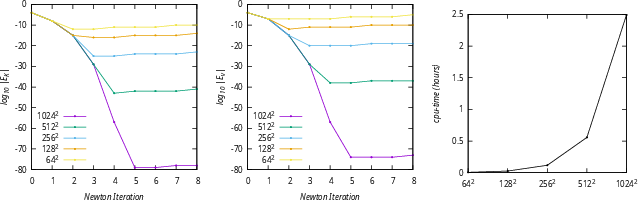
Figure 2: Quadratic convergence and residuals for high-order arithmetic in Algorithm~3 for a 3D model.
Numerical Results
Extensive model tests demonstrate the effectiveness of the methodology. Two canonical examples are provided:
- A high-dimensional synthetic system with explicitly known tori and normal bundles is used to verify rapid quadratic convergence of the Newton-KAM correction, full recovery of the true invariants near the unperturbed case, and accuracy under high-precision arithmetic.
- A three-dimensional saddle-node normal-form model captures the codimension-one bifurcation scenario. Pseudo-arclength continuation via the unfolding parameter is shown to transit the fold region seamlessly, where direct parameter continuation would stagnate due to loss of invertibility of the linearized normal dynamics.
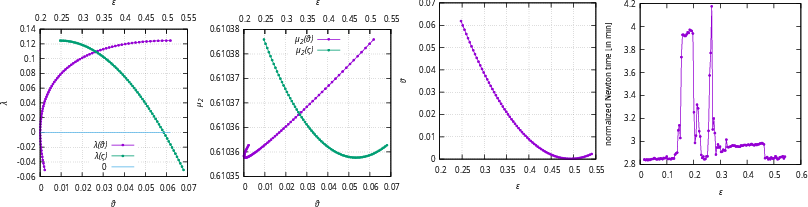
Figure 3: Continuation of the eigenvalue λ and parameter ϵ, illustrating crossing through a saddle-node fold.

Figure 4: Phase-space visualization—upper panels: initial and corrected solutions; lower panels: torus slices and continuation solutions.
The numerical experiments are executed at high working precision (up to 211 digits), allowing residuals to reach 10−50, thereby supporting potential future computer-assisted proofs. The code is designed for scalability, parallel execution, and rigorous arithmetic control.
Implications and Perspectives
This work establishes a general-purpose procedure for rigorous and robust computation of reducible NHITs and their codimension-one bifurcations in nonconservative ODEs. Potential applications extend to:
- Bifurcation analysis in high-dimensional dissipative flows, including physically relevant PDEs (e.g., Navier–Stokes, reaction-diffusion).
- Automated detection and traversal of complex bifurcation curves for invariant tori, relevant for understanding transitions to turbulence and hyperchaos.
- Computation of invariant objects required for data-driven or periodic-orbit-based statistical computations in high-dimensional systems.
The method enables precise location and continuation of saddle-node bifurcations of tori, relevant, for example, in the study of transitions to complex dynamics (such as hyperchaos) where invariant tori structure the attractor's geometry.
The extension to quasi-periodically forced systems and PDEs—where the normal bundle may not decompose into one-dimensional fibers—remains open for future investigation. The provided code and methodology are compatible with high-precision and interval-arithmetic validation, facilitating potential integration into computer-assisted proof pipelines.
Conclusion
The paper provides a rigorous, extensible, and computationally efficient Newton–KAM framework for the computation and parametric continuation of normally hyperbolic, reducible invariant tori and saddle-node bifurcations thereof in high-dimensional dissipative systems. Through explicit projection on moving frames and the introduction of pseudo-arclength variables, the method robustly handles the core analytic obstructions to such computations: small divisors, parameter drift, and degeneracy in the normal bundle. The algorithmic design supports future generalizations to higher codimension bifurcations and PDE contexts and provides a foundation for rigorous KAM-type numerics.

