- The paper demonstrates that superposing circular trajectories for UDW detectors produces quantum interference, resulting in oscillations and damping in transition probabilities.
- It employs rigorous numerical and analytical methods to compute effective temperatures and transition probabilities, highlighting deviations from classical Unruh thermal predictions.
- The findings reveal practical implications for analog quantum simulation experiments, suggesting that tailored ultracold atom setups can capture the observed interference-induced effects.
Superposed Circular Motion Unruh Effect in (3+1) Dimensions: A Technical Review
Introduction and Motivation
This work rigorously investigates the Unruh effect for Unruh-DeWitt (UDW) detectors traversing superpositions of distinct circular trajectories in (3+1)-dimensional Minkowski spacetime, building on refined quantum-control models that coherently superpose classical paths. The impetus is twofold: (i) assessing the operational influence of path superposition on detector responses, especially in light of experimental analogues with ultracold atom systems, and (ii) dissecting whether quantum interference between spatially distinct circular worldlines qualitatively alters thermality as witnessed by such a detector.
The study systematically analyzes four geometric detector superposition configurations: (a) vertically stacked circles, (b) horizontally displaced coplanar circles, (c) a static point superposed with an orthogonal circular worldline, and (d) concentric circles of differing radii. Across these, both transition probabilities and effective temperatures are numerically and analytically computed, with meticulous comparisons to decohered (mixed) path scenarios.
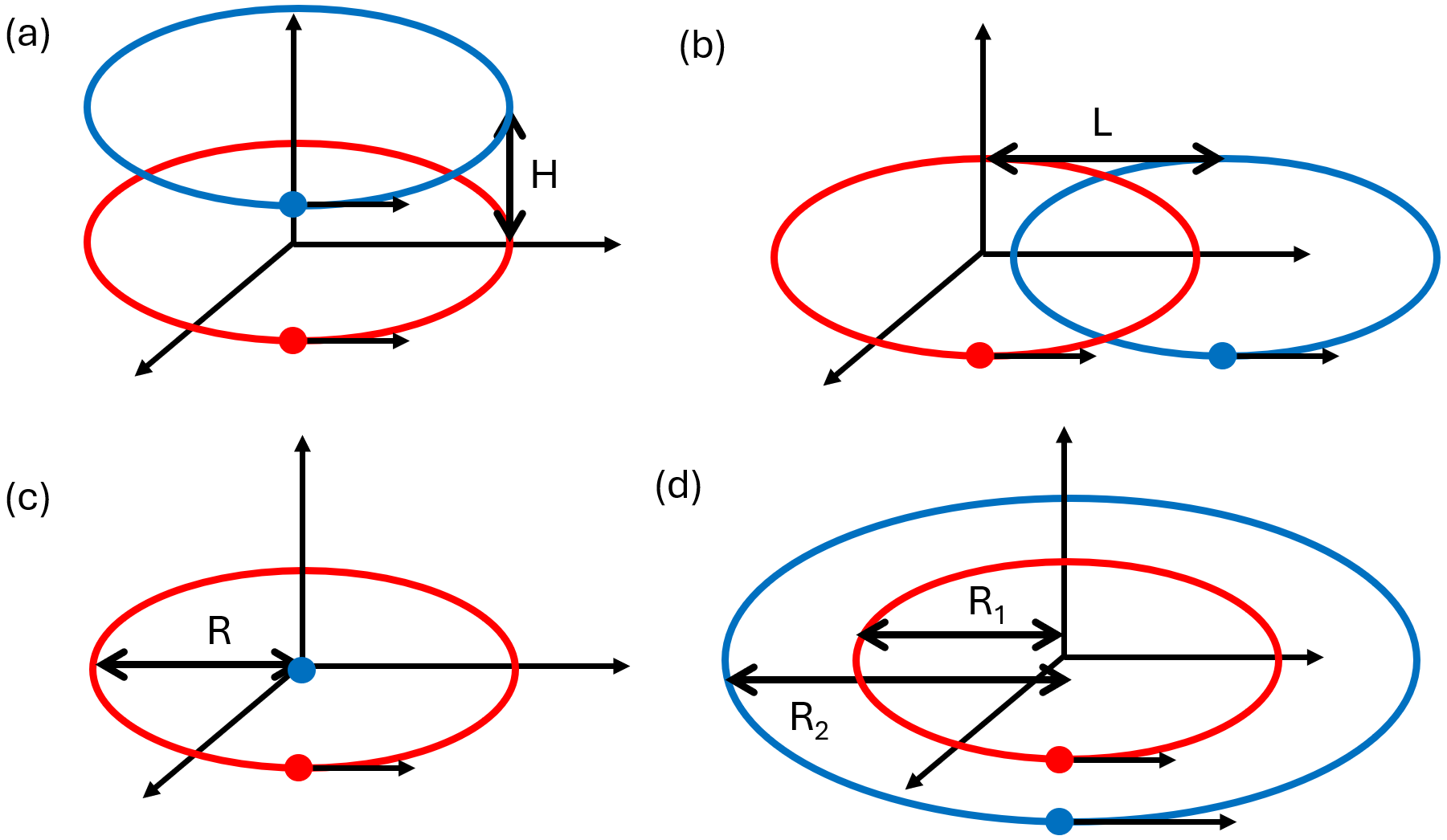
Figure 1: Superposed detector trajectories: (a) Vertically displaced, (b) horizontally displaced, (c) static + orbit, (d) concentric.
The detector–field system is initialized as ∣g⟩⊗∣ψ⟩⊗∣0⟩, with ∣ψ⟩ a coherent superposition of N=2 trajectory states. The interaction Hamiltonian in the interaction picture is given as
H^(τ)=λμ^(τ)j=1∑2ηj(τ)ϕ^(xj(τ))⊗∣j⟩⟨j∣,
where ηj(τ) is a broad Gaussian switching function, and μ^j(τ) induces detector transitions with gap Ω. Superposition-induced self-interference, manifesting through the off-diagonal elements of the Wightman function Wji(τi,τj′) for i=j, distinguishes the response from classical mixtures.
The total transition probability to first order in the coupling is
∣g⟩⊗∣ψ⟩⊗∣0⟩0
where ∣g⟩⊗∣ψ⟩⊗∣0⟩1 integrates along both paths and incorporates cross-trajectory field correlations.
Vertically and Horizontally Displaced Circular Superpositions
For vertically stacked circles, the stationary nature of the configuration (constant spatial offset ∣g⟩⊗∣ψ⟩⊗∣0⟩2 orthogonal to the plane) simplifies the off-diagonal Wightman function,
∣g⟩⊗∣ψ⟩⊗∣0⟩3
enabling efficient computation and asymptotic analysis. Numerically, the transition probability in superposition deviates only modestly from the single-path case, especially for large speeds or displacements, due to suppression of interference terms. However, for moderate ∣g⟩⊗∣ψ⟩⊗∣0⟩4 and tangential velocity, visible oscillations emerge near the maximal response regime, a clear quantum interference signature.
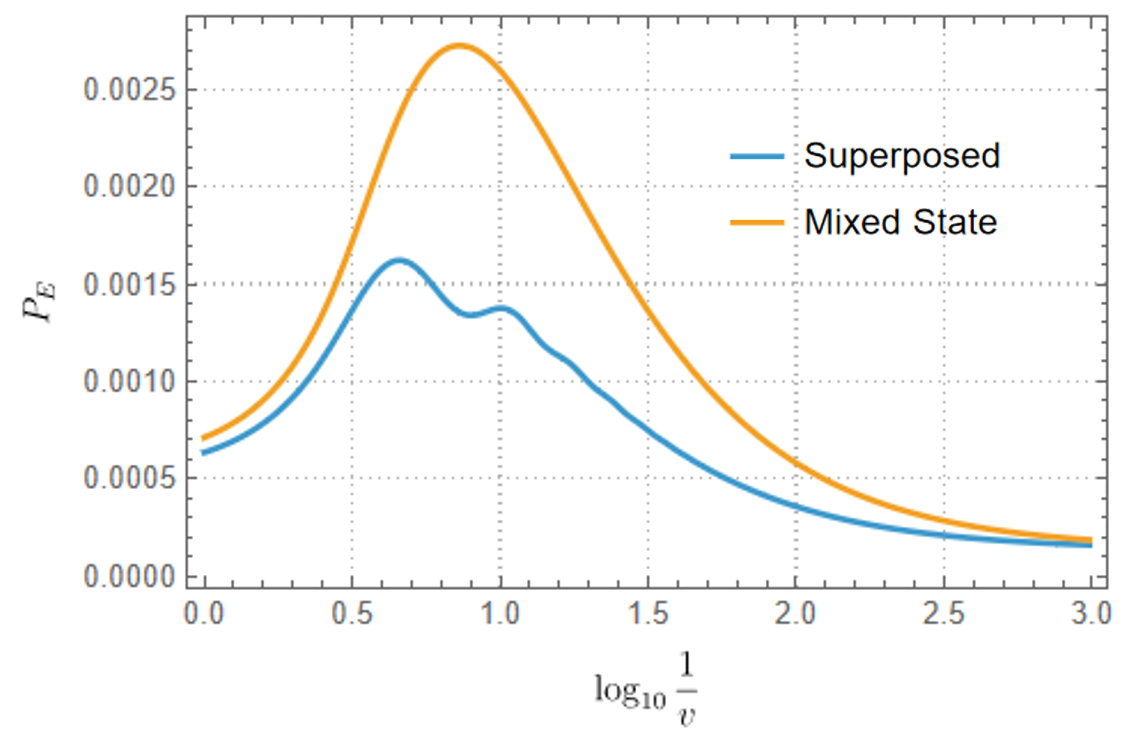
Figure 2: Comparison of transition probabilities: superposed (vertically displaced) versus single circular trajectory.
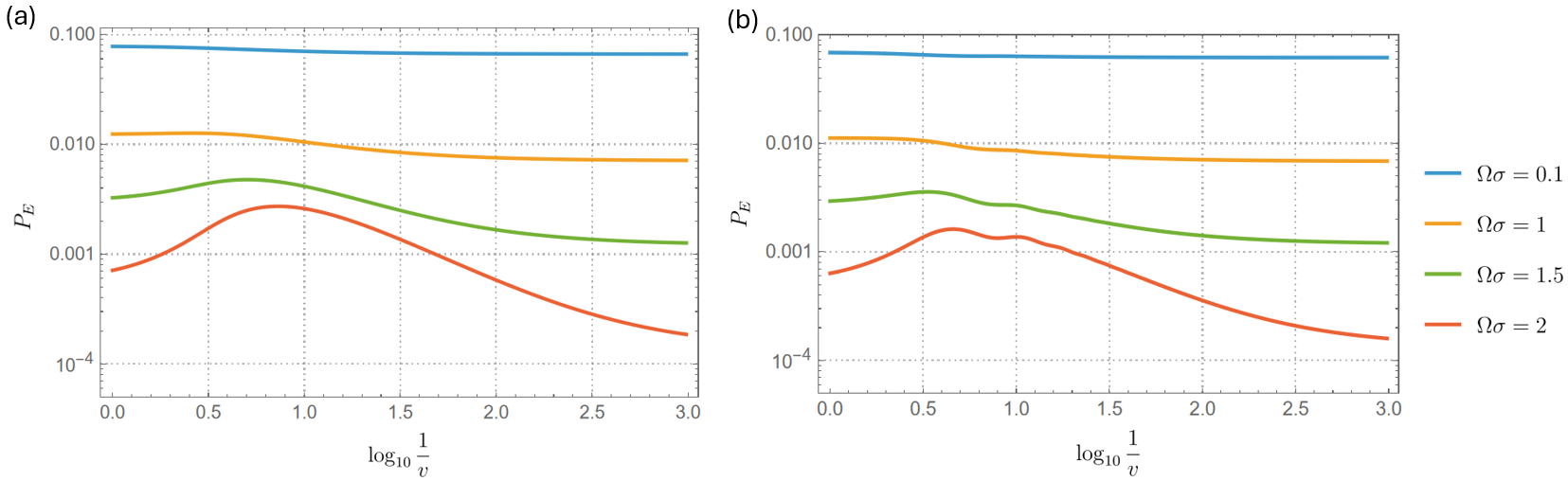
Figure 3: (a) Single detector transition probability vs tangential velocity at fixed acceleration. (b) Superposed detector: peak damping and oscillatory behavior at intermediate velocities.
The same study for horizontally displaced circles, with intercenter separation ∣g⟩⊗∣ψ⟩⊗∣0⟩5 in the plane, reveals that loss of strict stationarity introduces ∣g⟩⊗∣ψ⟩⊗∣0⟩6-dependence (∣g⟩⊗∣ψ⟩⊗∣0⟩7) in the Wightman function, increasing numerical overhead. Nevertheless, qualitatively the interference oscillations are even more pronounced and persist for a broader range of velocities. As ∣g⟩⊗∣ψ⟩⊗∣0⟩8 increases, cross-correlations, and thus the superposition effect, are exponentially suppressed, smoothly recovering the classical result.
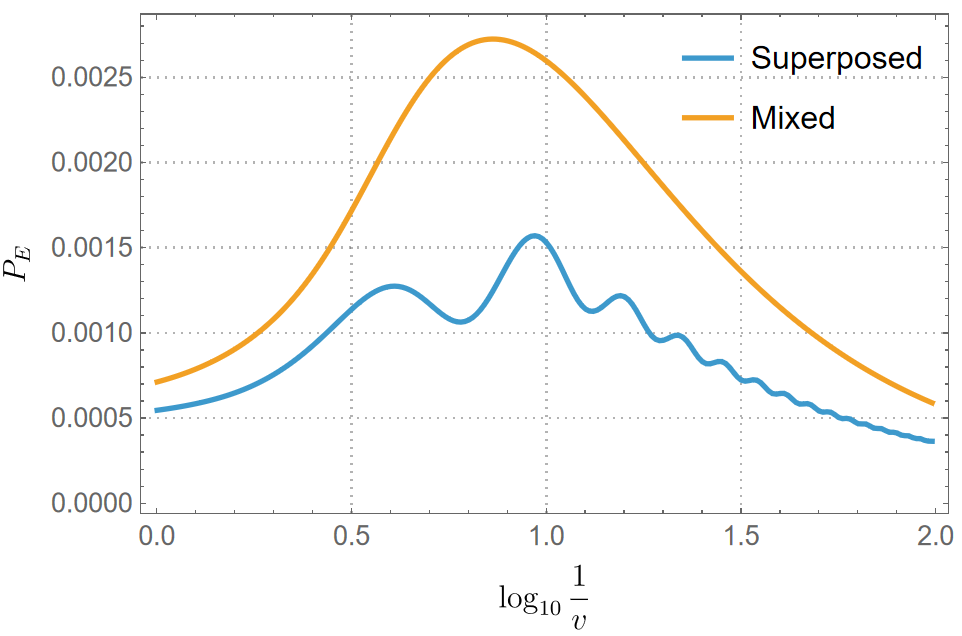
Figure 4: Transition probability for superposed (horizontally displaced) vs mixed state system reveals interference and reduction in excitation probability at moderate velocities.
Static-Orbit Superpositions
The configuration where the detector is in a superposition of the field-theory vacuum worldline (static) and an accelerated circular path yields a distinct, non-thermal signature. Interference removes oscillatory structure and instead yields strong damping of the transition probability as compared to an incoherent mixture. In the ultrarelativistic limit, the interference contribution is suppressed by ∣g⟩⊗∣ψ⟩⊗∣0⟩9, rendering the system effectively classical. In the nonrelativistic regime, the result is formally akin to a spatially superposed static detector, with a sinc-modulated suppression proportional to ∣ψ⟩0.
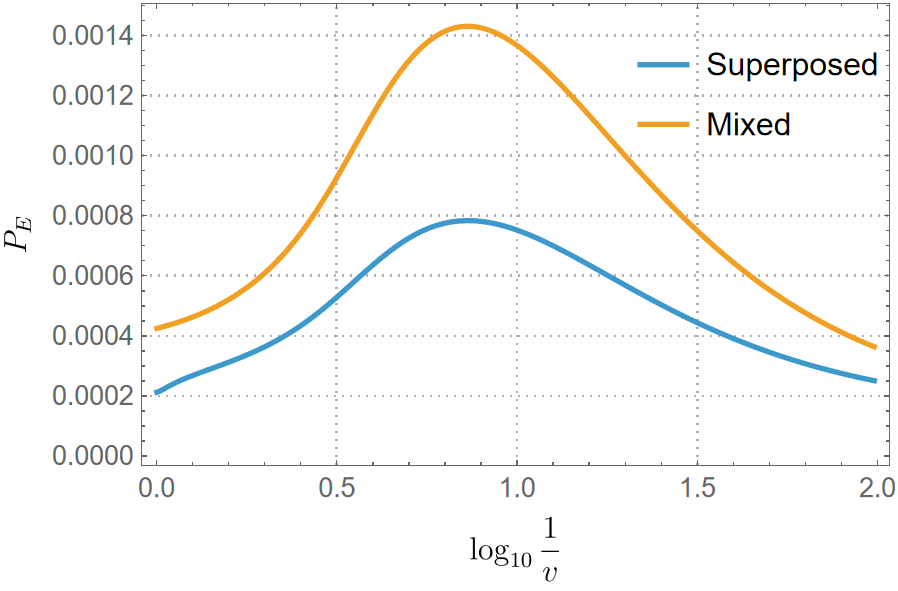
Figure 5: Transition probabilities for static-orbit superpositions exhibit strong, non-oscillatory damping compared to mixtures.
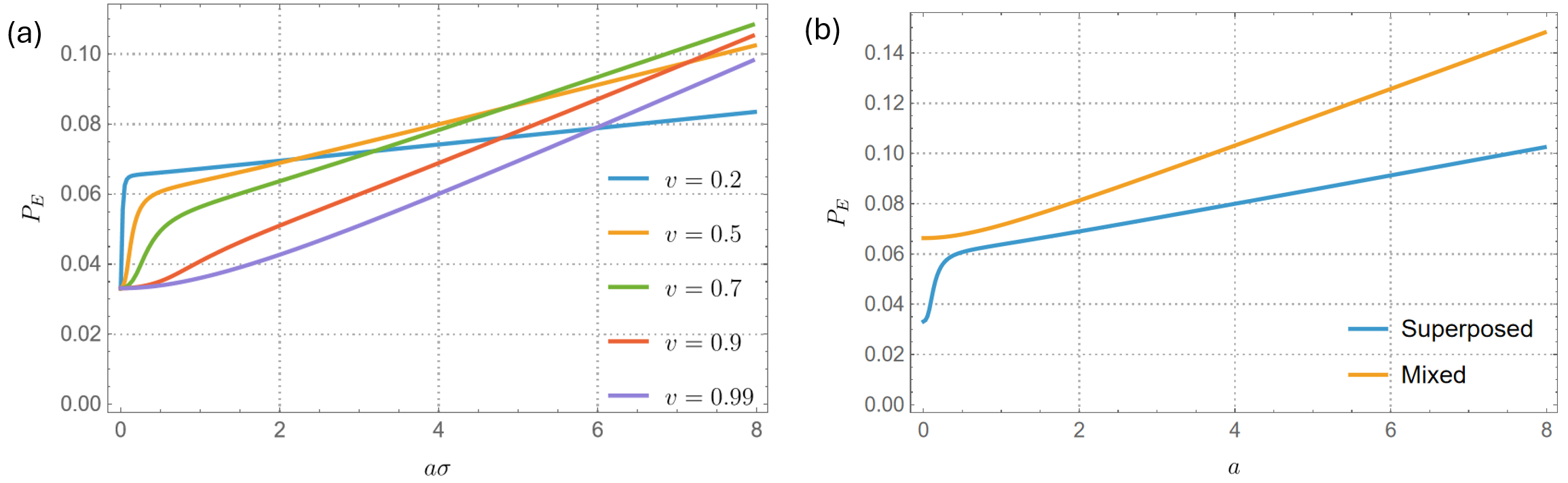
Figure 6: Static-orbit superposition: (a) Transition probability vs acceleration. (b) Damping persists for energy gap variation.
Concentric and Combined Configurations
Detectors initialized in a superposition of concentric circular orbits (differing radii and possibly differing vertical offset) exhibit behavior interpolating between the above extremes, depending on parameter symmetry. For equal radii without displacement, the response is nearly identical to the single path; for significant radius or vertical differences, interference yields oscillations as a function of detector velocity and gap, sensitive to both spatial arrangement and switching duration.
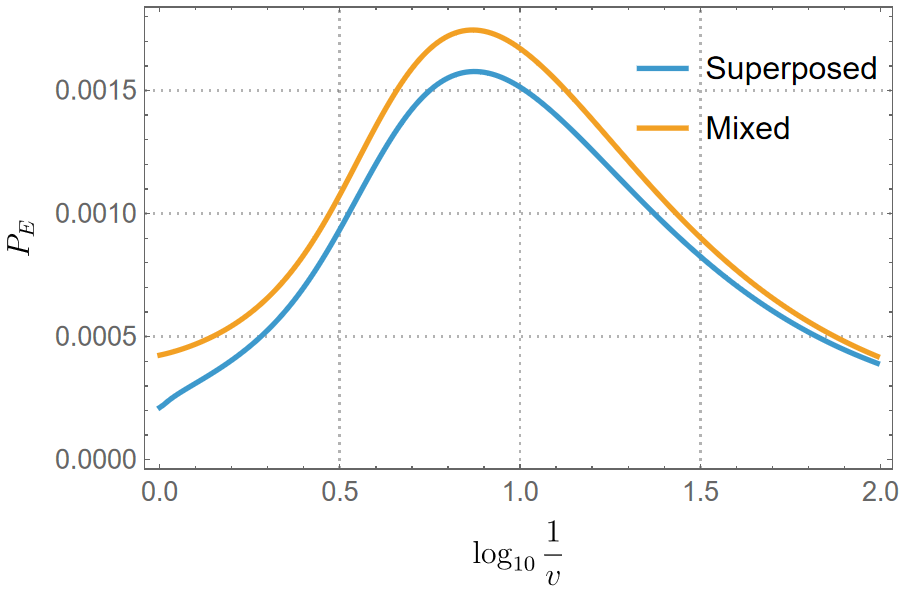
Figure 7: Transition probability for concentric superposed trajectories; damping and oscillatory features both present, dependent on radius ratio.
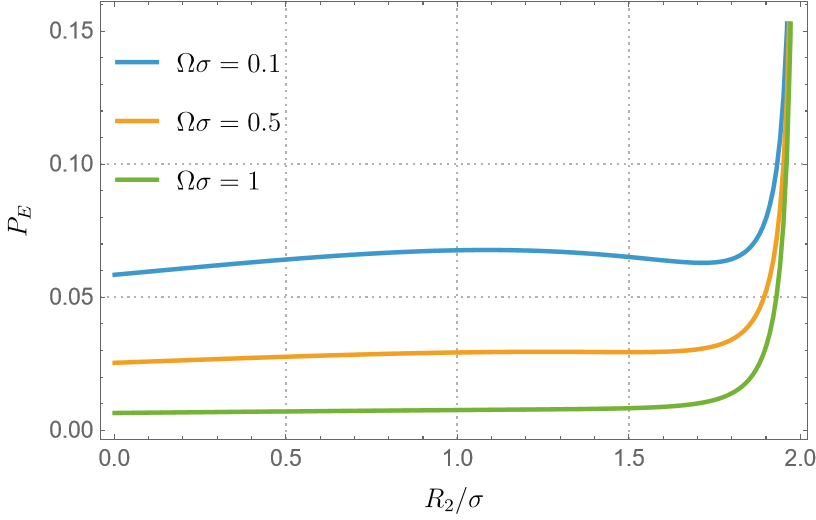
Figure 8: Response as a function of varying concentric circle radius.
Effective Temperatures: Deviation from Thermality
Effective temperature ∣ψ⟩1 is extracted via detailed balance,
∣ψ⟩2
in the finite switching-time regime, with KMS thermality recovered for infinite interactions and stationary trajectories. Across all scenarios, superpositions generally yield increased sensitivity of ∣ψ⟩3 to the gap ∣ψ⟩4—a strong departure from exact thermality. In the case of equal-radius displaced circles, temperatures at ultra-high velocities can even exceed those of classical detectors on either path, while for static-orbit superpositions the effective temperature can be substantially lower and vary non-monotonically with ∣ψ⟩5.
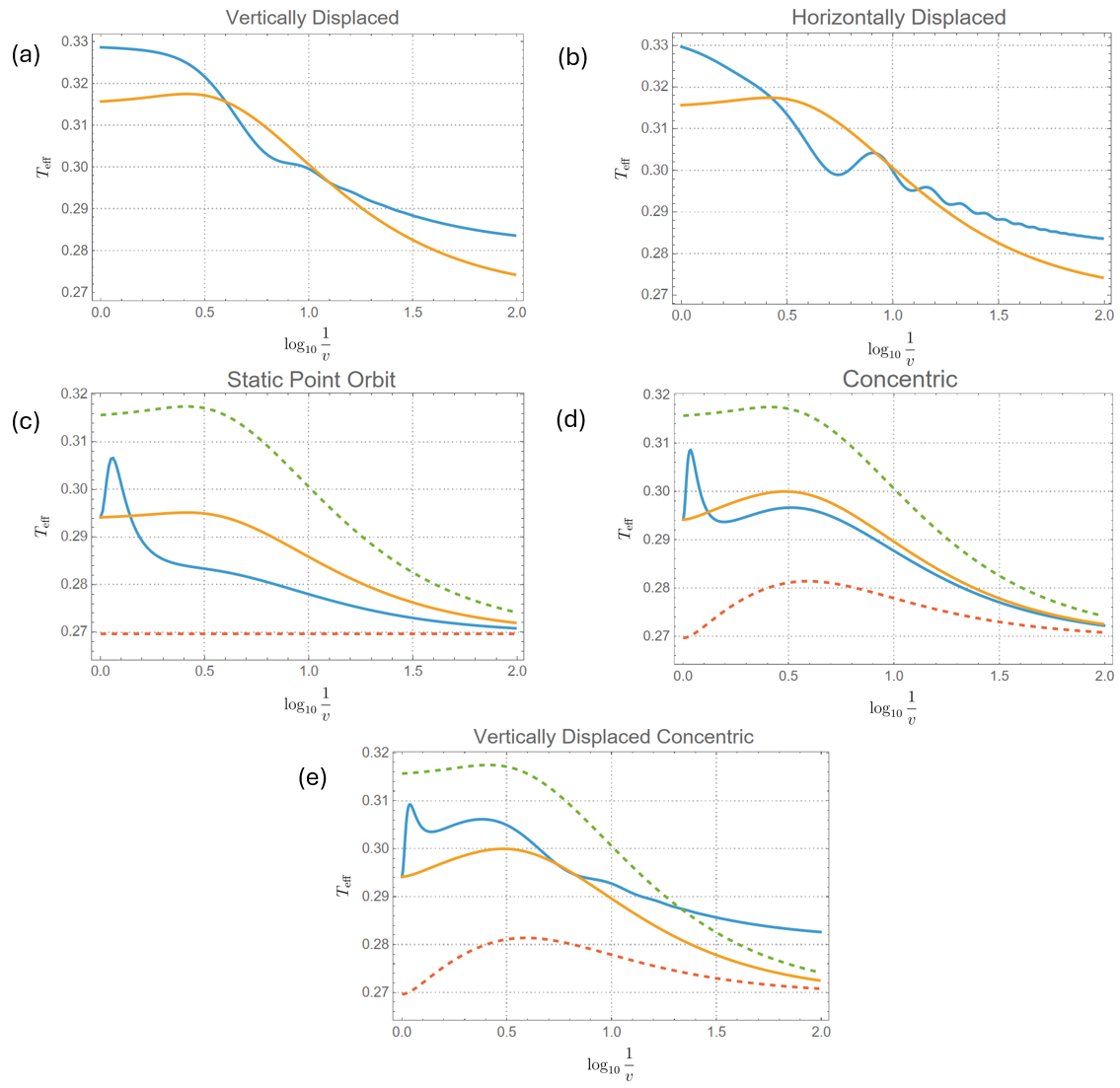
Figure 9: Comparison of ∣ψ⟩6 for superposed (blue) and mixed (orange) trajectories. Oscillations and regime-dependent enhancement/suppression are clear.
In the regime of large switching times, as appropriate for analog quantum simulation, the detailed balance approaches the KMS form. Here, interference-induced deviations from Unruh’s linear ∣ψ⟩7 law are minimal for vertically stacked circles but evident for static-orbit superpositions, where ∣ψ⟩8 can be greatly suppressed for small gap.
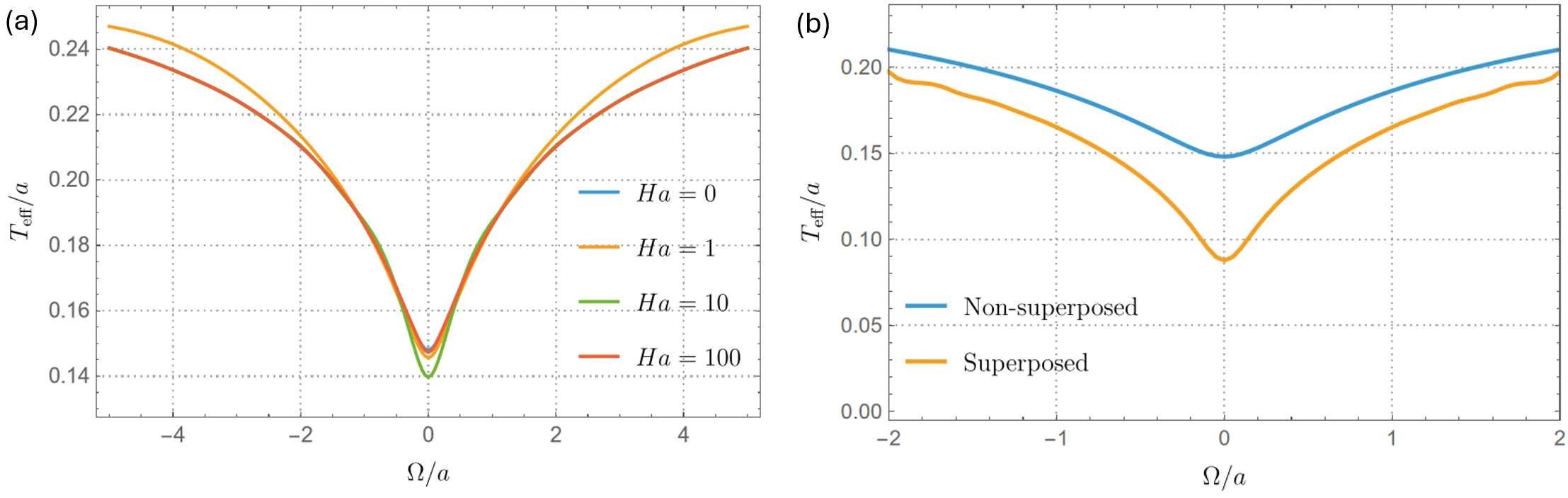
Figure 10: Effective temperature for vertically (a) and horizontally (b) displaced circular trajectories as a function of energy gap, highlighting dependence on displacement and superposition.
Implications and Experimental Outlook
The central practical implication is that off-diagonal quantum interference from superposed trajectories can qualitatively alter both the excitation spectrum and the estimated “Unruh temperature” of a local probe, particularly for arrangements with distinct classical parameters or nontrivial spatial separation. This is critical for analog gravity experiments seeking evidence of acceleration-induced thermality: the presence of trajectory superposition must be factored into both theoretical modeling and experimental interpretation. In ultracold atom implementations proposed previously, regimes of moderate switching duration are especially susceptible to observable superposition-induced oscillations, while long-duration, continuous-wave probing would tend to wash out coherent effects except in pathologically designed geometry.
On a theoretical level, these results underline the sensitivity of perceived field thermality to quantum superpositions of observer trajectories, strengthening the operational approach to quantum field theory. The findings may inform further studies in quantum gravity, in particular how semiclassical observers register local field observables when their own classical motion is not sharp, but a quantum control degree of freedom.
Conclusion
The paper gives a comprehensive characterization of UDW detector response, including transition probabilities and effective temperature, for a wide parameter space of superposed circular trajectories in four-dimensional spacetime. Interference effects appear as damping and oscillations in the transition probability and can lead to measurable deviations from classical thermality. The magnitude and nature of these effects depend nontrivially on trajectory geometry, displacement, and interaction time. The results are poised to inform experimental analogues, especially those using ultracold atoms, and stress-test commonly held assumptions on observer-dependent thermality in quantum field theory.

