- The paper introduces a projection-based algorithm that addresses general monotone SIVIs without relying on co-coercivity.
- It leverages Tikhonov regularization combined with increasing batch sizes to ensure almost sure convergence and provide explicit nonasymptotic residual rates.
- The framework bridges theoretical and practical gaps in stochastic inverse variational inequalities, with implications for network equilibrium control and related applications.
Regularized Projection Algorithms for Monotone Inverse Variational Inequalities
Introduction and Motivation
Stochastic Inverse Variational Inequalities (SIVIs) are central to applications involving equilibrium responses under uncertainty, including inverse road pricing and network equilibrium control. The classical treatment of SIVIs has relied heavily on restrictive operator properties, such as co-coercivity or strong monotonicity, limiting their applicability in broader practical scenarios. This paper "Regularized Projection Algorithms for Monotone Inverse Variational Inequalities" (2607.03464) addresses these limitations by developing a projection-based algorithmic framework capable of handling general monotone SIVIs without assuming co-coercivity.
The primary focus is on establishing robust algorithmic methods, specifically leveraging Tikhonov regularization combined with variance-controlled stochastic batching. Theoretical foundations are built to guarantee almost sure convergence as well as provide the first explicit nonasymptotic residual rates for monotone SIVIs.
The SIVI is formally defined as seeking x∗∈X such that for a monotone, Lipschitz continuous mean operator F(x)=E[G(x,ξ)], the equilibrium condition
⟨y−F(x∗),x∗⟩≥0,∀y∈X
is satisfied, where X⊂Rn is convex and closed. The operator G encapsulates the stochastic behavior, with ξ representing randomness inherent to the system.
Real applications include inverse traffic toll design, where the control vector (tolls) induces equilibrium flows fitting certain engineering or environmental constraints, and resource-constrained network equilibria, such as supply-demand management in commodity networks. The inverse mapping F−1 is frequently absent or computationally intractable, necessitating "inverse-free" solution methodologies.
Methodology: Regularized Projection and Variance Control
The proposed method, RVC-IPG (Regularized Variance-Controlled Inverse Projected Gradient), reformulates the SIVI as a fixed-point projection equation:
F(x∗)=PX(F(x∗)−ηx∗)
for some η>0, equivalently representing the optimal equilibrium condition.
To mitigate ill-posedness and stabilize the iterates under monotonicity, Tikhonov regularization is applied, introducing a strongly monotone Φ(x) with regularization parameter F(x)=E[G(x,ξ)]0. The regularized operator becomes F(x)=E[G(x,ξ)]1. Stochastic variance is controlled via increasing batch sizes F(x)=E[G(x,ξ)]2 at iteration F(x)=E[G(x,ξ)]3, providing increasingly accurate estimates for the expectation.
The iterative scheme updates:
- Projected stochastic estimate: F(x)=E[G(x,ξ)]4
- Gradient update: F(x)=E[G(x,ξ)]5
Residual mapping F(x)=E[G(x,ξ)]6 measures the violation of first-order optimality; bounding F(x)=E[G(x,ξ)]7 provides explicit convergence guarantees.
Convergence Guarantees and Complexity
Theoretical analysis establishes:
- Almost sure convergence: The distance from iterates to the SIVI solution set diminishes almost surely as F(x)=E[G(x,ξ)]8, regardless of stochastic variance, under monotonicity and Lipschitz conditions.
- Nonasymptotic rate: For carefully chosen parameter schedules (F(x)=E[G(x,ξ)]9, ⟨y−F(x∗),x∗⟩≥0,∀y∈X0, ⟨y−F(x∗),x∗⟩≥0,∀y∈X1, ⟨y−F(x∗),x∗⟩≥0,∀y∈X2), the expected squared residual exhibits
⟨y−F(x∗),x∗⟩≥0,∀y∈X3
This is the first such explicit nonasymptotic rate for monotone SIVIs, achieved without co-coercivity.
The iteration complexity to reach an ⟨y−F(x∗),x∗⟩≥0,∀y∈X4-level solution in expected squared residual is ⟨y−F(x∗),x∗⟩≥0,∀y∈X5, and the cumulative stochastic oracle calls required is ⟨y−F(x∗),x∗⟩≥0,∀y∈X6 for any ⟨y−F(x∗),x∗⟩≥0,∀y∈X7.
The deterministic counterpart (R-IPG) matches this iteration complexity (⟨y−F(x∗),x∗⟩≥0,∀y∈X8), needing exact operator evaluations. This bridges the gap with prior literature focusing on co-coercive or strongly monotone operators.
Numerical Evidence
A synthetic network equilibrium problem—monotone, Lipschitz continuous, but intentionally non-co-coercive—is used for empirical validation. The operator ⟨y−F(x∗),x∗⟩≥0,∀y∈X9 is constructed as X⊂Rn0, with X⊂Rn1 semidefinite, X⊂Rn2 skew-symmetric, and X⊂Rn3 offset; additive Gaussian noise is injected. Regularization is X⊂Rn4, batch sizes vary, and the residual is measured at each step.
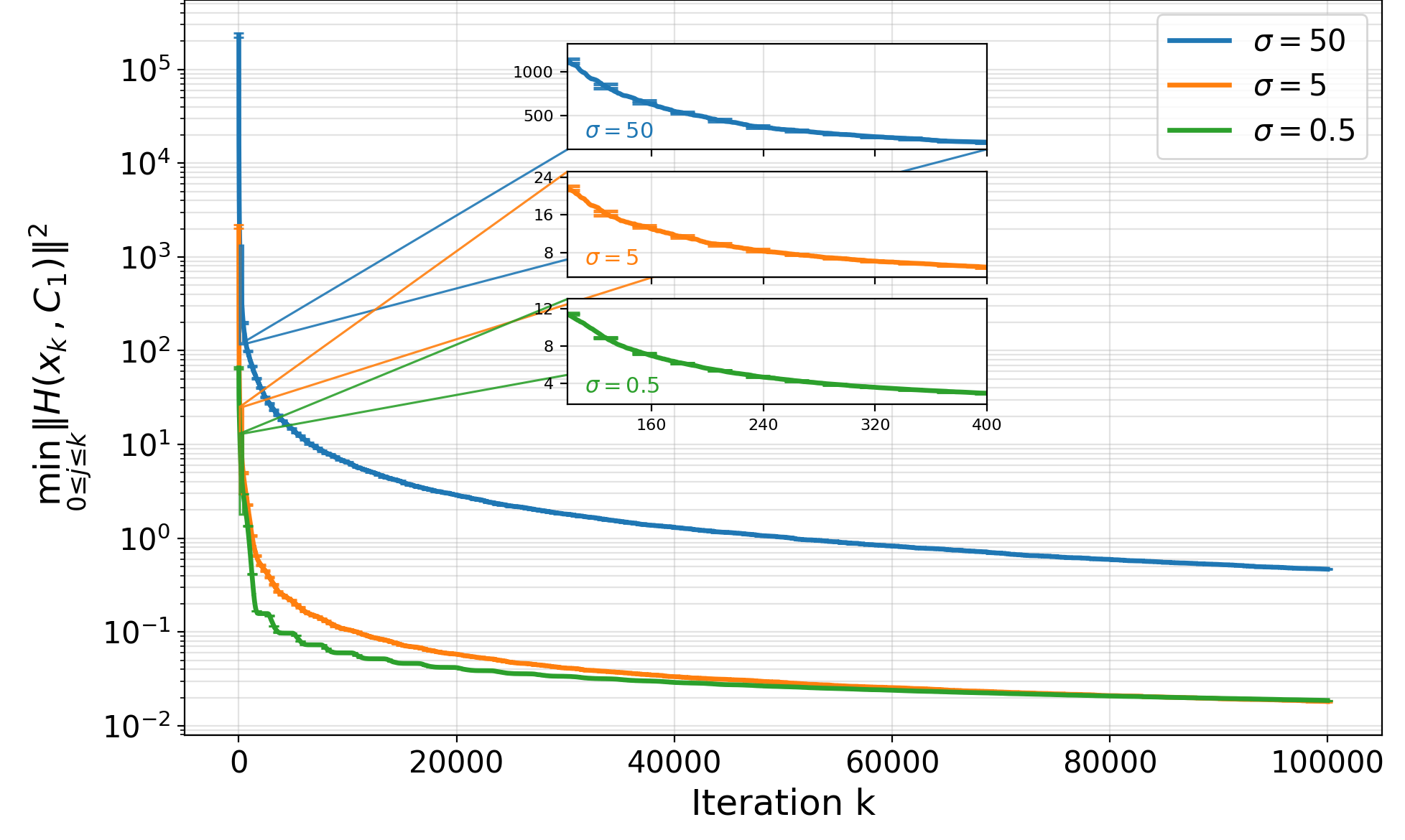
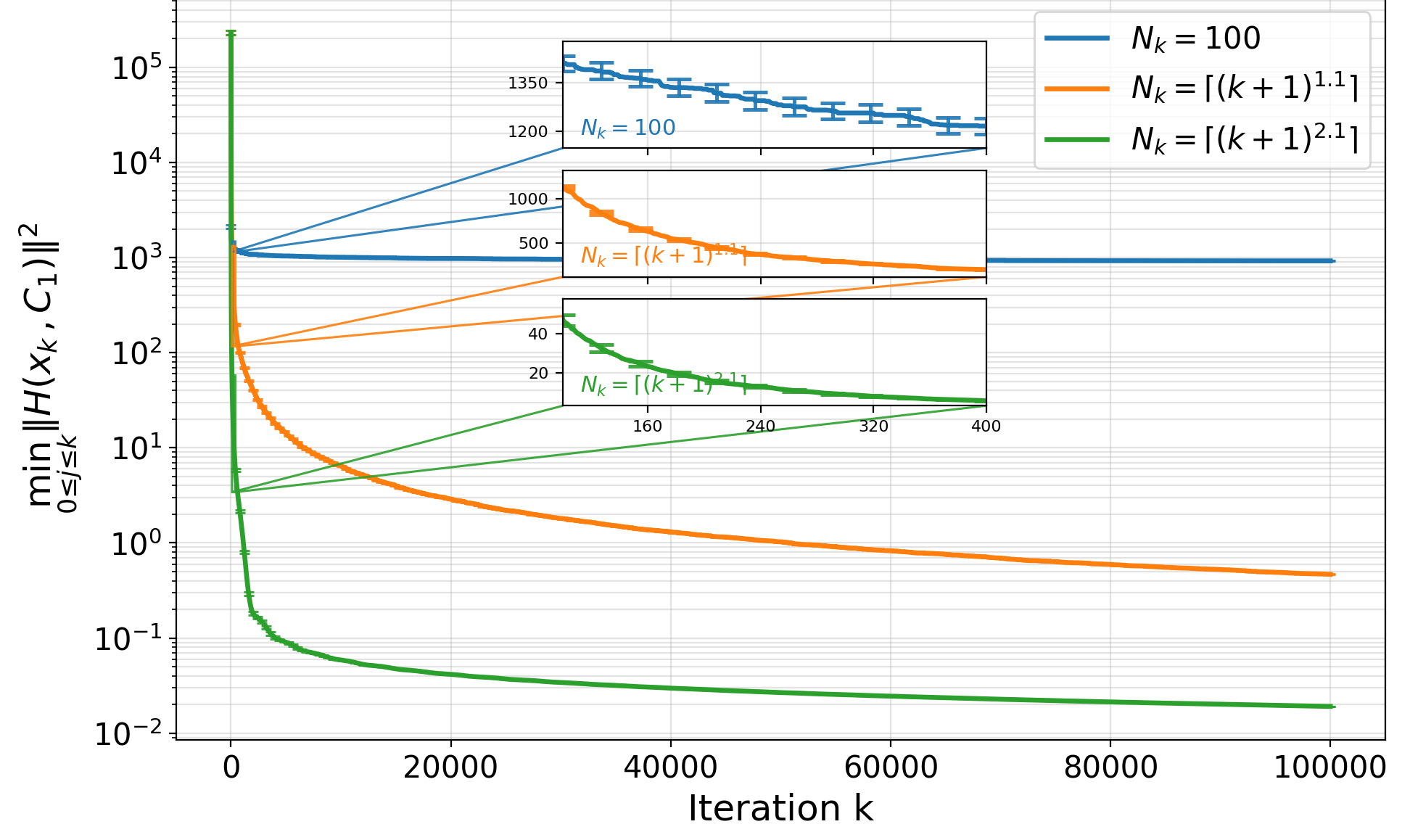
Figure 1: Pointwise residual X⊂Rn5 across iterations for varying noise levels and batch sizes, demonstrating convergence and variance reduction.
Numerical results demonstrate that the residual in the best iterate satisfies the prescribed nonasymptotic rate and that increasing batch size schedules are necessary to suppress stochastic error in practice.
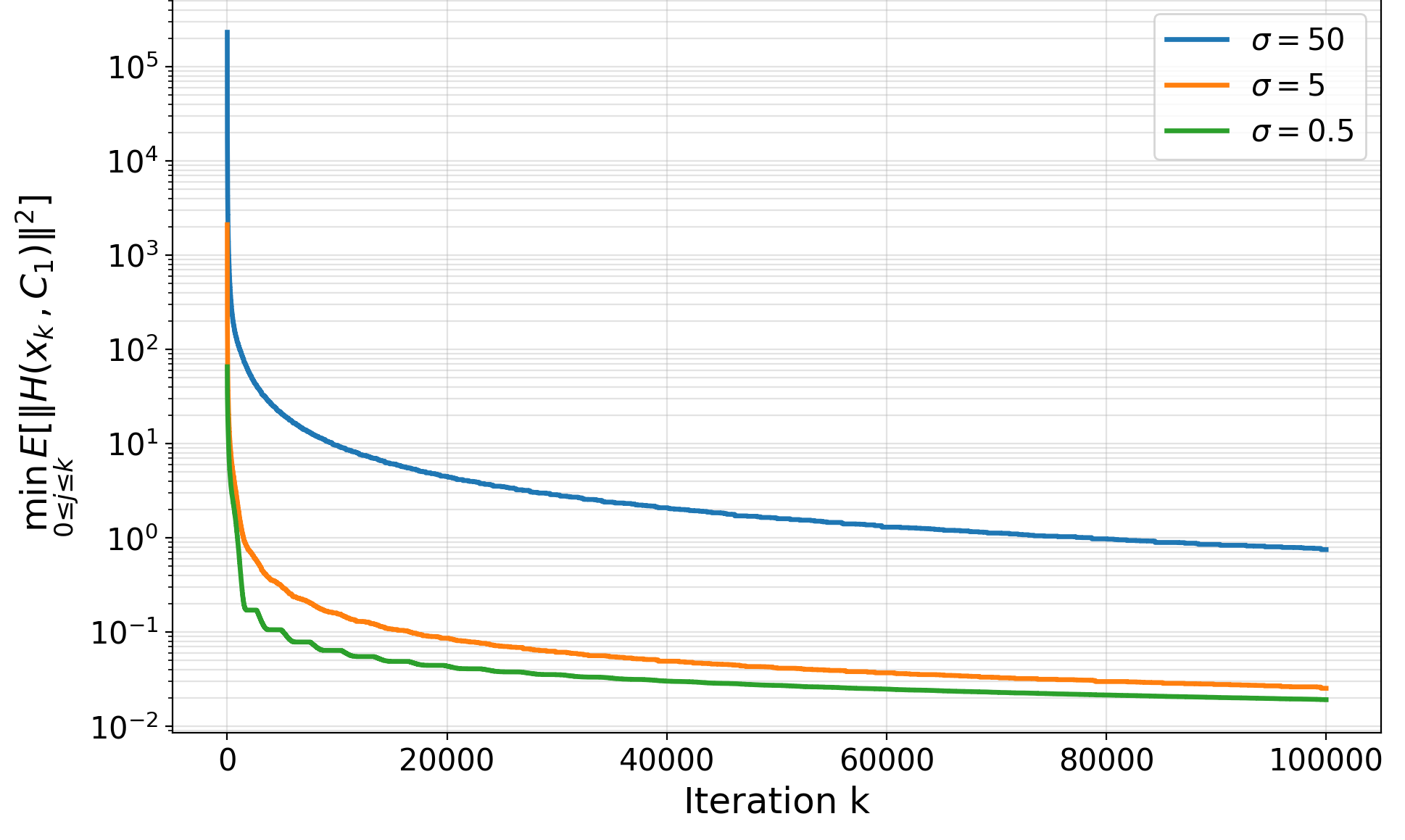
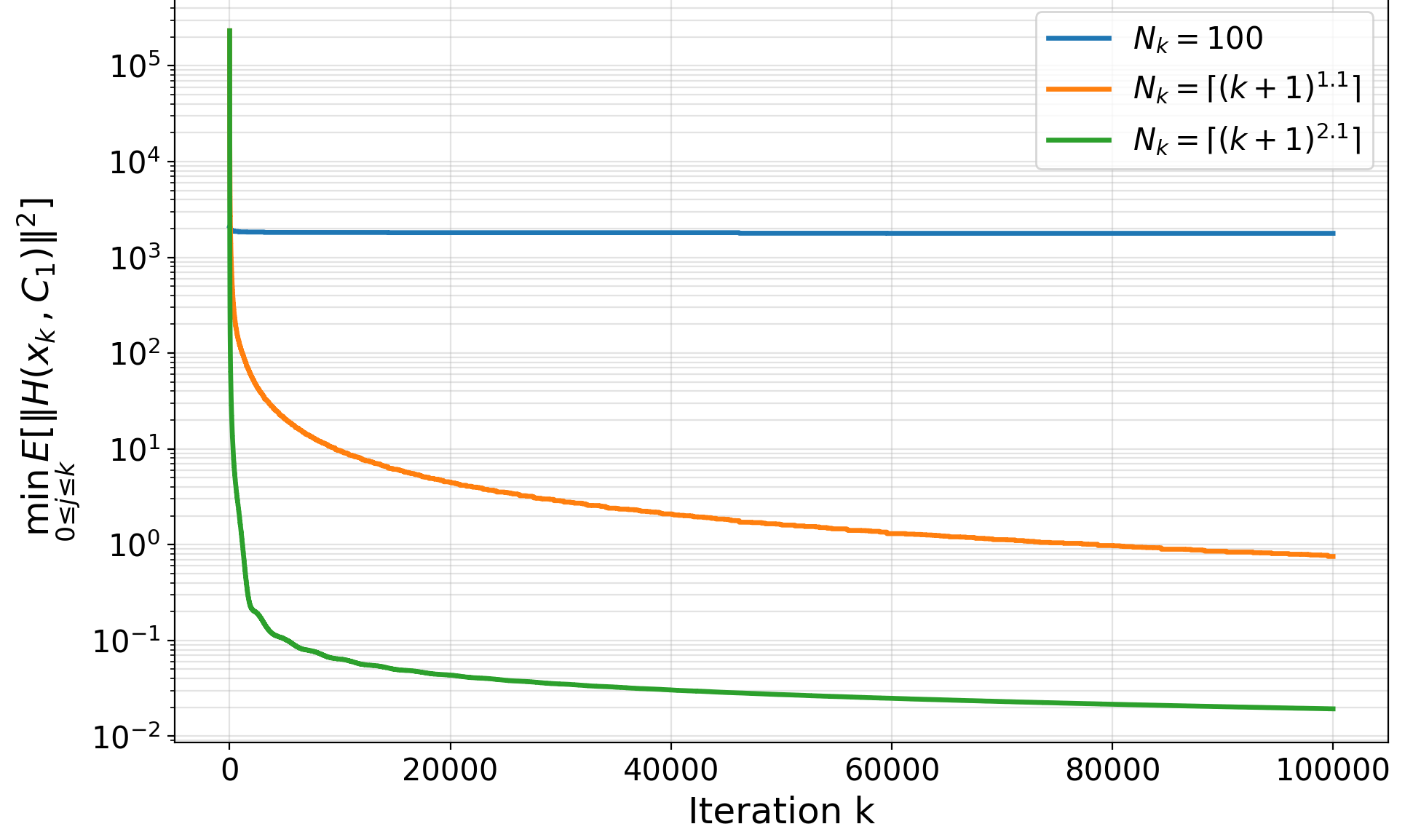
Figure 2: Best residual up to iteration X⊂Rn6, X⊂Rn7, confirming theoretical bounds under varying batch and noise.
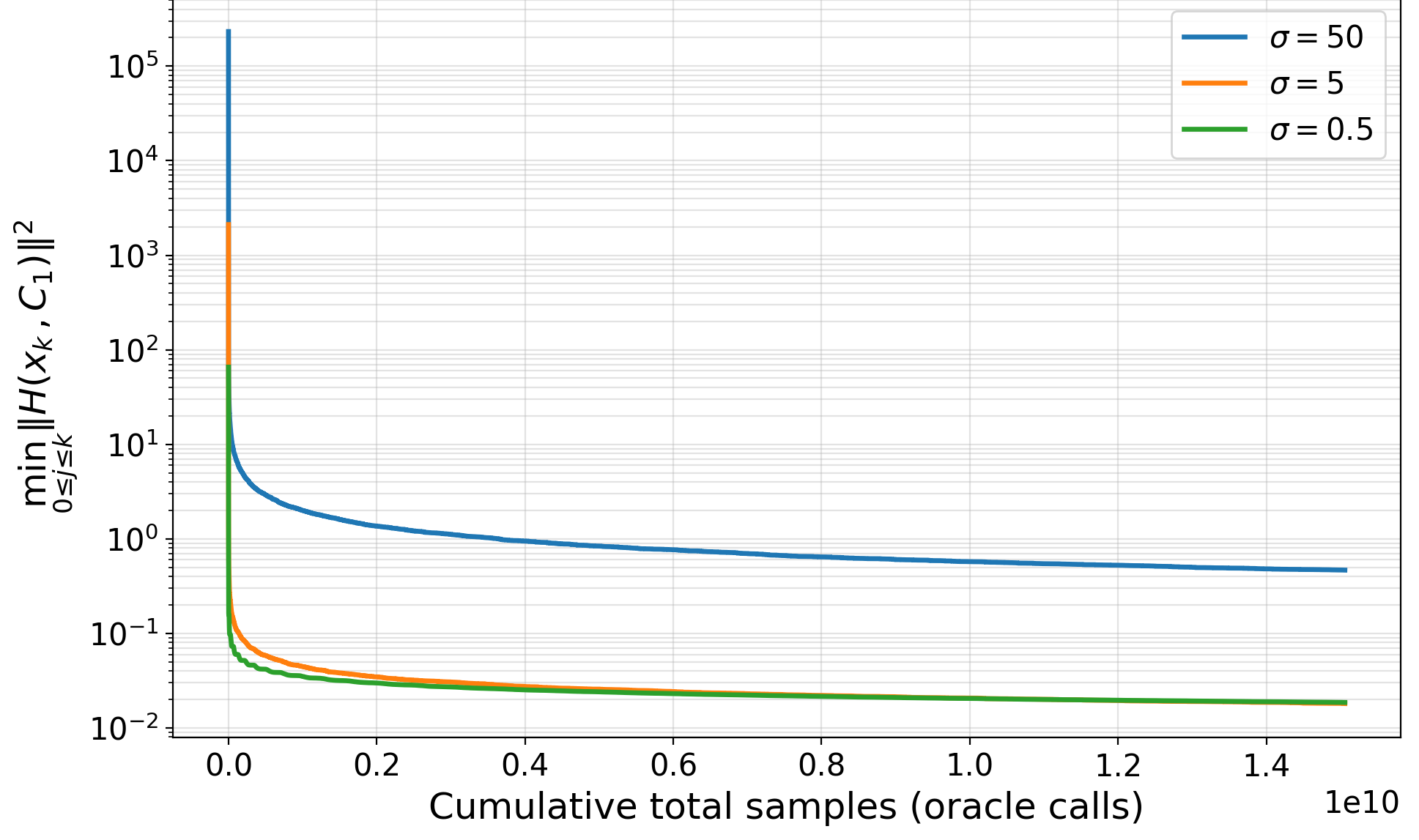
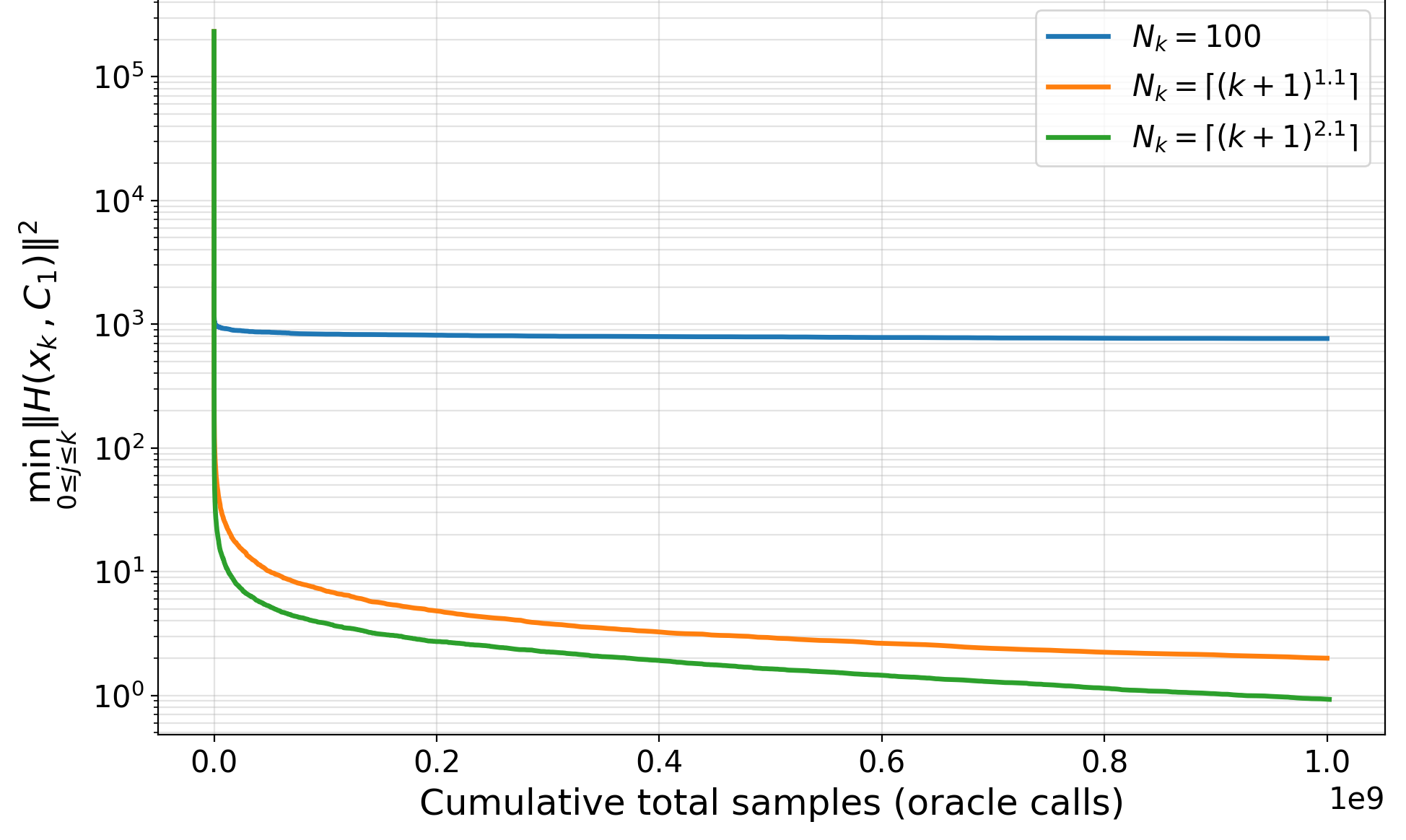
Figure 3: Best residual versus cumulative number of stochastic oracle calls, illustrating trade-offs between residual reduction and sampling effort.
Practical and Theoretical Implications
The paper’s framework substantially extends the applicability of projection-based methods for SIVIs, enabling rigorous convergence under weaker operator properties. From a practical perspective, the methods are relevant for equilibrium control and constrained optimization scenarios in transportation, network economics, and energy systems. The explicit residual rate provides actionable complexity bounds, guiding algorithmic parameterization and computational resource allocation.
On the theoretical side, establishing almost sure boundedness and convergence for monotone SIVIs in the absence of co-coercivity sets a new benchmark for stochastic equilibrium computation. The use of Tikhonov regularization combined with batch size scaling is likely transferrable to more complex, possibly distributed, inverse equilibrium problems.
Future Directions
Anticipated future developments include:
- Incorporating advanced variance-reduction techniques to improve the stochastic oracle complexity.
- Extending the framework to distributed or federated SIVIs, where network constraints and uncertainty are decentralized.
- Derivation of sharper convergence rates under bounded variance assumptions or additional structural properties (e.g., strong monotonicity).
- Application to real-world equilibrium control tasks, leveraging data-driven stochastic operator models.
Conclusion
The proposed regularized projection algorithmic framework for monotone SIVIs establishes both almost sure asymptotic consistency and explicit nonasymptotic residual bounds without requiring co-coercivity or strong monotonicity. Numerical evidence confirms theoretical predictions, and the methodology provides a foundation for scalable, robust equilibrium control in stochastic, monotone systems.