- The paper presents DANCE, a novel method that uses range–null-space decomposition combined with a diffusion prior to accurately estimate channels from sparse DMRS pilots.
- It leverages a noise-adaptive posterior correction mechanism that adjusts for pilot noise variance, demonstrating superior NMSE performance over classical and deep learning-based estimators.
- The framework shows robust performance in low-pilot-density regimes and offers potential extensions to MIMO and frequency-selective channel scenarios in practical deployments.
Diffusion-Based Noise-Adaptive Null-Space Channel Estimation for OFDM Systems
Introduction
The paper "Diffusion-Based Noise-Adaptive Null-Space Channel Estimation for OFDM Systems" (2607.03348) investigates the problem of channel estimation for OFDM receivers operating with sparse and noisy DMRS pilot patterns, which is critical for reliable coherent demodulation in current and future wireless networks (5G NR and beyond). The proposed framework, DANCE (Diffusion-based Noise-Adaptive Null-space Channel Estimation), is designed to address the limitations of classical (LMMSE, LS) and recent deep learning-based estimators, particularly in scenarios with low pilot density, varying DMRS allocation, high pilot noise, and distribution mismatch between training and deployment.
DANCE models DMRS-aided OFDM channel estimation as a sparse linear inverse problem. Each resource element (RE) receives a pilot or data assignment; DMRS pilots are available only on a subset of the time-frequency grid (see (Figure 1)). The classical channel estimation equation is:
Y=P⊙H+N
where P describes the DMRS allocation, H the time-frequency channel, and N the measurement noise.
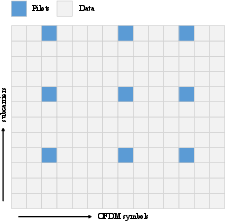
Figure 1: A representative example of a DMRS configuration. The REs highlighted in blue denote DMRS allocations, while the remaining REs are used for data transmission.
The critical insight is a unique orthogonal decomposition based on the measurement matrix:
h=A†Ah+(I−A†A)h
where the first term is the observable (pilot-supported) component, and the second lies in the null space, unrecoverable from measurement alone.
Diffusion Model-Based Estimation and Noise Adaptation
Conventional generative models often learn a direct mapping from sparse observation to full grid, leading to fragility under pilot pattern changes and distribution shifts. DANCE adopts an orthogonal approach: the observable channel is projected from pilot observations, and the unobservable (null-space) component is imputed via a learned diffusion prior—effectively decoupling explicit measurement fitting from generative modeling.
The system block diagram (Figure 2) outlines DANCE’s structure: observed pilot information is processed through range–null-space decomposition, and the null-space component is sampled with a conditional diffusion model.
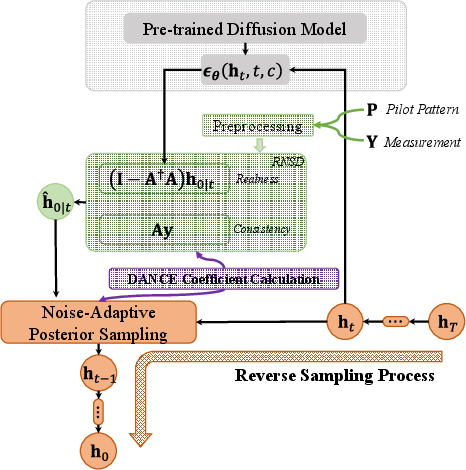
Figure 2: Block diagram of our proposed method DANCE.
In conventional denoising diffusion models, reverse sampling could inadvertently amplify pilot noise if exact projection constraints are imposed. DANCE introduces a noise-adaptive posterior correction—the strength of pilot-based correction and injected residual variance in each denoising step is automatically modulated as a function of pilot noise variance. The resulting mechanism adaptively balances measurement consistency and noise suppression, critical when pilots are severely noisy or sparse.
Conditional Denoising Network Architecture
The U-Net denoising backbone (see (Figure 3)) is specialized for complex-valued OFDM channel grids. Real and imaginary parts are treated as separate features; temporal (OFDM symbol) structure is maintained by restricting downsampling to the subcarrier dimension. The network is further conditioned via classifier-free guidance to enable adaptation to different channel scenarios without re-training.
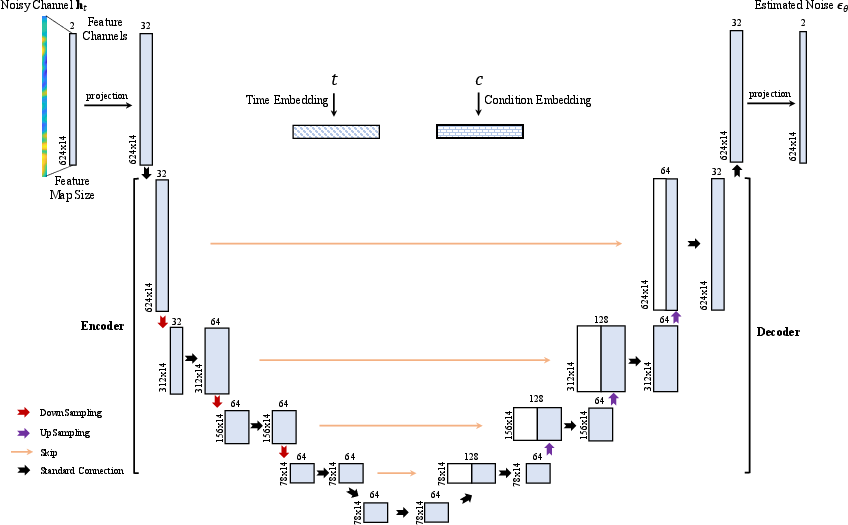
Figure 3: Detailed architecture of the proposed U-Net denoising network. The input noisy channel sample ht and the output estimated noise ϵθ are represented by two feature channels corresponding to real and imaginary parts.
This architecture yields strong generalization, efficient inference, and explicit incorporation of system structure.
Experimental Analysis
Quantitative assessment was performed on synthetic datasets generated from 5G NR TDL and CDL models, spanning a range of SNRs, DMRS densities, Doppler shifts, and degrees of train-test mismatch. Metrics centered on normalized mean squared error (NMSE).
A key empirical result is that DANCE consistently outperforms all baseline estimators—including optimal MMSE (with matched priors), MATLAB 5G Toolbox estimator, and state-of-the-art diffusion-based posterior sampling frameworks (DPS, DMPS)—in the low-pilot-density regime (see (Figure 4)). When the SNR is increased and pilot density rises, baseline methods improve but the gap persists, particularly for learned diffusion-based approaches.
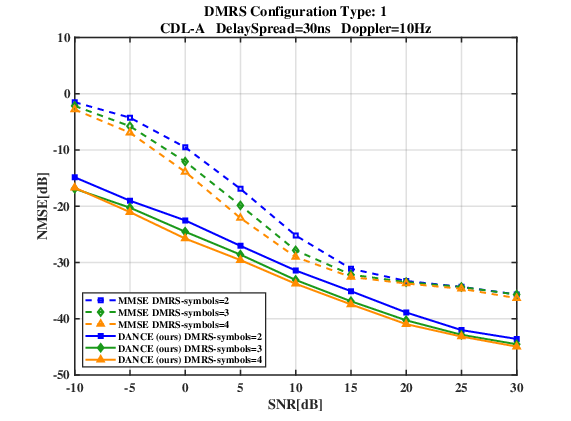
Figure 4: NMSE versus SNR performance under different numbers of DMRS symbols.
Crucially, DANCE exhibits superior robustness to channel and pilot pattern variability. When tested under severe train–test mismatch (OoD generalization), DANCE maintains competitive NMSE, outperforming non-adaptive neural baselines and sometimes even MMSE estimators lacking access to target distribution statistics.
An ablation study confirms that the proposed noise-adaptive posterior correction is strictly beneficial: omission leads to a notable NMSE penalty at high SNR, confirming its importance in balancing measurement information and noise risk under realistic pilot contamination.
Theoretical and Practical Implications
DANCE demonstrates that principled integration of measurement operator structure (via range/null decomposition), adaptive probabilistic correction, and expressive diffusion priors produces a practical estimator for high-dimensional, under-constrained channel inference tasks. The framework accommodates DMRS pattern variability and distributional uncertainty, which are endemic in real-world 5G/6G deployments due to mobility, topology shifts, and hardware imperfections.
Practically, DANCE could be deployed in receivers where CSI estimation from sparse pilot layouts degrades the performance of classical estimators. The modular architecture and computational efficiency (due to pseudo-inverse simplifications for diagonal pilot matrices and DDIM-style fast sampling) further facilitate hardware acceleration or on-chip deployment.
Future Directions
The described framework paves the way for several extensions:
- Extension to MIMO channel estimation via structured matrix priors and array-geometry-aware conditioning.
- Investigation of joint channel estimation and data detection with end-to-end differentiable receivers.
- Online adaptation mechanisms for real-time updating of the diffusion prior in the presence of changing propagation environments.
- Extension to frequency-selective fading scenarios with highly nonstationary channel statistics.
Conclusion
DANCE presents a principled, robust, and practical solution for OFDM channel estimation with sparse and noisy pilots, leveraging a range–null-space split augmented by diffusion-based learned priors and noise-adaptive posterior correction. The approach sets a new performance baseline for pilot-limited CSI acquisition tasks in OFDM systems, demonstrating strong NMSE gains, pattern generalization, and real-world adaptability.