- The paper demonstrates that closed-loop filters effectively constrain error growth and improve attitude estimation during extended flights, especially with low-grade sensors.
- It systematically compares both architectures using a 15-state error-state Kalman filter under various flight profiles and IMU quality levels.
- The study reveals that while open-loop filters may offer short-term accuracy with high-end sensors, they are prone to divergence when initialization errors and bias exist.
Comparative Analysis of Closed-Loop and Open-Loop Kalman Filter Architectures in Airborne Aided Inertial Navigation
Introduction
The paper "Closed-loop vs. Open-loop Kalman Filter Architectures in Airborne Aided Inertial Navigation" (2607.03338) delivers a rigorous assessment of two dominant Kalman filter architectures—closed-loop (feedback) and open-loop (feedforward)—in the context of airborne aided inertial navigation. This work is motivated by the architectural divergence between safety-critical airborne platforms, which typically rely on open-loop designs for fault isolation and operational independence, and autonomous robotic systems, which favor closed-loop designs for enhanced error correction in low-grade sensor environments. The authors present a controlled comparative study, employing identical mathematical baselines, to systematically isolate the impact of architectural choice on estimation performance across a range of IMU grades, operational trajectories, and initialization scenarios.
Theoretical Framework
The study implements a 15-state error-state Kalman filter (ESKF) in geodetic coordinates, encompassing position, velocity, attitude, and IMU bias states. Both architectures utilize identical state and error dynamic models, discretized with standard geodetic inertial navigation equations, and process bias dynamics via first-order Gauss-Markov models. The measurement update is realized with direct position aiding, representative of GNSS or equivalent absolute position sensors.
Closed-loop architectures inject estimated errors and biases directly back into the INS nominal state after each measurement update, resetting the error state. This mechanism limits the linearization region and suppresses compounding drift. In contrast, open-loop architectures maintain the mechanized INS solution independently, apply filter corrections externally, and preserve isolation. Error states are never reset, resulting in gradual deviation from the linearization validity as drift accumulates.
Simulation Setup
The paper's numerical analysis spans a comprehensive set of flight profiles, including dynamic and static (straight) trajectories, ranging from 5 minutes to 95 minutes with varying average velocities. Sensor models represent three IMU grades: consumer (∼10−2 VRW, ∼10−1 bias), tactical (∼10−4 VRW, ∼10−3 bias), and navigation-grade (∼10−12 VRW, 10−5 bias). Monte Carlo evaluations are performed over 50 runs per configuration. Position observations are sampled at 20 Hz and corrupted with 1 m white Gaussian noise. Filters are examined both with and without a constant bias initialization error to probe robustness and convergence dynamics.
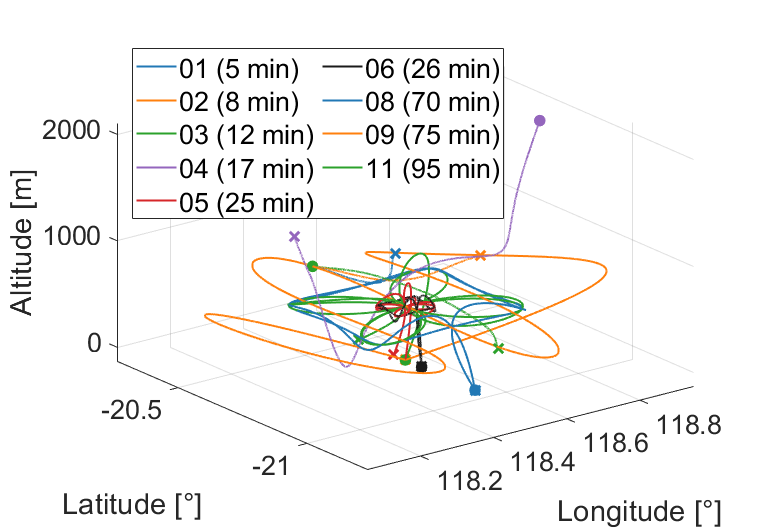
Figure 1: 3-D profiles of the dynamic trajectories evaluated; straight paths for Trajectories 07 and 10 are excluded.
Numerical Results and Architectural Impact
Position Estimation and Architectural Crossover
Performance analysis reveals a distinct trade-off boundary: for high-grade IMUs or short flight durations, open-loop filters yield lower position RMSE, leveraging noise isolation and minimizing direct coupling from measurement perturbations. As trajectory length increases or sensor grade diminishes, position errors in open-loop configurations grow rapidly, eventually diverging from the linearization validity regime. Closed-loop architectures, via error injection and state reset, enforce bounded error growth and retain stability even in low-grade sensor contexts or extended time horizons.
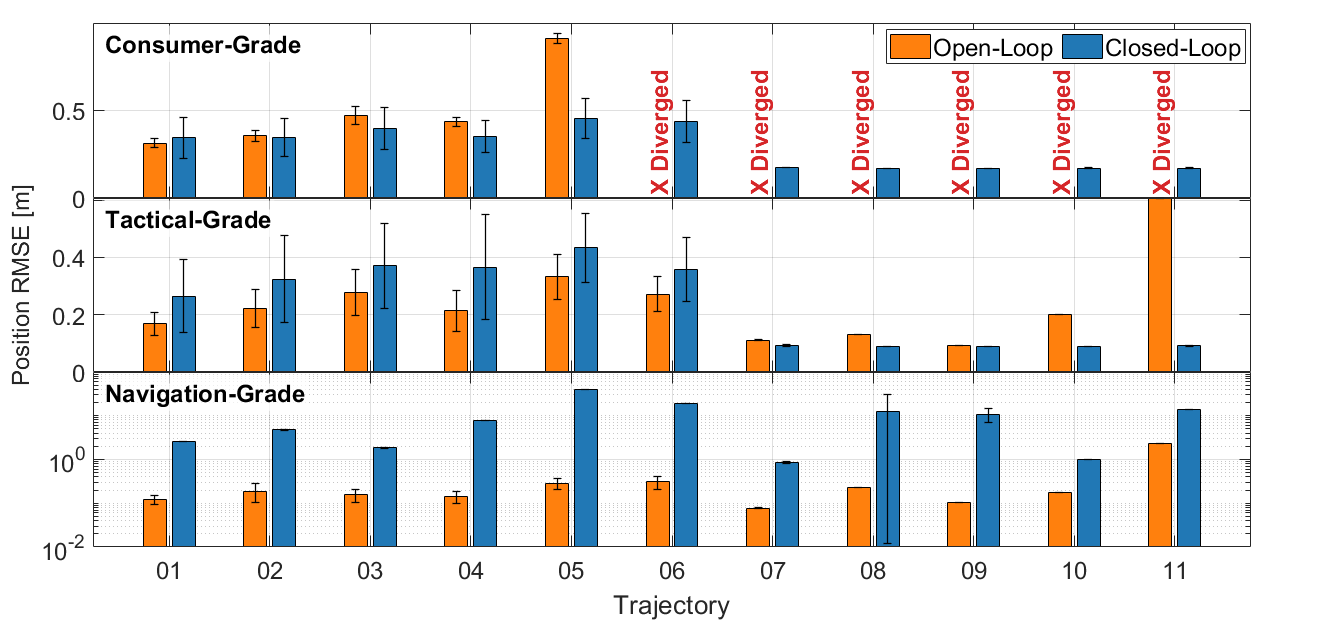
Figure 2: Monte Carlo position RMSE and standard deviation per trajectory across IMU grades without accelerometer bias offset.
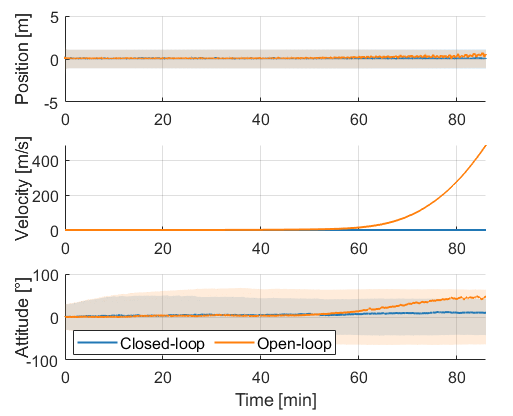
Figure 3: Position, velocity, and attitude errors with 3σ uncertainty for a 90-minute straight flight comparing closed- and open-loop filters with tactical IMU.
Attitude Estimation and Observability
Attitude RMS error analysis demonstrates closed-loop filters outperform open-loop designs in roll and pitch estimation for consumer and tactical IMUs. Yaw estimation, constrained by low heading observability and higher susceptibility to noise injection, favors open-loop architectures in high-grade sensor regimes for heading preservation.
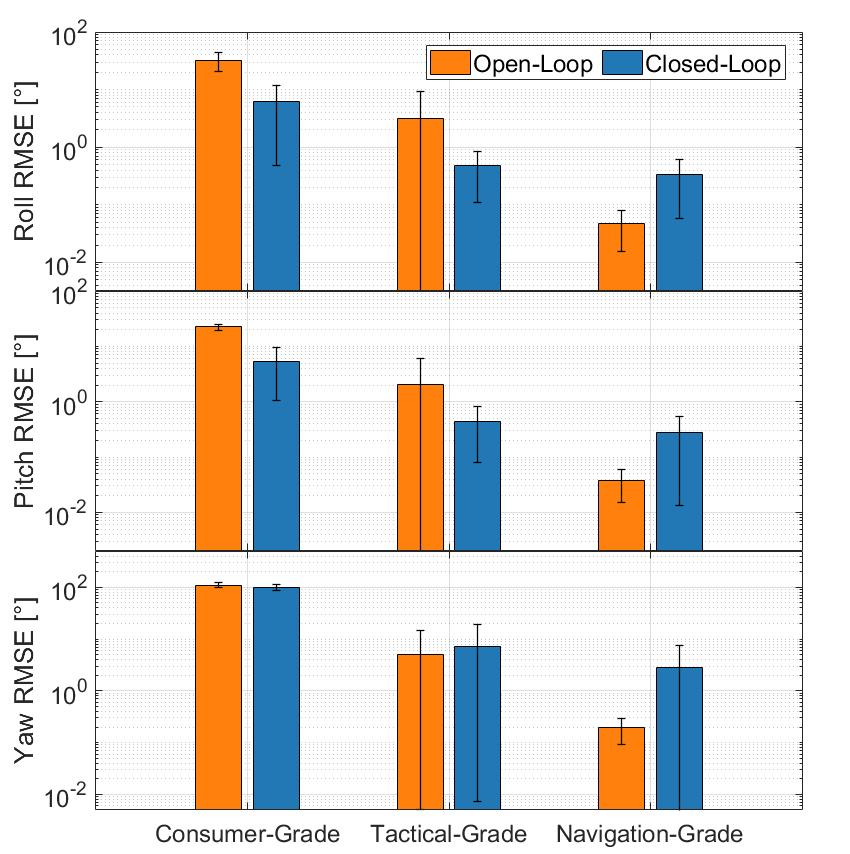
Figure 4: Attitude RMSE averaged over all trajectories and IMU grades, without initial accelerometer bias offset.
Sensitivity to Initialization Bias
Introduction of a constant unmodeled bias triggers architectural instability in open-loop filters. While initial performance appears stable, uncorrected bias amplifies over time, inducing filter divergence. Closed-loop filters rapidly isolate and mitigate initial bias, preserving bounded error convergence even under observability-limited trajectories.
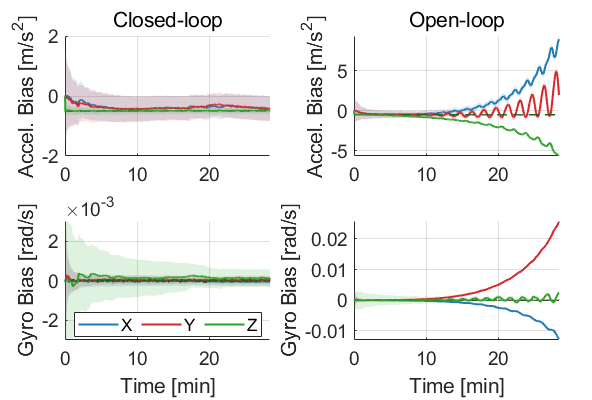
Figure 5: Accelerometer and gyroscope bias estimates with 3σ uncertainty for a 30-minute straight trajectory; impact of initialization bias.
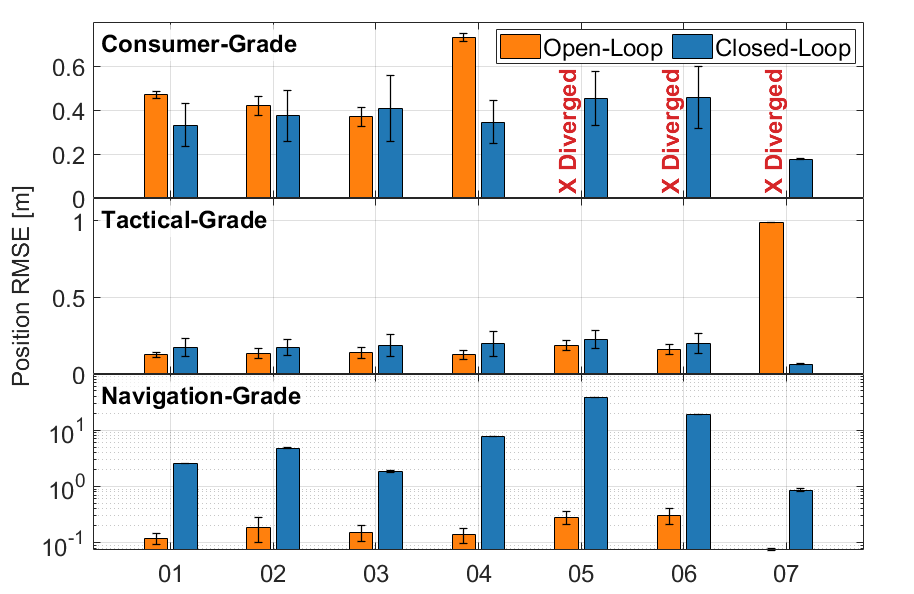
Figure 6: Position RMSE and standard deviation per trajectory for shorter durations with initial accelerometer bias offset.
Practical and Theoretical Implications
The results reinforce the established paradigm: closed-loop filtering is mandatory for platforms utilizing low-grade or marginal IMU hardware, ensuring convergence, consistency, and bounded error propagation. For high-end IMUs, open-loop architectures not only facilitate operational independence and fault isolation, as required in safety-critical avionics, but also deliver superior short-to-intermediate estimation accuracy by decoupling measurement fusion from inertial mechanization. The architectural crossover—where open-loop filters transition from superior to inferior performance—is a function of sensor grade, trajectory observability, and time horizon.
From a theoretical perspective, this paper elucidates how structural propagation pathways—not merely filter tuning—dictate the error accumulation dynamics and nonlinear regime violations, particularly in open-loop Kalman filters. The impact of initialization errors and observability, especially in scenarios with unmodeled bias and dynamic trajectories, is quantitatively demonstrated, leading to architectural guidelines for navigation system designers.
Speculative Outlook
Future advancements in AI-driven adaptive filtering, tightly coupled sensor fusion, and quantum-assured navigation (e.g., (Muradoglu et al., 10 Apr 2025)) can further extend the envelope of filter applicability. Integration with invariant filtering paradigms on matrix Lie groups (e.g., [maurer_equivalence_2025], [BarrauBonnabel2018_IKF]) may enhance local consistency and robustness to nonlinear error propagation, particularly for robotic platforms and emerging aerial vehicles. Architectures leveraging online noise covariance estimation and innovation-based adaptive estimation (e.g., [Mehra1970], [Jwo2008], [Meng2016]) may enable further real-time performance optimization and resilience to nonstationary sensor behaviors.
Conclusion
This study provides a systematic evidence base for choosing between closed-loop and open-loop Kalman filter architectures in airborne navigation, grounded in formal performance evaluations across a spectrum of IMU grades and operational scenarios. Open-loop architectures maximize accuracy and operational safety for high-end sensors, while closed-loop designs remain essential for platforms with constrained hardware or adversarial initialization conditions. The results establish practical boundaries and invite further exploration in adaptive filtering and invariant state estimation to address the evolving needs of both safety-critical and autonomous platforms.

