- The paper demonstrates that any coarsely separating subset in ℝ^d must have asymptotic dimension at least d-1 by employing a finitary combinatorial topology approach.
- It leverages classical algebraic tools like singular cohomology and Alexander duality to bypass specialized coarse cohomological machinery.
- The method yields new rigidity results and obstructions to coarse embeddings, with applications to Euclidean buildings and graphs of groups in geometric group theory.
Finitary Methods in Coarse Separation of Euclidean Spaces
Introduction
This work presents a fundamentally new approach to the coarse separation problem for Euclidean spaces, focusing on a finitary reduction enabling proofs through classical algebraic topology—specifically, singular cohomology and Alexander duality—rather than coarse cohomological frameworks. The main technical contribution is the demonstration that any coarsely separating family of subsets in Rd must have asymptotic dimension at least d−1. This is realized by establishing a finitary analog of the large-scale separation phenomenon, then extracting implications for general spaces with quasi-flats.
The author's method avoids specialized machinery (such as coarse Alexander duality in Roe's theory) and yields immediate applications to Euclidean buildings and products of geodesic spaces. The finitary approach further enables new obstructions to coarse embeddings of Euclidean spaces into certain groups' graphs-of-groups, providing a tool for rigidity phenomena in geometric group theory.
Coarse Separation and Asymptotic Dimension
The concept of coarse separation generalizes classical separation in topology to the large scale: a family S coarsely separates a metric space X if, after thickening each S∈S by some L>0, the complement X∖NL(S) has at least two unbounded connected components, and the separation can be detected arbitrarily far from S. This is fundamental in geometric group theory, for instance in the context of group splittings and quasi-isometric rigidity.
An essential large-scale invariant, the asymptotic dimension asdim, measures how spaces can be covered by uniformly bounded sets at large scales with controlled intersections. The paper builds on prior results that any subset coarsely separating Rd must have d−10, and for general coarse d−11 spaces, the result was previously known via coarse cohomological methods.
Property d−12 and Generalization
A key innovation is abstraction to property d−13: a metric space d−14 has d−15 if for any pair of points, one can isometrically embed a scaled copy of d−16 containing both, up to bounded distortion. This subsumes Euclidean buildings, products of d−17 geodesically complete spaces, and (trivially) d−18 itself.
The main theorem is:
If d−19 has S0 and a family S1 coarsely separates S2, then S3.
This statement extends to all spaces that are unions of large-scale Euclidean pieces, not just the standard S4.
Finitary Reduction: Cubes and Covers
The proof strategy crucially involves a reduction to a finitary statement about families of subsets S5 in growing cubes, with explicit distance separation from the Euclidean boundary and between the connected complements.
The core finitary theorem asserts that any such family of subsets, if separating cubes in this strong sense, will have S6. The argument proceeds by:
- Constructing fine covers of cubes with controlled mesh and multiplicity.
- Tracking separation properties through nerves of these covers, shown to be homeomorphic to simplicial S7-disks (S8).
- Applying classical Alexander duality to the combinatorial data to extract lower bounds on the asymptotic dimension.
This approach leverages ordinary algebraic topology—singular cohomology, relative cohomology of nerve pairs, and topological separation theorems—bypassing the need for coarse cohomological machinery.
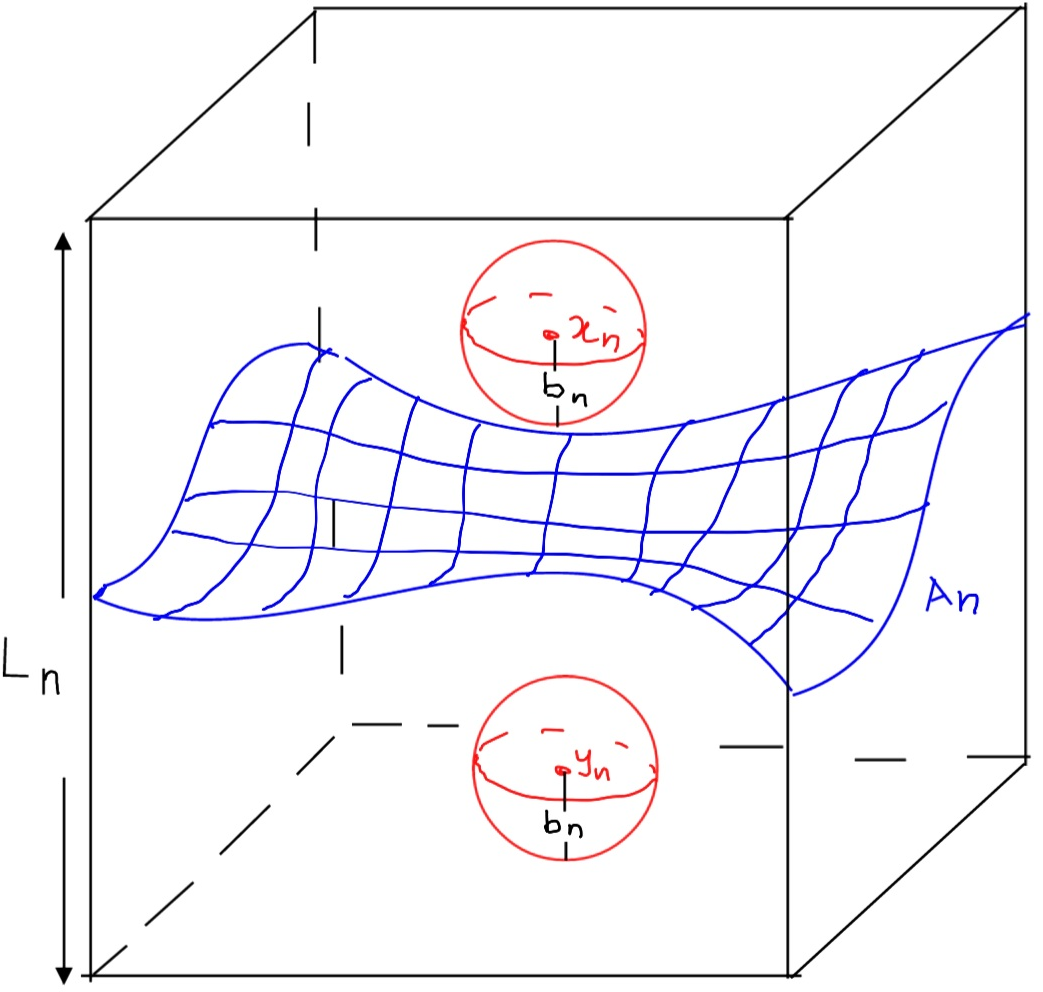
Figure 1: Depiction of a separating subset in a high-dimensional cube; illustrating how the subsets S9 must bisect the cube and remain far from the boundary.
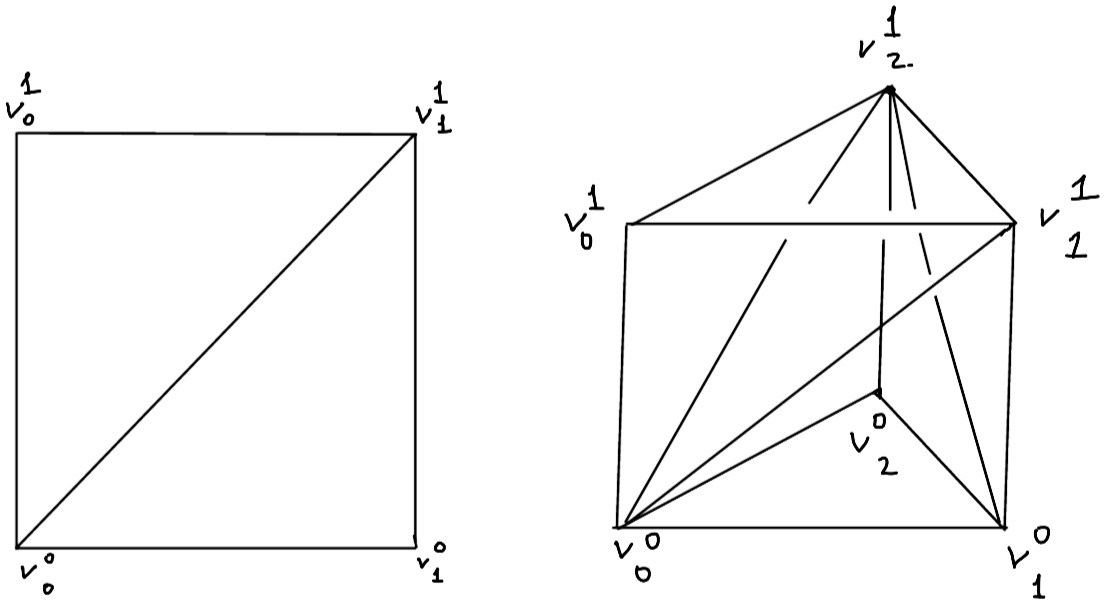
Figure 2: Triangulation and barycentric subdivision of the cube’s partition into smaller subcubes with mesh control.
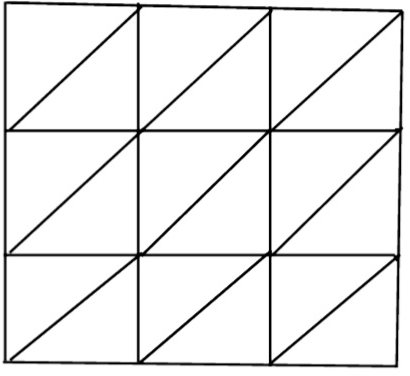
Figure 3: Local structure of the covering sets and their intersection patterns.
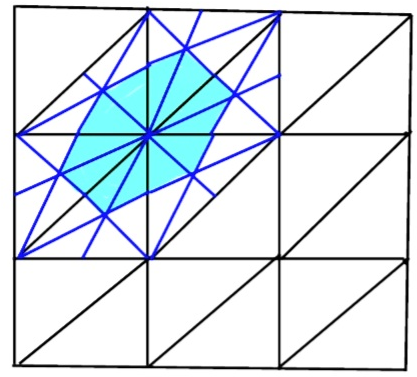
Figure 4: Schematic of the nerve of the cover, showing correspondence with a X0-disk.
Structural and Technical Lemmas
The technical sections detail the construction of covers with desirable properties:
- Barycentric subdivision is exploited to make geometric and combinatorial control precise.
- The nerves of covers, subjected to multiple scalability and refinement steps, retain topological disk structure, enabling duality applications.
- Careful control is maintained on the interaction of the covers with the boundary of the cubes, ensuring that the algebraic topology captures large-scale “codimension one” effects.
Key lemmas demonstrate connectivity properties and regular neighborhoods in combinatorial complexes, which underpin the topological arguments. The machinery can be extended to show naturality of Alexander duality under refinement maps induced by cover upgrades, ensuring that cohomology classes are functorially transported.
Applications to Coarse Embeddings and Graphs of Groups
Using the main finitary theorem, the author derives obstructions to coarse embeddings:
- If X1 has property X2 and X3 is a graph of spaces with edge-spaces of X4, then every coarse embedding X5 factors, up to finite distance, through a vertex space.
- This yields new rigidity and non-embedding results for high-dimensional Euclidean spaces into groups presented as graphs of groups—e.g., certain HNN-extensions and amalgamated products.
Such results link asymptotic dimension, group splittings, and large-scale geometry, connecting classical topological separation theorems with modern geometric group theory.
Implications and Future Directions
The finitary, classical-topological approach both clarifies and extends the coarse separation principle. By eschewing coarse cohomology in favor of standard tools, the proofs become more transparent and more broadly applicable, especially in contexts where large-scale coarse X6-space structure is absent but quasi-flats abound.
The flexibility of the method suggests further applicability to other spaces with nontrivial separation structure—such as rank one symmetric spaces, hyperbolic buildings, and possibly beyond.
The explicit link to cubical and simplicial decompositions, and the fine control over relative (co)homology through covering nerves, also suggests consequences for the quantitative topology of large metric spaces and for computational approaches to asymptotic invariants.
Conclusion
This paper establishes that any family of subsets coarsely separating X7—or, more generally, any space with a rich system of X8-dimensional quasi-flats—must have asymptotic dimension at least X9. The author achieves this through a reduction to explicit finitary, combinatorial topology in Euclidean cubes, employing only tools from classical algebraic topology. Applications include new rigidity results for coarse embeddings, especially in the context of geometric group theory, and avenues for further generalizations to other large-scale geometric settings.