- The paper introduces the first explicit Type II singularities in LMCF, exhibiting controlled curvature blow-up rates of (T-t)^(-K/2).
- It employs a modulation ansatz and spectral perturbation techniques to reduce the nonlinear PDE to finite-dimensional dynamics.
- The work provides rigorous analysis in Calabi–Yau settings, offering a new testbed for studying singular behavior in geometric flows.
Quantitatively Precise Dynamics for Finite-Time Singularities in Lagrangian Mean Curvature Flow
Introduction and Motivation
The paper "Finite-Time Singularities of Lagrangian Mean Curvature Flow with Quantitatively Precise Dynamics" (2607.03152) provides the first explicit construction of finite-time Type II singularities for the Lagrangian mean curvature flow (LMCF) in Cn that exhibit precise, quantifiable curvature blow-up rates. The context is the analytical and geometric study of Lagrangian submanifolds under curvature-driven flows, particularly in Calabi–Yau settings, with strong implications for existence and stability questions such as those raised by the Thomas-Yau conjecture.
Prior studies established the inevitability and genericity of singularities for LMCF but lacked constructions with fully explicit PDE-controlled, quantitative dynamics. The present work remedies this by demonstrating the emergence and evolution of singularities at exact rates, corresponding to geometric models derived from spectral perturbation theory.
Main Theorem and Singular Model Construction
The core result is the explicit construction, for each integer K≥2 when n≥4 (and K=2,3,4 when n=3), of almost-calibrated G-invariant Lagrangian flows LK(t)⊂Cn with the following features:
- Finite-Time Singularities: LK(t) develops a singularity at time T=T(n,K)<∞ at the origin.
- Sharp Curvature Blow-Up Rate: The second fundamental form satisfies
supLK(t)∣ALK(t)∣∼(T−t)−K/2
as K≥20.
- Type II Nature: Blow-up proceeds faster than the Type I regime, with the rate strictly controlled by the parameter K≥21.
- Geometric Structure: The tangent flow at the singularity is a transverse pair of cohomogeneity-one special Lagrangian cones; the Type II blow-up limit is a smooth, cohomogeneity-one special Lagrangian desingularization (Lawlor neck).
- Quantitative Modulation: The flow is described by a dynamical modulation around rescalings of the Lawlor neck solution; the profile function K≥22 is decomposed into an explicit special Lagrangian initial datum plus a spectrally controlled perturbation.
The construction is carried out for K≥23-invariant solutions, with K≥24 a compact, connected Lie group acting with generic orbit dimension K≥25. For instance, K≥26 yields rotational symmetry Figure 1.
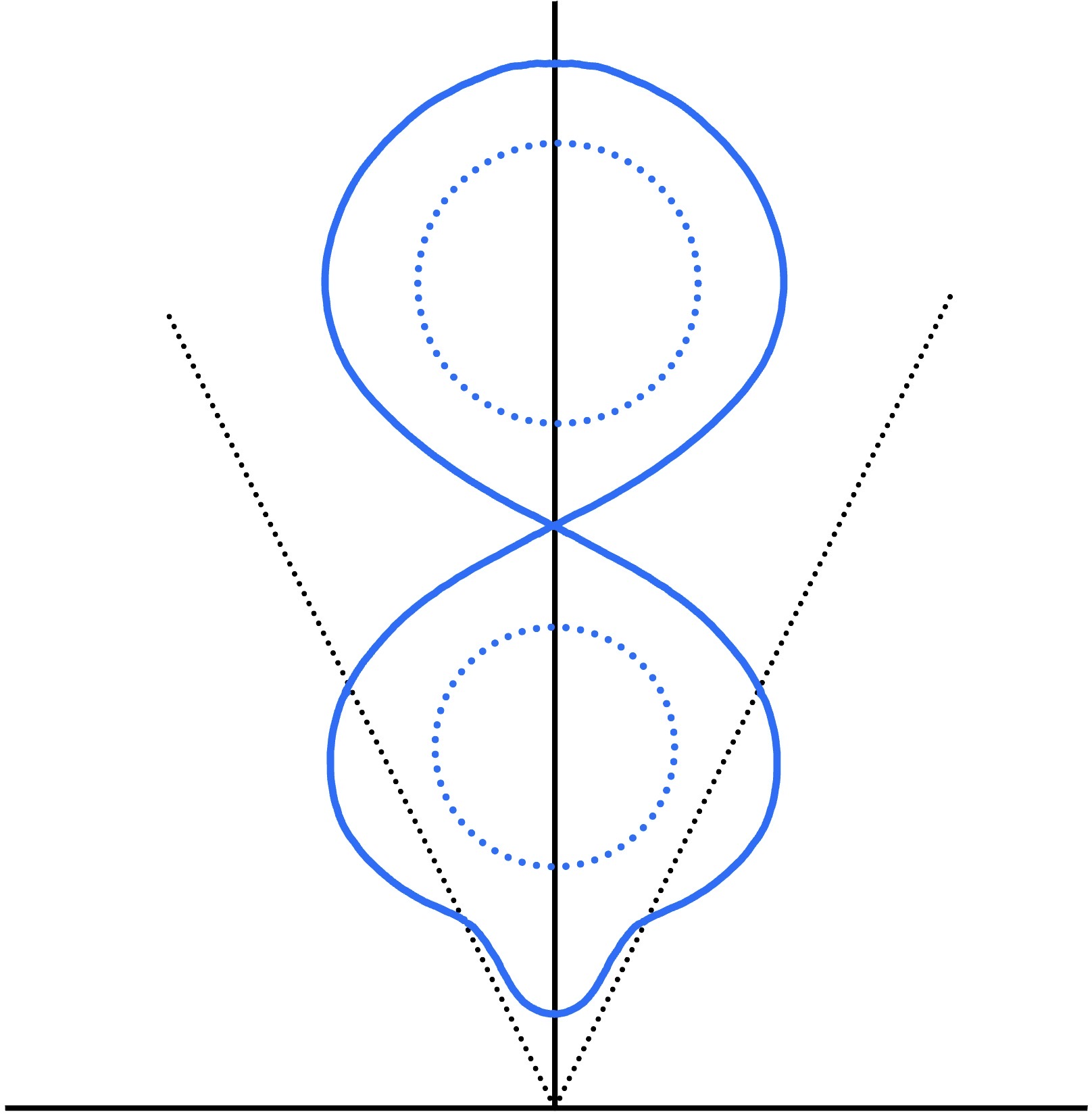
Figure 1: A heuristic compactification of the profile curve. The solid figure-eight-type curve is the profile curve of a compact immersed zero-Maslov Lagrangian, with interior dotted circles indicating invariant "barriers" that structure the blow-up locus.
Analytical and Geometric Framework
The Lagrangian mean curvature flow is governed by a fully nonlinear, scalar-valued parabolic PDE due to the preservation of the Lagrangian property in Calabi-Yau geometry. The cohomogeneity-one assumption allows reduction of the ambient evolution to a scalar PDE for the profile function, a severe analytical simplification compared to the general system case.
The solution ansatz is a time-dependent modulation of the special Lagrangian Lawlor neck, written as
K≥27
where K≥28 controls the profile neck width and K≥29 is a spectrally-controlled perturbation orthogonal (in a weighted n≥40 sense) to a finite set of dynamically distinguished modes.
Spectral perturbation theory—developed in [SS26I], the companion paper—yields a basis of (scale-dependent) eigenfunctions for the linearized operator around the Lawlor neck. The nonlinear PDE for the perturbation is then analyzed using this spectral decomposition, allowing the leading-order blow-up dynamics to be described by a finite-dimensional ODE for modulation coefficients.
The analysis addresses challenges unique to the Lagrangian context, notably:
- The lack of n≥41-integrable deformations of the tangent cone in higher dimensions (as the deformation 1-form decays faster than n≥42 but not integrably).
- The necessity of novel weighted Holder and n≥43 estimates for orthogonality-controlled perturbations near the singular locus.
Key Analytical Ingredients
Modulation Equation and Dynamical Reduction
A critical step is the reduction of the LMCF to a modulated ansatz:
n≥44
where n≥45 as n≥46 (rescaled time). Here, n≥47 satisfies nontrivial weighted orthogonality to the main eigen-modes. The modulation equations for n≥48 and n≥49 encode the finite-dimensional evolution, intended to capture the principal blow-up mechanism:
K=2,3,40
Spectral Gap and Stability Control
The K=2,3,41-spectral gap (for the relevant operator K=2,3,42) ensures that the remainder K=2,3,43 decays rapidly except along directions permitted by the modulation equations. The persistence and dominance of the principal unstable mode is a hallmark of the mechanism for producing Type II (non-self-similar, super-Type-I) singularities.
Topological Ważewski Argument
A topological Ważewski box method is employed to achieve the global control over the nonlinear evolution: By constructing a shrinking box in function space, the flow out of the box can only occur via a lower-dimensional manifold (formally impossible by homology), so a solution must exist globally that remains within the box and exhibits the prescribed modulation dynamics.
Weighted Schauder and Supremum Estimates
A hierarchy of weighted K=2,3,44—and, critically, sup-norm—estimates are developed to control the nonlinearities and perturbations close to the singularity, where the geometry degenerates and the maximum principle fails in its classical form. These are built via sharp blow-up and Liouville-type theorems for ancient solutions on the Lawlor neck and SL cones, guaranteeing non-existence of nontrivial solutions with the specific decay/growth profile.
Strong and Quantitative Features
This construction is the first to provide:
- Exact Power-Law Blow-Up: Curvature explodes at a rigorously determined rate
K=2,3,45
with control both above and below by matching power laws.
- Smooth Type II Model: The singularity model is not just a static tangent cone, but a smooth, asymptotically conical special Lagrangian, shown to arise dynamically as the Type II limit (by rescaling at a rate dictated by K=2,3,46).
- Arbitrarily Small Angle Oscillation: The initial data can be chosen with Lagrangian angle oscillation as small as desired, so formation of singularities is unrelated to high phase oscillation or Maslov index growth.
- Robustness and Generality: The methods can (with minor adaptations) yield both noncompact and compact/immersed/zero-Maslov examples.
Implications and Future Developments
Practical implications:
- The explicit, quantifiably controlled singularity formation offers new testbeds for the analytic study of LMCF, both numerically and theoretically.
- The techniques provide a blueprint for constructing and analyzing singularities in related fully nonlinear geometric flows with degenerate self-similar or integrability structure.
Theoretical consequences:
- The result exposes the subtleties of singularity passage for LMCF and refines the basis for conjectures like Thomas-Yau by showing the necessity of Type II behavior that is not captured by compactness and maximum principle arguments alone.
- The necessity of spectral (not K=2,3,47) integrability for controlling the deformation dynamics challenges heuristic analogies to mean curvature flow of hypersurfaces and reveals new nuances in high codimension.
Future directions:
- Extension to less symmetric or more general zero-Maslov Lagrangians, where the tangent cone lacks cohomogeneity-one symmetry.
- Deeper study of interaction between modulation instability, phase behavior, and geometric stability/instability landscapes.
- Application to fully nonlinear parabolic PDEs beyond geometric flows, given the adaptability of the spectral modulation–plus–topological box method.
Conclusion
The paper (2607.03152) achieves a significant technical advance in the precise, quantitative analysis of finite-time singularities for Lagrangian mean curvature flow. It establishes, for the first time, flows that realize sharp Type II blow-up rates, with explicit analytic and geometric control, resolving a fundamental open problem. Spectral techniques, refined modulation analysis, and novel parabolic estimates lay a foundation for future geometric and analytical investigations of singularities in high codimension, nonlinear parabolic settings.