- The paper shows that non-perturbative heavy-tailed non-Gaussianities enable sufficient primordial black hole formation to seed supermassive black holes while obeying CMB μ-distortion limits.
- It employs the δN formalism to derive and classify tail behaviors across various distributions, including stretched-exponential, power-law, and log-normal families.
- The analysis reveals that only genuinely non-Gaussian mechanisms with sub-exponential tails can bypass the Gaussian barrier, imposing novel constraints on inflationary models.
Evading the CMB μ-Distortion Bound on Supermassive PBH Seeds with Non-Gaussian Tails
Introduction
The identification of supermassive black holes (SMBHs) at redshifts z≳6, with masses ∼108–1010M⊙, challenges canonical astrophysical formation scenarios due to the stringent requirements for early assembly within the first billion years. Standard Eddington-limited accretion onto stellar-mass seeds struggles to explain both the mass and number density of these SMBHs, motivating alternative paths such as primordial black hole (PBH) seeds in the range 105–107M⊙. However, the PBH abundance in this mass regime is tightly constrained by the COBE/FIRAS limits on CMB μ-distortion, which translate into severe bounds on the amplitude of small-scale curvature perturbations. For Gaussian initial fluctuations, the so-called "Gaussian barrier" arises: the variance constraint simultaneously suppresses the tail of the probability distribution vital for PBH formation to negligible levels. This work systematically investigates whether non-Gaussian statistics—specifically, heavy tails generated through non-perturbative dynamics—can reopen the seed window while respecting the μ-distortion bound.
The Gaussian Barrier and the Variance–Tail Connection
The spectral distortion constraint is formulated as an upper bound on the squared variance σζ2 of curvature perturbations at seed masses via
σζ,max2(M)=2.2Wμ(M)μlim
where z≳60 is a window function selecting the relevant comoving scales. Over z≳61–z≳62, the cap is z≳63, corresponding to standardized thresholds z≳64–z≳65 for PBH collapse. For Gaussian statistics, the PBH formation probability z≳66 becomes exponentially suppressed, rendering the PBH abundance unviable for seeding purposes.
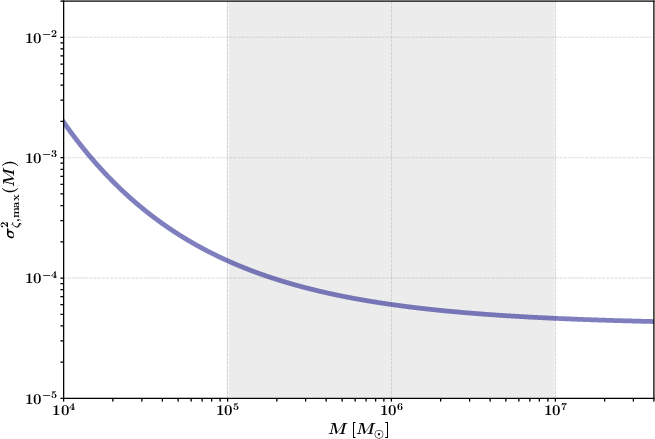
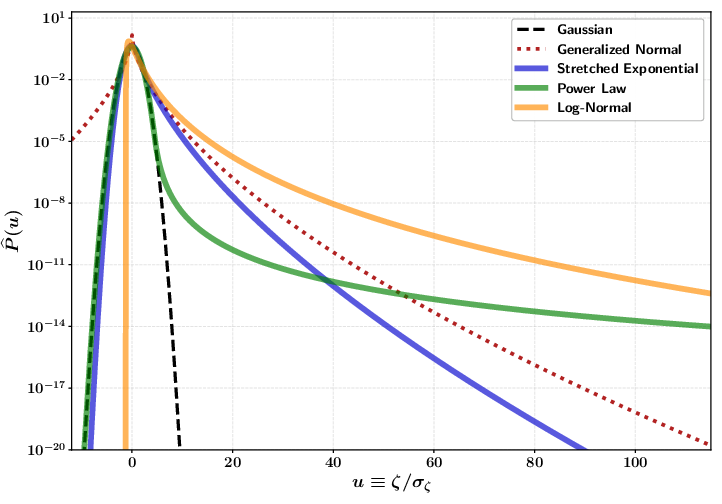
Figure 1: (a) Maximum variance z≳67 allowed by the FIRAS bound in the seed window; (b) Standardized PDFs of candidate non-Gaussian families highlight the relative weight in the formation-relevant tail.
This "Gaussian barrier" is a direct consequence of the fixed power–tail relationship in the Gaussian ensemble, not a limit on heavy-tail generations by genuinely non-Gaussian mechanisms.
PBH formation is a tail-sensitive observable: the collapse probability depends on events tens of standard deviations away from the bulk. This precludes perturbative approaches based on lowest-order non-Gaussianity parameters (e.g., z≳69), which cannot modulate the far tail independently of the variance. Instead, the non-perturbative ∼1080 formalism is employed: the PDF of ∼1081 is determined by the exact nonlinear ∼1082 map between Gaussian field fluctuations ∼1083 and curvature perturbations,
∼1084
leading to tail features controlled by the structure of ∼1085. The asymptotic tail behavior is classified by the local log-slope ∼1086, distinguishing exponential (∼1087) and "heavy" (∼1088) sub-exponential or power-law tails.
Four Gaussian-cored families are systematically constructed based on the non-perturbative ∼1089 map:
- A. Generalized Normal: Symmetric, minimal deformation of Gaussian, demonstrates impact of tail index 1010M⊙0.
- B. Gaussian/Stretched-Exponential: One-sided, as realized in single-field non-attractor transitions.
- C. Gaussian/Power-Law: Arises from 1010M⊙1 maps with finite-field singularities, associated with fractional-potential models.
- D. Asymmetric Log-Normal: Phenomenological proxy for multiplicative mechanisms (e.g., multifield modulations).
These families are engineered to match the observed null CMB 1010M⊙2-distortion while possessing flexible, non-Gaussian tails.
Tail Families: Structure and Abundance
Symmetric Generalized Normal Family
Empirically, the generalized normal (GN) distribution starkly illustrates how reducing the tail decay index 1010M⊙3—even without changing core variance—can exponentially enhance the PBH formation probability at fixed variance. However, symmetric GN is unphysical as it also enhances voids, which are not associated with black hole formation.
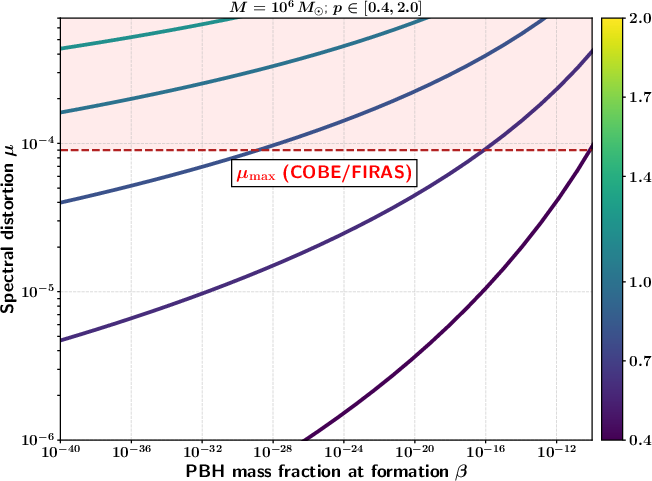
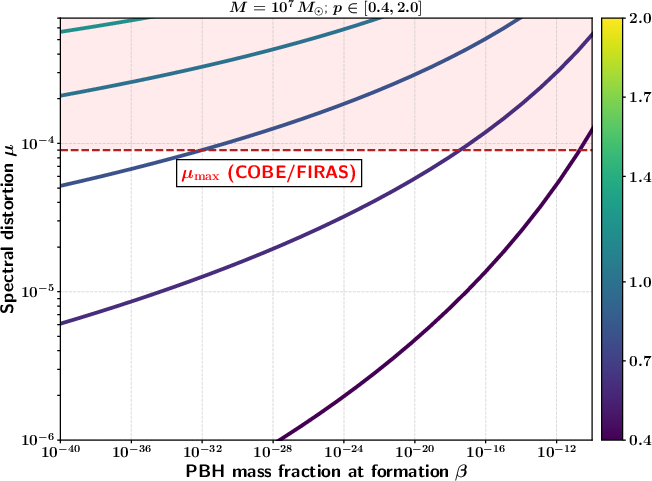
Figure 2: 1010M⊙4-distortion versus PBH mass fraction 1010M⊙5 for generalized-normal tail; decreasing 1010M⊙6 boosts 1010M⊙7 significantly within the FIRAS limit.
Stretched-Exponential (Single-Sided) Family and Physical Models
The physically motivated stretched-exponential family captures the output of single-field inflation with transient non-attractor dynamics. For all canonical single-field dynamics, the tail never exceeds the exponential form (1010M⊙8). Even with maximal flattening (1010M⊙9), the spectral distortion cap ensures 1050 remains orders of magnitude below the seed window. Only strictly sub-exponential cases (1051) enable seed-relevant abundances, but these require nonstandard, non-perturbative inflationary mechanisms.
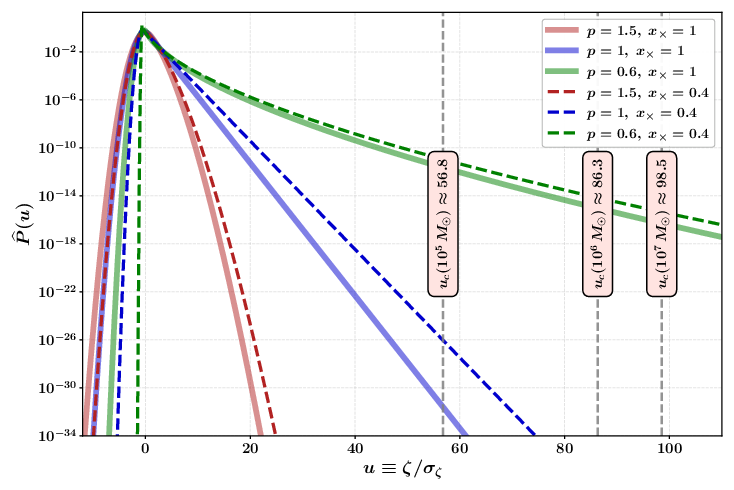
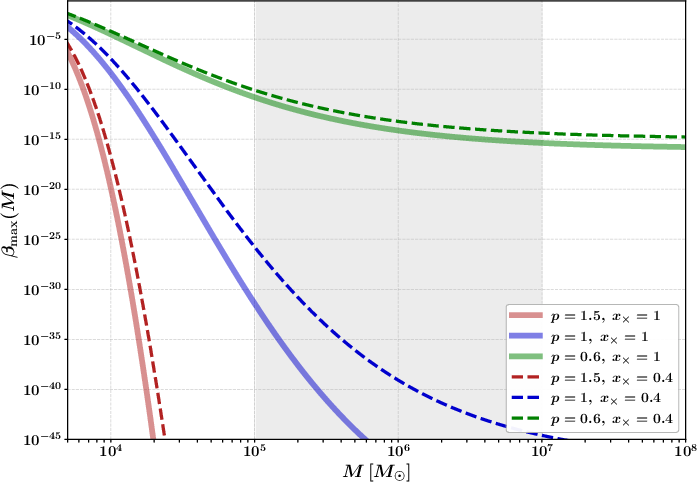
Figure 3: Family B: PDFs and 1052 for the matched stretched-exponential model. The exponential tail (1053) is insufficient; sub-exponential tails are necessary.
Power-Law (Algebraic) Tail Family
The heaviest physical tails derive from non-attractor classical inflationary dynamics on potentials with fractional power corrections. These yield PBH abundances that are almost insensitive to changes in the seed mass, since algebraic decay lacks exponential suppression. Viable power-law models correspond to potential corrections of the form 1054 with 1055.
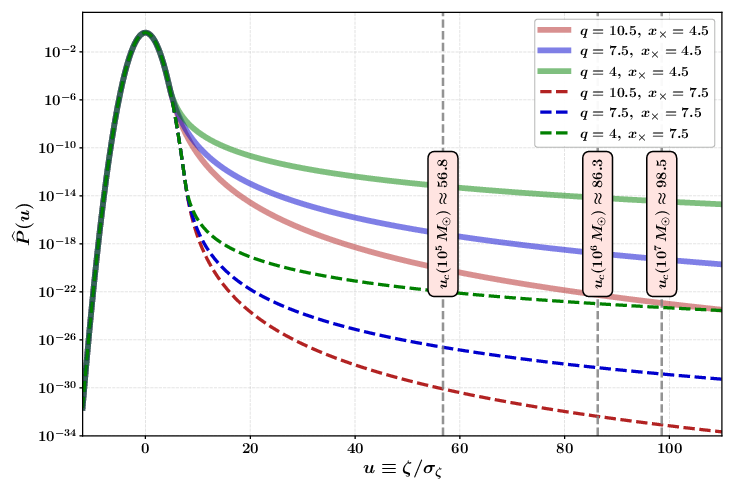
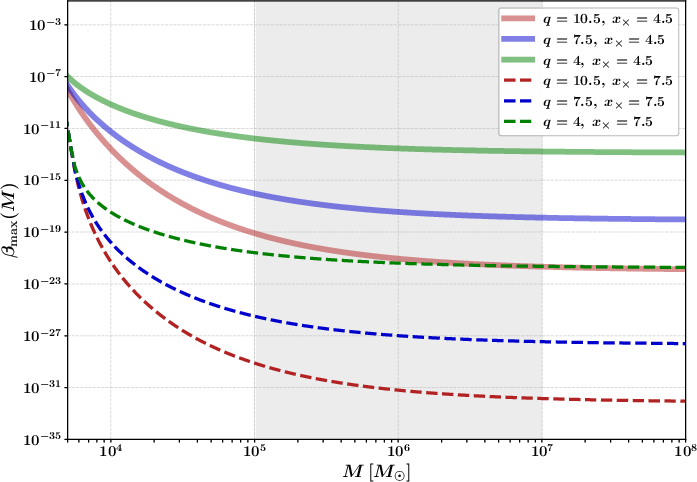
Figure 4: Family C: PDFs and 1056 for Gaussian core with power-law tail; even moderate indices (1057) yield substantial seed abundances for 1058.
Asymmetric Log-Normal Family
The log-normal family represents dynamics where the curvature perturbation is built multiplicatively, possibly realized in multifield or weighted measures of expansion. This family yields the heaviest tails: for moderate shape parameters (1059), the abundance easily exceeds the seed threshold. However, concrete single-field models producing such tails are not provided, so this case is treated as phenomenologically motivated.
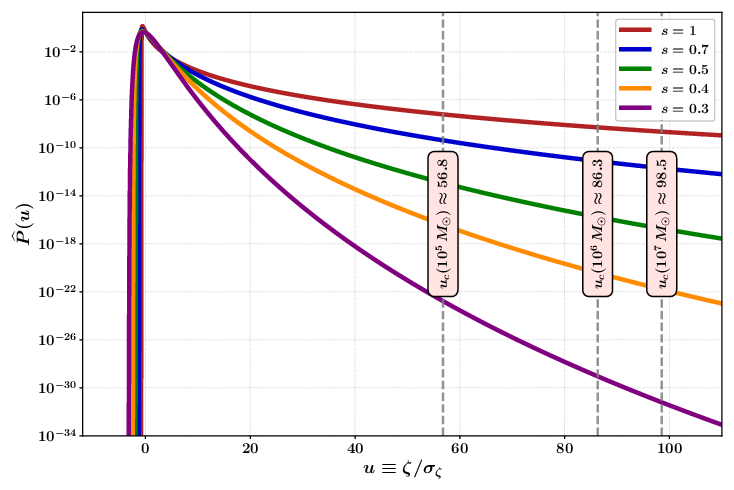
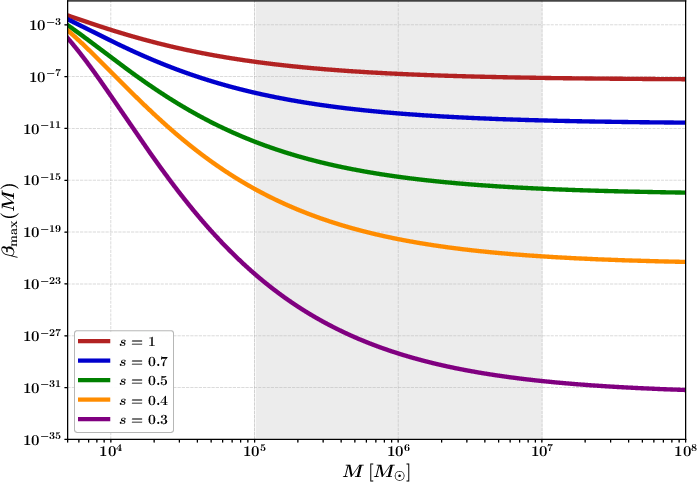
Figure 5: Family D: PDFs and corresponding 107M⊙0 for standardized log-normal tails. Multiplicative amplification of tail events ensure strong survival of seed-forming probability.
Parameter Space and Abundance Mapping
A comprehensive scan shows the abundance is controlled almost exclusively by asymptotic tail properties rather than core features, as variance is already capped by FIRAS. In the power-law and log-normal parameterizations, the dependence on the mass scale nearly disappears for physical indices over 107M⊙1–107M⊙2, with heavy-tail families achieving 107M⊙3 required for seeding.
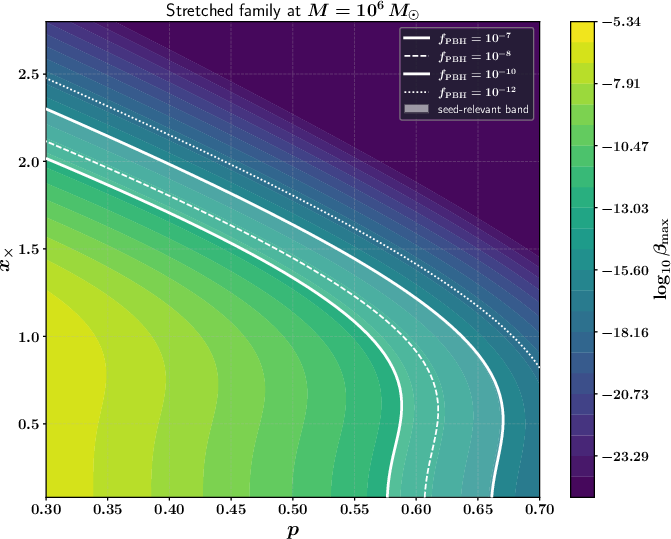
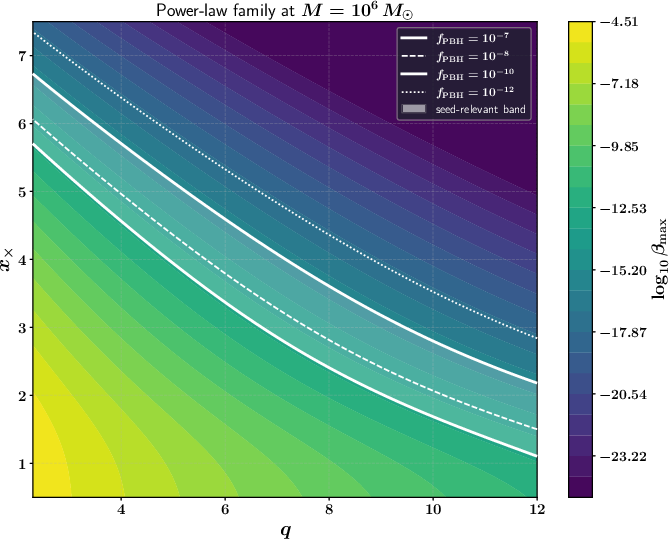
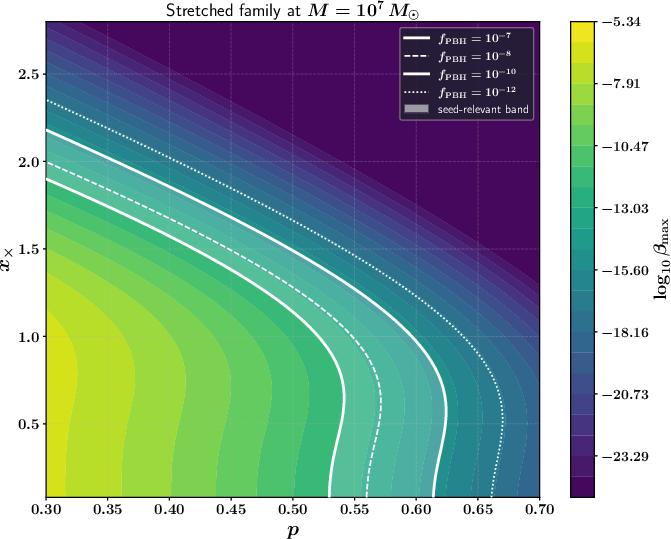
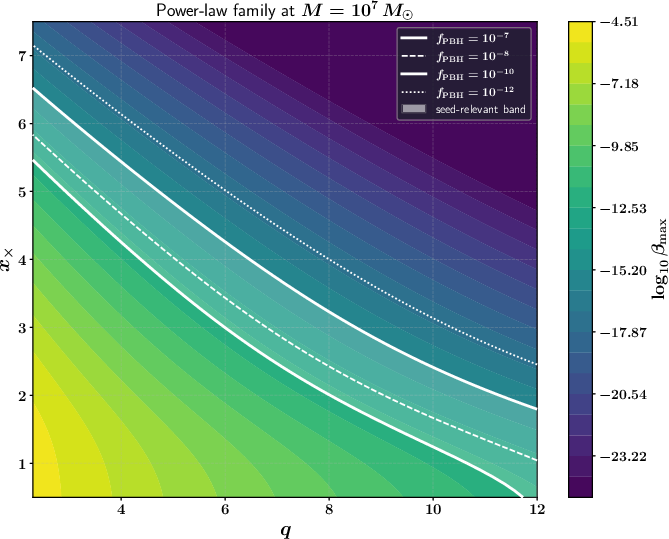
Figure 6: Distortion-capped PBH abundance in tail index parameter space, mapping contours of present-day 107M⊙4 at fixed seed mass.
Theoretical and Astrophysical Implications
Astrophysical Requirements: The minimum seeding fraction merely requires one PBH per high-107M⊙5 quasar 107M⊙6, whereas a more ambitious scenario replaces the entire SMBH population 107M⊙7. The distortion-evading heavy-tail mechanisms described are easily compatible with these requirements and avoid robust exclusions from current dynamical, accretion, and lensing constraints.
Inflationary Model Constraints: The results delineate sharp boundaries for viable early-universe mechanisms:
- Single-field ultra-slow-roll or sharp potential features: Exponential tails too light; cannot evade the Gaussian barrier even with maximal enhancement.
- Fractional-potential and non-canonical kinetic sectors: Capable of power-law tails that can evade all current and projected distortion limits.
- Multiplicative/multifield scenarios: The heaviest viable tails, but require explicit model construction.
The analysis demonstrates that only genuinely non-Gaussian (heavy-tail) mechanisms with 107M⊙8 can produce sufficient seeds under the spectral-distortion cap. This insight highlights the need for precise, non-perturbative modeling of curvature perturbation statistics in inflationary cosmology, especially when connecting PBH constraints to inflationary model-building.
Future Directions
Several avenues for extension are identified:
- Model Realizations: Explicit construction of inflationary setups (e.g., Dirac–Born–Infeld, sound-speed resonance, multifield, or curvaton models) that dynamically realize power-law or log-normal tails with sufficient amplitude.
- Non-Gaussian Dissipation Corrections: Calculation of corrections to the energy injection (107M⊙9) from higher-order correlators for strongly non-Gaussian statistics.
- Improved Collapse Criteria: Incorporation of realistic compaction functions and critical collapse thresholds, especially with nonlinearity between μ0 and the density contrast.
- Next-Generation Distortion Probes: Anticipation of future improvements from experiments such as PIXIE, which can lower the μ1 limit, tightening the allowed region for heavy-tail models.
Conclusion
When the tail of the curvature perturbation PDF is decoupled from its variance, PBH formation for supermassive seeds can evade the CMB μ2-distortion bound. However, the underlying inflationary mechanism must go beyond both perturbative non-Gaussianity and the standard single-field non-attractor constructions. The possibility of seeding the first SMBHs with PBHs is not excluded by present distortion data—but only if the inflationary small-scale fluctuations are dominated by genuinely non-Gaussian, heavy-tailed statistics. This imposes strong theoretical constraints on viable early-universe models and foregrounds the necessity of full, non-perturbative one-point statistics in connecting CMB observables to PBH-based inflationary constraints.