- The paper demonstrates how conservation of crystal angular momentum produces a single-Q winding CDW with macroscopic chirality.
- It employs electron–phonon coupling models combined with symmetry constraints to derive quantitative phase diagrams for chiral versus nematic states.
- The study outlines experimental signatures, such as chiral phonon softening and vortex-like phase patterns, that could validate the proposed framework.
Winding Charge Density Wave: Intertwining of Structural Chirality and Phase Topology of Electronic Order
Introduction
This paper presents a generalized theoretical framework for chiral charge density waves (CDWs) that fundamentally incorporates the interplay between crystal geometry, angular momentum selection rules, and the topological phase structure of electronic order (2607.03102). The authors introduce the concept of a "winding CDW"—a class of macroscopic chiral electronic order which arises despite being characterized by a single modulation wavevector, in contrast to previously reported chiral CDWs that require multi-Q configurations.
The core mechanism relies on the conservation of crystal angular momentum (CAM) during electron–phonon coupling, which aligns the topological winding of the CDW phase with that of the underlying lattice geometry. This is shown to be generic for chiral (screw-symmetric) as well as achiral (rotationally symmetric) crystals, enabling the emergence of topological chirality in a broad array of material systems.
Schematic Classification and Theoretical Foundation
The standard paradigm for chiral CDWs has been the requirement of multiple, non-collinear nesting vectors, yielding patterns with broken inversion and mirror symmetry (Figure 1, left). The paper departs from this model with the introduction of winding CDWs, which exhibit macroscopic chirality even with uniaxial, single-Q modulation (Figure 1, right). The crucial ingredient is that the CAM difference between paired electronic states, inherited from screw or discrete rotational symmetry of the crystal, is transferred to the azimuthal phase winding of the CDW via the selection rules enforced by electron–phonon coupling.
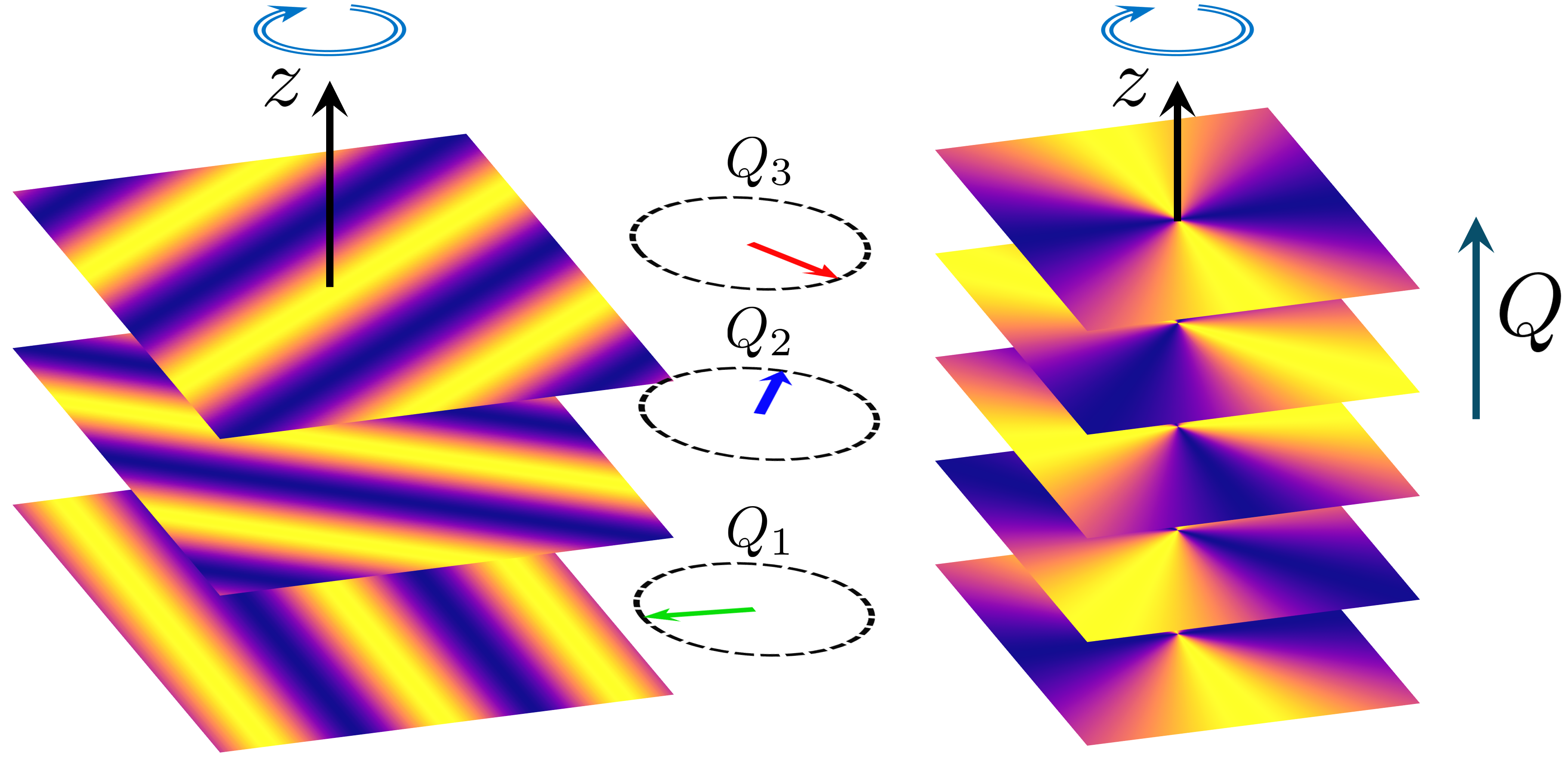
Figure 1: Schematic illustration contrasting conventional (left) and winding (right) chiral CDW states; the latter displays a chiral texture despite a single-Q modulation due to its intrinsic phase topology.
The conservation law is mathematically expressed for an n-fold symmetry as:
mel+lph=mel′modn
where mel, mel′ are electron CAMs, and lph is the phonon CAM. This relation is shown to govern the possible scattering processes and hence the resulting CDW topology.
The authors consider paradigmatic S^3 (threefold screw) symmetric crystals and analyze the electronic and phononic band structure projected onto the high-symmetry axis, e.g., the Γ–A line. Splitting between opposite angular momenta of both electrons and phonons, induced by the absence of inversion and mirror symmetries, lifts degeneracy and leads to selective Peierls instability for certain CAM channels (Figure 2b).
When the Fermi level intersects only bands with Q0, the CAM selection rule dictates that only chiral phonons with Q1 mediate scattering, thereby strongly favoring condensation in specific angular momentum channels. This results in a CDW with a real-space density modulation Q2, evidencing an azimuthal phase winding directly inherited from the electronic structure (Figures 2c, 2d).
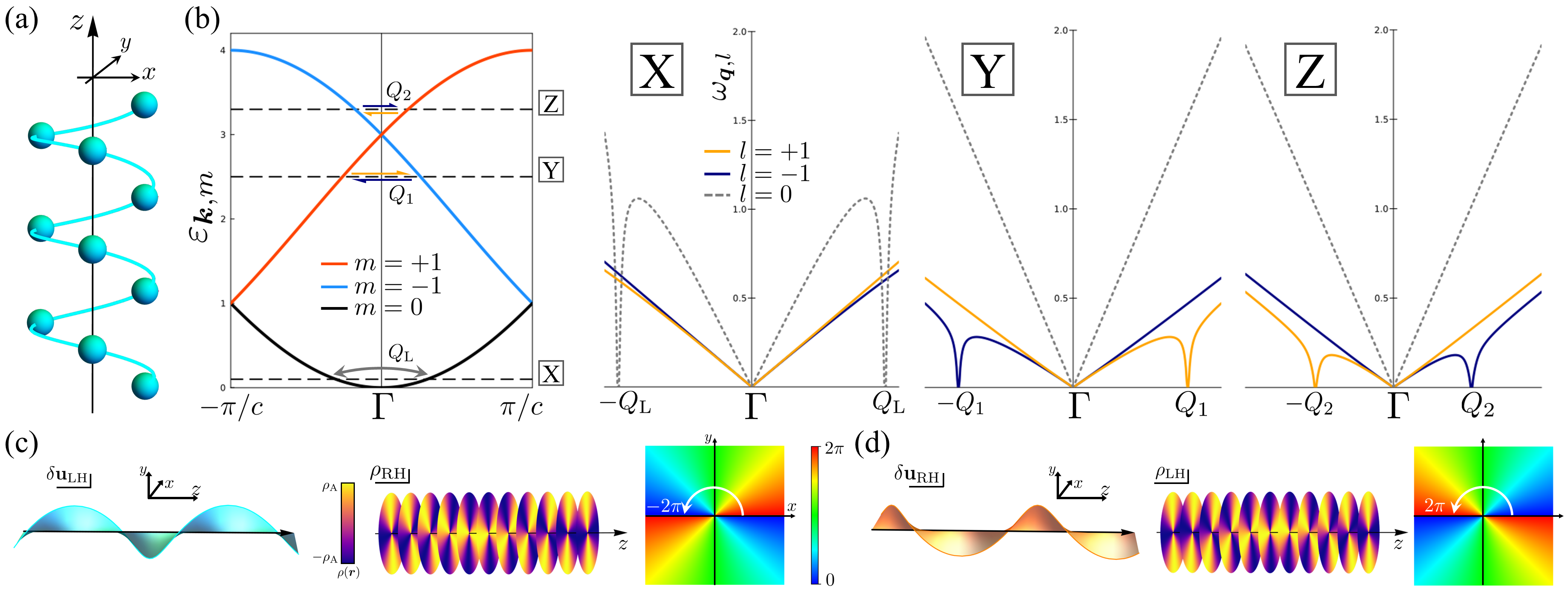
Figure 2: (a) Crystal structure with Q3 symmetry; (b) Split electronic and phonon branches with CAM labeling and relevant Fermi energies; (c, d) Real-space visualization and phase maps of RH and LH winding CDWs and their associated lattice displacements.
The macroscopic handedness (right- or left-handedness) is set by the selected CAM channel and is necessarily coupled to the crystal's handedness. Notably, the winding CDW possesses an integer winding number, akin to the topological charge of vortex states.
Emergence in Achiral Crystals and Spontaneous Symmetry Breaking
For achiral crystals with discrete rotational symmetry (e.g., Q4), the generic presence of degeneracy among Q5 electron bands and Q6 phonon modes leads, at mean field level, to degeneracy between chiral and achiral (nematic) CDW states. The competition between these minima is resolved by quartic terms in the Landau free energy, whose coefficients are derived diagrammatically (Figure 3).
Winding CDW order is stabilized provided the inter-channel coupling parameter Q7 exceeds twice the intra-channel coupling Q8. The calculation finds this regime accessible when the Q9 band is close to the Fermi surface (Figure 3d, 3e), giving rise to spontaneous breaking of mirror symmetry: an achiral-to-chiral structural phase transition in an electronic system with otherwise achiral lattice symmetry.
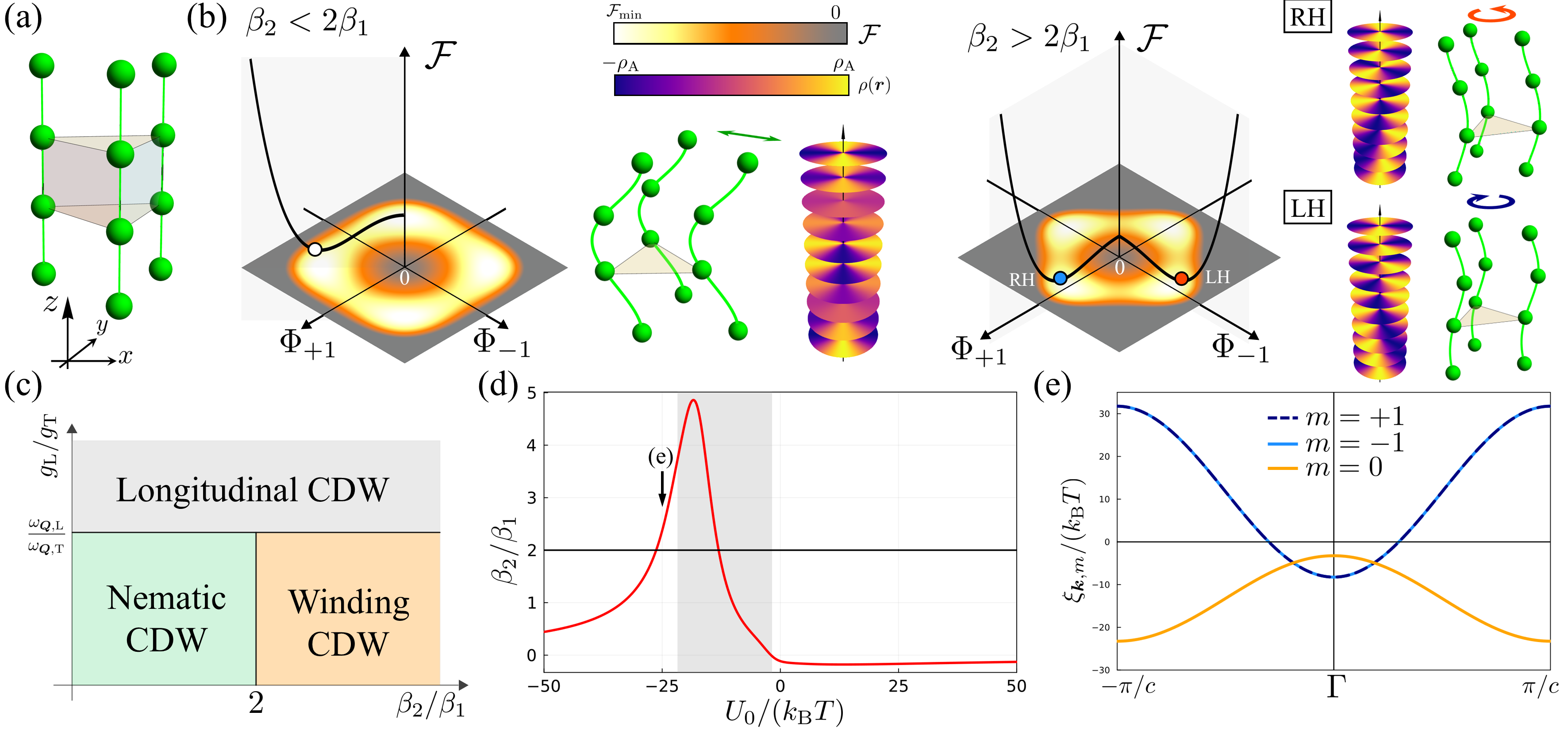
Figure 4: (a) Parent Q0-symmetric structure; (b) Landau free energy landscape and corresponding nematic/winding CDW states; (c) Phase diagram of CDW order; (d) Calculated phase boundary for realistic band parameters; (e) Relevant electronic band configuration for Q1.
Implications and Experimental Prospects
Strong claims established in the paper include:
- The realization of macroscopic chirality and integer phase winding in uniaxial (single-Q2) CDWs, solely from crystalline symmetry and CAM selection rules.
- The stabilization of winding CDW states in achiral lattices through purely electronic interactions and spontaneous symmetry breaking, without any static chiral structural motif.
- Quantitative phase diagrams and critical parameter regimes (via Q3) controlling the occurrence of nematic versus chiral CDW order.
The direct experimental signature of winding CDWs would be observation of chiral phonon softening and vortex-like phase structure in the CDW, accessible via inelastic X-ray or neutron scattering, phase-sensitive transmission electron microscopy (e.g., 4D-STEM), and nonlinear optical probes. Materials such as EuAlQ4 and SrAlQ5 are identified as candidate systems, with experimental reports of transverse Peierls transitions and potential chiral CDW states aligning with the conditions derived here.
Conclusion
This work establishes a topological–symmetry framework for chiral electronic order in crystalline solids, specifically identifying conditions for winding CDWs where phase topology is dictated by lattice geometry and CAM selection rules. The mechanism is generic across chiral and achiral platforms and provides a unified viewpoint connecting the angular momentum structure of electrons and phonons with emergent electronic order. The theoretical apparatus presented offers predictive guidance for discovering and engineering new classes of topologically nontrivial quantum materials, and motivates experimental characterization of chiral order parameters in CDW systems.