- The paper establishes a comprehensive phase diagram, identifying trimer VBC and magnon-crystal orders along with robust magnetization plateaus at m=0, 1/3, 7/9, and 8/9.
- It employs large-scale Lanczos diagonalization and finite-temperature Lanczos methods to capture zero- and finite-temperature magnetization processes, including discrete jumps and thermal effects.
- The results offer practical benchmarks for experimental thermodynamic studies in spin-1 kagome materials and motivate further investigations with larger clusters and perturbations.
Quantum Magnetism of the Spin-1 Kagome-Lattice Antiferromagnet
Introduction
The kagome-lattice Heisenberg antiferromagnet is a prototypical model for investigating strongly correlated quantum spin systems in the presence of geometric frustration. The spin-1/2 variant has been explored extensively, with studies revealing complex ground states, including spin liquids, valence-bond crystals (VBCs), and magnon-crystal plateaus. In contrast, the spin-1 kagome-lattice system remains less fully characterized despite recent theoretical and experimental advances. This work delivers a comprehensive analysis of the spin-1 kagome-lattice Heisenberg antiferromagnet using large-scale Lanczos diagonalization and finite-temperature Lanczos methods (FTLM), systematically resolving its zero- and finite-temperature phase and magnetization behavior, and correlational structure.
Model and Methodology
The Hamiltonian investigated is:
H=J⟨i,j⟩∑Si⋅Sj−hi∑Siz
with Si spin-1 operators, J being the nearest-neighbor antiferromagnetic exchange, and h the applied magnetic field. Exact diagonalization via the Lanczos algorithm is executed for finite-size clusters up to N=45 sites (PBC), targeting zero-temperature ground-state properties and obtaining the lowest energy per total magnetization sector. Thermodynamic observables at finite temperature are calculated with FTLM for N=21, $24$, and $27$ clusters, with numerical accuracy enhanced using orthogonalized (OFTLM) and replaced (RFTLM) variants of FTLM.
For visualization and analysis of magnetization processes, the authors introduce a Gaussian-kernel smoothing technique to reconstruct a continuous energy-versus-magnetization curve, allowing for accurate extraction of plateau and jump features from finite-size staircase magnetization.
Zero-Temperature Magnetization Plateaus and Jumps
The calculated zero-temperature magnetization curve reveals prominent plateaus at m=0, $1/3$, Si0, and Si1, where Si2 and Si3 for spin-1 systems. These plateaus are robust features, persisting in the largest considered clusters and in the smoothed magnetization curve.
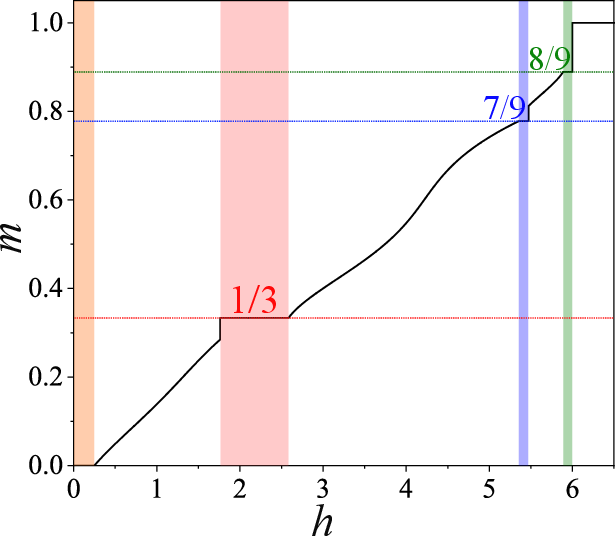
Figure 1: Zero-temperature magnetization curve of the spin-1 kagome-lattice Heisenberg antiferromagnet constructed using Gaussian-kernel smoothing. Plateaus at Si4, Si5, Si6, and Si7 are retained; magnetization jumps occur near the lower-field edge of Si8 and upper-field edges of Si9 and J0.
Discrete finite-cluster results Figure 2 display these plateaus and disclose steep step transitions near the edges of some plateaus, interpreted as magnetization jumps in the thermodynamic limit.
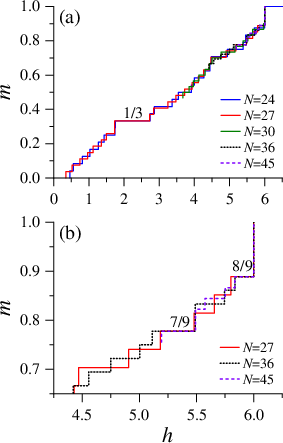
Figure 2: (a) Finite-size zero-temperature magnetization processes for J1, J2, J3, J4, and J5 clusters. (b) Enlarged high-magnetization region, emphasizing J6 and J7 plateaus.
Magnetization jumps are identified at the lower-field edge of J8, and the upper-field sides of J9 and h0. The h1 jump is an exact result, corresponding to a localized-magnon crystal scenario. For h2, analogous behavior is substantiated by the systematic exclusion of intermediate magnetization sectors between plateaus as cluster size grows.
Microscopic Plateau Structure
Analysis of correlation functions on the plateau states yields the following:
- h3 Plateau: The bond correlations on the h4 cluster reveal a clear trimerization pattern breaking lattice rotational symmetry, identifying this state as a trimer valence-bond crystal (VBC).
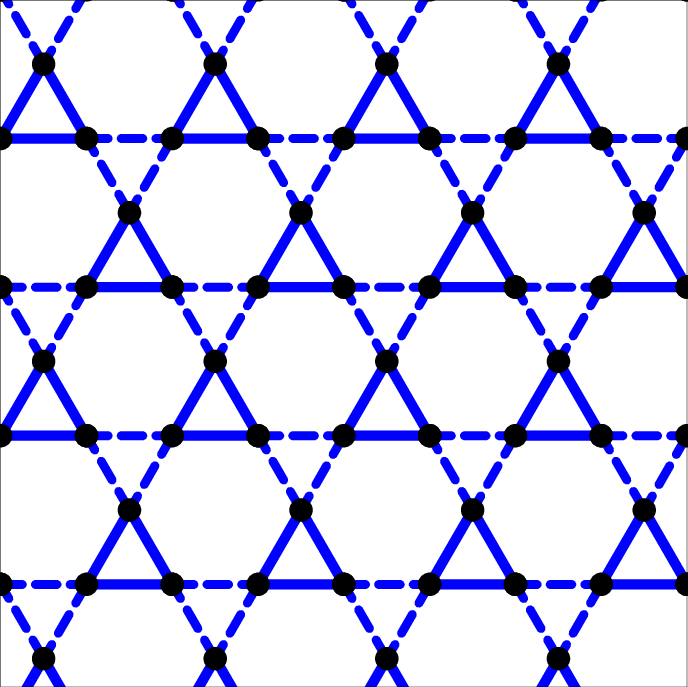
Figure 3: Trimerized bond correlations in the h5 state on the h6 cluster, evidencing a twofold ground-state degeneracy and reduction of rotational symmetry.
- h7 and h8 Plateaus: Dimer--dimer correlations at h9 on N=450 manifest a periodic arrangement of strongly correlated hexagons, consistent with magnon-crystal order. The N=451 plateau is known exactly as a localized-magnon crystal.
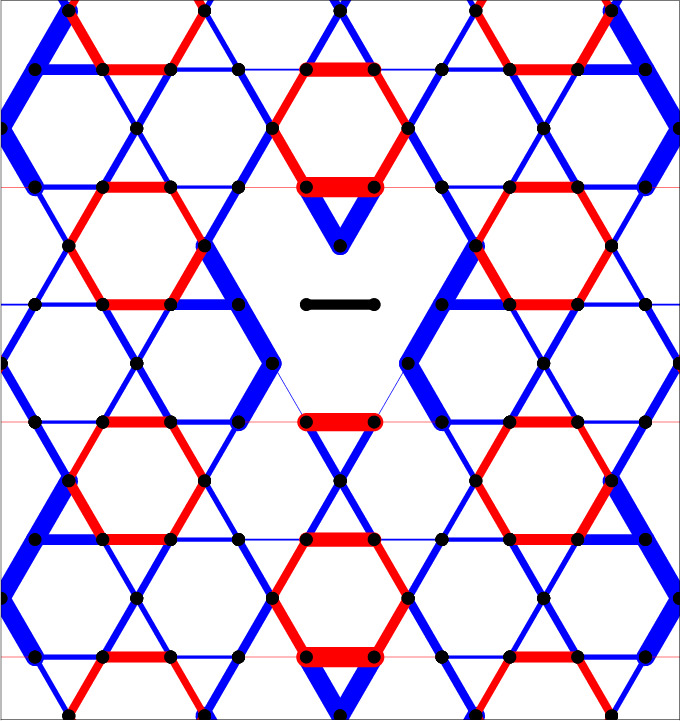
Figure 4: Dimer--dimer correlations in the N=452 state (N=453 cluster). Regularly arranged positive-correlation hexagons indicate magnon-crystal character.
- N=454 Plateau: The spin structure factor N=455 displays comparably enhanced intensities at momenta N=456 and N=457, signatures of both N=458 uud and N=459 uud patterns; the dimer--dimer correlation pattern hints at partial magnon-crystal features without full development. Thus, the plateau's microscopic nature remains unresolved within current system sizes.
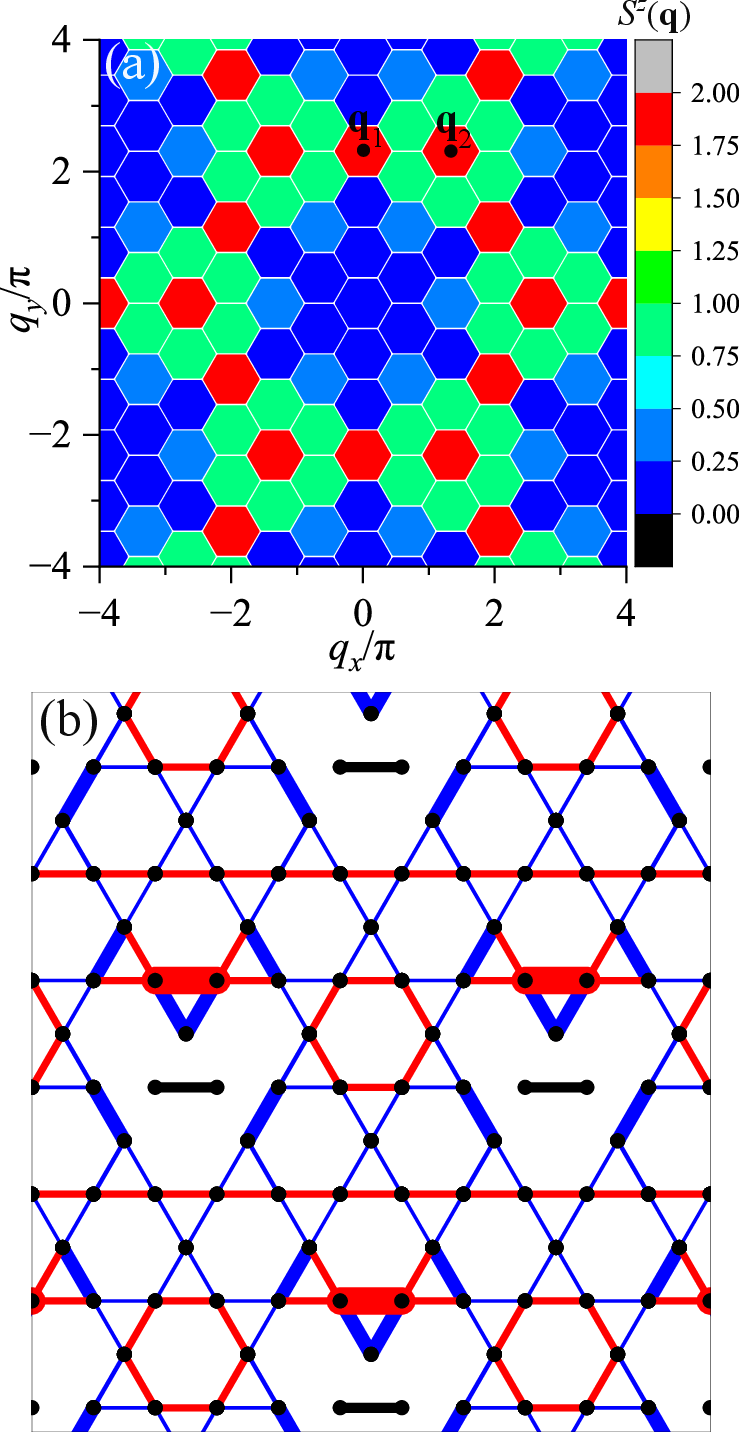
Figure 5: (a) N=210 in the N=211 plateau (N=212), showing close intensities for N=213 and N=214 structures. (b) Dimer--dimer correlations, partially consistent with incipient magnon-crystal order.
Finite-Temperature Thermodynamics
The FTLM calculations afford finite-temperature benchmarks for susceptibility, specific heat, and magnetization curves.
- Susceptibility N=215: Exhibits a broad maximum at N=216 associated with short-range order, followed by rapid low-N=217 suppression due to the nonmagnetic ground state.
- Specific Heat N=218: Shows a robust double-peak structure with a broad high-N=219 maximum near $24$0 (short-range correlations) and a sharp low-$24$1 peak near $24$2, likely associated with trimer VBC formation and possibly a finite-$24$3 transition.
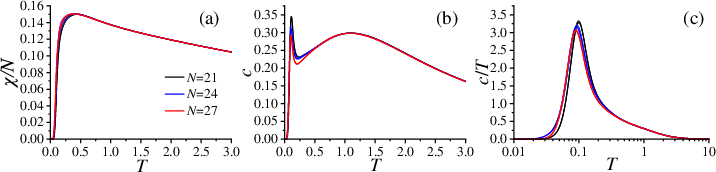
Figure 6: (a) Magnetic susceptibility $24$4, (b) specific heat $24$5, and (c) $24$6, for $24$7, $24$8, $24$9 clusters. The double-peak in $27$0 and robust low-$27$1 feature in $27$2 are size-insensitive for $27$3.
- Finite-Temperature Magnetization: The $27$4 plateau is visible at $27$5, with edges subsequently rounding out at $27$6. High-field plateaus $27$7, $27$8 are particularly sensitive to thermal effects and are rapidly washed out above $27$9.
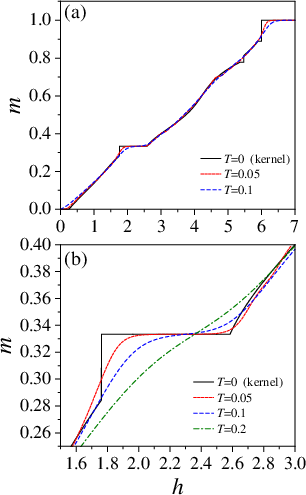
Figure 7: (a) Low-temperature FTLM magnetization curves (m=00) versus smoothed m=01 curve. (b) Plateau structure and thermal smearing around m=02.
Figure 8 (Supplementary) confirms the negligible finite-size effects in finite-m=03 curves for m=04, while lower temperatures are sensitive to cluster size discretization.
Discussion and Implications
This analysis strongly establishes the presence of trimer VBC order at zero field, a stable m=05 plateau potentially compatible with uud-type or nascent magnon-crystal correlations, and magnon-crystal states at high fields (m=06 and the rigorous m=07). The observed magnetization jumps at select plateau edges are direct finite-size prefigurations of first-order transitions, solidified for m=08 and highly plausible for m=09.
The double-peak profile in specific heat and the finite-temperature evolution of plateaus represent vital benchmarks for experimental identification of spin-1 kagome antiferromagnet materials. Observability of the high-field magnon-crystal plateaus in experiment necessitates temperatures well below $1/3$0. The robust finite-size stability of the $1/3$1 plateau and the double-peak $1/3$2 provide reference points for thermodynamic measurements in synthesized kagome magnets.
Conclusion
This work delivers a complete numerical investigation of the spin-1 kagome-lattice Heisenberg antiferromagnet, establishing its zero-temperature plateau and jump structure, characterizing ground-state orders, and benchmarking its thermodynamics up to accessible finite temperatures. The identification of the trimer VBC as the $1/3$3 plateau, magnon-crystal order for $1/3$4 and $1/3$5, and the unresolved microscopic structure of the $1/3$6 plateau are primary outcomes. The thorough finite-temperature profiles for susceptibility, specific heat, and magnetization serve as benchmarks for comparison with experimental data from candidate materials containing spin-1 kagome planes. The results invite future work with larger clusters, tensor network extensions, and studies including perturbations such as single-ion anisotropy or further-neighbor interactions to reconcile theoretical predictions with the full complexity of real materials.