High-frequency spectral asymptotics and homogenization for quasiperiodic operators
Published 3 Jul 2026 in math.AP | (2607.03064v1)
Abstract: We study the spectral asymptotics of elliptic operators with quasiperiodic coefficients by exploiting projections from higher-dimensional periodic functions. Using the framework of two-scale convergence adapted to cut-and-project quasiperiodic structures we establish that, in the low-frequency (homogenization) regime, the spectrum converges to that of a homogenized operator with effective coefficients determined by a cell problem on the higher-dimensional torus. In the high-frequency regime, we introduce a rescaling approach that transforms the problem to an expanding domain with asymptotically frozen coefficients. In the critical scaling, the rescaled spectrum converges to the union of the Bloch spectra arising from the quasiperiodic bulk and a boundary layer spectrum consisting of eigenfunctions concentrated near the boundary of the macroscopic domain. This boundary spectrum can be characterised as a subset of the spectrum of a family of half-space operators with frozen macroscopic coefficients. For any non-critical scaling, the rescaled spectrum fills the positive real line.
The paper rigorously characterizes spectral convergence under critical high-frequency scaling, revealing a union of bulk (Bloch) and boundary layer spectra.
It adapts classical two-scale convergence to quasiperiodic structures via cut-and-project methods, enabling effective homogenization.
The results offer new analytic tools with practical implications for modeling quasicrystals, aperiodic media, and metamaterials.
High-Frequency Spectral Asymptotics and Homogenization for Quasiperiodic Operators
Introduction
This paper performs an in-depth spectral analysis of second-order elliptic operators with quasiperiodic coefficients constructed via cut-and-project methods. The authors rigorously characterize spectral behavior in both low- and high-frequency regimes, with a methodological focus on two-scale convergence adapted to quasiperiodic (QC) structures. The work advances the state-of-the-art by describing spectral convergence, establishing the homogenized operator's structure, and, crucially, detailing the critical high-frequency regime where the spectrum is the union of bulk Bloch and boundary layer spectra. The results provide both new analytic tools and theoretical understanding relevant for effective models of quasicrystals, aperiodic media, and generalized metamaterials.
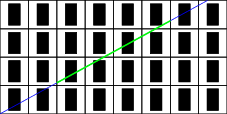
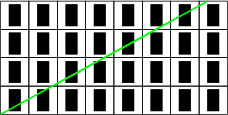
Figure 1: A cut-and-project quasiperiodic structure with an increasing one-dimensional domain size, while the two-dimensional fundamental cell size is fixed.
Quasiperiodic Media and Two-Scale Convergence
The analysis is set within the framework of the cut-and-project construction, representing QC patterns as projections of periodic structures from higher-dimensional superspaces to physical space. This formalism permits the adaptation of classical homogenization techniques—specifically, two-scale convergence—by generalizing periodic test functions to ones indexed by the incommensurate cut directions.
Let A(x,y) denote a coefficient field periodic in y∈Ym. The “physical” coefficients are sampled along incommensurate cuts y=Px, with P∈Rm×n satisfying strong incommensurability. This formalism supports the definition of weak and strong two-scale (cut-and-project) convergence—ensuring compactness of bounded sequences and justifying the homogenization analysis.
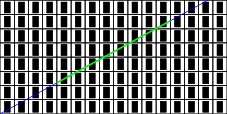
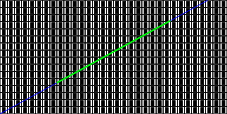
Figure 2: Change of the cut-and-project structure by fixing the domain size and decreasing the fundamental cell size.
Low-Frequency (Homogenization) Regime
In the low-frequency regime, i.e., for elliptic spectral problems with coefficients oscillating rapidly on spatial scale η→0, the paper recovers the expected homogenized limit. Specifically, the spectrum of the rescaled operator converges to that of a homogenized operator, with effective coefficients computed as the solution to a QC “cell problem” in the higher-dimensional fundamental domain.
Given
−div(A(x,ηPx)∇vη(x))=ληvη(x)
with Dirichlet conditions, the solution converges (in the appropriate topology) to that of a homogenized operator Ah(x) defined by a localized cell problem: Aikh(x)=∫YmAij(x,y)(δjk−∇Pχk(x,y))dy
where χk are correctors defined on the higher-dimensional torus. This result is proved via adaptation of classical results (e.g., Allaire) to the cut-and-project QC setting.
High-Frequency Spectral Asymptotics
The most significant theoretical contributions are in the high-frequency regime, where the spectral scaling is tuned such that the “fast” oscillations persist macroscopically. By a change of variables, the authors analyze spectral behavior as the physical domain is dilated while the quasi-lattice remains unscaled, focusing on the “critical scaling” (aη=η).
A key analytic maneuver is to represent the spectral problem in the expanded domain, reducing to a family of operators with locally frozen macroscopic variable but persistent QC microstructure: y∈Ym0
As y∈Ym1, the variable y∈Ym2 freezes, producing a direct integral over “frozen-coefficient” (Bloch) operators parameterized by the macroscopic variable.
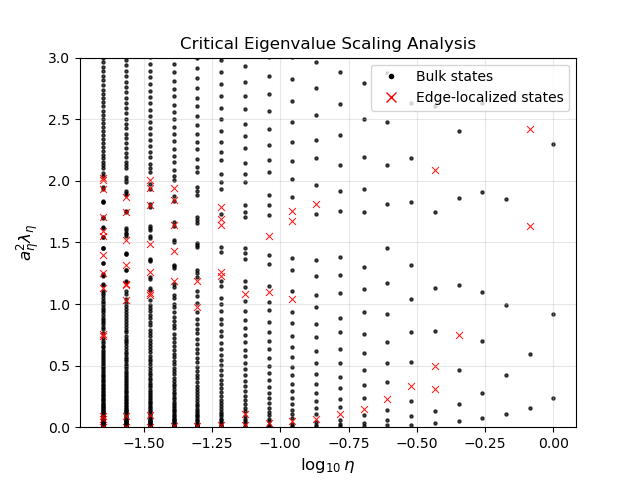
The main theorem establishes that, in the critical regime, the rescaled spectrum converges (in the Hausdorff sense) to the union of:
The bulk (Bloch) spectrum: the union over all possible spectra of “frozen” operators y∈Ym3 spanning the macroscopic variable y∈Ym4,
The boundary layer spectrum: associated with half-space operators with coefficients frozen at boundary points, capturing eigenfunctions localized near y∈Ym5.
Figure 3: Eigenvalues in the critical scaling regime for y∈Ym6 along the cut y∈Ym7, where y∈Ym8 is the golden ratio. The convergence to a fractal-like bulk spectrum is evident, intertwined with the boundary spectrum.
Crucially, in non-critical regimes (i.e., when the expansion speed y∈Ym9 is much smaller or larger than y=Px0), the rescaled spectrum diverges and fills the entire positive real line, manifesting the loss of non-trivial spectral structure.
Characterization of the Boundary Layer Spectrum
The analysis provides a refined description of the boundary spectrum. In the limit, eigenfunctions associated with this spectrum become highly localized near the domain boundary. The authors prove that the limiting boundary spectrum is a subset of the union of spectra of half-space operators y=Px1, where y=Px2 runs over boundary points and y=Px3 describes shifts in the internal variable arising from the sequence of rescalings.
The proof uses geometric localization, rescaling, and cutoff arguments, with error estimates controlled via the regularity and structure of the coefficients. This construction generalizes known results for periodic domains to the QC context and justifies, via explicit test function construction and operator norm estimates, the inclusions y=Px4.
Implications and Outlook
The theoretical results rigorously justify, for the QC context, the practical homogenization and asymptotic analyses frequently employed in materials modeling and wave propagation studies. The spectral decomposition provides a solid analytic basis for predicting the existence and character of spectral gaps, critical to transport and scattering phenomena in quasicrystals and aperiodic metamaterials.
On the theoretical side, the union of Bloch and boundary spectra is shown to inherit QC spectral features, such as Cantor-type gaps and fractality, even in the large-domain and high-frequency limit. This contrasts with both disordered and periodic media and clarifies the interplay between geometry, spectrum, and localization effects.
The framework is generic and is expected to extend to non-selfadjoint and higher-order problems, random or stochastic geometric perturbations (non-deterministic cut-and-projects), and to the systematic design of materials with tailored high-frequency responses. In particular, understanding how spectral gaps and localization emerge in the critical regime has direct applications to photonic and phononic quasicrystals, topologically nontrivial QC media, and the design of “rainbow” or topological waveguiding structures.
Conclusion
The paper makes substantial analytic progress in the understanding of the spectral asymptotics of QC elliptic operators. By bridging tools from homogenization, spectral theory, and QC geometry, it delivers a complete description of low- and high-frequency effective spectra, rigorously characterizing both the bulk and boundary contributions. These results frame practical guidelines for both theoretical exploration and computational modeling of physical systems with QC modulated parameters.
[High-frequency spectral asymptotics and homogenization for quasiperiodic operators, (2607.03064)]