- The paper develops recursive constructions for generating block-transitive 2-designs by extending poset-based structures while preserving the t-invariant.
- It introduces single node (chain growth) and double node (independent nodes) extensions to explicitly realize infinite families of designs.
- The work bridges combinatorial design and group theory, offering practical implications for applications like error-correcting codes and network design.
Recursive Constructions for Block-Transitive, Poset-Imprimitive Two-Designs
Introduction and Context
The paper "Recursive constructions for block-transitive, poset-imprimitive two-designs" (2607.03029) develops two recursive combinatorial constructions that systematically generate infinite families of block-transitive $2$-designs with specified automorphism group imprimitive structures, parameterized by arbitrary posets of partitions. The constructions generalize the classical Cameron-Praeger method to enable explicit realizations for a broad spectrum of poset-imprimitive structures, notably including posets beyond mere chains of partitions, for which prior explicit constructions were limited.
Preliminaries and Poset Block Structures
A $2$-(v,k,λ) design is characterized by a point set P and a set of k-subsets ("blocks") where every pair of points is contained in exactly λ blocks. Block-transitive automorphism groups act transitively on the set of blocks, and poset-imprimitive action refers to the preservation of a poset structure on partition systems over the point set. The machinery developed is deeply rooted in generalized wreath products associated with poset block structures, which induce natural hierarchies of partition refinement.
Arbitrary posets I=(I,≼) are implemented as lattice structures over point partitions Π∗, with ancestral subsets encoding partition intersections. This framework generalizes the classical chain- or antichain-based partition systems, extending the scope of imprimitive block-transitive design construction.
Recursive Constructions
Single Node Extension (Chain Growth)
The first construction iteratively "adds a node on top" of a given poset via a recursive process on $1$-designs, where, starting from an initial $2$-design $2$0 with point set $2$1 and blocks $2$2, and an integer $2$3, a new design $2$4 is constructed on the point set $2$5, $2$6 an $2$7-element set. Each block is formed by choosing a block of $2$8 on one fibre and singleton points elsewhere. This construction produces a $2$9-design precisely when the input design fulfills a divisibility condition: the parameter (v,k,λ)0 must be integral, and (v,k,λ)1 is uniquely determined by (v,k,λ)2 and (v,k,λ)3.
This construction may be recursively applied, producing a hierarchy where each recursion adds a chain node "on top" of the poset in the associated block partition structure.
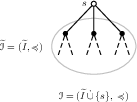
Figure 1: Poset after one application of Construction~\ref{con:wr-comb}, showing chain extension via a new node.
This mechanism is formalized in Theorem 1 (in the original paper) and enables the realization of block-transitive (v,k,λ)4-designs for arbitrary-length chain posets and, by suitable initial inputs, for richer poset structures such as the inverted-(v,k,λ)5 and small non-chain posets.
Double Node Extension (Independent Nodes)
The second construction, given in Construction~\ref{con:rect-comb}, introduces two new independent nodes at the top of the poset. The input comprises a (v,k,λ)6-design (v,k,λ)7 and two integers (v,k,λ)8, with (v,k,λ)9 dividing P0. The points of the output design are P1. The block structure is governed by mappings between the auxiliary sets, encoding how extensions interact among different "fibres." The output is a P2-design precisely when the parameters meet a family of equations dependent on P3, tightening the structures permissible for the process.
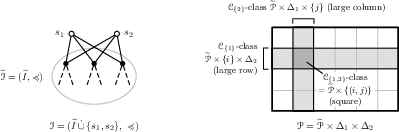
Figure 3: Poset after applying Construction~\ref{con:rect-comb}, exemplifying the addition of two incomparable nodes.
Via recursive and interleaved application with the preceding single-node extension, a wide variety of finite posets can be constructed at the top of a fixed initial block-structure.
Recursive and Interleaved Extensions
The central technical advance in this work is the realization that the P4-invariant parameter is preserved under both the single- and double-node constructions. Thus, any finite sequence of these extensions from a valid starting design yields a valid (block-transitive, poset-imprimitive) P5-design, so long as parameter equations at each step are solvable.
The authors classify which posets with up to four nodes are obtainable by these constructions, and show that only five remain unresolved. They also provide explicit parameters and closed-form combinatorial enumerations for extended families, including those previously known only at the theoretical level.
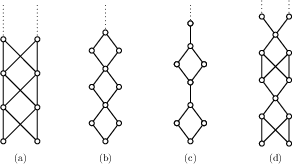
Figure 5: Posets of arbitrary size that can be constructed via sequences of single- and double-node additions.
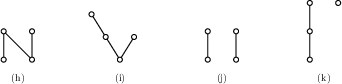
Figure 7: The class of four-node posets with known infinite design families realizable by the recursive constructions.
Figure 9: Four-node posets with known design families that are not accessible via the two main recursive constructions.
Implications and Open Questions
The constructions in the paper sharply extend the class of explicit, parameterized block-transitive P6-designs with poset-imprimitive automorphism groups. The recursive method separates the core parameter-theoretic considerations (i.e., the P7-invariant) from the poset topology, systematizing design existence and embedding.
Theoretically, this work clarifies the relationship between poset block structures and P8-design symmetry, especially by connecting wreath products and partition lattices, and by demonstrating a high degree of flexibility in imprimitive automorphism structures. Practically, these constructions provide new templates for combinatorial design in applications such as error-correcting codes, network design, and symmetry-based experimental layouts.
Several open questions persist—for example, the characterization of all possible poset block structures attainable by recursive sequences, the fine structure of exceptional posets in the 4-node case, and the potential for analogous recursive constructions for P9-designs with k0.
Conclusion
This work supplies a robust, recursive framework for generating block-transitive, poset-imprimitive k1-designs associated with large and arbitrary posets. The interplay of combinatorial design, group action, and poset theory realized via these constructions significantly broadens the explicit toolkit for incidence geometry and design theory. The characterization of accessible posets and the persistence of integer invariants under recursion underlines the deep harmony between group-theoretic and combinatorial structures in finite design theory.