- The paper presents a function-space diffusion model (FSD-MP) that models trajectories as continuous functions, overcoming limitations of fixed-length waypoint representations.
- It employs a spectral diffusion process with a DST-based Fourier Neural Operator to ensure endpoint compliance and zero-boundary residuals across resolutions.
- Empirical results demonstrate consistent success and valid rates, achieving zero-shot generalization from coarse to fine resolutions in diverse 2D and 3D robotic tasks.
Function-Space Diffusion for Discretization-Invariant Motion Planning
Motivation and Context
Diffusion-based generative models have demonstrated impressive capabilities for multimodal trajectory generation in robotic motion planning tasks. Existing methods, however, operate on fixed-length waypoint sequences, resulting in models whose behavior and fidelity are tightly coupled to the discretization scheme used at training time. Such resolution-dependent architectures lack the flexibility to support diverse downstream requirements (e.g., high-fidelity planning or computationally constrained deployment) and preclude zero-shot generalization across resolutions. The presented work "Function-Space Diffusion for Motion Planning" (2607.02977) addresses this fundamental limitation by formulating motion planning as diffusion in function space, introducing a discretization-invariant architecture—FSD-MP.
Methodological Innovations
FSD-MP models trajectories as continuous functions x(τ) in a Hilbert space, rather than finite sequences. The diffusion process is carried out in the spectral domain, defining a mode-wise forward process:
- Each trajectory is projected onto an orthonormal spectral basis.
- The forward SDE applies noise with a Matérn-type covariance, which ensures well-defined infinite-dimensional Gaussian noise.
- Each spectral mode evolves independently with a variance determined by its eigenvalue, preserving the structure of the underlying function space.
This continuous representation allows for a closed-form marginal for each mode, facilitating both tractable training objectives and efficient sampling.
Reverse Process: DST-based Fourier Neural Operator
A core innovation is the use of a Discrete Sine Transform-based Fourier Neural Operator (DST-FNO) for the reverse process. Unlike standard FNOs employing periodic bases (FFT), the DST basis enforces zero-boundary residuals, allowing trajectories to satisfy endpoint (start-goal) constraints across any resolution. Feature-wise Linear Modulation (FiLM) provides conditionality on boundary conditions, preserving the ability to generate trajectories anchored at specific configurations seamlessly.
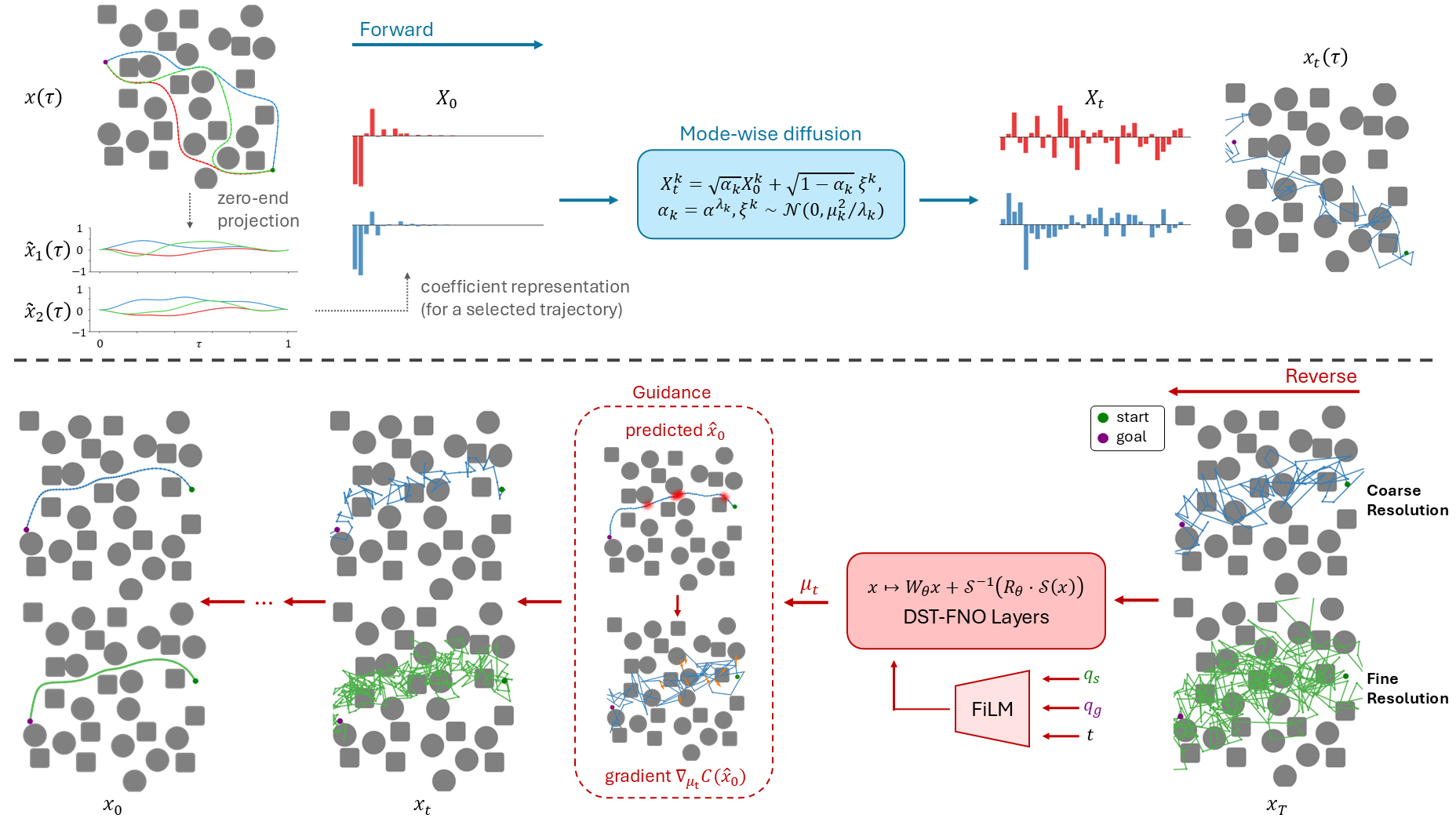
Figure 1: FSD-MP schematic showing the zero-end projection, DST coefficient transformation, mode-wise diffusion, and DST-FNO-conditioned denoising/guidance in the reverse process.
Endpoint Constraints and Zero-End Projection
Instead of inpainting or post-hoc correction, endpoint compliance is achieved by learning and sampling residuals with zero endpoint values, reconstructing the final trajectory by deterministic addition of the affine line connecting start and goal. This approach avoids introducing artifacts or inconsistencies when evaluating at arbitrary resolutions.
Function-Space Classifier Guidance
Collision avoidance and additional task constraints are applied in a manner aligned with the function-space perspective: guidance is computed via gradients on the clean trajectory estimate, not on heavily corrupted samples. This results in more physically meaningful constraint gradients and enhances inference stability.
Empirical Results
Benchmarks and Evaluation Protocol
The approach was benchmarked across a suite of environments (2D point robot and 7-DoF Franka manipulator), including scenarios involving unseen obstacles at inference time to test the method's adaptability and generalization (see Figure 2 and Figure 3).


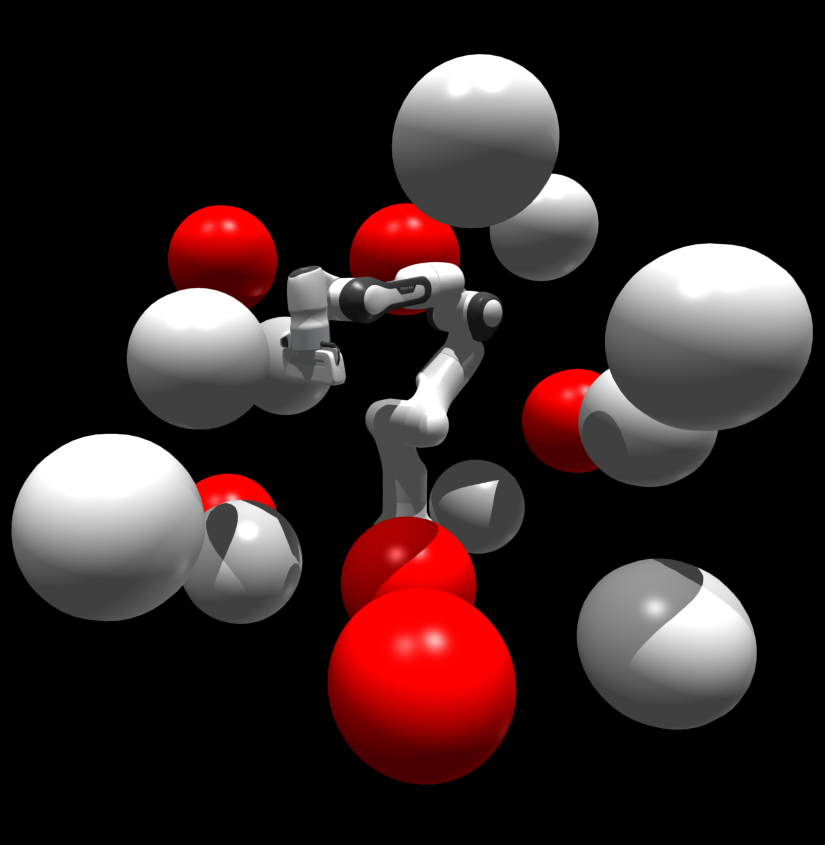
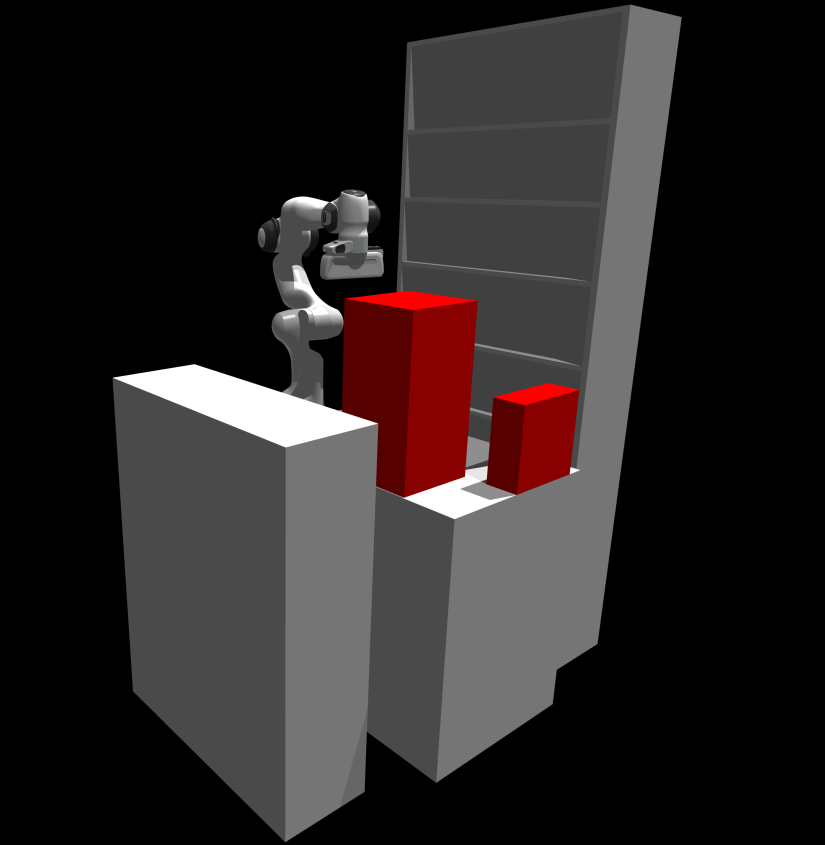
Figure 2: Simple2D point robot environment with obstacles used in benchmarking.
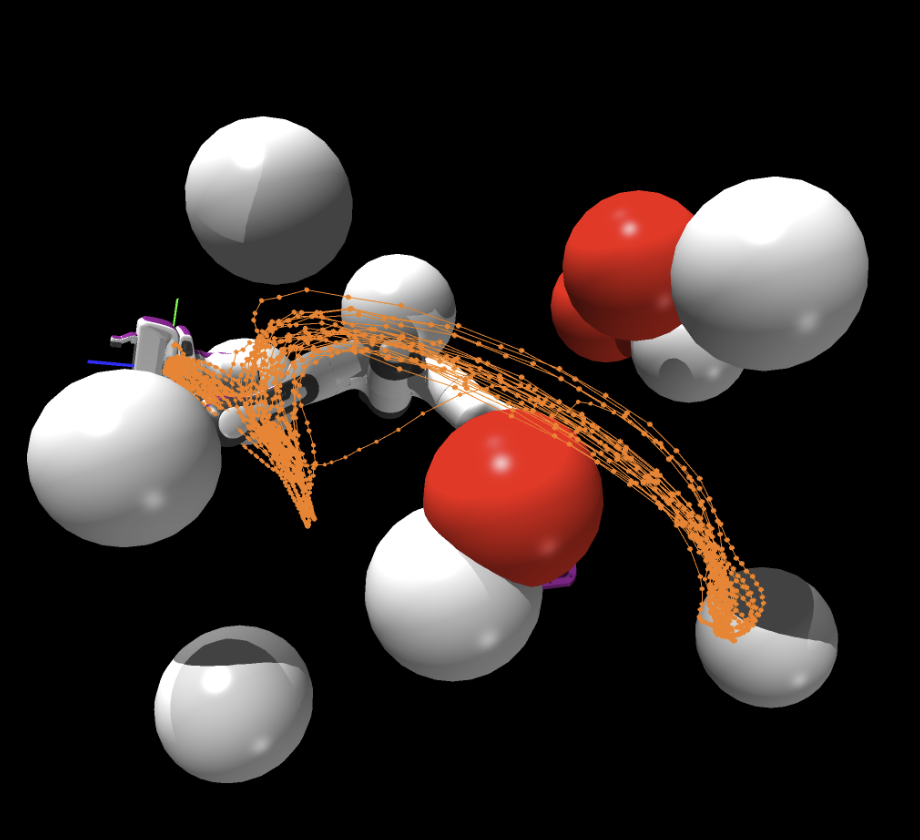
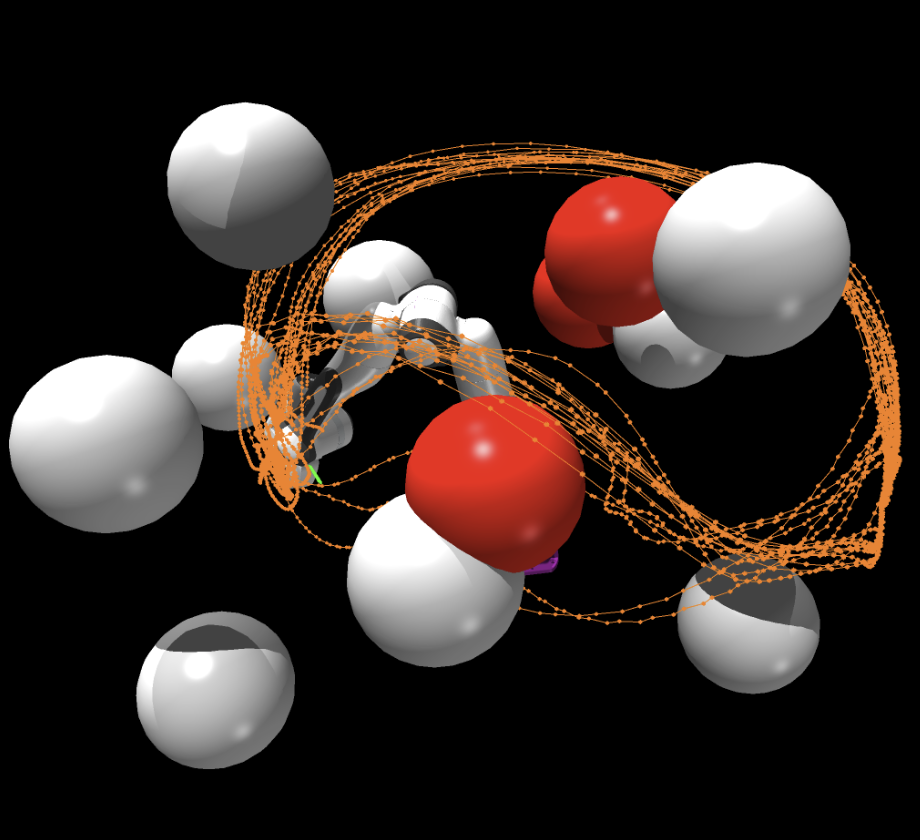
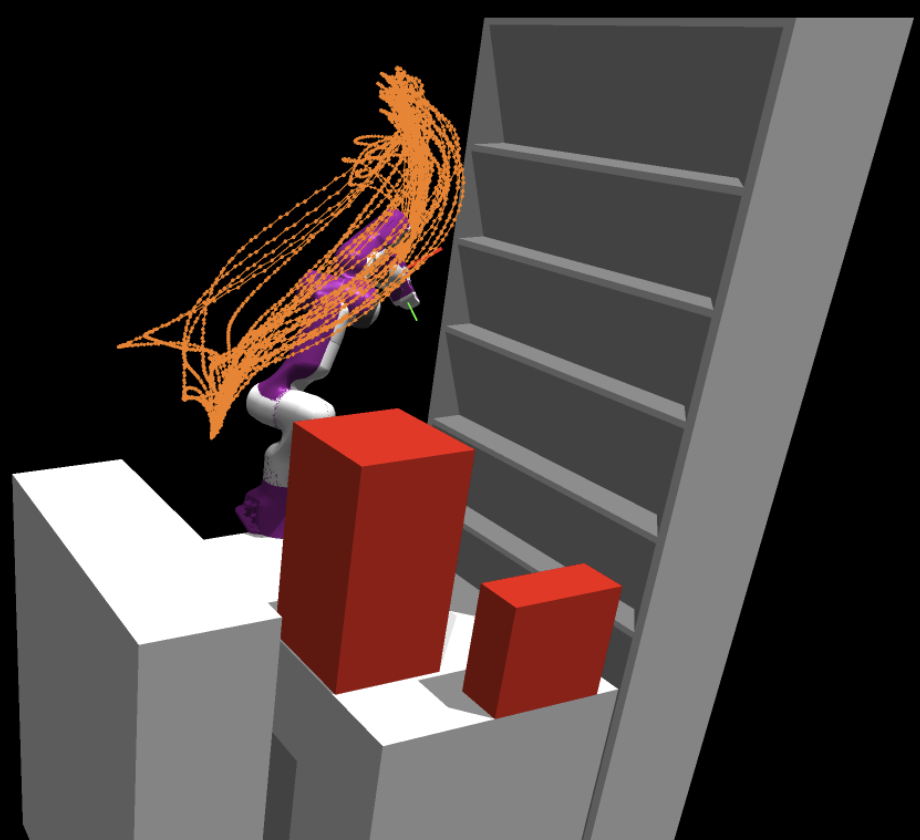
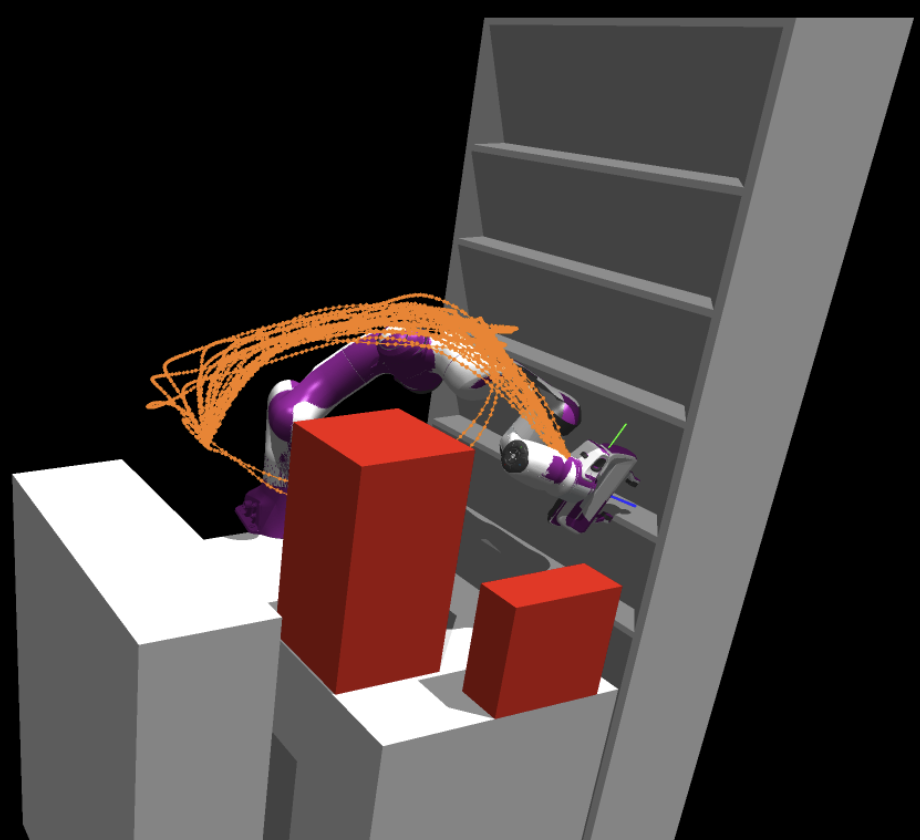
Figure 3: A 3D planning scenario for a Franka arm (Spheres3D, Context 1), with additional obstacles introduced at inference.
Comparative Metrics
- Success Rate: Fraction of start-goal pairs for which at least one trajectory is collision-free.
- Valid Rate: Fraction of total sampled trajectories that are collision-free.
FSD-MP is directly compared to:
- Fixed-resolution diffusion planners (MPD, MPD-Spline),
- GPMP (Continuous-time Gaussian process motion planning),
- MPD-Retrain (diffusion model retrained for each target resolution).
Key Findings
FSD-MP demonstrates competitive or superior planning rates (success and validity) on both 2D and 3D robotic tasks. Notably, it maintains consistent performance across resolutions ranging from N=64 (training) up to N=1024 or N=2000 (inference), whereas all baselines (except MPD-Retrain) degrade significantly when challenged out-of-distribution on resolution.
Strong numerical results include:
- 100% success, 99.8% valid rates on Simple2D across all tested resolutions.
- On Spheres3D, maintaining 100% success, 83% valid rate at both training and 16× finer resolutions—without retraining.
- FSD-MP generalizes to environments with extra test-time obstacles when supplied with online classifier guidance.
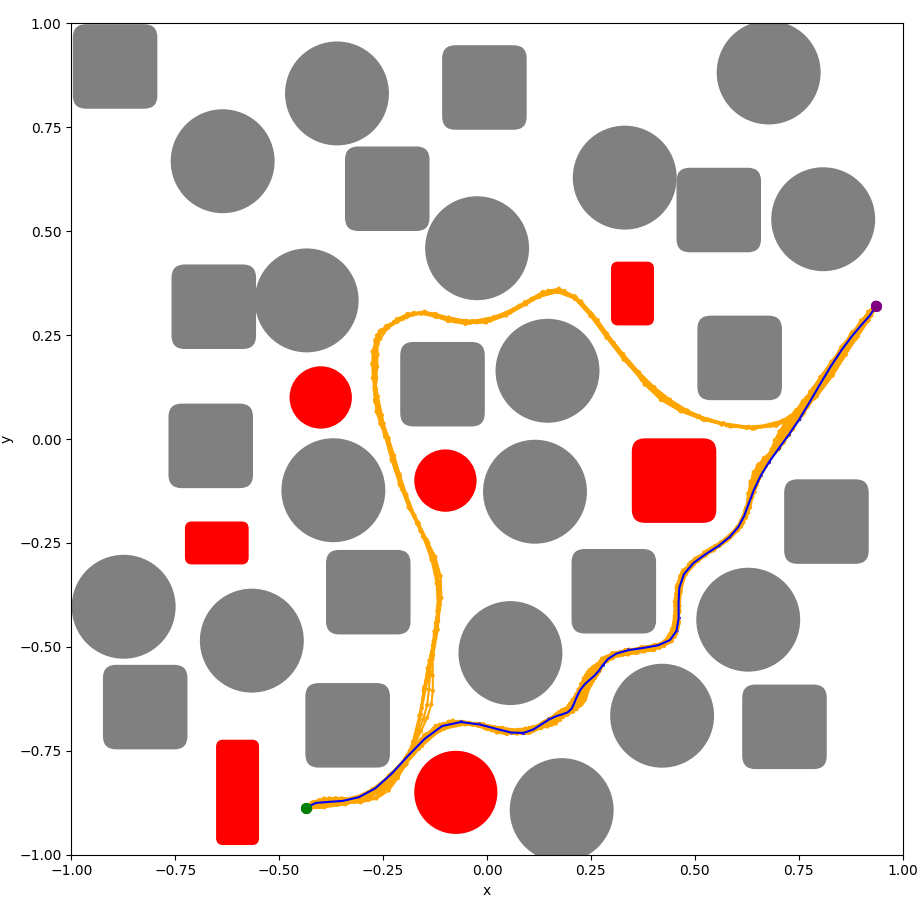
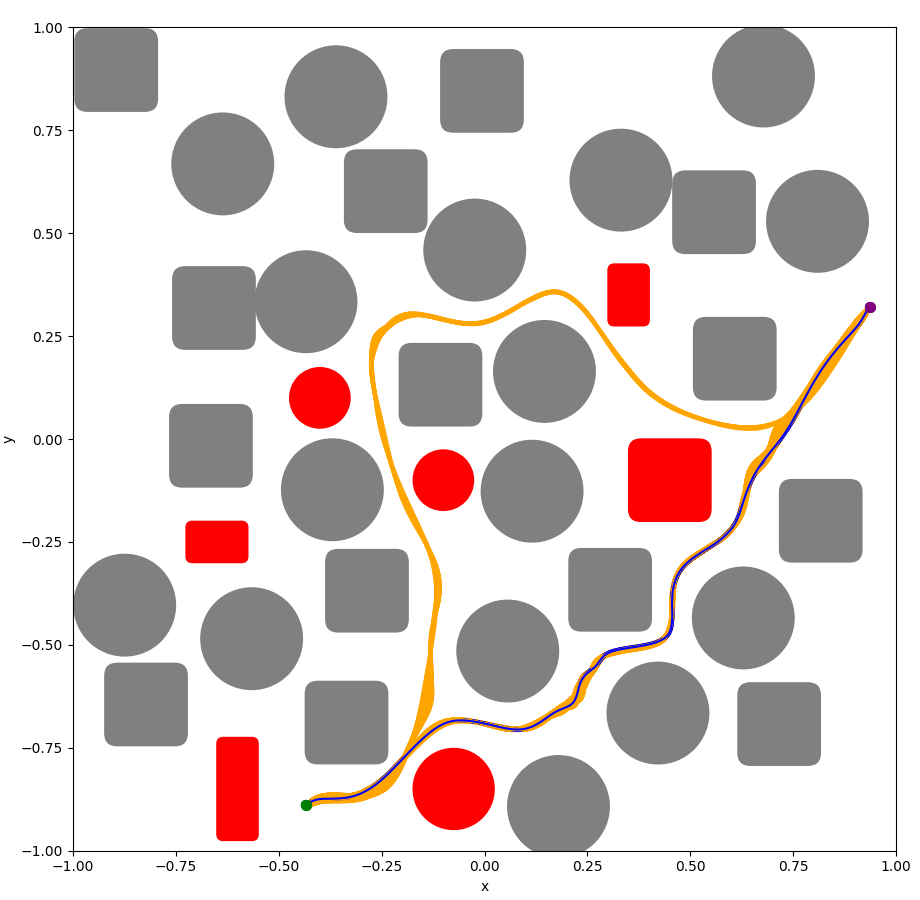
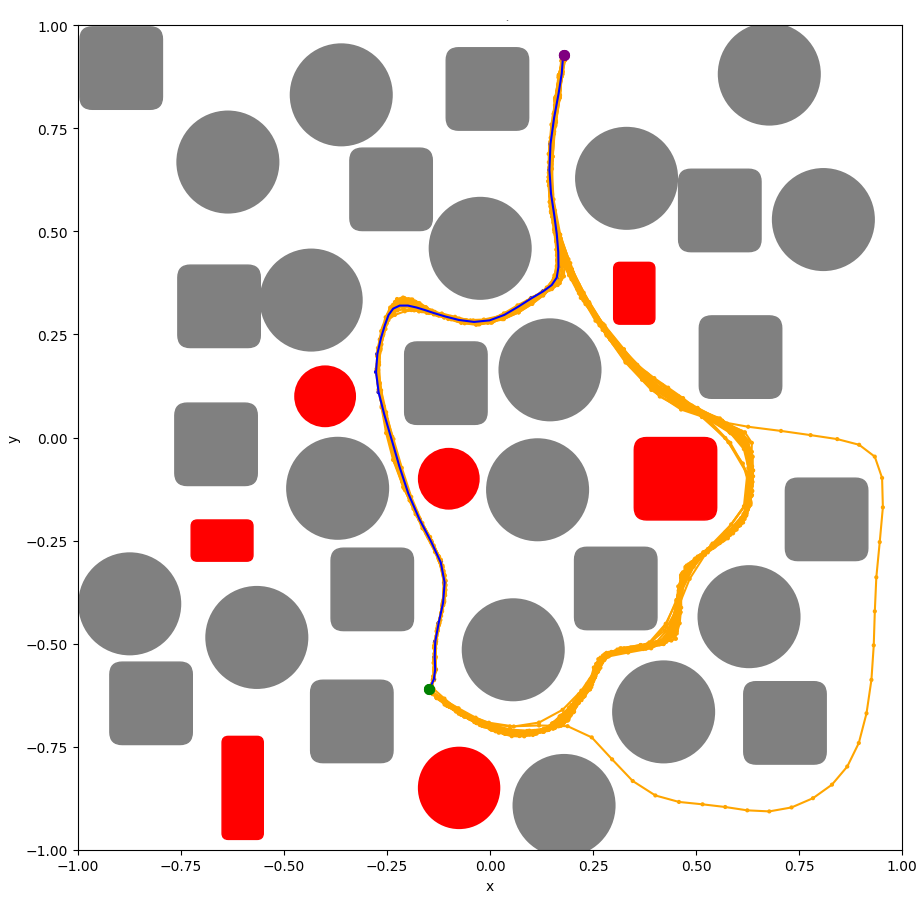
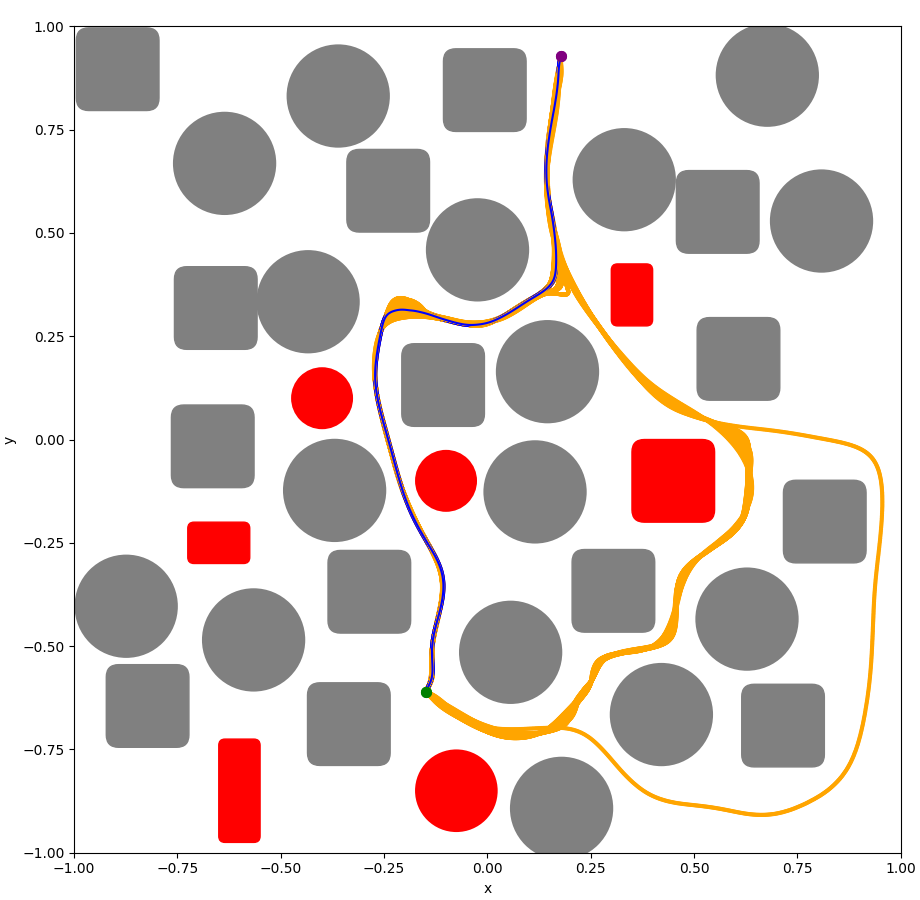
Figure 4: FSD-MP-generated trajectory in a context from the N=64 training environment, illustrating smooth, collision-free planning.
Ablation studies confirm that:
- Using a standard FFT/FNO degrades performance on cross-resolution inference due to incompatibility with endpoint constraints.
- White noise as a covariance fails to ensure valid function-space measure, leading to consistency loss.
- UNet backbones collapse when evaluated at out-of-distribution discretizations.
Theoretical and Practical Implications
Theoretical Advancements
The function-space approach bridges recent theoretical work on score-based diffusion models in infinite dimensions [lim2025score, pidstrigach2024infinite] with practical motion planning. By carefully constructing the forward SDE and leveraging the DST basis, FSD-MP avoids the pitfalls of ill-posed Gaussian noise in function spaces and maintains strong inductive bias for boundary compliance.
Furthermore, classifier guidance is performed using gradients computed on the clean trajectory estimates, aligning the inference machinery with the continuous-space planning problem and improving constraint adherence compared to standard approaches.
Practical Relevance
- Discretization invariance allows practitioners to deploy a single model for a wide variety of task requirements, from coarse global planning to fine-resolution control, without retraining.
- The architecture's compatibility with functionally continuous representations supports downstream integration with high-fidelity controllers and physics-based simulators.
- The zero-shot generalization property reduces storage and maintenance overhead in safety-critical systems with variable real-time constraints.
Future Directions
Building on this foundation, future research will likely explore:
- Extension to higher-dimensional configurations (e.g., mobile manipulation, multi-robot coordination).
- Adaptive and coarse-to-fine inference, potentially by combining function-space diffusion with local refinement methods near obstacles.
- Integration of richer environmental context and task constraints into the operator.
- Further formal analysis of infinite-dimensional diffusion models for more general classes of planning and control applications.
Conclusion
FSD-MP represents a significant methodological advance for learning-based motion planning, achieving discretization-invariant, multimodal trajectory generation through a principled infinite-dimensional diffusion formulation. The boundary-compatible DST-FNO and well-posed function-space SDE design underpin its strong empirical performance and generalization properties. These innovations pave the way for robust, flexible, and theoretically grounded planning frameworks for complex robotic systems.
(2607.02977)