- The paper demonstrates a Neural ODE framework for reconstructing bulk holographic fields from ARPES data with sub-percent errors on analytic models.
- It validates that strange metal spectra in cuprates align with AdS2×R2 dualities, confirming negligible gauge potentials at low temperatures.
- The approach highlights limitations at elevated temperatures and the inability of normalized single-particle spectra to determine thermodynamic properties.
Introduction and Motivation
The paper "Holographic Learning from Fermionic Spectra: Application to Strange Metal Phenomenology" (2607.02861) establishes a technical framework for reconstructing static, planar-symmetric black hole metrics and U(1) gauge profiles from frequency- and momentum-resolved boundary fermionic spectra, encoded in the retarded Green's function. Using Neural ODEs, the authors solve an inverse problem: given ARPES-calibrated data for the strange metal phase (notably in cuprates such as Bi2201), they determine effective bulk fields that reproduce observed spectral anomalies within AdS/CFT and semi-holographic settings. Validation is performed against analytic models (Einstein--Maxwell, Gubser--Rocha), with sub-percent accuracy before proceeding to experimental input.
Holographic Setup and Inverse Problem
Fermionic spectral functions are computed holographically by evolving bulk Dirac fields on static backgrounds. The massless probe limit yields flow equations insensitive to the static conformal factor, with boundary extraction performed via the conserved radial flux. For the semi-holographic context, the PLL (power-law liquid) model is generalized to momentum-dependent exponents, motivated by explicit holographic IR solutions (Gubser--Rocha). The physical electron self-energy is thus linked to the imaginary part of the holographic composite Green's function, post-conjugation with the particle-hole swap relevant for ARPES.
Neural ODE Learning Architecture
The inverse solution requires parameterizing three bulk functions (f(z),h(z),qAt(z)), each represented by independent neural nets. The full set of coupled ODEs is solved numerically at each iteration. The learning protocol incorporates multiple stages: parallel seed optimization, variant fine-tuning, deep optimization, and precision polishing, primarily via Adam and BFGS. Spectral predictions are matched pointwise via the Itakura–Saito divergence, compatible with positivity constraints from the holographic prescription.
Validation on Analytic Models
Reconstructions on synthetic boundary data from Einstein--Maxwell and Gubser--Rocha models confirm the method's precision. For both Q=1 and Q=1.5 (Einstein--Maxwell), as well as Q=1 and Q=3 (Gubser--Rocha), learned f(z),h(z),qAt(z) profiles closely match analytic expressions, with mean relative errors below 0.5%.
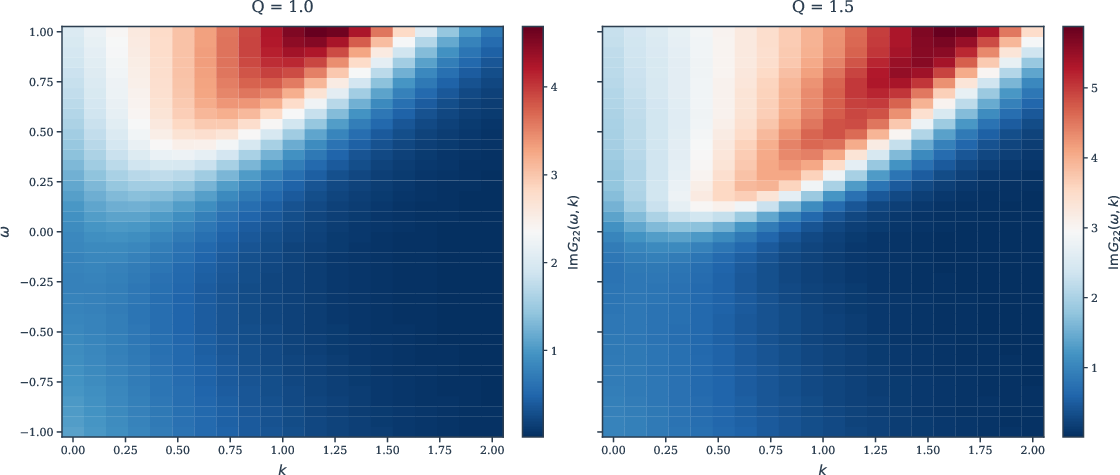
Figure 1: Heatmap of the spectral function in the Einstein--Maxwell theory, displayed for Q=1 and Q=1.5.
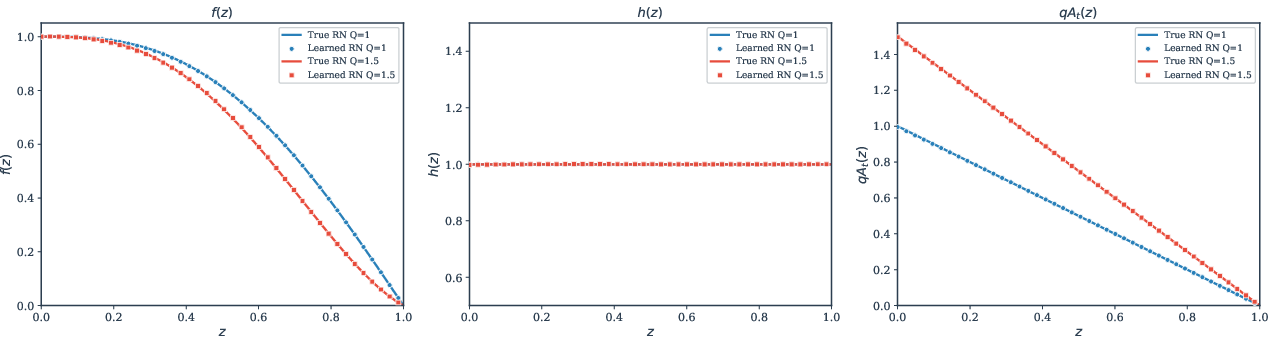
Figure 2: Reconstruction accuracy: learned metric functions and gauge profile compared to analytic RN solutions for f(z),h(z),qAt(z)0 and f(z),h(z),qAt(z)1.
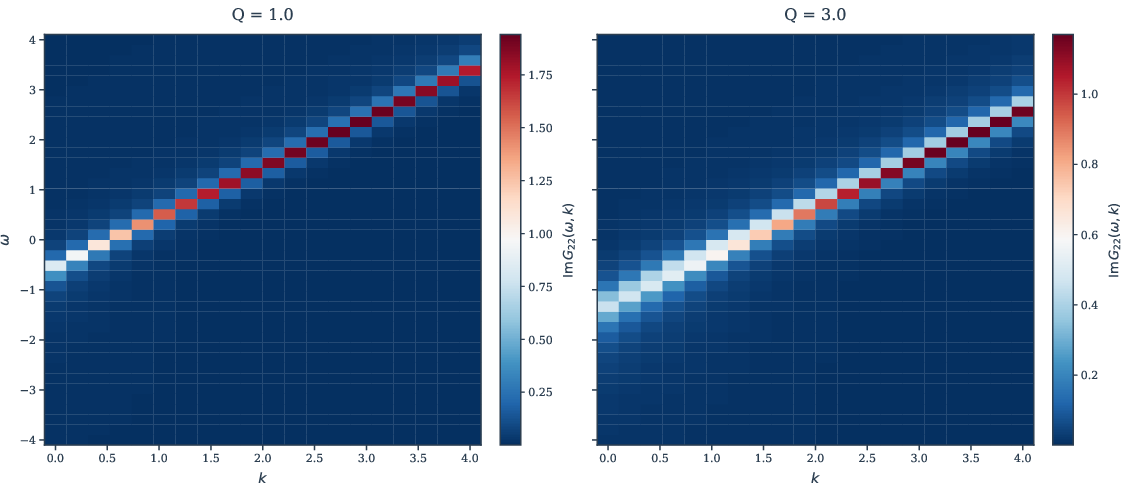
Figure 3: Heatmap of the spectral function in the Gubser--Rocha model for f(z),h(z),qAt(z)2 and f(z),h(z),qAt(z)3.
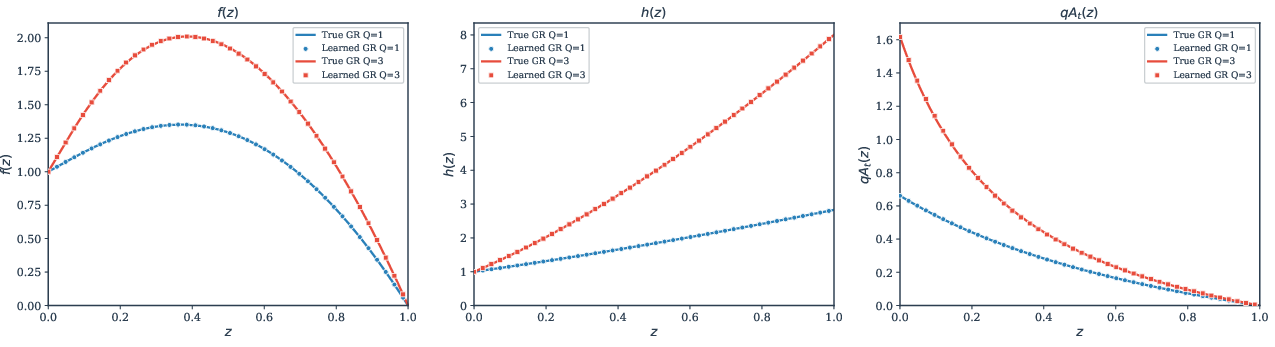
Figure 4: Reconstruction accuracy for Gubser--Rocha model: learned f(z),h(z),qAt(z)4 versus analytic baseline.
For underdoped Bi2201 samples (e.g., UD32K) at low temperatures, the extended PLL model (with momentum-dependent exponent f(z),h(z),qAt(z)5) yields boundary spectra closely reproducible via the Neural ODE approach. The learned bulk geometry conforms to f(z),h(z),qAt(z)6 black holes, with a negligible gauge potential (f(z),h(z),qAt(z)7 eV).
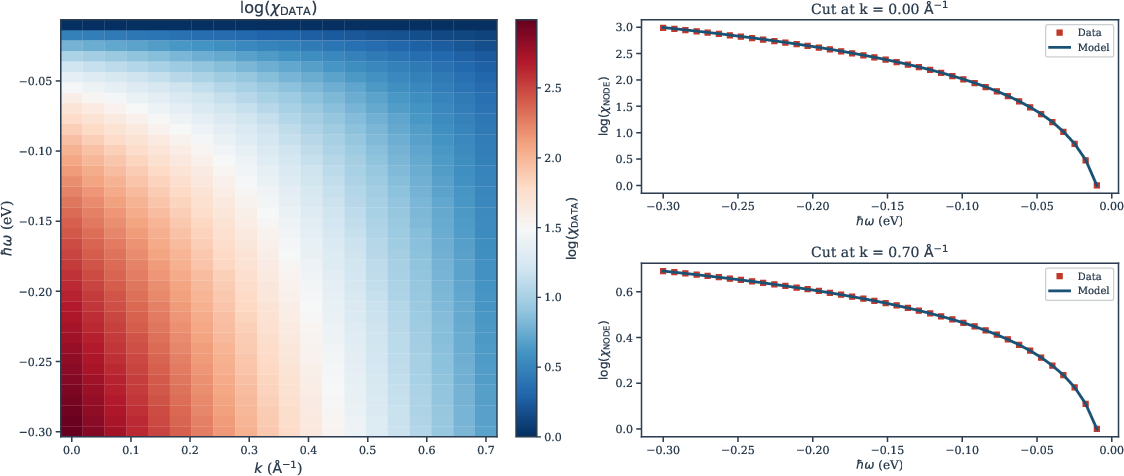
Figure 5: PLL target and Neural-ODE prediction for UD32K at f(z),h(z),qAt(z)8 K, illustrating precise spectral match.
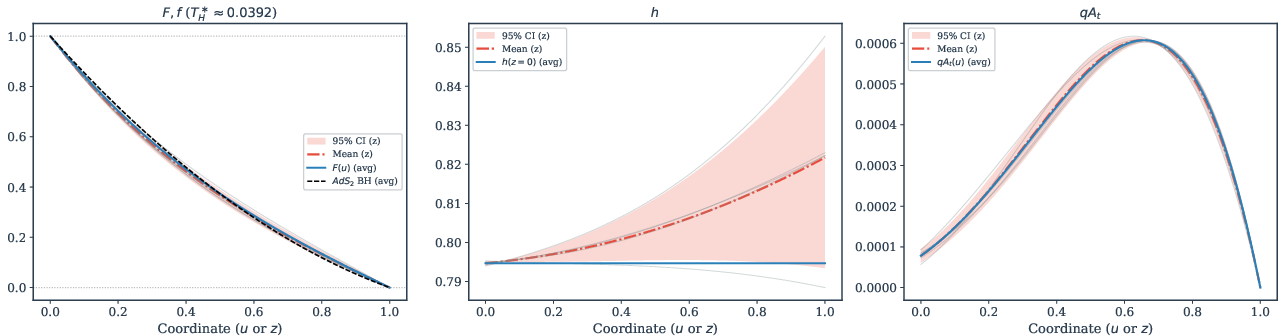
Figure 6: Extracted bulk fields for optimal doping UD32K at f(z),h(z),qAt(z)9 K: blackening factor, spatial metric, and Q=10; confidence intervals over final-candidate solutions.
The learned spatial metric Q=11 is consistent with the input PLL exponent (Q=12). Fitting the blackening factor reveals near-coincidence with the Q=13 black hole form—a result emergent from data rather than imposed by the ansatz. The spectra are insensitive to the conformal factor Q=14, precluding unique determination of macroscopic thermodynamics (entropy density, specific heat) from single-particle signatures.
Robustness Across Doping and Temperature
In the overdoped regime (OD23K, OD15K, OD3K, OD0K), the method remains viable at Q=15 K, with loss increasing mildly as samples depart from the marginal Fermi liquid point. The gauge potential remains negligible across all samples.
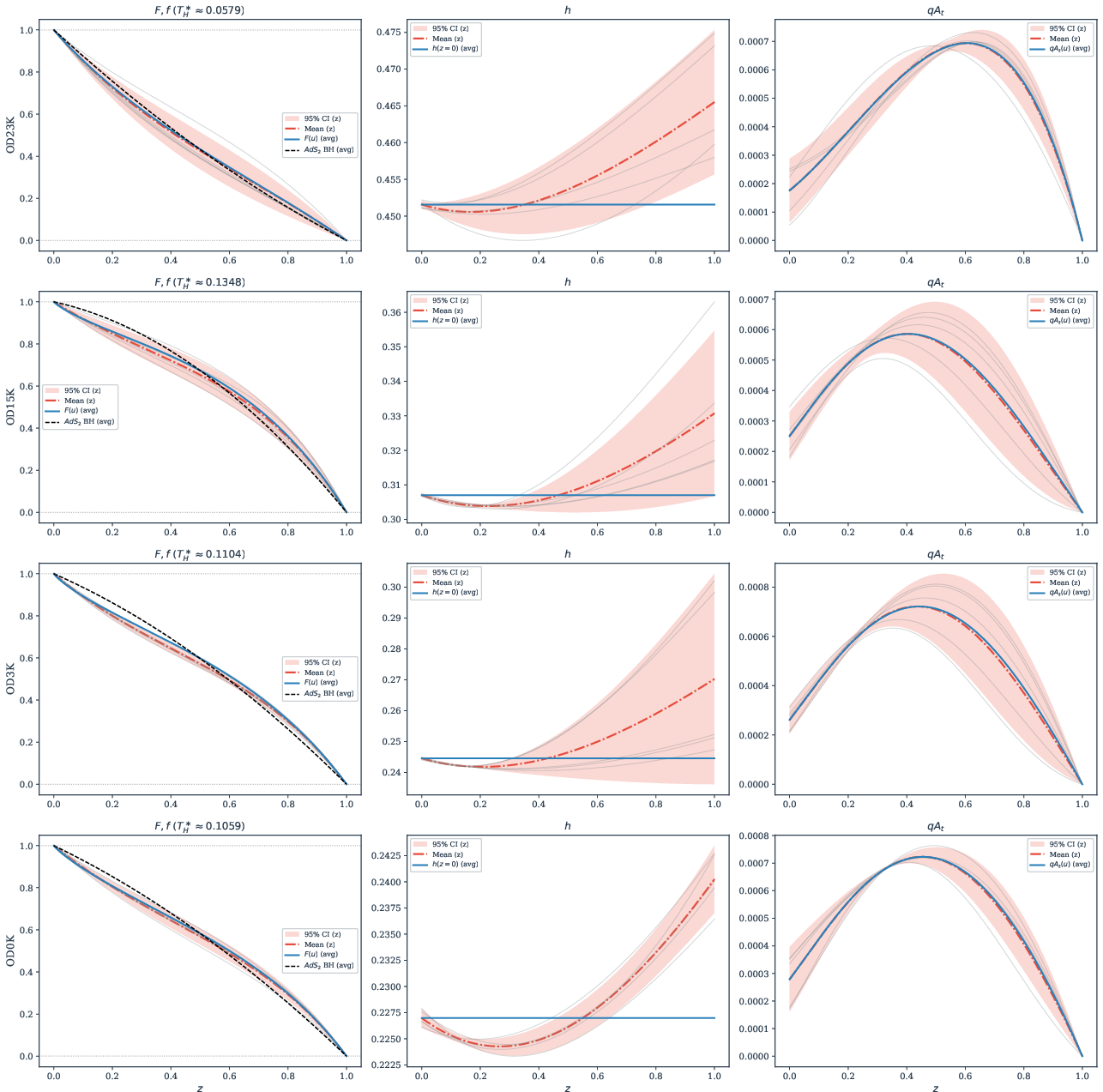
Figure 7: Learned bulk fields for overdoped samples at Q=16 K; all profiles consistent with Q=17 baseline and negligible gauge potential.
For elevated temperatures, the method displays empirical limitations: loss increases, Q=18 grows (Q=19 eV at Q=1.50 K), and the reconstructed spectrum develops significant particle-hole asymmetry. No parameter refinements (e.g., temperature-dependent coupling Q=1.51 or additional offsets) resolve these residuals within the normalized PLL target and the chosen ansatz class.
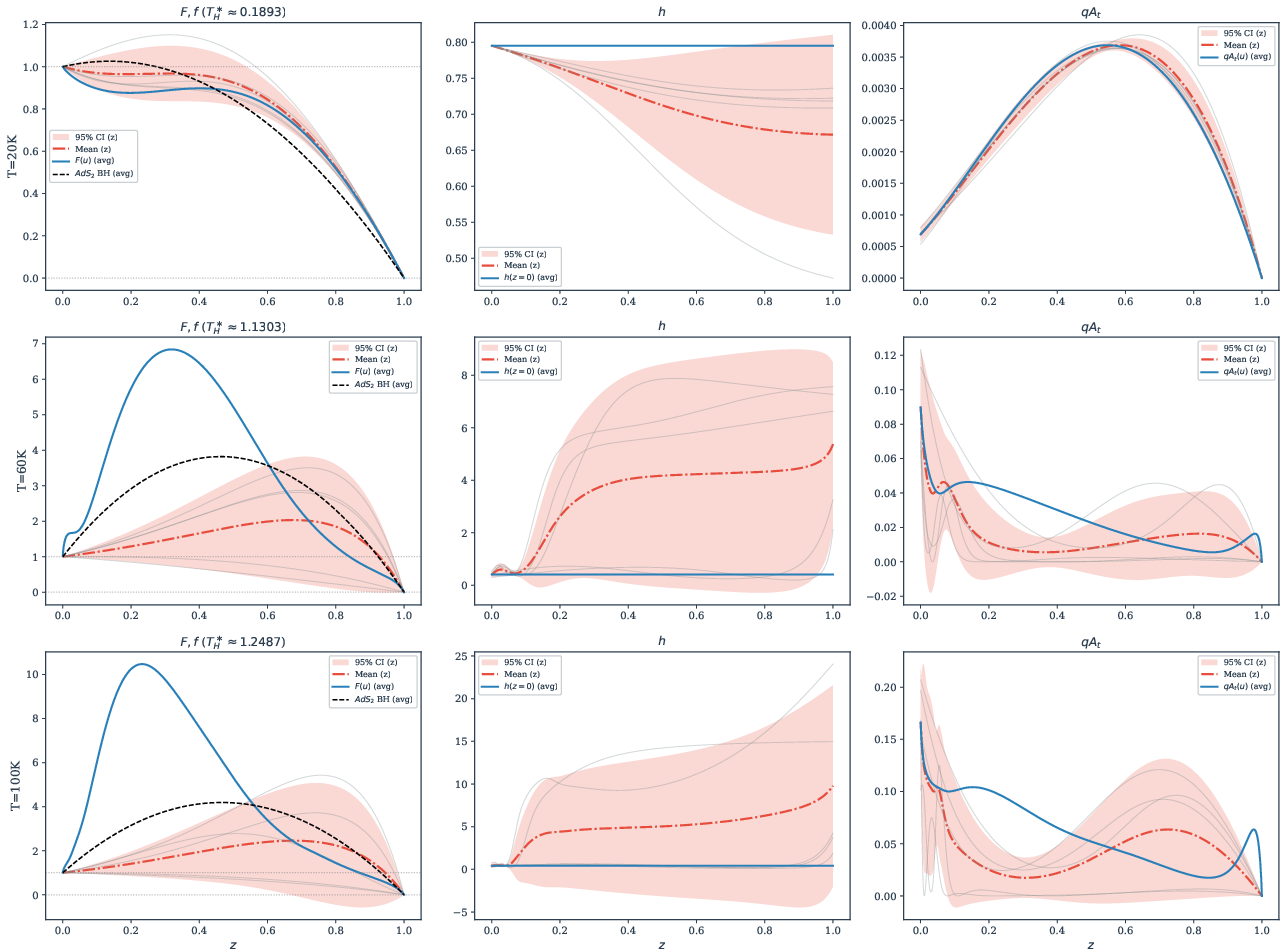
Figure 8: Learned bulk fields for UD32K at Q=1.52, Q=1.53, Q=1.54 K; deviation from Q=1.55 geometry increases with Q=1.56.
Gauge Invariance and Temperature Degeneracy
A key structural insight is the temperature degeneracy: normalized single-particle spectra only fix the conformal class, not the Hawking temperature, for massless probes. This is validated by controlled learning with fixed Q=1.57 across multiple samples, showing robust spectral fitting and gauge potential recovery.
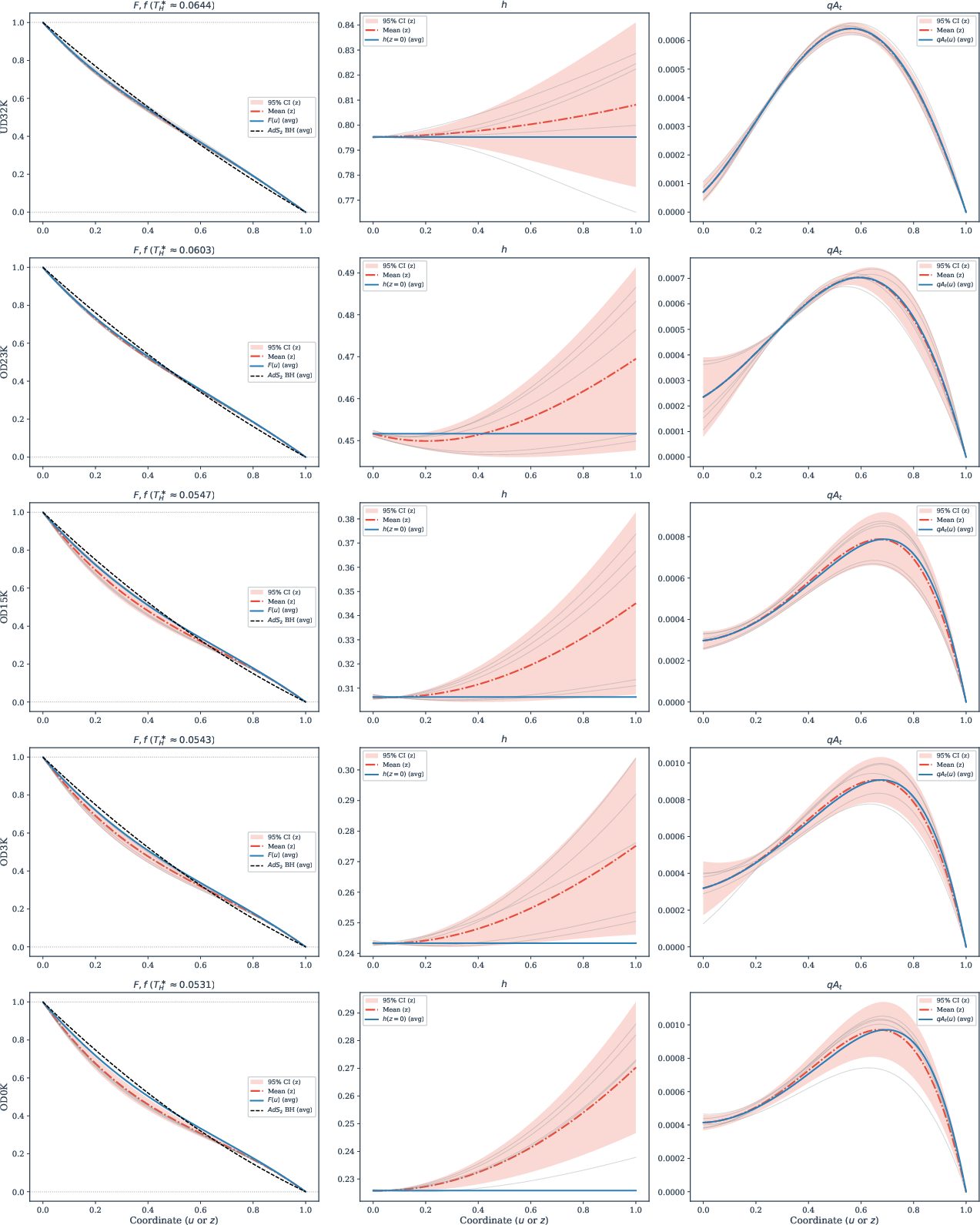
Figure 9: Fixed-temperature test: bulk fields learned for multiple doping samples at Q=1.58 K with prescribed Q=1.59.
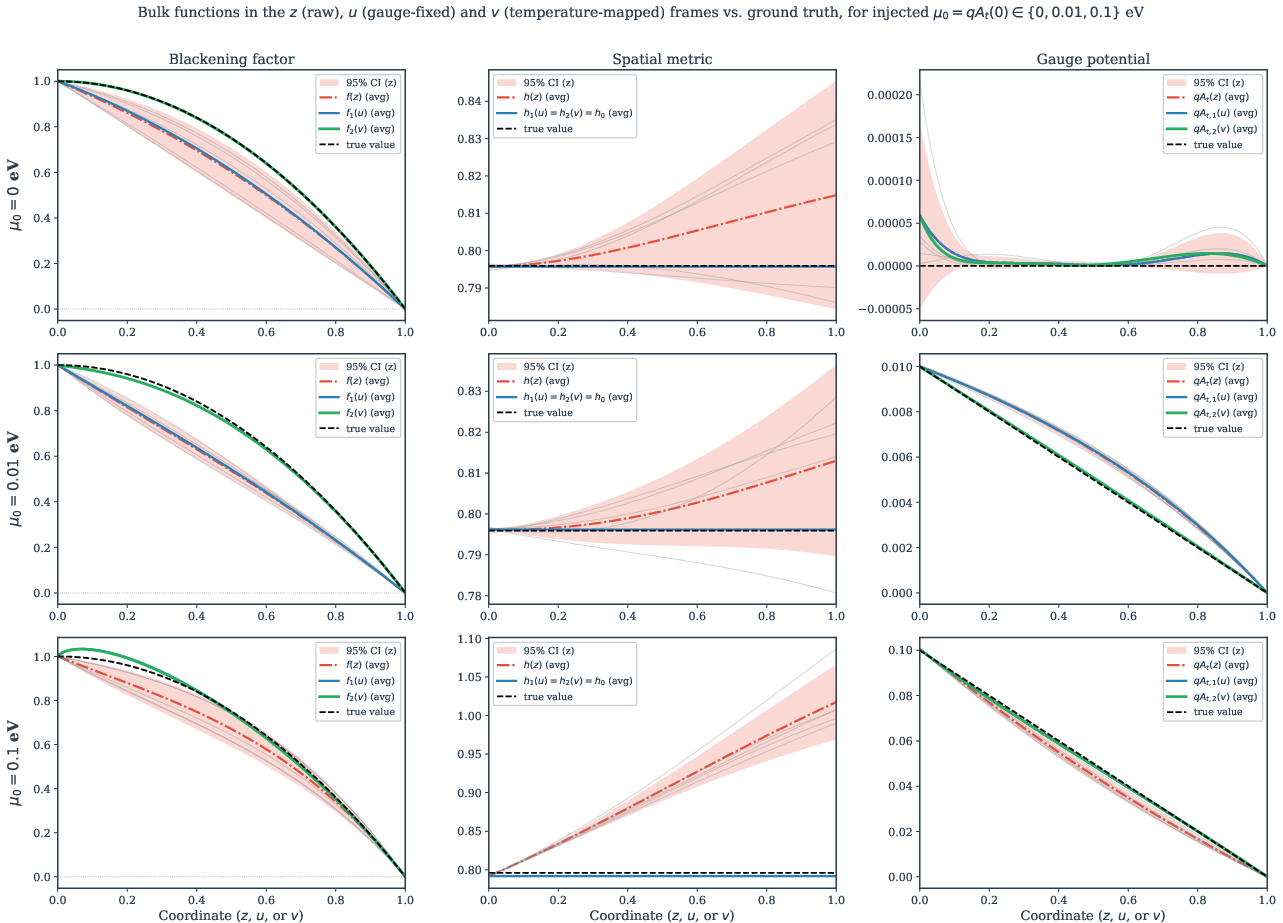
Figure 10: Controlled reconstructions: synthetic spectra from Q=10 black holes with varied boundary gauge potentials are accurately inverted.
Implications and Future Directions
The present framework provides a systematic machine-learning pipeline for holographic inverse problems, establishing high-fidelity bulk reconstructions from boundary fermionic observables in both synthetic and semi-holographic settings. The main practical ramification is the demonstration that normalized ARPES spectra in strange metals are consistent with Q=11 bulk duals with negligible gauge charge at low temperature; the geometric degeneracy precludes extraction of thermodynamic quantities from single-particle spectra alone.
Theoretically, this result clarifies the separation between spectral and thermodynamic observables in quantum-critical metals, supporting independent microscopic input for bulk thermodynamics. Empirically, the increasing loss and nonphysical features at high temperatures bolster the case for additional degrees of freedom or extensions beyond conformal-to-Q=12 black holes.
Future developments could encompass: relaxing symmetry constraints, incorporating mass terms, using alternate boundary conditions, integrating transport or macroscopic observables, and extending to other strongly correlated systems (e.g., heavy fermions) to delimit the practical applicability of holographic and semi-holographic model classes.
Conclusion
The paper provides a rigorous, scalable methodology for learning bulk gravitational fields from boundary fermionic spectra, with strong numerical results on both analytic and ARPES-calibrated datasets. It delineates the boundaries of holographic applicability in condensed matter contexts, clarifies the implications of gauge-invariant reconstruction, and motivates further extensions merging single-particle and macroscopic observables.