- The paper presents a recursive analytical framework that quantifies overload cascades in multiplex networks with nodes exhibiting partial functionality.
- It uses numerical simulations to validate that partial functionality can trigger asymmetric layer collapses and non-monotone robustness phenomena.
- The study proposes optimized free-space allocation strategies that enhance dual-layer robustness in complex infrastructures such as power grids and cloud systems.
Overload-Based Cascades in Multiplex Flow Networks with Partial Functionality
Introduction
The paper "Overload-Based Cascades in Multiplex Flow Networks with Partial Functionality" (2607.02844) introduces a comprehensive analytical framework for understanding cascading failures in multiplex flow networks where nodes possess partial rather than joint functionality. Unlike traditional models—which assume that nodes either survive or fail entirely across all network layers—this work explores settings where nodes concurrently support multiple distinct flows or functionalities. Failure in one particular layer only triggers redistribution of load within that layer, leaving remaining capacities available for others. This formalism better reflects the architectural realities of complex infrastructures such as power grids, cloud computing systems, and supply chains, where physical resources are shared across tasks but do not enforce all-or-nothing operational coupling.
Multiplex Flow Network Model and Partial Functionality
The network is modeled as a multiplex structure with M layers (M≥2), each responsible for a unique flow type (Figure 1). The two-layer scenario, denoted as {A,B}, is analyzed in depth. Each node vx carries load vectors [Lx,A,Lx,B] and capacity vectors [Cx,A,Cx,B]. Partial functionality is defined such that a node can survive in layer-A if Lx,A+βBLx,B≤Cx,A, and in layer-B if Lx,B+βALx,A≤Cx,B, where M≥20 and M≥21 are cross-layer influence factors quantifying the impact of load in one layer on the capacity in another.
Cross-layer influence induces complex interdependencies; heavy demand in one functionality subtracts from available resources for others, but failure in a single layer redistributes only that layer’s load. This creates distinct node states: surviving in both layers, surviving only in one, or failing in both.
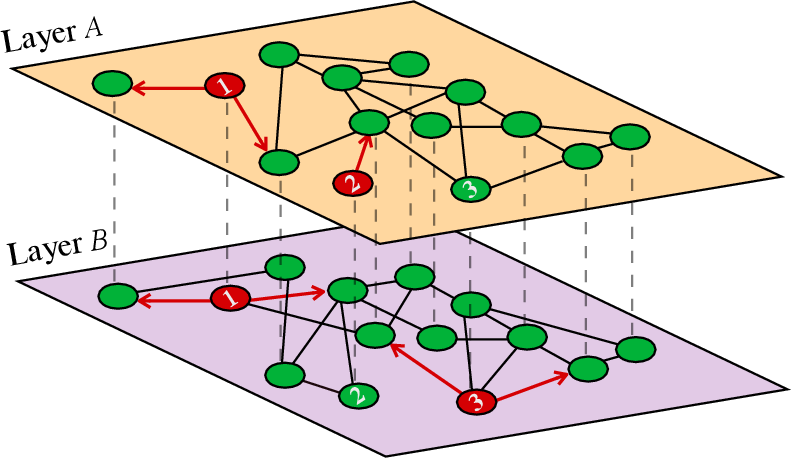
Figure 1: Multiplex flow network with partial functionality; layers M≥22 and M≥23 have independent edge sets and flows, and nodes may fail in either or both layers, triggering layer-specific load redistributions.
Analytical Framework for Cascade Dynamics
The paper presents a mean-field recursive analysis applicable to general load and capacity distributions. Cascades are triggered by random attacks that initially remove a fraction M≥24 of nodes. Load from failed nodes is redistributed equally among survivors within each layer (global redistribution rule). Cascade progression is tracked via the sets of nodes surviving in both layers (M≥25), only in layer-M≥26, or only in layer-M≥27 (Figure 2).
Recursive equations for excess loads M≥28 are provided, reflecting the time evolution of layer-specific overloads. Survival in each layer depends on current excess load plus cross-layer contributions, making each layer’s stability contingent on the state of the other. Unlike joint-functionality and interdependent models, partial-functionality introduces dynamic capacity relief: failure in one layer releases the cross-layer burden, sometimes increasing survivability of the other.
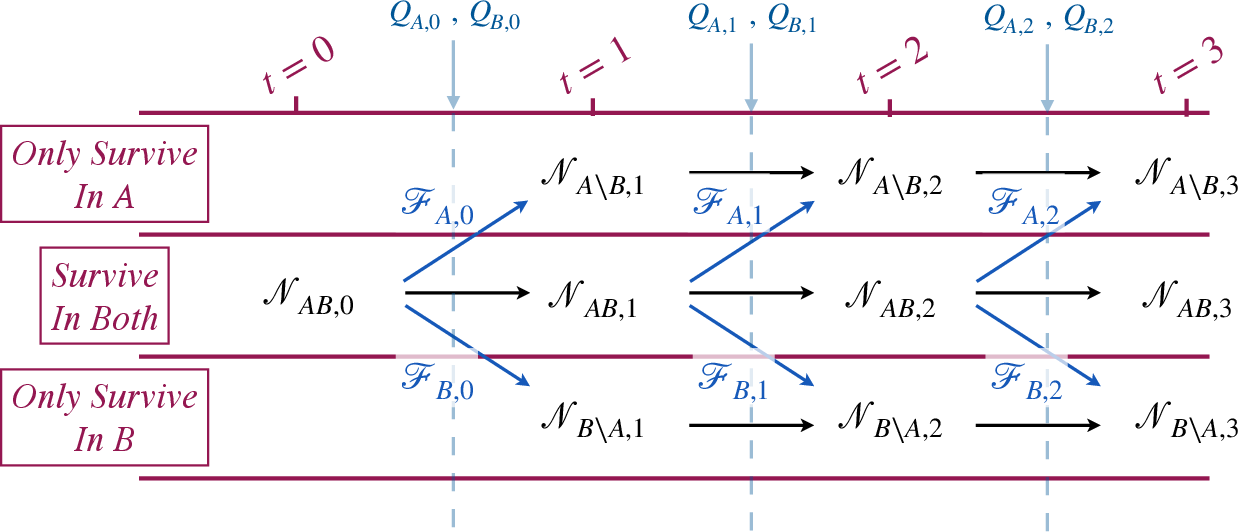
Figure 2: Cascade progression diagram showing transitions between both-layer survival and single-layer survival states due to iterative flow redistribution.
Numerical Validation and Cascade Behavior
Numerical simulations validate the analytical predictions across diverse load/capacity distributions (Uniform, Pareto, Weibull). Robustness curves (final surviving fractions as functions of attack size M≥29) demonstrate several distinguished phenomena:
- Asymmetric Layer Collapses: One layer can fail while the other remains operational, depending on the parameter regimes.
- Non-monotone Robustness: For specific configurations, increasing the attack size {A,B}0 can paradoxically result in a higher surviving fraction in a layer due to earlier collapse of the interdependent layer, which releases cross-layer capacity.
- Critical Thresholds and Regimes: Steady-state outcomes include dual-layer survival, single-layer survival (in {A,B}1 or {A,B}2), and complete collapse.
Simulation and analytic agreement is strong across all regimes, confirming the rigorous applicability of the recursive framework (Figure 3, Figure 4).
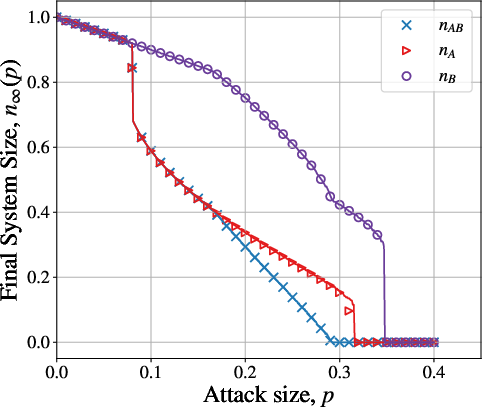
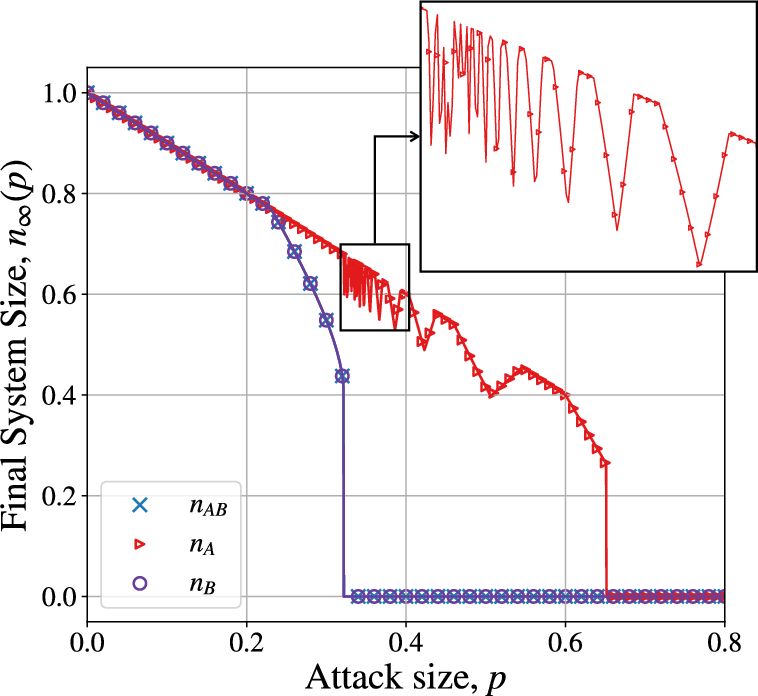
Figure 3: Validation comparison between mean-field recursive predictions and Monte Carlo simulation averages for robustness curves under two representative configurations.
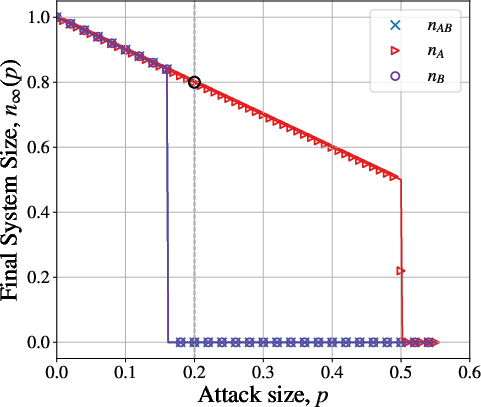
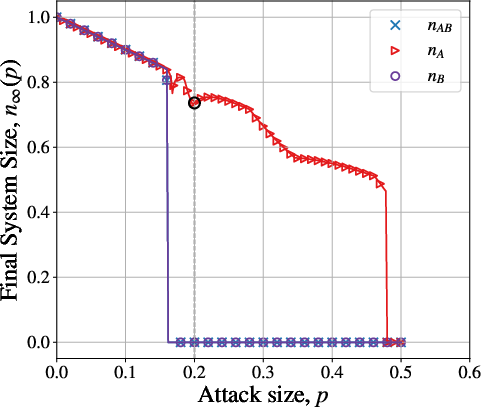
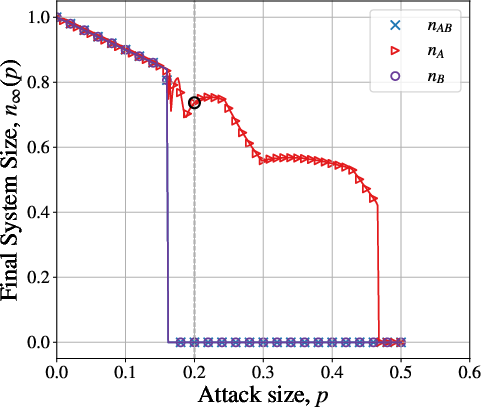
Figure 4: Robustness curves illustrating the effect of cross-layer influence {A,B}3; as {A,B}4 increases, layer-{A,B}5 exhibits non-monotonic response with respect to attack size {A,B}6.
Cross-Layer Influence Effects
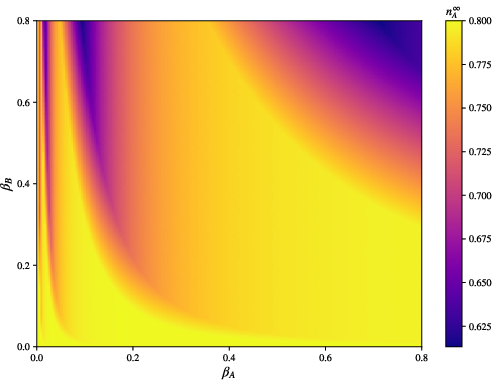
Systematic sweeps of cross-layer influence factors ({A,B}7, {A,B}8) uncover nontrivial, often counterintuitive consequences:
Cascade Outcome Phase Diagrams
The paper presents phase diagrams mapping cascade outcomes as a function of attack size vx2 and cross-layer influence (Figures 7 and 8). The vx3 space is partitioned into:
- Dual-layer survival region
- Single-layer survival regime (where only vx4 or vx5 survives)
- Complete collapse
Critical thresholds for each state (vx6, vx7, vx8) are extracted. Comparison to prior joint-functionality models shows greater robustness—particularly expanded regions of dual-layer survival.
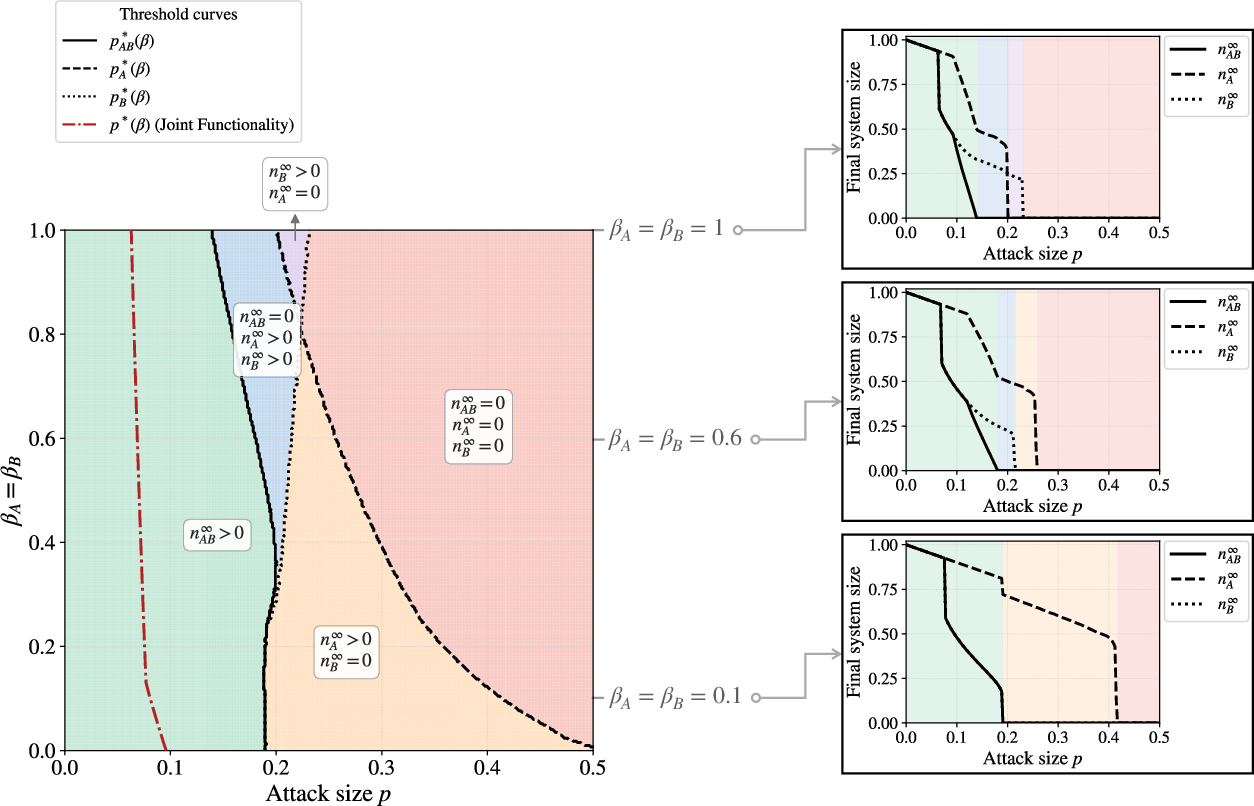
Figure 6: Cascade-outcome phase diagram in the vx9 plane, showing regions for dual-layer survival, single-layer survival, and collapse with critical boundaries.
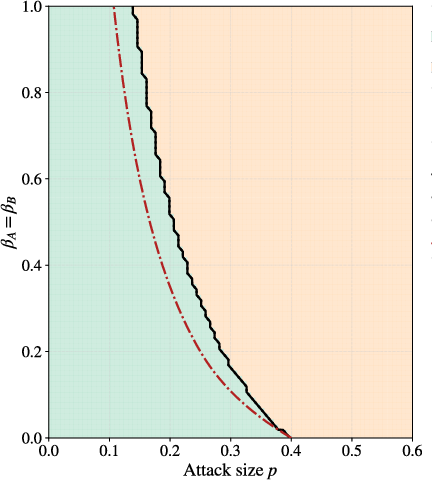
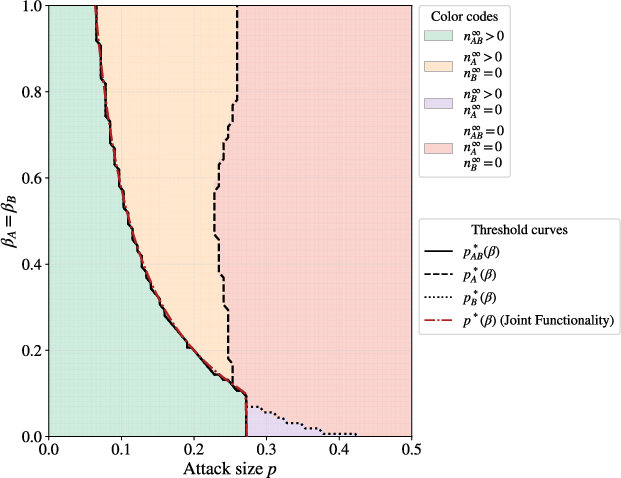
Figure 7: Alternative phase diagrams for different load/capacity distributions, demonstrating distribution-sensitive effects of partial functionality.
Robustness Maximization and Free-Space Allocation Strategies
The allocation of limited node capacity ("free space") is analyzed under both global and local load redistribution regimes. Several strategies are considered:
- Layer-weighted equal FSA: Allocates free space based on expected loads and cross-layer influences; optimal for dual-layer robustness.
- Equal FSA: Assigns equal free space to all nodes/layers.
- Equal tolerance factor: Assigns free space proportional to node load.
Layer-weighted equal FSA consistently maximizes dual-layer robustness in global redistribution settings. Under local redistribution (with explicit network topology), a novel Local-risk-weighted FSA—which assigns capacity based on local neighbor degree and load exposure—demonstrates superior critical thresholds in both ER and scale-free network environments.
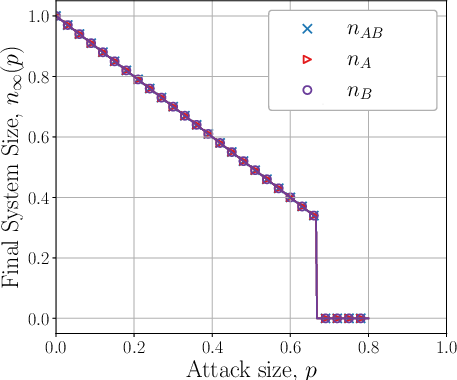
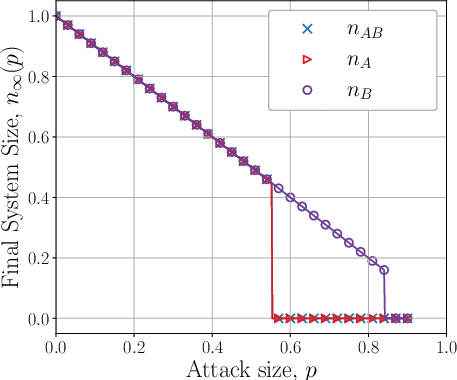
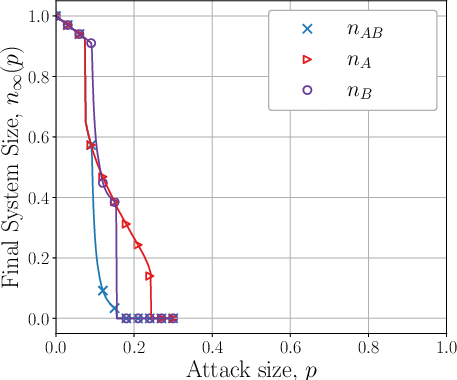
Figure 8: Final surviving fractions under three free-space allocation strategies, demonstrating superiority of layer-weighted equal FSA for dual-layer robustness.
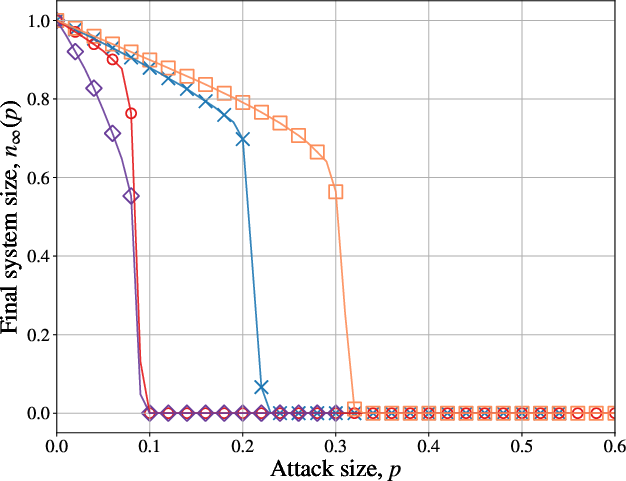
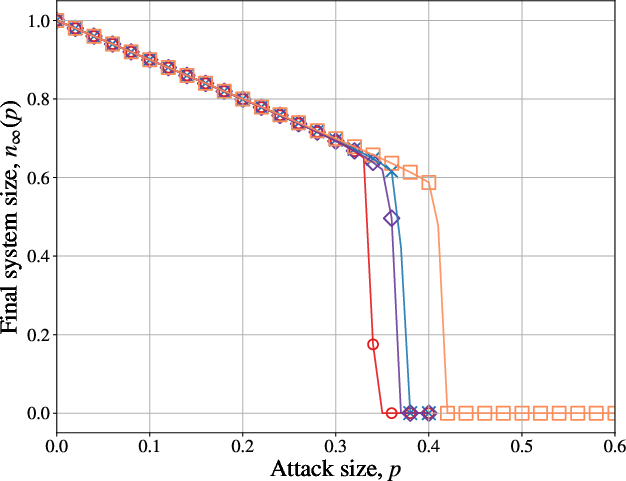
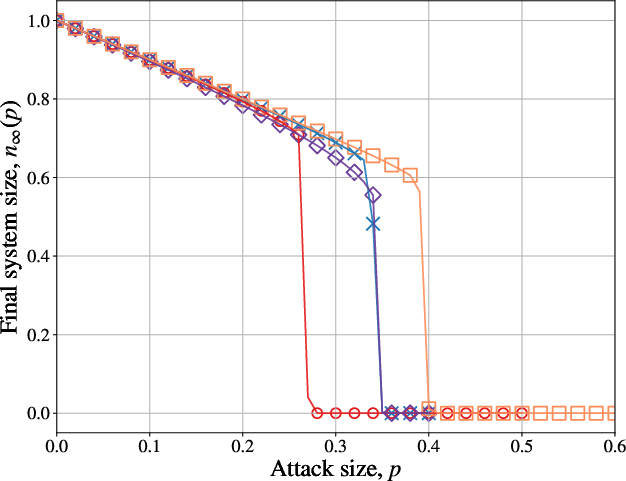
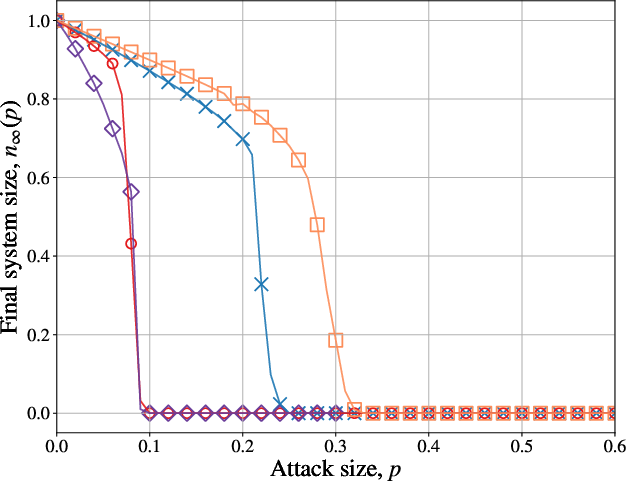
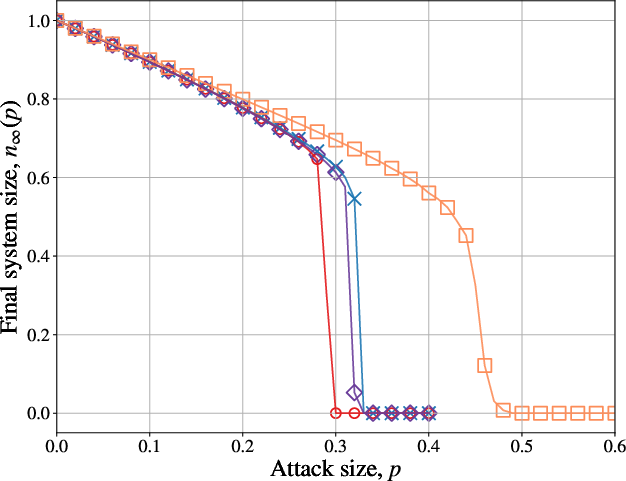
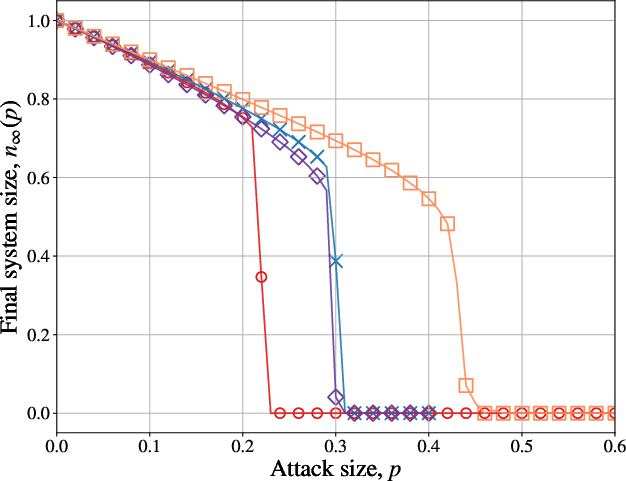

Figure 9: Local redistribution simulation outcomes comparing free-space allocation strategies; local-risk-weighted FSA achieves highest robustness in both ER and SF networks.
Implications and Future Directions
The partial-functionality multiplex flow model offers a fundamentally more nuanced depiction of overload-based cascading failure than previous frameworks. Practical implications include the potential to devise free-space allocation policies that maximize system robustness by exploiting capacity relief upon partial failure, rather than enforcing rigid all-or-nothing operational coupling. Theoretical implications extend to the identification of distinct critical thresholds and cascade regimes, highlighting the importance of heterogeneous layer dynamics and distributional effects.
Future developments should include analysis of local redistribution on explicit topologies, systematic optimization or bounding of free-space allocation strategies, and investigation of targeted attacks (highest-load removal), which may further refine robustness maximization protocols. This work provides a technical foundation for resilient design of real-world multiplex infrastructures with shared but partitionable resources.
Conclusion
This paper rigorously formulates and analyzes cascading failures in multiplex flow networks with partial functionality, offering recursive analytical tools, simulation validation, and optimization insights for robustness. It demonstrates that partial functionality not only introduces qualitatively new collapse regimes and critical thresholds, but also can expand the region of dual-layer operational robustness. The complexities uncovered—non-monotone robustness, asymmetric influence, and distribution-sensitive regime shifts—establish the value of the partial-functionality paradigm for modeling, simulation, and policy in multiplex networked systems.