- The paper introduces a novel mass-conserving boundary condition for the Fisher-KPP equation, eliminating artificial loss of population mass.
- It employs phase-plane analysis and numerical simulations to characterize invading (c > 0) and receding (c < 0) sharp-fronted traveling waves.
- The study establishes stability criteria and bifurcation structures, with clear implications for modeling biological invasion and tissue dynamics.
Mass-Conserving Traveling Waves in the Fisher-KPP Equation with a Moving Boundary
Introduction and Motivation
This work presents a mass-conserving free boundary formulation for the Fisher-KPP equation, shifting the paradigm of modeling biological invasion and recession. Previous models, particularly those based on the Fisher-Stefan framework, have invoked flux-based conditions at moving boundaries, often resulting in artificial loss of population mass at the propagating front. This paper introduces a boundary condition that ensures local mass conservation during interface motion, reflecting realistic biological scenarios where the domain edge advances or recedes without destruction or creation of material at the boundary.

Figure 1: Schematic illustration of biological population evolution—(a),(b) invading and (c) receding—with associated density profiles from both classical Fisher-KPP (smooth, fuzzy front) and mass-conserving sharp interface models.
Such a boundary condition enables the study of both invading and receding sharp-fronted traveling wave solutions, which are relevant for phenomena including tumor regression and wound healing. This approach addresses significant limitations of the classical Fisher-KPP and Fisher-Stefan models: the former cannot produce receding waves, and the latter introduces nonphysical mass loss at the wave front.
Let u(x,t) denote the population density on the semi-infinite domain x∈(−∞,L(t)), where L(t) is the (generally time-dependent) position of the moving boundary. The governing PDE is the nondimensional Fisher-KPP equation: ∂t∂u=∂x2∂2u+u(1−u)
with the moving boundary L(t) evolving as
dtdL=f(u(L(t),t))
where f is a general (possibly nonlinear) function of the front density, together with the mass-conserving boundary condition: ∂x∂u(L(t),t)=−u(L(t),t)dtdL
This condition equates advective transport due to domain expansion and the diffusive flux at the front, guaranteeing that any change in mass is solely due to the reaction (growth/death) term and not by artificial boundary leakage.
Analytical Phase Plane Structure
The existence and characteristics of traveling wave solutions were investigated via phase-plane analysis. For traveling wave coordinate z=x−ct and profile u(x,t)=U(z), the system reduces to
x∈(−∞,L(t))0
with boundary conditions securing mass conservation and linking the wave speed x∈(−∞,L(t))1 to the front density x∈(−∞,L(t))2 as x∈(−∞,L(t))3 and x∈(−∞,L(t))4. Here x∈(−∞,L(t))5.
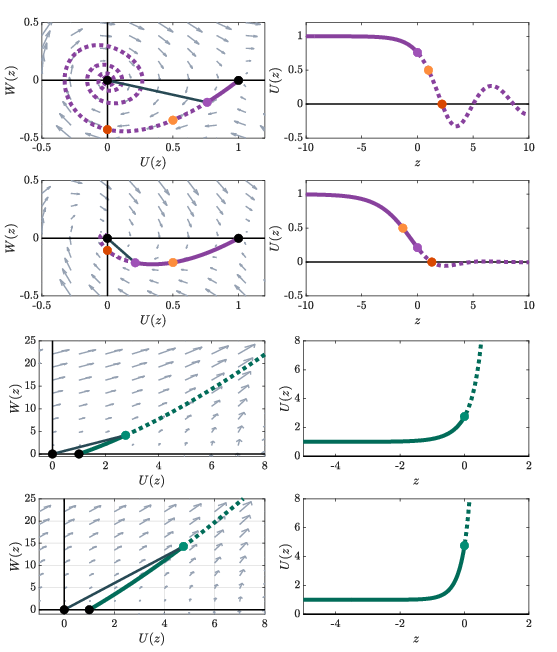
Figure 2: Traveling wave trajectories in phase space x∈(−∞,L(t))6 and associated density profiles, for a spectrum of positive and negative wave speeds, featuring both invading (x∈(−∞,L(t))7) and receding (x∈(−∞,L(t))8) solutions.
A critical finding is that, under the mass-conserving condition, truncated traveling wave orbits with both x∈(−∞,L(t))9 (invasion) and L(t)0 (recession) exist, and all corresponding density profiles satisfy L(t)1.
Invading waves (L(t)2): L(t)3. The wavefront is below the uniform steady state, with velocity constrained to L(t)4.
Receding waves (L(t)5): L(t)6. The front is locally overdense, consistent with "bunching up" due to boundary contraction, and the wave can recede with arbitrarily negative speed.
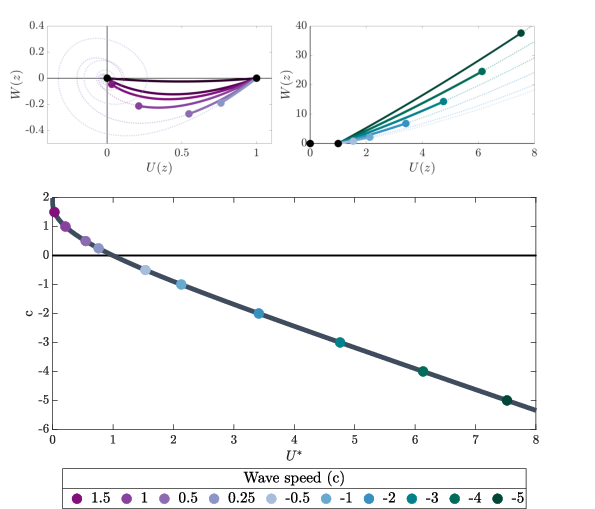
Figure 3: Family of phase plane trajectories and the L(t)7–L(t)8 relationship; valid traveling waves exist for L(t)9, with front density and speed linked monotonically.
The analytic structure was further elucidated via perturbation analysis for ∂t∂u=∂x2∂2u+u(1−u)0 and ∂t∂u=∂x2∂2u+u(1−u)1, yielding explicit asymptotic expressions for the front density–speed curve. In particular:
- For ∂t∂u=∂x2∂2u+u(1−u)2, ∂t∂u=∂x2∂2u+u(1−u)3.
- For ∂t∂u=∂x2∂2u+u(1−u)4, ∂t∂u=∂x2∂2u+u(1−u)5.
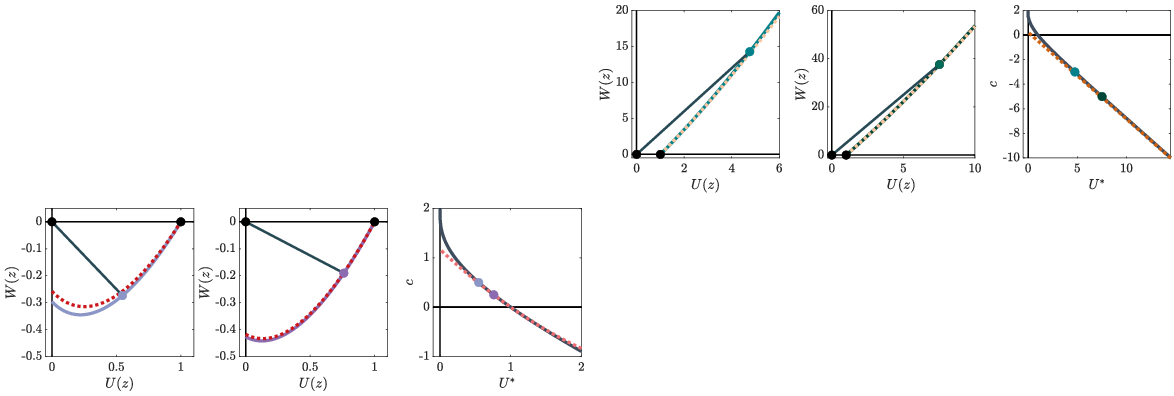
Figure 4: Comparison between analytic perturbation solutions and numerically computed phase plane trajectories and wave speed–front density relationships, for both slow and fast receding wave limits.
Parameterization via Boundary Velocity Function
A pivotal aspect is the flexibility provided by the function ∂t∂u=∂x2∂2u+u(1−u)6. The paper focuses on the linear choice
∂t∂u=∂x2∂2u+u(1−u)7
with ∂t∂u=∂x2∂2u+u(1−u)8 real constants. The existence and stability of traveling wave solutions depend critically on ∂t∂u=∂x2∂2u+u(1−u)9 and L(t)0; intersections of L(t)1 with the L(t)2–L(t)3 curve identify admissible waves.
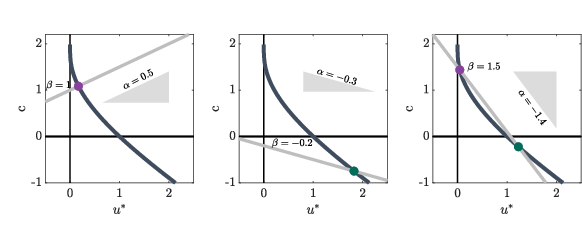
Figure 5: Graphical determination of traveling wave solutions via intersection of the boundary velocity function L(t)4 with the theoretically derived L(t)5–L(t)6 wave speed curve.

Figure 6: Existence and stability diagram for traveling waves in the L(t)7 parameter plane under a linear boundary velocity; stable and unstable, invading and receding regimes are all manifest, with regions featuring multiple coexisting (but non-equally stable) waves.
Distinct regimes arise:
- For suitable L(t)8 there exist both receding and invading waves, sometimes with multiple solutions for one parameter pair.
- The solution with the largest (least negative) wave speed is always stable.
- Boundaries in L(t)9 separate regimes with zero, one, or two traveling waves, as well as a uniform steady state.
Numerical Verification of Traveling Waves and Stability
The theoretical findings are comprehensively validated via numerical simulations of the PDE system. Both single and multiple traveling wave solutions are constructed and verified to converge to their analytically predicted speeds and front densities.
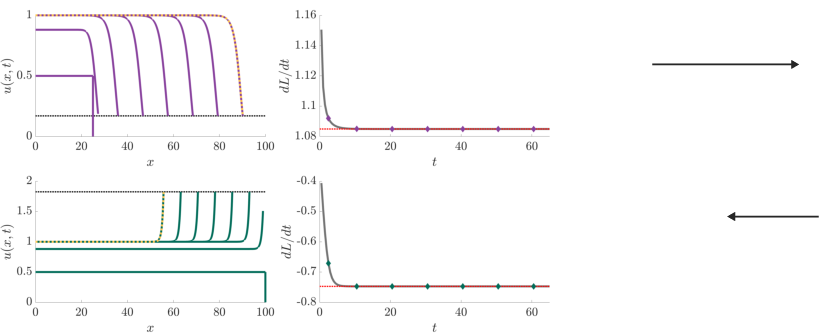
Figure 7: Numerical realization of single stable invading and receding traveling waves, tracking both density profiles and front speed convergence to the theoretical prediction.
For cases with multiple admissible waves, only the fastest is stable; simulations initialized near the slower solution ultimately converge to the faster wave.
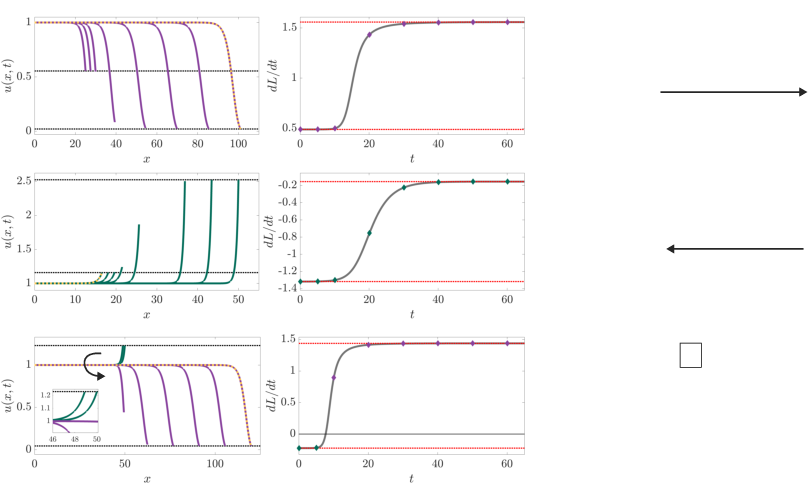
Figure 8: Dynamics in the multi-solution regime; initial conditions corresponding to an unstable wave eventually transition to the stable higher-speed wave (invading or receding depending on parameters).
When stable traveling waves do not exist, alternative behaviors such as "runaway" front advancement or contraction emerge, governed asymptotically by bulk Fisher-KPP dynamics.
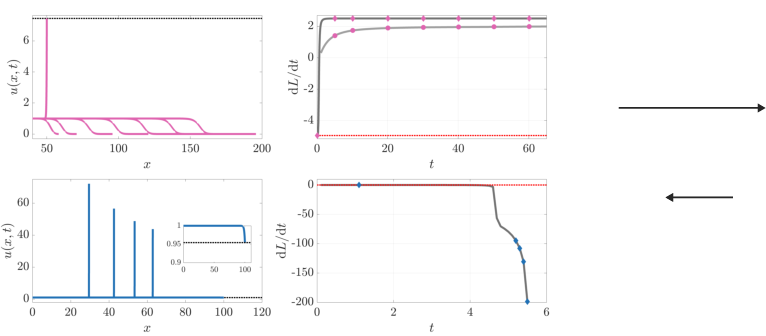
Figure 9: Non-traveling wave regimes; in the absence of a stable wave, the front may run away faster than the bulk, or density can diverge due to positive feedback at a receding boundary.
Stability Analysis and Bifurcation Structure
The stability of uniform steady states along the critical line dtdL=f(u(L(t),t))0 is meticulously analyzed, revealing a transcritical bifurcation at dtdL=f(u(L(t),t))1. For dtdL=f(u(L(t),t))2, the steady state is stable; for more negative dtdL=f(u(L(t),t))3, traveling waves and positive-feedback instabilities arise, precisely matching the predictions of the phase-plane and perturbative analyses.

Figure 10: Numerical stability diagram for the steady state solution as a function of initial density and boundary parameters; bifurcation loci and basins of attraction for different solution branches are quantified.
These results are rigorously supported by analytical investigation of small perturbations about the steady state, showing that growth or decay rates are controlled by the sign of dtdL=f(u(L(t),t))4, reconciling the observed numerical dynamics.
Implications and Future Perspectives
The modeling framework developed here generalizes prior biologically motivated reaction-diffusion models by decoupling the moving interface from flux-based mass loss and allowing an arbitrary (possibly nonlinear) law relating front velocity to local density. This architecture facilitates new analyses of tissue growth, wound healing, tumor regression, and other settings where mass conservation at moving boundaries is physically mandated.
Key outcomes include:
- Nontrivial existence of both invading and receding sharp-fronted traveling waves under mass conservation.
- Flexibility to produce multiple coexisting wave solutions for a given boundary law, with explicit stability criteria.
- Capacity to capture sharp population recession, stability exchange via bifurcation, and more exotic non-traveling behaviors for parameter choices outside the stable wave regime.
The framework readily extends to more realistic nonlinear boundary velocity functions or higher-dimensional geometries, as suggested by the authors. This opens pathways for future work exploring morphology-dependent invasion/recession, pattern formation in expanding or contracting domains, and parameter inference for biological systems where moving boundaries are observed experimentally but not directly manipulated.
Conclusion
This study rigorously formulates and analyzes the Fisher-KPP equation endowed with a mass-conserving, moving boundary. The results delineate a comprehensive taxonomy of sharp-fronted traveling wave solutions and their stability, encompassing both invasion and recession, as governed by arbitrary (and particularly linear) boundary velocity laws. The methods are broadly extensible and promise substantial utility in mechano-biological modeling contexts where conservation at an evolving edge is critical.
(2607.02779)

