- The paper establishes quench spectroscopy on a digital quantum processor to extract energy- and momentum-resolved excitations in various XXZ regimes.
- It employs both local and dual global-plus-local quench protocols to accurately capture magnon dispersions, multi-magnon bound states, and spinon continua in ferromagnetic, XY, and antiferromagnetic phases.
- The method bypasses explicit ground state preparation by leveraging hardware-native operations and robust error mitigation, enhancing scalability for many-body quantum systems.
Quench Spectroscopy of Magnetic Excitations on a Superconducting Quantum Processor
Introduction and Motivation
This work presents a comprehensive study of quench spectroscopy as a probe of elementary excitation spectra in strongly correlated quantum spin chains, specifically the spin-21 XXZ model, using a digital superconducting quantum processor to access system sizes up to L=101 qubits (2607.02673). The central aim is twofold: (i) to establish quench spectroscopy as an efficient, hardware-native method for extracting collective spectra—magnons, bound states, and continua—in different quantum phases, and (ii) to demonstrate a protocol that obviates the need for explicit ground state preparation, making such spectroscopic analysis viable on current and near-term quantum hardware. This approach is positioned relative to dynamical structure factor (DSF) measurements, which are both experimentally and classically challenging for large, strongly correlated systems.
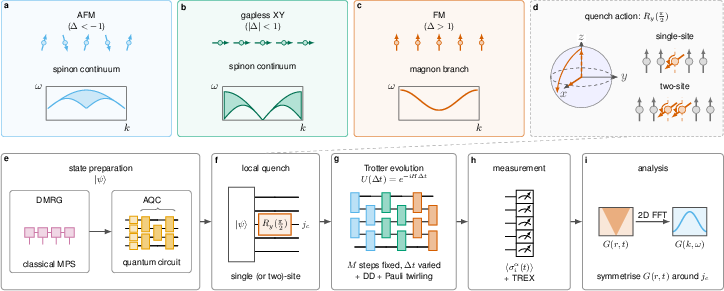
Figure 1: Protocol overview: preparation and execution of local quench spectroscopy on a digital quantum processor, spanning state preparation, local quench, time evolution, measurement, and Fourier analysis.
Quench Spectroscopy Protocol and Theoretical Background
Quench spectroscopy probes the excitation spectrum by perturbing a quantum system out of equilibrium with a local or global unitary quench, then monitoring the spatiotemporal evolution of local observables and extracting spectral features via Fourier transformation. Unlike DSF approaches that require unequal-time correlation functions and are limited by linear response theory, the quench spectral function (QSF) approach employed here yields direct access to energy- and momentum-resolved excitations from time-series data of a single local observable, without state reconstruction or equilibrium assumptions.
For a local quench, the QSF is defined as
G(k,ω)=∫drdte−i(k⋅r−ωt)G(r,t),
where G(r,t)=⟨O(r,t)⟩ is the expectation value of a local observable post-quench. Spectral features (peaks or continua) in (k,ω) space directly reflect the many-body excitation content generated by the quench, contingent on appropriate choices of initial state, quench operator, and observable.
This method allows fine control over the excitation sector probed and is inherently parallelizable across hardware qubits. It is robust to finite energy densities and non-equilibrium initial states, provided selection rules for observable/quench coupling are respected.
Implementation on Quantum Hardware
The experiments use a large-scale (101-qubit) superconducting quantum processor (IBM). For the XXZ spin chain, three regimes are systematically explored by tuning the anisotropy parameter Δ:
- Ferromagnetic (FM, Δ>1): product state ground state, well-defined single-magnon and multi-magnon bound state excitations.
- Critical (gapless XY, ∣Δ∣<1): Luttinger liquid with gapless excitations and enhanced entanglement.
- Antiferromagnetic (AFM, Δ<−1): symmetry-breaking ground state with fractionalized (spinon) excitations.
State preparation is optimized according to entanglement constraints. In the FM and XY regimes, low-depth product state initialization is viable. For the gapped AFM case, a classical DMRG-obtained MPS is compiled into a shallow brickwork quantum circuit using tensor-network-based Approximate Quantum Compiling (AQC). Time evolution is implemented via Trotterization, with standard error mitigation (Pauli twirling, TREX, dynamical decoupling) to suppress device and readout noise.
Ferromagnetic Regime: Magnons and Bound States
Single-site local Ry(π/2) quenches inject magnonic excitations whose light-cone propagation and dispersion relations match Bethe ansatz predictions. The QSF yields sharply defined spectral branches for the magnon mode. Notably, as the critical point L=1010 is approached, the spectral gap closes at L=1011 and the spectral weight quantitatively tracks the theoretical curve.
Two-site quench/observable protocols (adjacent L=1012 and two-spin projectors) unambiguously reveal multi-magnon bound state branches in the QSF, again consistent with Bethe predictions. The direct hardware-resolved observation of bound state branches at such system sizes underscores the feasibility of scalable, fine-grained hardware spectroscopy.
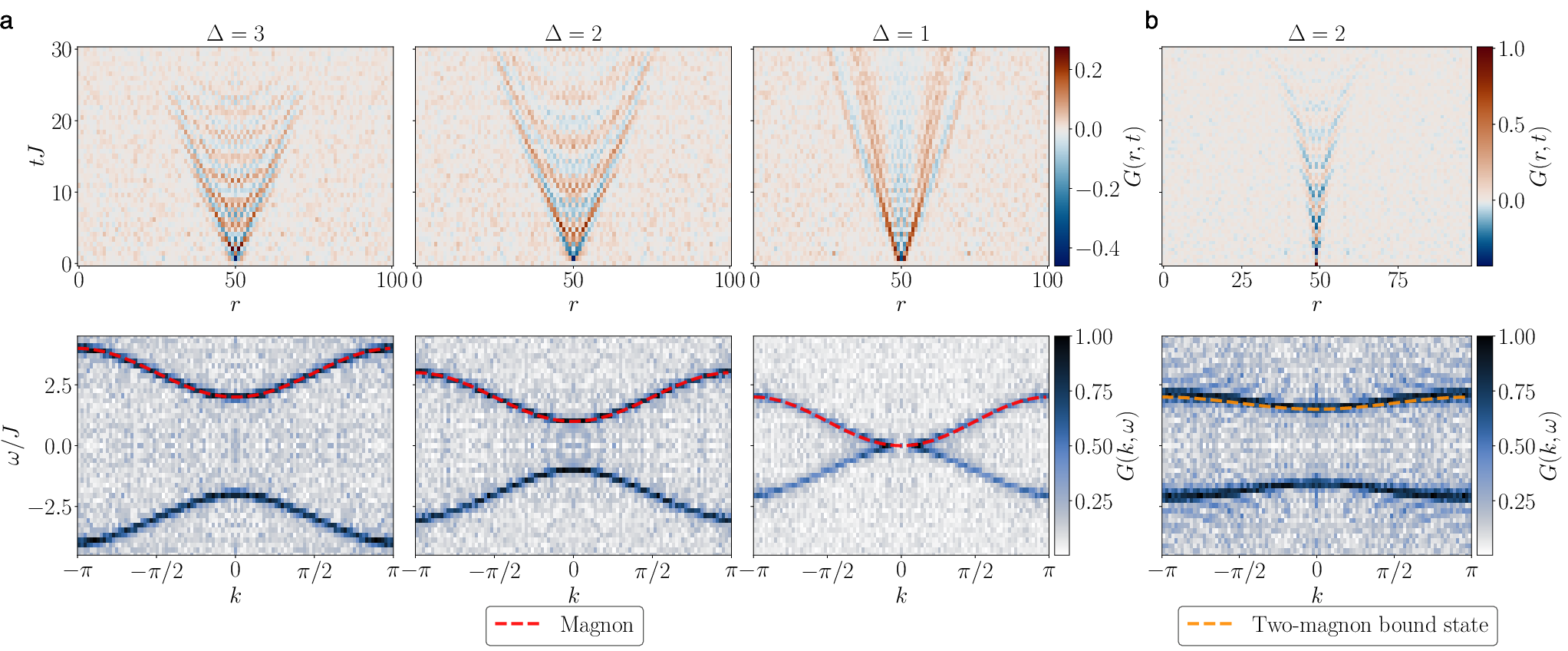
Figure 2: Spectroscopic resolution of magnons and magnon bound states in the ferromagnetic XXZ chain (single- and two-site local quenches).
Antiferromagnetic Regime: Spinon Continua
Transitioning to the AFM regime, the elementary excitations are fractionalized spinons forming continua rather than sharp modes. Ground state preparation exploits DMRG-MPS-compiled circuits (high fidelity, low depth due to finite correlation length). Single-site local quenches generate broad light-cone dynamics; their QSFs display pronounced two-spinon continua, with spectral weight concentrated at the lower continuum boundary. The extracted edge follows the Bethe ansatz precisely.
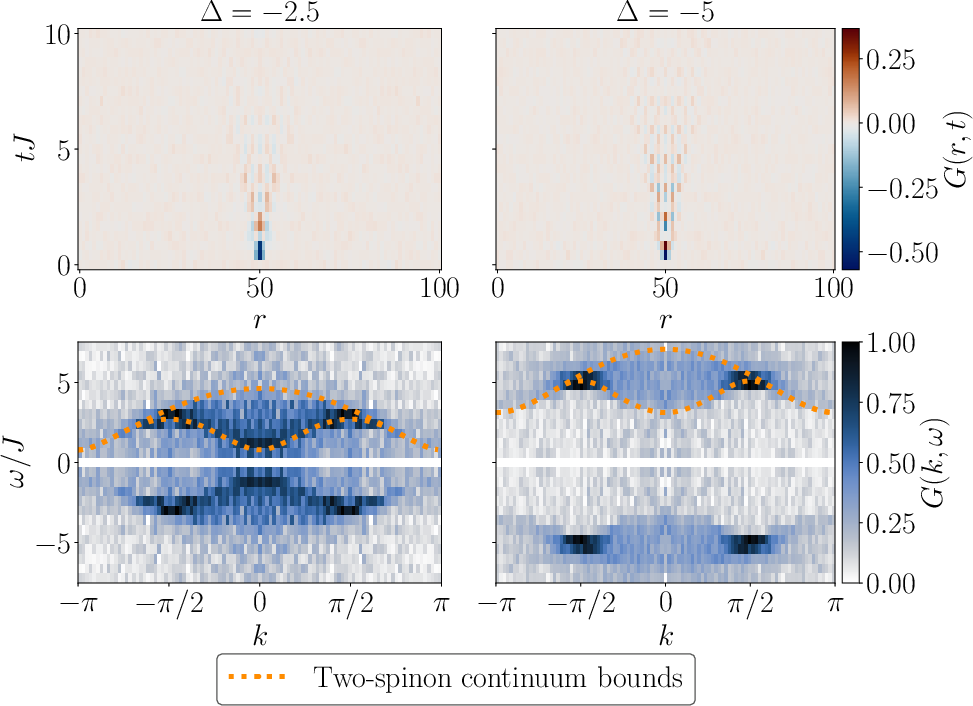
Figure 3: Extraction of two-spinon continua in the antiferromagnetic phase, comparing QSFs for L=1013 and L=1014 to analytic continuum boundaries.
These results are in direct analogy to experimental neutron scattering data in one-dimensional antiferromagnets, validating the quantum hardware and providing a benchmark for much larger system sizes than classically accessible.
Gapless XY Regime: Local plus Global Quenches Without Ground State Preparation
In the critical XY regime, ground state entanglement precludes efficient state preparation for large L=1015. By employing a dual global-plus-local quench protocol—initializing a simple product state, then applying a local L=1016 rotation—spectral response is obtained even though the system is far from its ground state. Provided the prepared state is within the correct symmetry sector and not at excessively high energy density, the QSF still reveals meaningful single-particle (magnon-like) and continuum features, tracking theoretical excitations over a substantial L=1017 range with high fidelity. Any deviations reflect the presence of strong finite-energy-density effects or symmetry breaking.
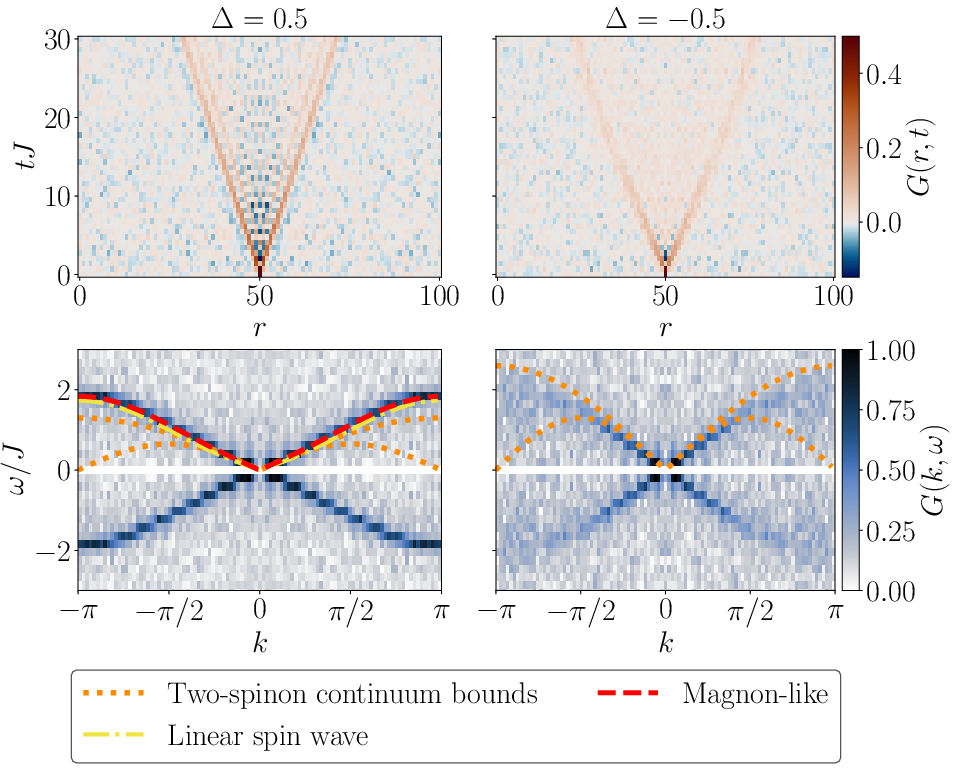
Figure 4: QSFs in the XY regime using a global-plus-local quench protocol, illustrating magnon-like excitation branches for L=1018 and two-spinon continuum boundaries for L=1019.
This protocol substantially lowers hardware requirements, demonstrating that accurate spectroscopic data can be obtained with minimal circuit complexity—a contradictory claim relative to prior assumptions that high-fidelity ground state preparation is essential for meaningful spectroscopy.
Practical and Theoretical Implications
These results provide a foundation for quantum hardware to act as a direct spectroscopic tool for emergent many-body excitations in strongly correlated systems. Key implications include:
- Hardware benchmarking: The measured excitation spectra serve as stringent benchmarks for device fidelity, error mitigation, and quantum circuit implementation at scale.
- Extension to complex models: The scalability and flexibility of the protocol pave the way for exploring higher-dimensional models (e.g., frustrated magnets, quantum spin liquids [Savary+17], van der Waals magnets [Burch+18, Park+26]) and regimes where linear response and classical numerics break down.
- New regimes for quantum advantage: The QSF method, not limited by linear response or restricted to ground state preparation, enables investigation of high-energy-density phenomena, dynamical phase transitions, and non-Hermitian/lattice gauge models [Despres25, Chanda+24].
- Entanglement and information diagnostics: Combining QSF with hardware-resolved entanglement metrics [Scheie+25], dynamics of nonequilibrium phases, and quench-induced scrambling benchmarks is now within reach.
On the theoretical frontier, further exploration of the interplay between global quench, symmetry, and observable selection will sharpen guidelines for meaningful spectroscopic protocols on NISQ-era hardware, including models with long-range interactions and nontrivial topology.
Conclusion
Quench spectroscopy, implemented via local perturbation and direct time evolution on a 101-qubit superconducting quantum processor, robustly resolves magnon dispersions, bound state branches, and spinon continua across the XXZ phase diagram, with direct quantitative agreement to exact theory. The demonstration that explicit ground state preparation is not strictly necessary (if suitable symmetry sectors are respected and moderate energy densities are maintained) drastically broadens the practical reach of quantum spectroscopy protocols. These results open scalable routes for quantum simulation of dynamical phenomena in systems beyond classical reach, providing a spectroscopic pathway to investigate exotic many-body phases, dynamical criticality, and emergent collective excitations.
(2607.02673)