- The paper introduces a non-parametric analysis of gas and electron density profiles in z≈2 protoclusters using over 3800 simulated regions.
- It demonstrates that density profiles deviate from self-similarity, with inner densities increasing up to a factor of 2 in high-mass halos and showing a distinct double-β morphology.
- The study highlights that assembly state and AGN feedback contribute to profile variations, indicating challenges for observational detection and simulation modeling.
Non-Parametric Characterization of the Gas and Electron Density Profiles in z≃2 Protoclusters
Overview and Motivation
This work presents a statistical analysis of gas and electron number density profiles in protocluster cores at z≃2, focusing on their non-parametric characterization as a function of mass, dynamical state, and AGN feedback. Leveraging a sample of over 3800 protocluster regions from the Magneticum Pathfinder simulations, the study addresses the thermodynamic youth of the proto-ICM, its structural deviations from self-similar evolution, and implications for the thermal and ionization structure critical for cosmological and astrophysical observables.
Simulation Methodology and Sample Selection
The study utilizes the Magneticum Box2b/hr simulation, which models (640 h−1 Mpc)3 (with baryonic and DM mass resolutions of 1.4×10⁸M⊙ and 6.9×10⁸M⊙), incorporating full baryonic physics, radiative cooling, AGN and stellar feedback, and chemical enrichment. Protocluster cores are operationally defined by Subfind/ASOHF-detected overdensities exceeding M500c>1013 M⊙ at z=2.
Gas properties are radially profiled by extracting three-dimensional shells out to 8R500c, and advanced post-processing computes electron number densities for arbitrary chemical and ionization states. Secondary properties, including galaxy mass ratios (M12, a proxy for dynamical disturbance) and time-averaged Eddington ratios of central SMBHs (fˉEdd), are used to parse the impact of assembly and AGN activity.
Mass Dependence of Gas Density Profiles
A core result is that gas density profiles in z≃20 protoclusters exhibit clear deviations from pure self-similarity. While self-similar scaling predicts universal profile shapes upon mass scaling (as often assumed at low redshift), protocluster profiles systematically steepen toward smaller radii in higher mass halos, manifesting a pronounced double-z≃21 morphology:
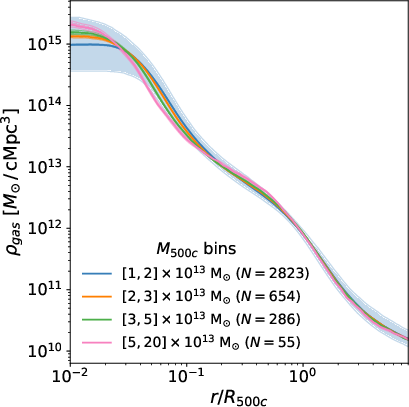
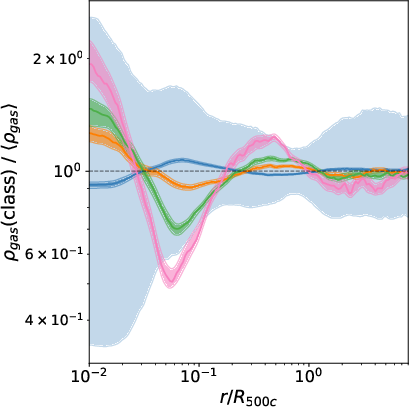
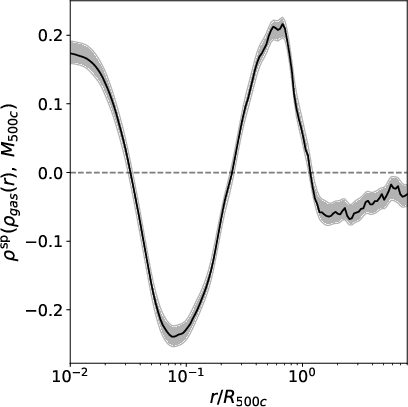
*Figure 1: Mass dependence of the protocluster gas density profiles; left: stacked comoving gas density profiles by protocluster mass z≃22. *
Densities increase by a factor z≃23 in the inner z≃24--z≃25 as z≃26 increases, and show an excess at intermediate radii for massive halos. Deviations from self-similarity at the inner and z≃27--z≃28 radii are moderate but significant, with Spearman z≃29 up to (640 h−1 Mpc)30.
Temperature and Ionization Structure
The analysis of mass fractions above key temperature thresholds reveals a complex, multiphase ICM. The cold ISM dominates inside (640 h−1 Mpc)31 comoving kpc, with the proto-ICM phase rising steeply outside this core. Full ionization (i.e., (640 h−1 Mpc)32) and the hot, X-ray phase ((640 h−1 Mpc)33) become prominent only beyond (640 h−1 Mpc)34, and only the most massive halos host a baryon-dominated bremsstrahlung regime ((640 h−1 Mpc)35) in their cores.
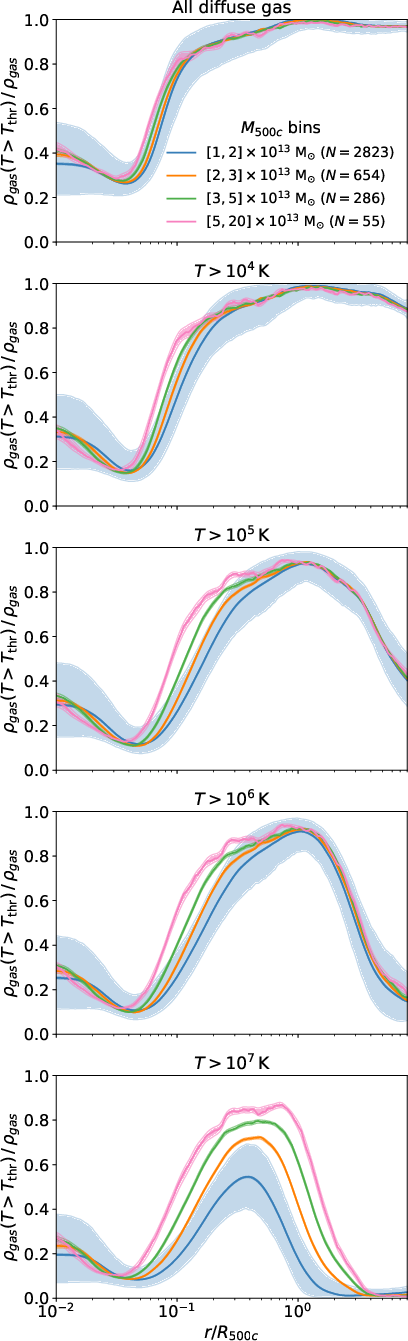
Figure 2: Radial density fraction above several temperature thresholds, for different (640 h−1 Mpc)36 bins.
The independence from self-similar radial scaling at the cold/hot gas transition highlights feedback- and merger-driven gas redistribution, in contrast to low-(640 h−1 Mpc)37 clusters.
Electron Number Density and Comparison to Observations
Electron density profiles, (640 h−1 Mpc)38, inherit the double-(640 h−1 Mpc)39 structure, with central values scaling from 1.4×10⁸M⊙0 (comoving) up to 1.4×10⁸M⊙1 near 1.4×10⁸M⊙2 in physical units. Inner electron densities are more than double in the most massive halos relative to the lowest. The mean ionization fraction transitions sharply from 1.4×10⁸M⊙3 in the center to near-unity at 1.4×10⁸M⊙4, tracking the emergence of the hot phase.
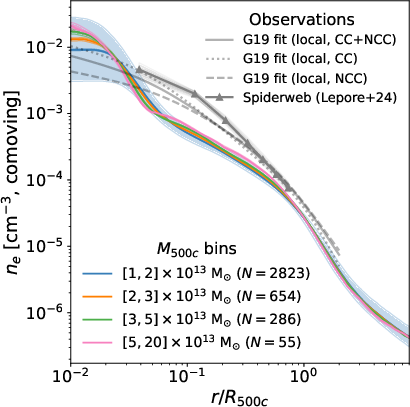
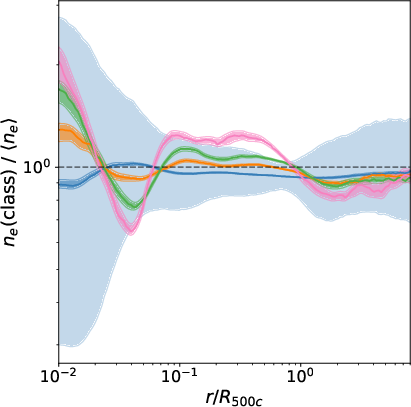
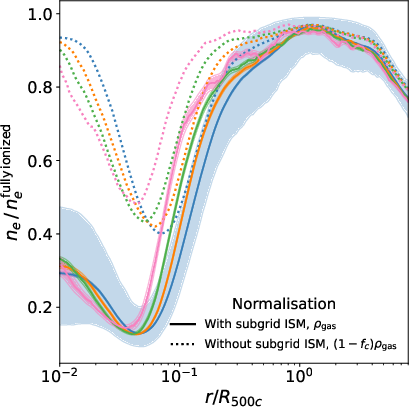
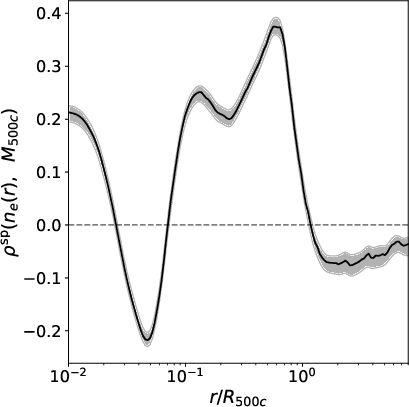
Figure 3: Analysis of 1.4×10⁸M⊙5 as a function of 1.4×10⁸M⊙6, including comparison to 1.4×10⁸M⊙7 data.
Observed 1.4×10⁸M⊙8 cool-core clusters present flatter, monotonically decreasing comoving 1.4×10⁸M⊙9 profiles, in contrast to the double-6.9×10⁸M⊙0 structure at 6.9×10⁸M⊙1. Magneticum protoclusters' central comoving 6.9×10⁸M⊙2 align with local cool-core clusters, but are systematically lower than central densities inferred for the Spiderweb protocluster at comparable radii, with no simulated system matching the Spiderweb's mean 6.9×10⁸M⊙3 within 6.9×10⁸M⊙4 unless selection/inhomogeneity biases are accounted for.
Secondary Dependence: Impact of Dynamical State and AGN Feedback
Beyond mass, dynamical disturbance (traced by 6.9×10⁸M⊙5) and central SMBH accretion modulate ICM structure. Protoclusters with high 6.9×10⁸M⊙6 (recent mergers) exhibit reduced hot/ionized gas fractions at 6.9×10⁸M⊙7, and displace ionized baryons from the center, producing a flatter 6.9×10⁸M⊙8 core. Elevated 6.9×10⁸M⊙9 (AGN feedback) enhances central density and ionization, but can also promote neutral gas just beyond the AGN-heated zone (M500c>1013 M⊙0 kpc), a feature robustly emerging over an order of magnitude beyond the gravitational softening scale, pointing to a physical effect.
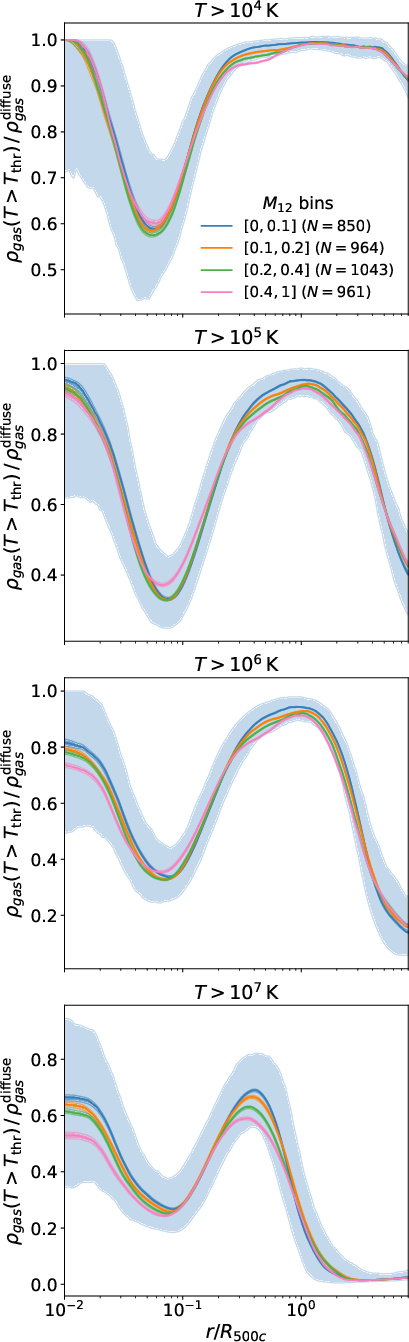
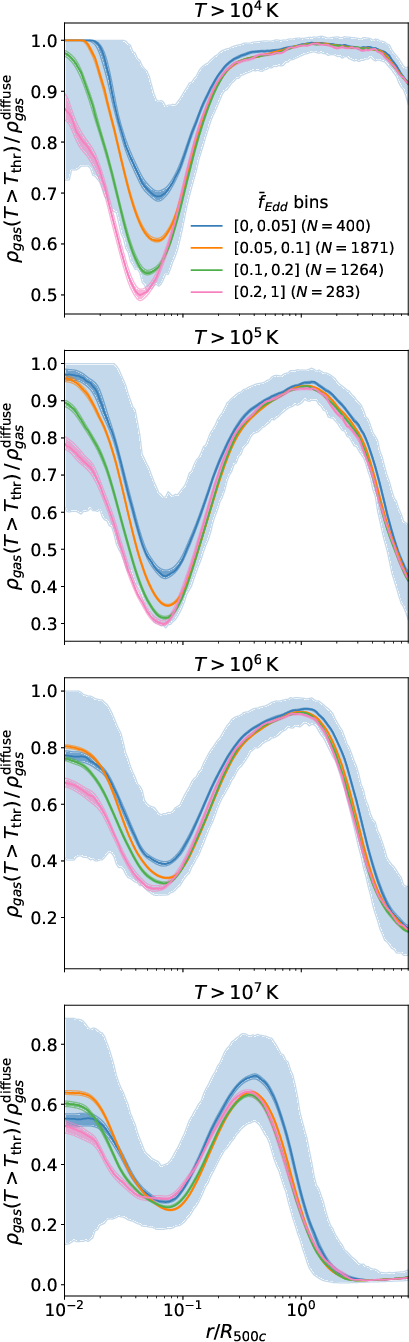
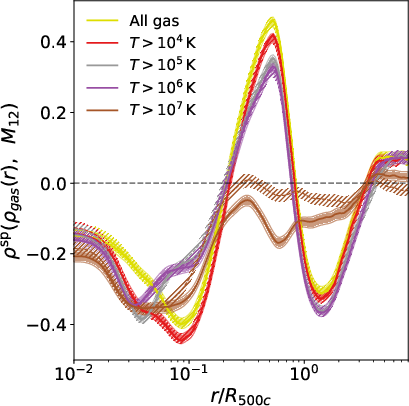

Figure 4: Density fraction of diffuse gas above temperature thresholds, stacked by M500c>1013 M⊙1; central activity trends are shown.
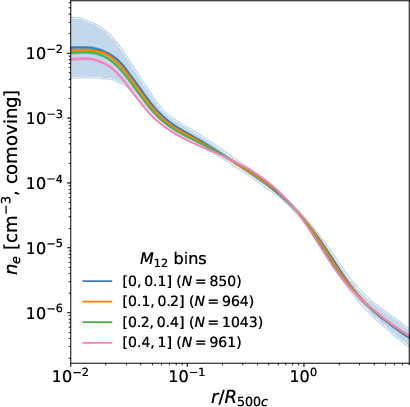
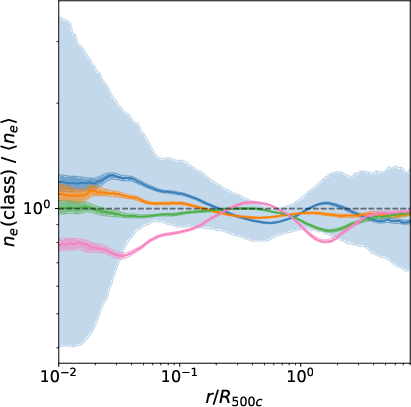
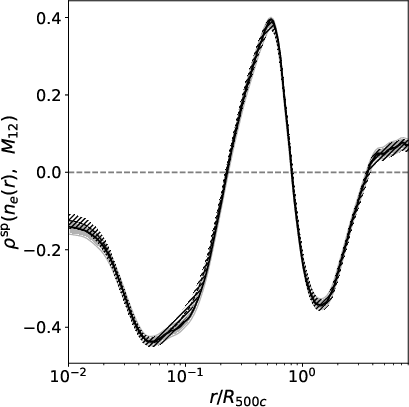
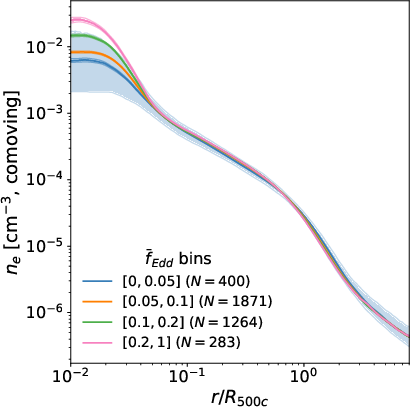
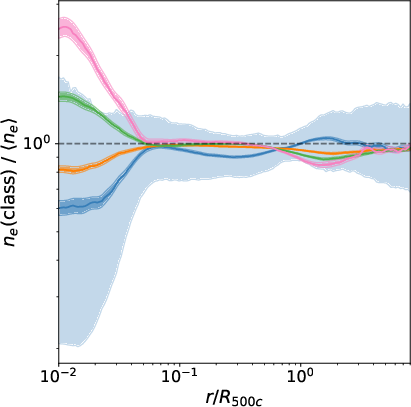
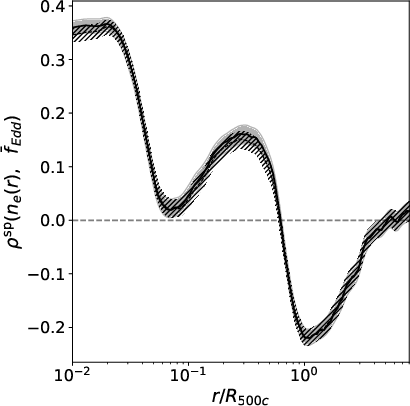
Figure 5: Dependence of M500c>1013 M⊙2 on M500c>1013 M⊙3 (top) and M500c>1013 M⊙4 (bottom), with their respective correlation profiles.
Combined, assembly state and AGN drive considerable (but not dominant) scatter in ICM properties—an ANOVA decomposition reveals that M500c>1013 M⊙5, M500c>1013 M⊙6, and M500c>1013 M⊙7 together account for only M500c>1013 M⊙8 of the logarithmic variance in M500c>1013 M⊙9.
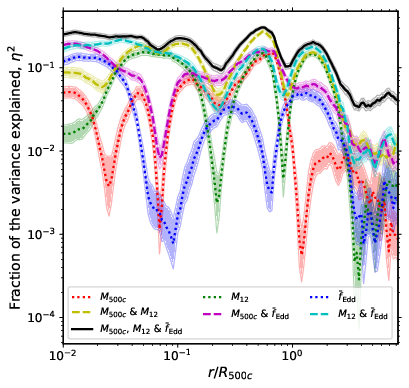
Figure 6: Fraction of variance in z=20 explained by z=21, z=22, and z=23, individually and jointly.
Observational Accessibility and Model Implications
Simulations indicate severe observational challenges in detecting and characterizing proto-ICM at z=24: even with high-throughput, low-background X-ray facilities (e.g. Chandra), achieving a z=25 detection in the z=26 band beyond z=27 requires exposures in excess of several hundred ks for z=28 protoclusters.
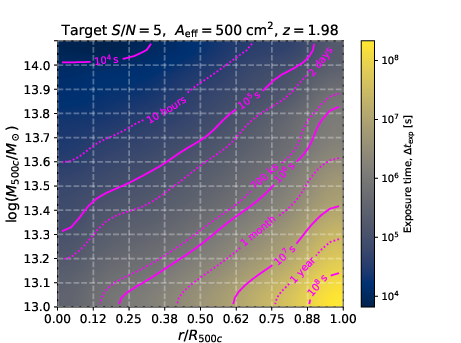
Figure 7: Estimated exposure time z=29 for a 8R500c0 detection, as function of mass and radius.
Practical inference of proto-ICM structure thus necessarily relies on calibrations from advanced simulations. However, the apparent discrepancy between simulated and observed high central 8R500c1 in select systems (e.g., Spiderweb) underscores the potential limitations of purely thermal AGN feedback prescriptions and points to model incompleteness or selection for rare, highly active systems.
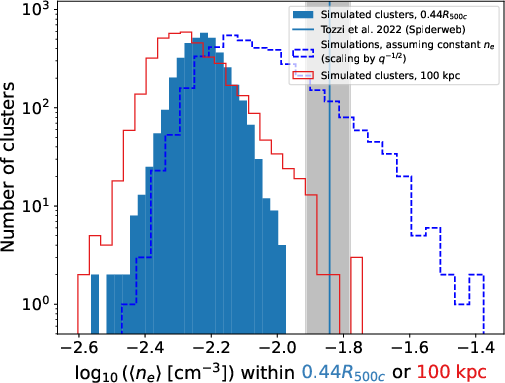
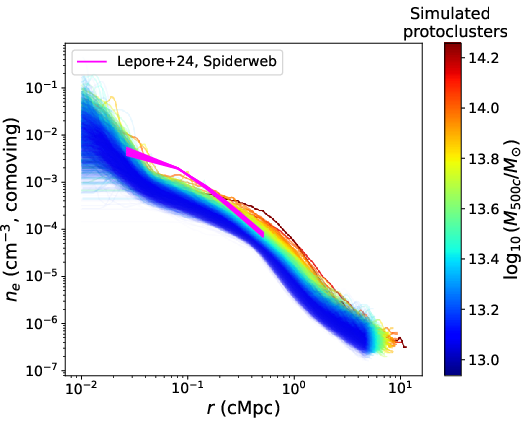
Figure 8: Comparison of simulated 8R500c2 values to those observed in the Spiderweb protocluster.
Implications and Future Directions
This study establishes a non-parametric, statistically robust picture of the proto-ICM, emphasizing the breakdown of self-similar scaling and the critical roles of dynamical state and AGN feedback in shaping thermodynamic structure. The predictive variance due to observable parameters is moderate, limiting the precision of empirical scaling relations but establishing a framework for next-generation parametric modeling.
From a theoretical perspective, the results challenge simulation models to reproduce high central densities observed in select protoclusters, potentially motivating the inclusion of non-thermal/kinetic AGN feedback and more sophisticated modeling of baryonic physics at high 8R500c3.
These findings have direct application to the interpretation of future multi-wavelength surveys targeting proto-ICM physics, cosmic magnetism (via Faraday rotation constraints), and SZ/X-ray stacking analyses. The reported double-8R500c4 structure, mass-dependent temperature evolution, and assembly/feedback-driven non-universality must be encoded in models aiming to support these observational campaigns.
Conclusion
By statistically characterizing the gas and electron density profiles in a large sample of simulated 8R500c5 protoclusters, this study identifies moderate mass-dependent departures from self-similarity, a critical role of assembly and AGN-driven feedback in modulating thermodynamic structure, and only partial explanatory power of observable proxies for the full profile variance. The established electron density profiles provide a reference for interpreting high-redshift ICM observables and highlight key areas—the treatment of central feedback and dynamical disturbance—where simulation prescriptions may require substantial revision to align with forthcoming observational constraints.
(2607.02654)