- The paper introduces a circuit model showing how controlled SWAP gate density triggers the crossover from integrability to chaotic ballistic spreading, as revealed by OTOC measurements.
- It maps the averaged OTOC dynamics onto a classical Markov process and noisy F-KPP equation, yielding analytic predictions for scaling regimes, crossover times, and lengths.
- The findings offer practical insights for quantum simulations by demonstrating robust operator spreading and universality in many-body quantum chaos.
Emergence of Quantum Many-Body Chaos from Tunably-Broken Integrability
Introduction and Motivation
The study of how chaotic dynamics emerge in quantum many-body systems—particularly as integrability is weakly broken—addresses foundational questions at the intersection of quantum statistical mechanics, information theory, and quantum simulation. This work introduces a circuit model featuring a one-dimensional chain of qubits (or equivalently, Majorana fermions), where integrability is controllably broken via the inclusion of SWAP gates at tunable density λ. The model is designed to bridge the gap between exactly solvable but non-generic models (such as dual-unitary or random circuits) and experimentally relevant scenarios with small local Hilbert dimensions and universal gate sets.
The central probe utilized is the out-of-time-ordered correlator (OTOC), which operationalizes scrambling and the onset of chaotic dynamics. The study establishes a quantitative framework to characterize the crossover from integrable to chaotic regimes, providing analytic and numerical insights into the underlying mechanisms, spatiotemporal scaling, and universality.
Model and Analytical Framework
The model alternates between layers of random two-qubit matchgates (quadratic in fermions) and SWAP gates that induce quartic interactions, yielding a universal gate set when mixed. The integrability-breaking is tuned by the density λ of SWAP gates introduced into the circuit. When λ=0, the system is a free-fermion, exactly integrable circuit; for λ>0, it transitions to a chaotic regime.
The OTOCs of interest are defined for pairs of Pauli Z operators or, in the fermionic language, for Majorana operators. The authors map the ensemble-averaged OTOC dynamics exactly onto a classical Markov process on configurations of hard-core particles, capitalizing on the statistical independence introduced by matchgate twirling. This mapping allows for simulation of large systems and supports analytic treatment based on stochastic Fisher-KPP (F-KPP) equations.
Operator Spreading and Crossover Phenomenology
At λ=0, OTOC spreading is diffusive with a Gaussian envelope, reflecting the absence of chaos and the conservation of the number of fermions enforced by the matchgates. This is exemplified by the lack of a ballistic light-cone for the OTOC between distant operators.
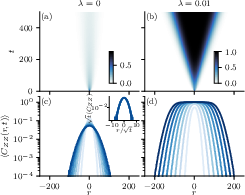
Figure 1: The space-time profile and temporal slices of the OTOC between Z0 and Zr illustrate the diffusive (integrable) versus ballistic (chaotic) spreading for λ=0 and λ>0.
With finite λ0, the stochastic insertion of SWAP gates induces local nonlinear amplification of operator weight—these act as "hotspots" for chaos. The OTOC eventually develops a ballistic front defined by the butterfly velocity λ1 with a diffusive broadening governed by an effective diffusion constant.
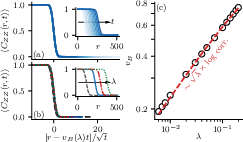
Figure 2: Collapse of OTOC profiles onto a universal scaling form as a function of λ2, evidencing ballistic propagation and λ3-independent broadening.
The functional form for the OTOC in the chaotic regime is
λ4
with λ5 (modulo logarithmic corrections). Notably, the diffusion constant associated with operator front broadening is essentially independent of λ6.
A significant result is the explicit identification of crossover scales: a timescale λ7 and a length scale λ8. These scales delineate regimes where OTOC propagation transitions from integrable to chaotic, with local maxima in OTOC occurring at λ9 prior to the arrival of the chaotic front.
Scaling Theory for the Integrable-to-Chaotic Crossover
The crossover regime is governed by a scaling solution:
λ=00
where λ=01 and λ=02. The numerics support this form robustly across both spatial and temporal cuts.
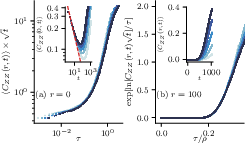
Figure 3: Demonstration of crossover scaling, with OTOC data for different λ=03 collapsing when rescaled by the appropriate time and length scales.
Moreover, full spatiotemporal collapse is exhibited in the Markov process numerics with all data conforming to the predicted scaling curve once appropriately nondimensionalized.
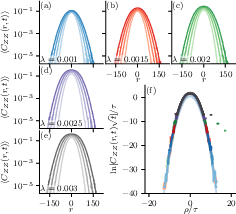
Figure 4: Spatial profiles of the OTOC at various times and λ=04; rescaled data collapse onto a universal curve consistent with crossover scaling.
Noisy F-KPP Equation: Nonlinearity and Demographic Noise
A continuum theory for the averaged OTOC is derived in the form of a noisy F-KPP equation, incorporating both deterministic nonlinear terms (arising from SWAP-induced operator branching/annihilation) and stochastic noise, the latter capturing the demographic fluctuations due to finite Hilbert space dimensionality:
λ=05
This formalism rationalizes both the mean-field growth of OTOC (via λ=06) and the logarithmically weak dependence of the front diffusion constant on λ=07 (via demographic noise). Analytic linearization in the crossover regime yields the explicit scaling of crossover times/lengths, matching numerics.
Implications and Future Directions
This model provides a rare instance of a controlled and generic setting for probing the onset of chaos in many-body quantum dynamics, capturing both early-time integrable dynamics and asymptotic chaos. The Markov process representation and F-KPP reduction should be extensible to other architectures, potentially including systems with conservation laws or additional symmetries.
The results clarify the precise mechanistic role of localized integrability-breaking events in seeding chaos and elucidate the emergence of ballistic information spreading from initially diffusive operator growth. Practically, the findings are directly relevant for the analysis of quantum simulation experiments where engineered integrability-breaking is used to tune between thermalizing and non-thermalizing regimes. The robustness of the scaling forms, including λ=08-independent broadening of the OTOC front, is of significant interest for the universality class of operator spreading.
Future research should probe the hierarchical structure of scrambling—namely, higher-order λ=09-OTOCs and their associated design times, which connect to quantum designs, free independence, and the saturation of random-matrix statistics in larger subsystems. Extension to finite-temperature analogues, systems with multiple conservation laws, or higher dimensions are natural continuations.
Conclusion
This work introduces a comprehensive, analytically tractable framework for the quantitative study of chaos onset due to tunably-broken integrability in quantum circuits. The summary of strong results includes explicit forms and scalings for OTOCs across the integrability-chaos crossover, identification of physical crossover times and length scales, and universal scaling in both numerics and analytic theory. The operator spreading phenomenology elucidated here sets a robust foundation for both theoretical investigations and experimental probes of quantum chaos in engineered many-body systems.
Reference: "On the emergence of quantum many-body chaos for tunably-broken integrability" (2607.02506)

