- The paper demonstrates robust cycle existence under random edge percolation, showing that graphs retain nearly optimal cycle lengths even after significant edge deletions.
- It introduces a hyperstability framework which reveals that failure to achieve the anticipated cycle length is tightly constrained by structural bounds on vertex covers.
- The work leverages a novel decomposition theorem and classical tools like Szemerédi’s Regularity Lemma to bridge deterministic extremal results with probabilistic graph behavior.
Robustness and Hyperstability in the Erdős–Gallai Theorem
Introduction and Background
The Erdős–Gallai theorem is a classical result in extremal graph theory, stating that any graph with average degree d (for d≥2) contains a cycle of length at least d. While simple in statement, this theorem underpins critical connections between degree properties and long cycles, impacting topics from Hamiltonicity to random graph theory. The subtlety of its extremal examples and its resistance to standard stability and robustness analyses distinguish it from other results in extremal combinatorics.
The work under review establishes two major advancements:
- Robust Extension: Demonstrates the persistence of long cycles under random edge deletions, specifically percolation of graphs with given average degree.
- Hyperstability Phenomenon: Establishes a new stability framework for Erdős–Gallai, showing that significant structural constraints govern the failure to attain the threshold cycle length, across a wide parameter range.
Both results are underpinned by a decompositional structure theorem, inspired by recent advances in hyperstability for trees, and bringing new machinery to the study of cycles in dense and perturbed environments.
Robustness Under Percolation
The paper resolves a long-standing question concerning the resilience of the Erdős–Gallai bound under random edge percolation. Concretely, for every c>0, there exists K=K(c) such that if G is an n-vertex graph of average degree d≥K and if p≥K/d, then the percolated subgraph Gp (formed by retaining each edge independently with probability d≥20) contains, with high probability, a cycle of length at least d≥21 as d≥22.
This result sharpens prior work by only requiring an average degree (as opposed to minimum degree) condition, and achieves asymptotically optimal dependency on d≥23 for robust persistence of long cycles. It is tightly aligned with known thresholds for long cycles in random graphs, interpolating between deterministic extremal and random settings.
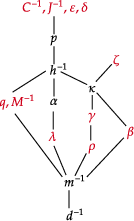
Figure 1: The diagram displays the partial order of parameters in the proof of Theorem~\ref{thm: structure}, critical for the robust decomposition.
Hyperstability and Structural Constraints
A central theoretical innovation is the hyperstability formulation for the Erdős–Gallai theorem. The result asserts that if a graph d≥24 does not contain a cycle of length at least d≥25, then there exists a set of at most d≥26 edges whose removal renders all connected components of the residual graph with vertex-covers of order at most d≥27. This unifies the strong (99%) and weak (1%) flavors of stability:
- 1% stability: Holds structural information even far from the extremal regime.
- 99% stability: The outcome is approximately captured by extremal examples or their structured “blowups.”
This is a significant departure from previous stability results in extremal graph theory, which were typically only applicable in near-extremal settings. The notion that the only obstruction to a long cycle is proximity to a union of bounded vertex-cover components gives a fine-resolution understanding of extremal behavior for cycles.
Pokrovskiy's Structure Theorem: Decomposition Framework
Both the robustness and hyperstability results hinge on a graph decomposition theorem derived from the work of Pokrovskiy. This theorem partitions any graph into five (four substantial) types of edge-disjoint subgraphs:
- d≥28 ("Small vertex-cover"): Subgraphs whose components all have small vertex covers.
- d≥29 ("Large regular cores"): Union of edge-disjoint cut-dense graphs, each hosting a large regular subgraph.
- d0 ("Nowhere dense"): Subgraphs without dense spots, preventing large edge-density on small sets.
- d1 ("Well-connected pieces"): Edge-disjoint sum of highly connected, small-diameter graphs with controlled intersections.
- d2 (Exceptionally small): Contains a vanishing fraction of total edges.
The proof strategy for robust cycles or hyperstability proceeds by analyzing whether any of d3, d4, or d5 retains a positive fraction of the edge set; if so, strong expansion and connectivity arguments allow extraction of cycles much longer than the threshold. Otherwise, the structure collapses onto d6, reducing the problem to the classical dense regime.
Figure 1: The parameter dependency hierarchy underlying the structure decomposition, instrumental for tuning robustness and hyperstability bounds.
Proof Techniques and Key Lemmas
The proofs involve integrating extremal, probabilistic, and algorithmic tools:
- Szemerédi's Regularity Lemma: Offers control over edge-distribution in dense subgraphs, supporting path and cycle discovery even post-percolation.
- DFS-Forests and Percolated DFS: Algorithmic framework for tracking cycle creation and identifying d7-long edges after random deletion.
The decomposition leverages regularity to identify expanders and cut-dense regions, then recursively merges blobs while tracking a matching parameter in cluster graphs—delicately balancing local regularity with global cut-density. The nuanced control over these merges is critical for both robustness and structure theorems.
Strong Numerical Results and Claims
- Optimal dependency: The percolation threshold d8 is shown to be tight up to constants.
- Subexponential failure probability: The probability of absence of a cycle longer than d9 decays rapidly as c>00 grows, under the prescribed threshold.
- Structure theorem universality: The decomposition framework applies to any graph, without assumptions on average degree, highlighting the method's generality.
The work additionally provides extremal constructions proving the necessity of each term in the decomposition (e.g., necessity of c>01 for graphs built from c>02), and sketches future routes, e.g., applications to embeddings of trees and robust versions of the Erdős–Sós conjecture.
Implications and Future Directions
The theoretical implications are twofold:
- Transferred robustness: The conclusions suggest that many extremal phenomena (formerly only provable in ideal, highly regular hosts) endure through significant random or adversarial edge deletion, so long as average degree and minimal “dense core” remain.
- Hyperstability paradigm: The introduction of hyperstability invites parallel developments for other extremal theorems (e.g., Turán-type results, bounded-degree tree embeddings), potentially unlocking 1%–99% stability unification in a broader swath of combinatorics.
Practically, these results inform robustness in network design, fault-tolerance in large graphs, and analysis of random processes on structured hosts. The decomposition approach also provides a template for algorithmic detection of long cycles or cycle-rich substructures in large-scale or evolving networks.
Conclusion
This work achieves a robust extension and a hyperstability result for the Erdős–Gallai theorem, reconciling extremal, random, and structural methods via a deep decomposition of graph structure. The results advance understanding on both the probabilistic resilience and fine-grained obstructions to long cycles, and set a promising foundation for further exploration of robust and hyperstable extremal properties in graphs.