- The paper introduces a physics-based gauge-fixing strategy using Lindbladian dynamics to enforce conjugate Pauli fidelity symmetry.
- It derives selection rules that determine when first-order noise asymmetry arises in Clifford gates via dissipative contributions.
- Experimental validation on IBM devices confirms accurate SPAM separation and reduced bias in error mitigation protocols.
Symmetries of Pauli Noise from Lindbladian Dynamics: Technical Overview and Implications
Introduction and Physical Motivation
The characterization and mitigation of noise remains central to progress in quantum information processing, particularly in the context of near-term devices where error rates limit circuit depth and algorithmic complexity. Pauli channels provide a widely adopted operational abstraction due to their relevance for Clifford gates subjected to randomized compiling and Pauli twirling, which induce effective noise diagonal in the Pauli basis. Accurate inference of such noise channels underlies protocols for error mitigation (e.g., PEC and ZNE), quantum error correction, and device calibration workflows. However, persistent gauge degrees of freedom hinder the unambiguous separation of noise contributions from state preparation, measurement (SPAM), and gates. This gauge ambiguity is a fundamental consequence of the structure of quantum circuits: generalized depolarizing channels can be freely inserted and redistributed among the circuit elements without observable consequence, leading to underdetermined parameter identification.
Conventional gauge resolution tactics—assuming symmetry between conjugate Pauli fidelities or fixing state preparation as noiseless—lack physical justification and can engender model inconsistencies that bias downstream error mitigation or assignment. This work introduces a principled alternative grounded in the physical structure of Markovian quantum noise—specifically, approximate symmetry constraints imposed by Lindbladian dynamics—establishing symmetry-selection rules that sharply constrain when first-order asymmetry in conjugated Pauli fidelities can emerge.
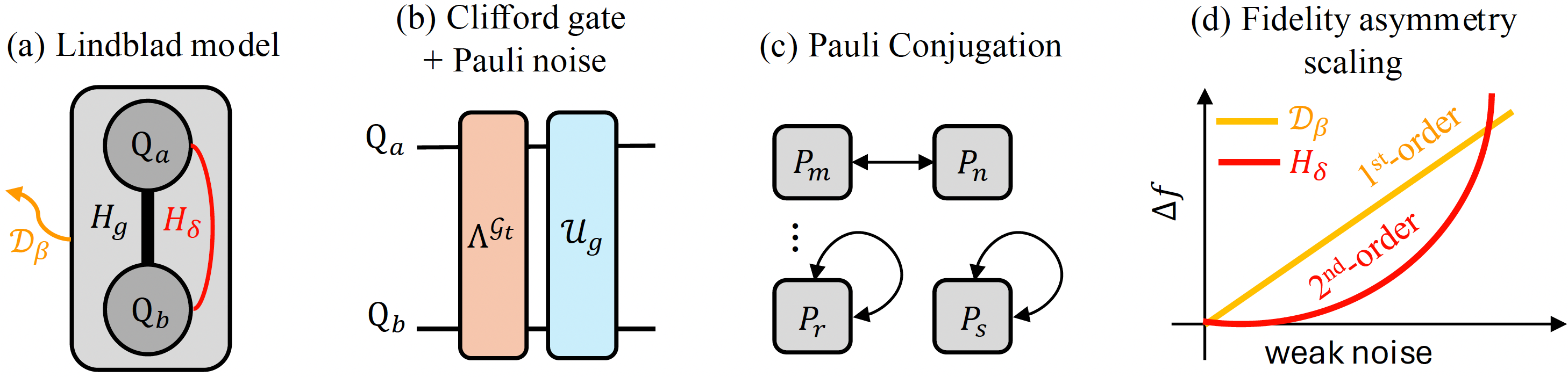
Figure 1: Schematic illustration of Lindbladian noise structure, conjugation actions, and symmetry considerations for two-qubit gates.
Lindbladian Framework and Channel Symmetry
The physical model assumes Markovian Lindblad dynamics for noisy gates, where the generator includes both coherent (Hamiltonian) and dissipative contributions parameterized as
ρ˙(t)=−i[Hg+Hδ,ρ(t)]+Dβ[ρ(t)],
with Hg the ideal gate Hamiltonian, Hδ the noise Hamiltonian (parametrized by real coefficients in the Pauli basis), and the dissipator Dβ characterized by a positive semidefinite matrix in the Pauli basis. The gate noise channel is extracted by time-evolving the Lindblad master equation over the gate interval, then removing the ideal evolution.
A key analytical step is the transformation to the interaction frame, enabling perturbative Lindblad-Dyson expansion around the ideal operation. This derivation leads to explicit expressions for the first-order (in noise strength) corrections to the Pauli fidelities, furnishing the foundation for symmetry and asymmetry classification.
Selection Rules: Asymmetry in Pauli Fidelities
The fundamental observation is that for a broad class of Clifford gates (including ZZπ/2, CZ, CNOT, iSWAP, SWAP), coherent errors (Hamiltonian terms) can only contribute to asymmetric fidelities between a Pauli P and its conjugate UgPUg† at second order in noise strength. In contrast, only a restricted (primarily off-diagonal) set of dissipative noise elements can induce first-order asymmetry, contingent upon their commutation/anticommutation relations with the gate generators.
Explicit Selection Criteria
- Single-Pauli generator gates: Only off-diagonal dissipator elements βjk for which PjPk∝Pg and {Pj,Pg}={Pk,Pg}=0 yield first-order asymmetry [Result 1].
- Multi-Pauli (commuting) generators: The first-order asymmetry arises for each generator Hg0 from Hg1 with Hg2 and both Hg3 and Hg4 anticommute with Hg5 [Result 2].
- Physical noise processes: Standard amplitude damping (Hg6) and pure dephasing (Hg7) channels, whether acting locally or globally, only contribute to second-order (quadratic) asymmetry terms—first-order effects cancel due to matrix structure and physical constraints.
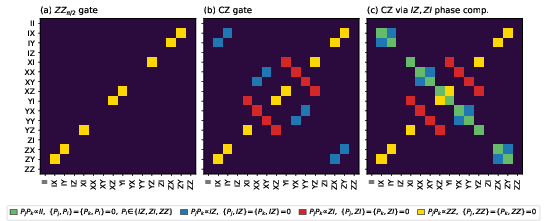
Figure 2: Visualization of first-order fidelity asymmetry patterns for various two-qubit gates as determined by offending dissipator elements in the Pauli basis.
Numerical simulations confirm the analytical selection rules. For Clifford gates realized by a sum of mutually commuting Pauli terms, generator-specific subspaces are formed, each exhibiting distinct susceptibility to first-order asymmetric perturbations. Example subspaces for CZ, iSWAP, SWAP, and CNOT are detailed in the figures, with symmetry-enforced vanishing of leading-order asymmetry for generic Markovian noise.
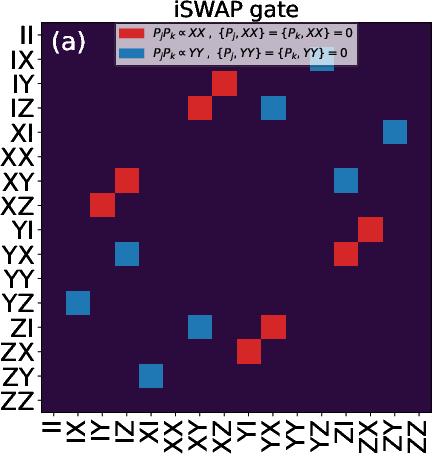
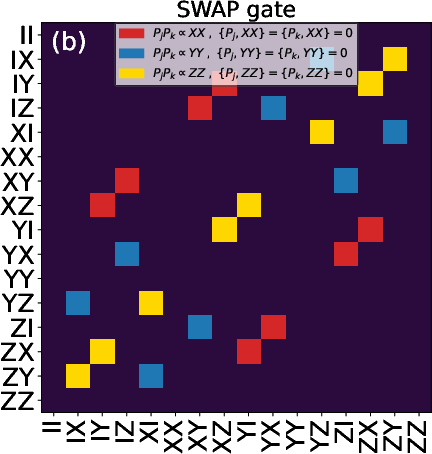
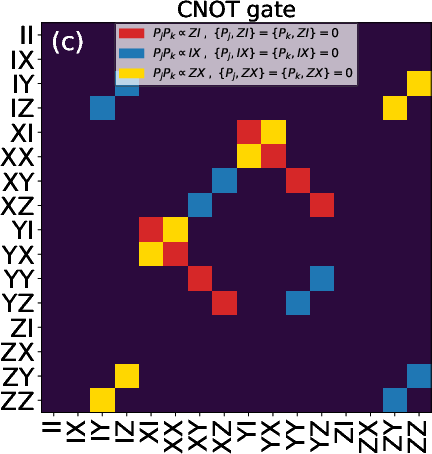
Figure 4: Additional asymmetry patterns for other two-qubit Clifford gates (iSWAP, SWAP, CNOT) consistent with selection rules.
Phase-compensated CZ gates, as realized in experiments with residual Hg8 and Hg9 terms, exhibit more intricate symmetry behaviour, but first-order asymmetry still arises only under definite commutator constraints (see Fig. 7).
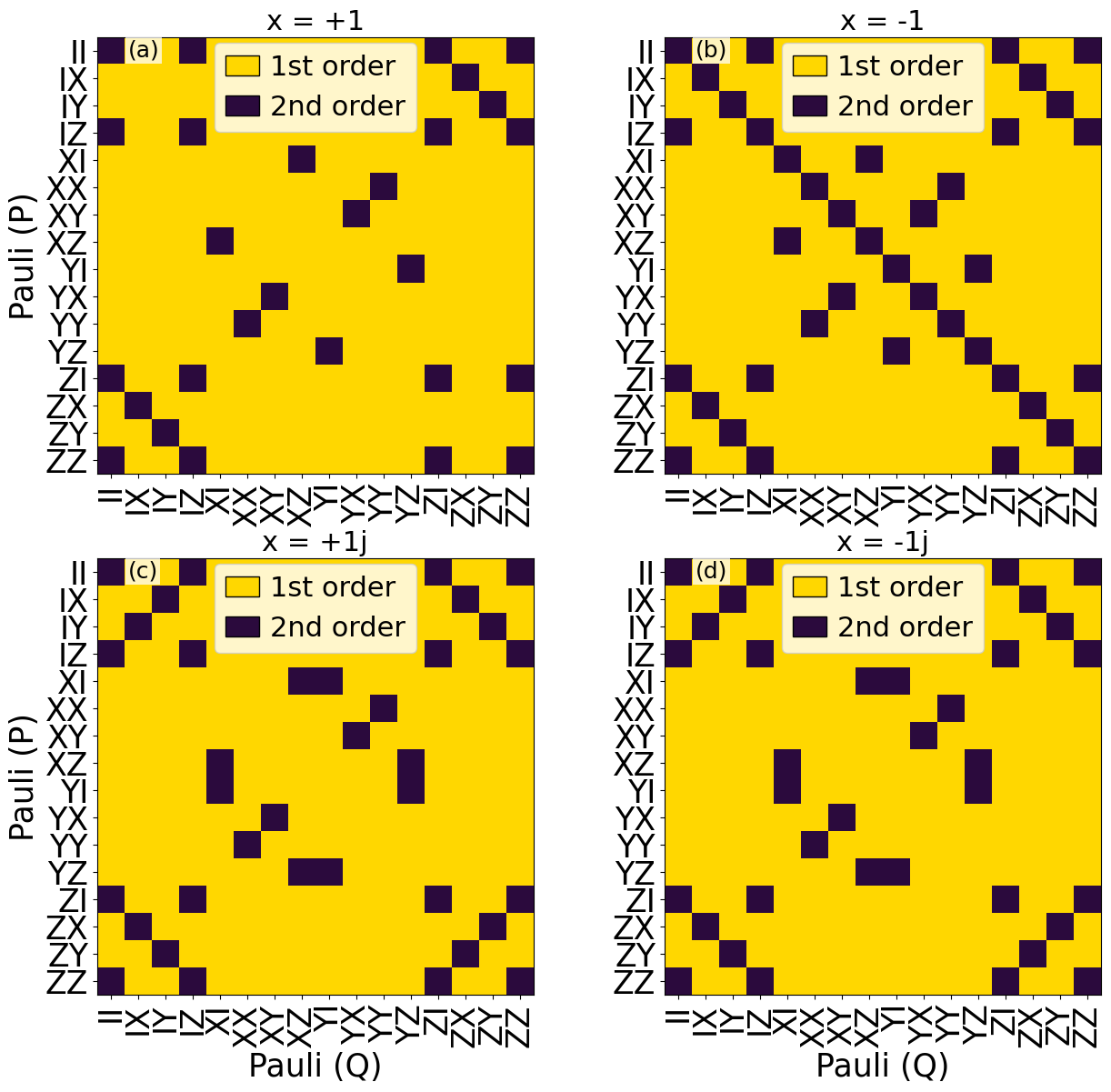
Figure 6: Pauli-fidelity asymmetry for a CZ gate with phase compensation, illustrating the structure imposed by PSD requirements on dissipators.
Gauge Resolution and Pauli Noise Learning
The established (approximate) symmetry of conjugate Pauli fidelities under physical Lindblad noise suggests a natural, physics-based gauge-fixing prescription: enforce equality of these fidelities (to first order in noise) in the gate noise channel, leveraging only knowledge of the noise type—not its strength. This unique gauge resolution enables the consistent decomposition of measured state-preparation/measurement products (as in depth-0 circuits) and SPAM-plus-gate fidelities (from depth-1 circuits) into separate SPAM and gate error channels.
The protocol consists of:
- Depth-0 circuits: Measure (SPAM) products for each relevant Pauli basis.
- Depth-1 circuits: Apply entangling gates and appropriate single-qubit operations (e.g., Hadamards) to access off-diagonal Pauli fidelities, probing conjugate pairs.
- Gauge fixing: Impose conjugate-pair fidelity symmetry to solve for the gauge degrees of freedom (single-qubit depolarizing parameters), separating SPAM.
- Physicality verification: Ensure all assigned fidelities remain within the physically meaningful interval Hδ0.
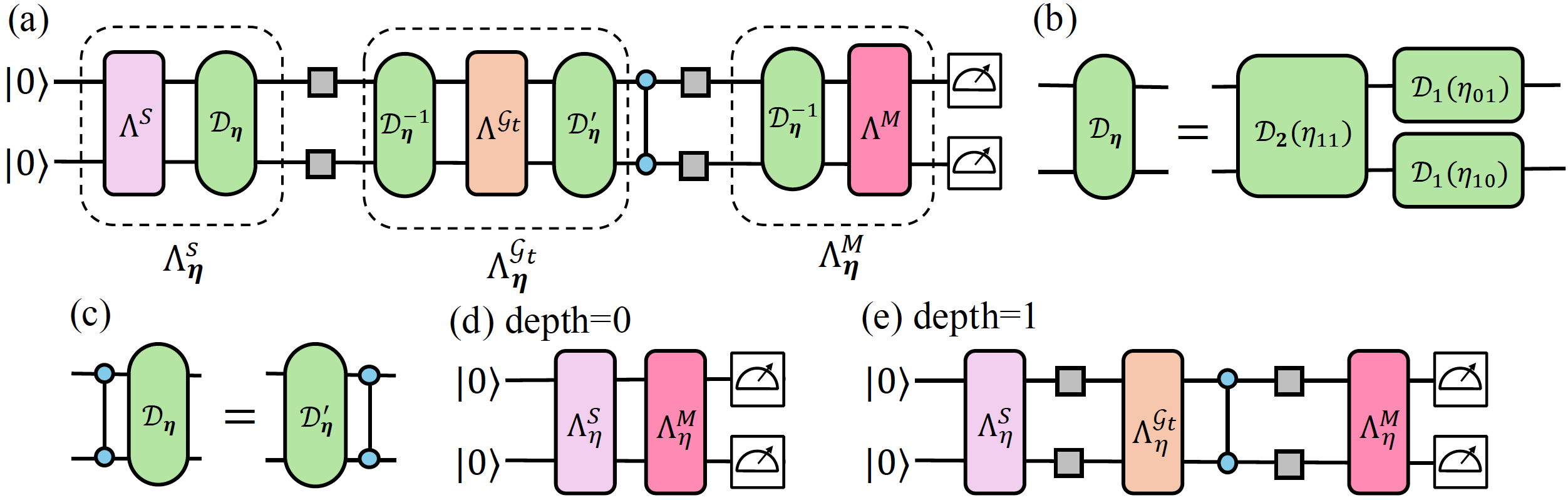
Figure 7: Schematic of self-consistent Pauli noise learning and gauge-fixing based on physical symmetry constraints.
This approach requires no additional hardware, does not predicate on noiseless state-preparation or specific symmetry of gate noise beyond what is physically justified, and is robust to the magnitude of SPAM errors.
Experimental Validation and SPAM Error Attribution
Experiments on the IBM Kingston device corroborate the theoretical picture. CZ gates with phase compensation are analyzed in 16 parallel non-overlapping qubit pairs. The protocol, when subjected to synthetic injection of state-preparation errors (implemented as noisy bit-flip channels), produces a clean decomposition in the symmetric gauge: reduction in state-preparation fidelity is accurately attributed to the SP channel, with measurement and gate fidelities remaining invariant (within experimental error).
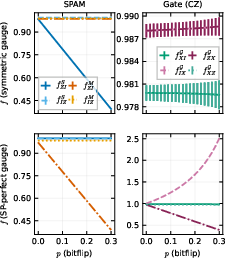
Figure 3: Extracted fidelities under synthetic state-preparation noise. Only SP fidelities vary in the physically motivated (symmetric) gauge.
Per-qubit error budgets extracted in the symmetric gauge indicate a consistent hierarchy where state-preparation errors are smaller—oftentimes by an order of magnitude—than measurement errors, in alignment with established device physics for superconducting qubits. Violations of physicality checks (extracted Hδ1) occur only for qubit pairs affected by statistical noise or model breakdown.
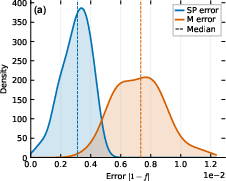
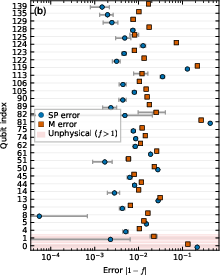
Figure 5: Per-qubit state-preparation and measurement errors across all qubits, confirming the typical measurement-dominated hierarchy.
Comparison to Alternative SPAM Characterization Protocols
The appendix presents a technical comparison with ancilla-assisted SPAM characterization protocols and zero-noise extrapolation methods [as in Yu & Wei, 2306.XXXX]. Unlike these methods, which rely on explicit gate-noise symmetry assumptions or extrapolation in the number of noisy operations and may incur substantial systematic bias under realistic noise, the physics-driven gauge-fixing protocol remains accurate over a wide range of parameters. Numerical simulations demonstrate strong quantitative agreement between the physically motivated gauge and the ground truth, with negligible bias even under significant gate noise and dephasing.
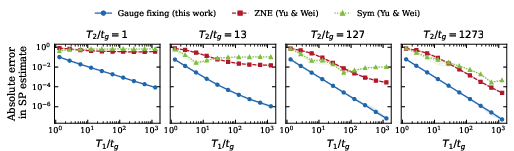
Figure 9: Absolute estimation error for the state-preparation parameter as a function of Hδ2 for several Hδ3 values and various protocols. The physically motivated gauge (blue) outperforms both symmetrization and zero-noise extrapolation approaches.
Theoretical and Practical Implications
The framework delineates a direct connection between the microscopic physics of open quantum systems and operational noise characterization in quantum information processing. The practical upshot is that SPAM separation—critical for unbiased error mitigation and faithful error correction performance assessment—can be executed without assumption about error magnitude, provided only the structural form of the dominant noise channels.
For scalable characterization, this prescription enables gate-by-gate gauge fixing prior to executing large-scale learning protocols such as cycle benchmarking or scalable SPL modeling. A natural direction for extension is the derivation of analogous symmetry constraints for layers of parallel two-qubit gates, accommodating device crosstalk and correlated Lindbladian noise.
Conclusion
Approximate conjugate-Pauli fidelity symmetry emerges as a robust physical property of Lindbladian noise for a broad class of gates and devices, rigorously justifying a symmetry-based gauge-fixing strategy for SPAM separation. This approach is both physically sound and practically effective, enabling consistent and unbiased assignment of SPAM and gate errors—validated by experiment and simulation. Future work should extend these symmetry constraints to circuit layers and address the interplay with correlated environmental processes and non-Markovianity.