- The paper demonstrates that n=1→2 microwave shielding effectively suppresses collisional losses by avoiding two-body bound state formation.
- It employs a Hamiltonian framework with coupled-channel calculations to model rotational transitions and quantifies scattering observables.
- Optimized microwave parameters, especially for m_tot=1, significantly reduce three-body recombination, enabling high-density molecular ensembles.
Microwave Shielding on the Rotational Transition n=1→2 for Ultracold Polar Molecules
Introduction
The efficient suppression of collisional losses in ultracold polar molecule gases is central to the advancement of quantum simulation, quantum many-body physics, and precision measurements. Conventional approaches employing static electric fields or microwave radiation have improved molecular stability, but typically at the expense of incurring two-body bound states that facilitate three-body recombination, thereby restricting the sample's lifetime and precluding evaporative cooling. This paper presents a detailed theoretical treatment of microwave shielding on the higher rotational transition n=1→2, quantitatively demonstrating that such a scheme avoids unwanted two-molecule bound states for a broad range of field parameters, offering a strategic advantage over established n=0→1 shielding protocols (2607.02470).
Theoretical Framework
The interactions between a polar molecule and a blue-detuned, circularly polarized microwave field are rigorously modeled using a Hamiltonian formalism that incorporates the coupling between rotational levels and the photon field through the dipole operator. Distinct values of mtot, where mtot=mn−Nph, partition the Hilbert space into three manifolds with differing Rabi couplings and effective dipole moments, a structure absent in the simpler n=0→1 scheme.
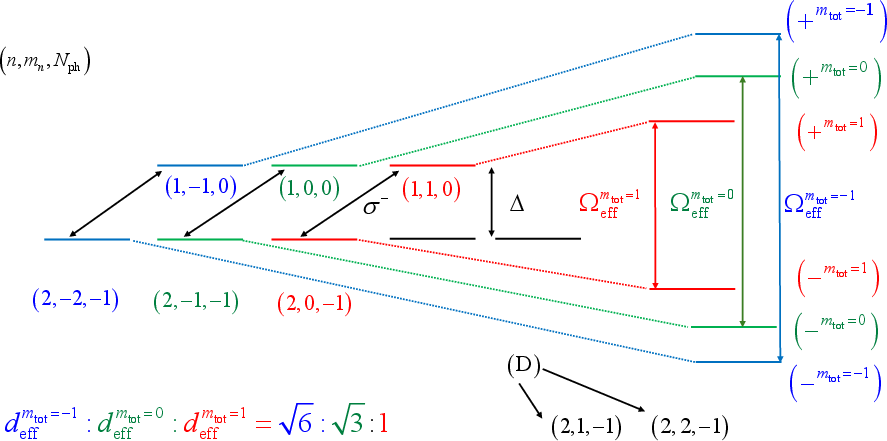
Figure 1: Monomer interaction picture for microwave dressing on the transition n=1→2, with three blocks corresponding to mtot and the relevant selection rules for circular polarization.
Long-range molecular collisions are characterized via coupled-channel calculations, retaining the electric dipole-dipole interaction as the dominant term and neglecting higher-order multipoles that decay rapidly with intermolecular separation. The scattering observables—elastic and inelastic rate coefficients, scattering lengths, and the presence of bound states—are computed in a universal, dimensionless framework leveraging reduced units specific to each molecular species.
Shielding Efficiency and Collisional Loss Suppression
The paper meticulously examines the elastic and total loss rate coefficients as functions of the microwave field parameters, comparing n=1→2 and n=0→1 transitions across NaRb, NaCs, and KAg molecules. For n=1→20, shielding is found to be most efficient due to the increased kinetic energy gap to the nearest loss channel, resulting in a substantial decrease in nonadiabatic transition probabilities.
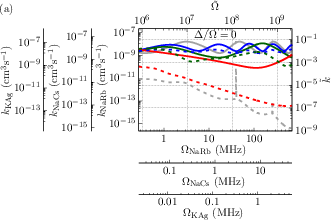
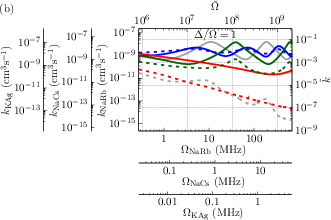
Figure 2: Rate coefficients for elastic scattering (solid) and total loss (dashed) as a function of n=1→21, for various transitions and quantum states, across representative molecules.
The distinct adiabatic potentials (adiabats n=1→22) for n=1→23 reveal the dynamical suppression of inelastic transitions for the n=1→24 channel. The absence of bound states in the lower n=1→25 sectors is supported by the absence of poles in the real part n=1→26 of the scattering length as a function of Rabi frequency.
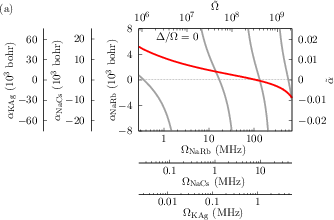
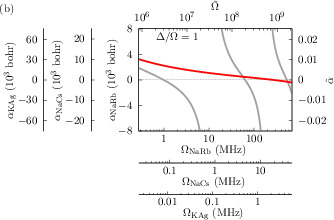
Figure 3: Real part n=1→27 of the scattering length as a function of n=1→28 for both n=1→29 and n=0→10 transitions, highlighting the lack of poles for the latter—implying the absence of shielded two-body bound states.
The adiabatic potentials for different values of n=0→11 further confirm the strong suppression of collisional loss for n=0→12.
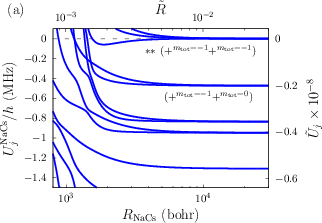
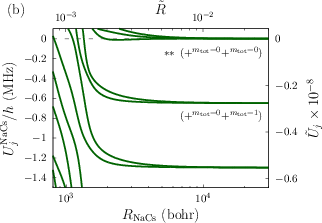
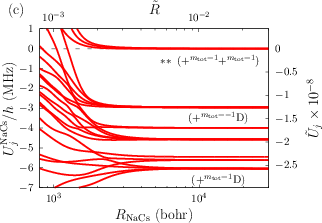
Figure 4: Adiabats n=0→13 for n=0→14 showing the effects of n=0→15 on repulsive barriers and loss suppression in the n=0→16 manifold.
Absence of Two-Body Bound States and Its Consequences
A key numerical result is that shielding on n=0→17 does not support two-molecule bound states for n=0→18 in reduced units for any n=0→19. This is attributed to the significantly weaker long-range attraction—scaling as mtot0—compared to mtot1 shielding.
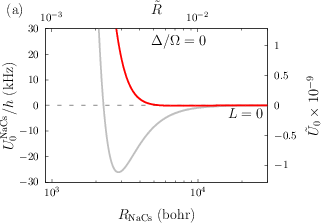
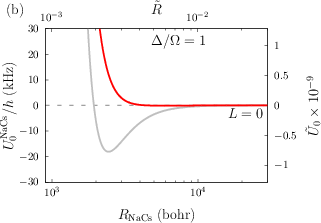
Figure 5: Incoming s-wave adiabats for both mtot2 and mtot3 transitions, illustrating the much shallower long-range well for the latter case.
As a result, the three-body recombination rate is drastically reduced, and the experimental complexity of double-field microwave configurations becomes unnecessary, potentially simplifying apparatus design and enabling higher phase-space densities.
Dependence on Microwave Parameters
The suppression of losses and the location of loss features strongly depend on the detuning-to-Rabi-frequency ratio mtot4. A pronounced peak in loss rate appears around mtot5, associated with pair-state crossings enhancing channel mixing.
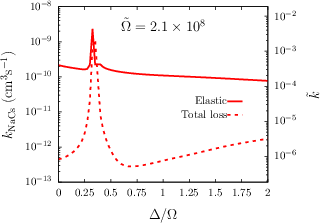
Figure 6: Rate coefficients for elastic and total loss as functions of mtot6 at fixed Rabi frequency, showing an identifiable peak due to channel crossings.
The energy structure of the field-dressed pair states further elucidates these resonant behaviors.
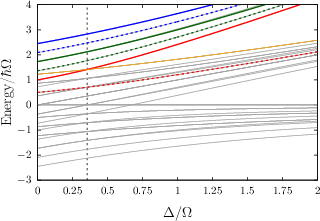
Figure 7: Energies of field-dressed pair states as a function of mtot7, identifying (via colored lines) the location of incoming thresholds and nearby loss channels.
The optimal choice of mtot8 and mtot9 allows for strong loss suppression without the emergence of bound states, as required for stable quantum degenerate gases.
Generalization and Practical Considerations
While the study focuses on mtot=mn−Nph0, the methodology generalizes to higher rotational transitions with increased field strengths required. The effective dipole moments and associated dipole-dipole interactions weaken for larger mtot=mn−Nph1, as the transition moments scale inversely with mtot=mn−Nph2, demanding correspondingly larger ac fields for equivalent Rabi couplings.
Conclusion
Microwave shielding on mtot=mn−Nph3, particularly in the mtot=mn−Nph4 dressed state with mtot=mn−Nph5 circular polarization, provides effective suppression of collisional losses in ultracold polar molecules without forming deleterious two-body bound states. The resulting shallower long-range well drastically mitigates three-body recombination, precluding the necessity for more complex double-field techniques. These findings facilitate experimental realization of high-density, quantum degenerate molecular ensembles where standard microwave shielding is inadequate or impractical. Future developments may leverage these insights to explore novel quantum phases and precision control in ultracold molecular gases.

