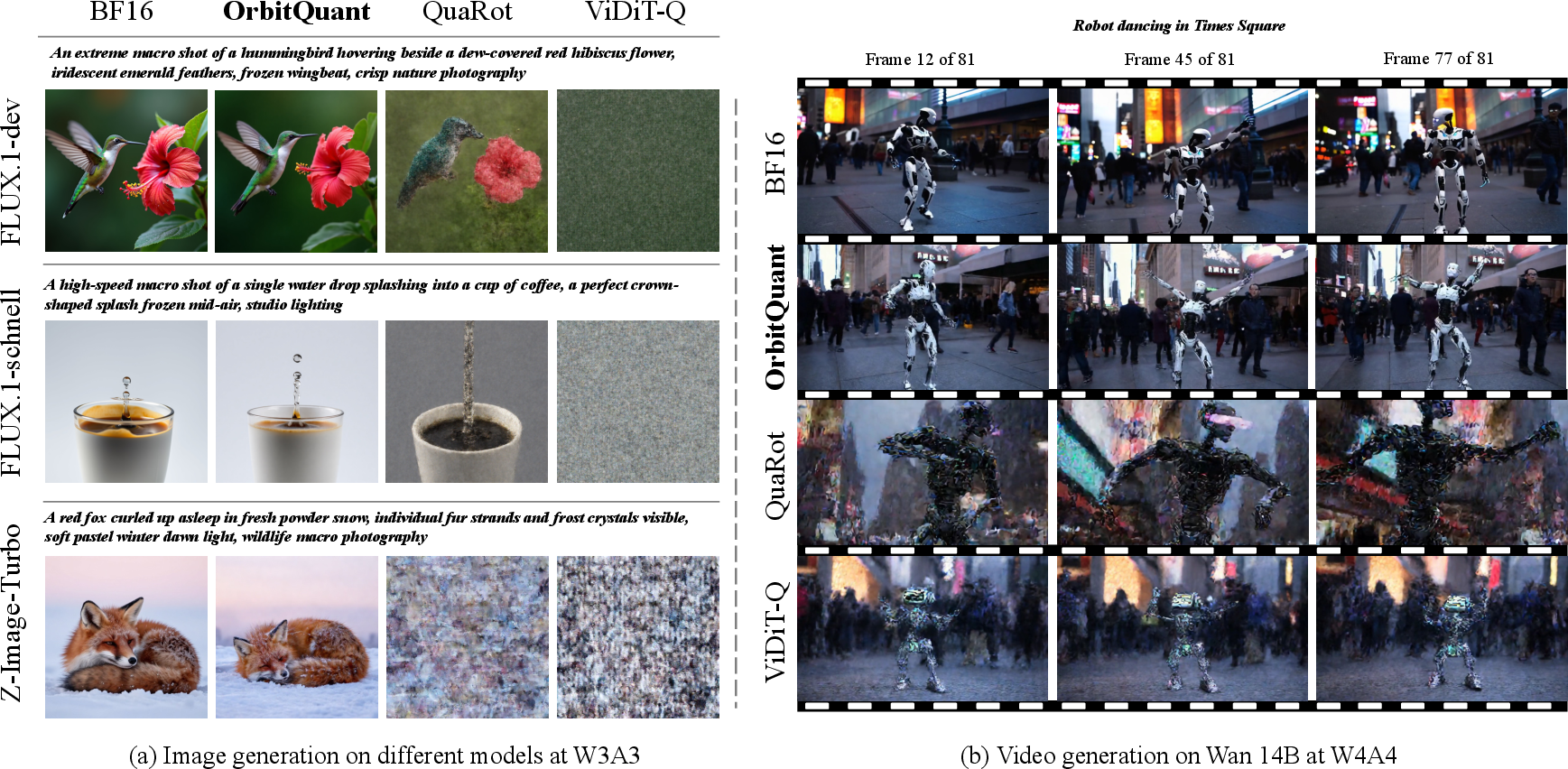
- The paper introduces OrbitQuant, a framework that uses randomized permuted block-Hadamard rotation for calibration-free quantization of DiTs.
- It achieves state-of-the-art post-training quantization accuracy on both image and video models even at ultra-low precision (e.g., W4A4) without calibration data.
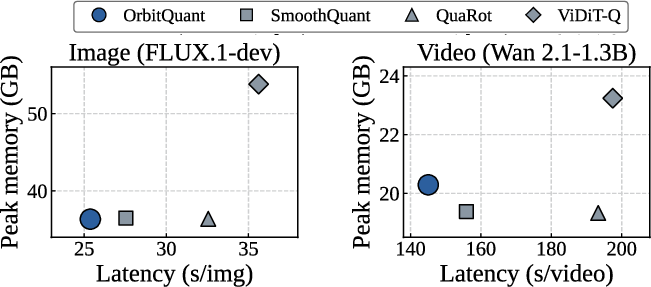
- The approach reduces computational overhead by efficiently quantizing weights and activations, making high-fidelity generative transformers more deployment-ready.
Introduction and Motivation
The proliferation of diffusion transformers (DiTs) has shifted the landscape of high-fidelity image and video generation. DiTs, with transformer-based denoisers, have superseded traditional convolutional architectures, delivering state-of-the-art results. However, DiTs present significant computational overhead in inference due to repeated transformer evaluations across multiple denoising timesteps and their fundamental compute-bound behavior. Post-training quantization (PTQ) of both weights and activations is an intuitive strategy for alleviating these bottlenecks. Yet, unlike in LLMs, DiT activations exhibit challenging input-dependent range drift across timesteps, prompts, and classifier-free guidance (CFG) branches. This drift fundamentally undermines conventional PTQ that relies on activation range calibration, necessitating repeated recalibration for every checkpoint and modality.
OrbitQuant introduces a data-agnostic weight-activation quantization framework that eliminates the need for calibration data. It leverages random rotations to concentrate activations in a permuted block-Hadamard (RPBH) basis where each coordinate is well-behaved and admits a fixed, analytic quantization codebook, independent of the input, prompt, or timestep. This methodology extends uniformly across image and video modalities and supports quantization down to ultra-low precision.
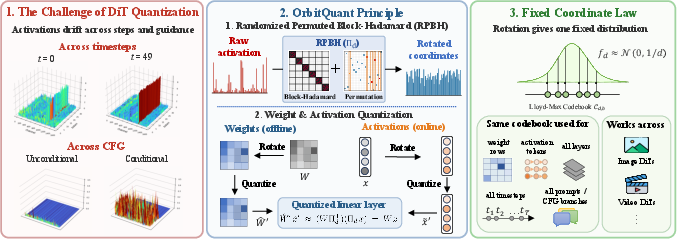
Figure 1: Overview of OrbitQuant. (1) DiT activations drift across timesteps and CFG branches, so calibrated scales do not transfer. (2) The RPBH rotation Πd maps raw activations to well-behaved coordinates. Folded into the weights, it cancels inside each layer (W^′x^′≈Wx).
Methodology
Rotation-Based Quantization Framework
OrbitQuant operates by transforming both weights and activations into a shared, rotated, normalized coordinate system where the marginal coordinate distributions are fixed and analytically tractable. Specifically, the key innovation is the use of a randomized permuted block-Hadamard (RPBH) rotation, consisting of a block-diagonal Hadamard structure and a global, data-independent random permutation. This choice ensures:
- All coordinates across the rotated vector are approximately distributed as N(0,1/d) regardless of input data, timestep, or prompt (as guaranteed by universal variance concentration).
- Only a single, offline MSE-optimal Lloyd–Max codebook per dimension and bit-width is necessary, eliminating the expense and risk of calibration drift.
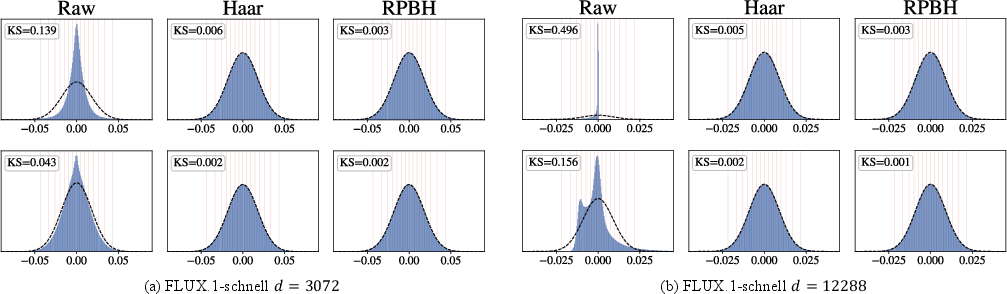
Figure 2: Rotated activation coordinates follow the dimension marginal fd. For (a) an attention projection and (b) a feed-forward projection, the rotated distribution matches closely to N(0,1/d), enabling use of a fixed codebook.
Offline Weight Quantization
- Weights W are rotated offline by the shared RPBH transformation and split into unit directions and norms.
- Directions are quantized with the distribution-derived Lloyd–Max codebook; norms are stored as low-precision scalars.
- All weight rows for a given input dimension share the same codebook and rotation.
- After absorbing the rotation, the product with rotated activations cancels the basis transformation, reconstructing the intended semantics.
Online Activation Quantization
- Activations x are projected (at runtime) into the same rotated basis and normalized.
- Each normalized coordinate is quantized via lookup in the invariant codebook; the per-token activation norm is preserved as a scalar.
- Only a forward rotation per activation batch is required, resulting in negligible compute overhead, which is further minimized by the block-Hadamard structure.
RPBH Rotation and Data-Agnostic Codebook
- The RPBH is O(dlogh)—far more computationally efficient than a dense Haar rotation—while ensuring near-optimal matching to the target marginal.
- Theoretical analysis guarantees that the random permutation phase of RPBH effectively distributes activation variance, preventing block-concentrated outlier effects commonly encountered in DiTs.
- The codebook is therefore maximally robust, transferable across all model layers and tasks.
Experimental Results
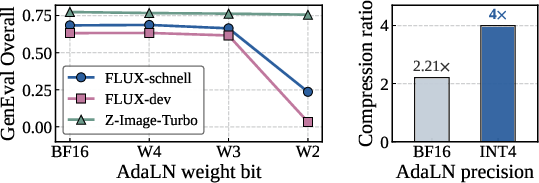
OrbitQuant is benchmarked on various state-of-the-art image (FLUX.1, Z-Image-Turbo) and video (Wan 2.1, CogVideoX) DiTs under multiple bit-widths. The results evidence state-of-the-art PTQ accuracy for weight-and-activation quantization, without any calibration data, even at ultra-low precisions where prior art collapses.
Quantitative metrics on VBench for video models confirm that OrbitQuant not only closes the gap to full precision inference but also outperforms calibration-based approaches on critical dimensions, including Overall Consistency, Motion Smoothness, and Scene maintenance.
Efficiency and Latency
Ablations
Implications and Future Directions
Theoretical Implications: OrbitQuant's calibration-free paradigm generalizes the use of distributional codebooks for quantization beyond LLMs, demonstrating that randomization and analytic marginal control can overcome non-stationary activation statistics in generative transformers. This advances robust PTQ theory by decoupling quantizer design from model- and input-dependent calibration.
Practical Implications: Deployment-ready DiTs now benefit from aggressive quantization, enabling massive reductions in inference compute and model size without retraining or calibration datasets. The single quantizer recipe simultaneously supports diverse modalities (image/video) and architectures.
Open Challenges: The current pipeline requires a small, structured runtime rotation per layer; integrating native low-bit matmul kernels optimized for lookup-table-based, non-uniform codebooks could further reduce overhead. Extension to context-dependent or dynamic codebooks, while maintaining analytic guarantees, is an open avenue.
Conclusion
OrbitQuant establishes a new standard for PTQ in generative diffusion transformers by utilizing analytic, calibration-free quantization in a robust, rotated basis. The proposed RPBH rotation with a universal Lloyd–Max codebook yields unequivocal numerical and qualitative gains over calibration-driven and heuristic PTQ for both images and video, pushing non-uniform quantization into regimes where all prior methods fail. This work demonstrates the viability and generality of analytic, distributional PTQ methods for large-scale generative models.
(2607.02461)