- The paper introduces A-GEF, a novel method for forecasting explicit, activity-driven scene graph edits using language-conditioned neural networks.
- It leverages the SG-Ego dataset and the GLEN architecture to align human activity narrations with evolving scene representations.
- Experimental evaluations demonstrate that GLEN achieves up to 48.49% R@100, significantly outperforming LLM baselines in structured video reasoning.
Learning to Evolve Scenes: Scene Graph Reasoning for Human Activity Understanding
Introduction and Motivation
Modeling the dynamic evolution of real-world scenes under human activity presents a crucial yet under-explored challenge in embodied AI and video understanding. Conventional first-person video modeling approaches typically pursue compact, modality-agnostic embeddings, losing explicit structural information required for detailed causal, temporal, and relational reasoning about scene change. This work introduces a new paradigm based on spatio-temporal scene graphs and proposes a methodology, dataset, and neural architecture for explicit, activity-conditioned modeling of scene evolution.
Specifically, the authors introduce the SG-Ego dataset—a large-scale corpus of egocentric video annotated with temporally-evolving scene graphs—and GLEN (Graph-Language Edit Network), a graph neural network architecture designed to predict and align activity-driven changes in scene graphs. The central formulation is activity-conditioned graph edit forecasting (A-GEF), which predicts structured changes in the scene graph as direct effects of described human actions.
The process of reasoning over evolving scenes is formally cast as the activity-conditioned graph edit forecasting (A-GEF) problem. Here, the key insight is to move from passive visual description to explicit structural prediction: given a current scene graph Gt and a textual description of an action actt, infer the edited scene graph Gt:t+T that would result after the action completes.
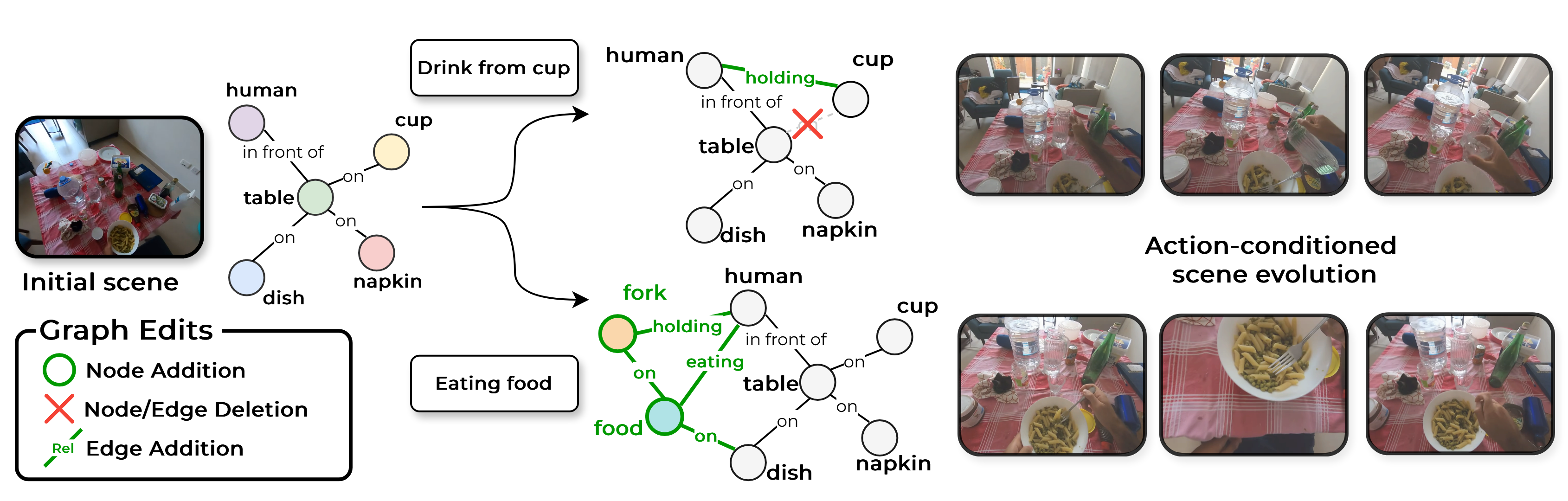
Figure 1: Reasoning over evolving scenes is formulated as activity-conditioned graph edit forecasting, where actions induce structured edits to the scene graph over time.
This task necessitates (1) activity-aware prediction of object/node insertions and deletions, (2) dynamic relation/edge updates, and (3) tight alignment between language and structured visual representation. The explicit nature of graph edits also supports interpretable, compositional, and editable scene models.
The SG-Ego Dataset
SG-Ego provides a large-scale resource of spatio-temporal scene graphs annotated from Ego4D egocentric video. Each sample consists of an initial spatial scene graph Gt, a spatio-temporal (consolidated) graph Gt:t+T, and a corresponding activity narration actt. The pipeline proceeds in three stages:
- Frame-Level Triplet Extraction: A multi-modal LLM (e.g., Qwen3.5) is prompted to output subject-relation-object triplets for each frame.
- Visual Grounding: GroundingDINO is used to localize nodes and edges in frame images.
- Consolidation Across Time: Instance tracking and feature-based matching merge node identities and relations over the action window, producing Gt:t+T.
These graphs use vocabularies of 1480 object categories and 387 relation types.
The GLEN Model Architecture
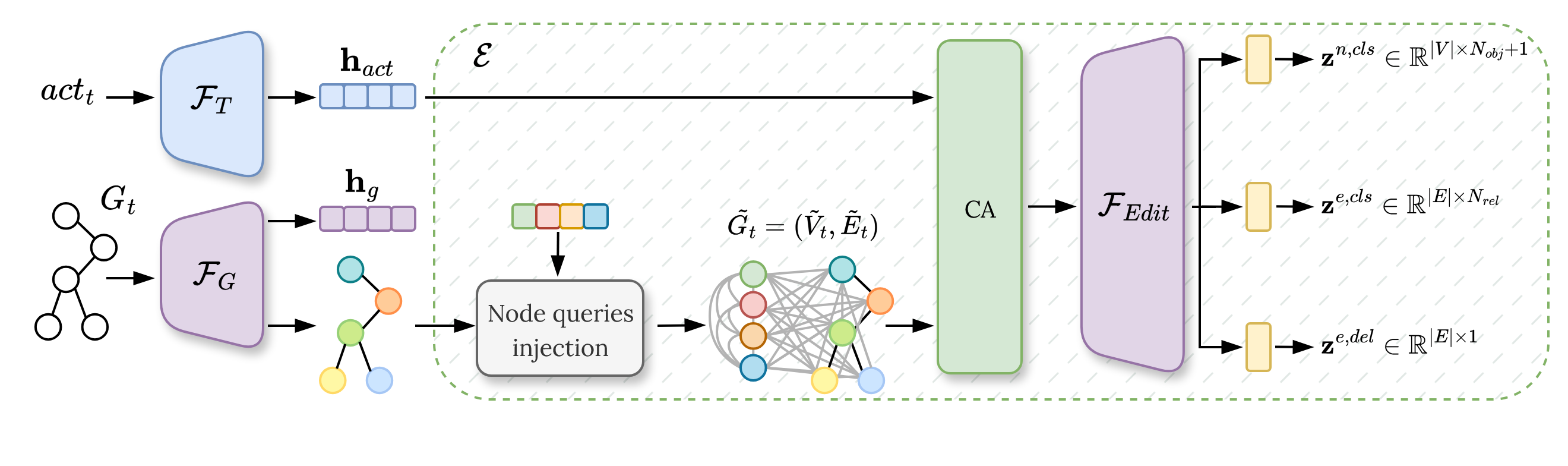
GLEN is a graph neural architecture designed for (a) graph-text alignment and (b) structured, activity-conditioned graph editing:
The inclusion of learnable query nodes and edge slots enables flexible and scalable graph augmentation, vital for dense, long-horizon activity sequences.
Qualitative Evidence from SG-Ego
The qualitative SG-Ego samples highlight the temporal compositionality and enrichment of consolidated scene graphs: actt2 captures object and relation changes not available in a single frame, supporting higher-fidelity activity reasoning.
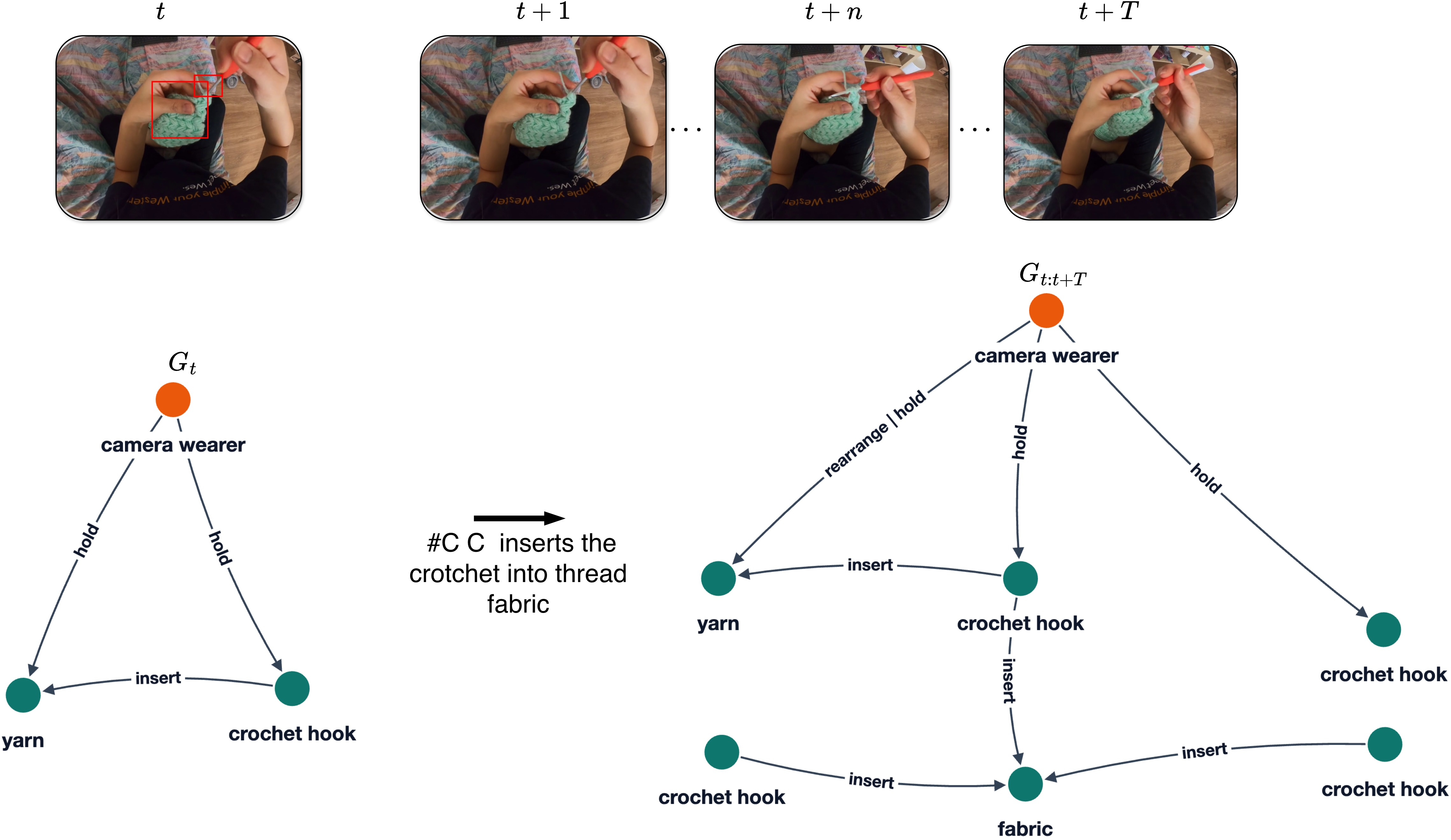
Figure 3: Qualitative example: temporal aggregation introduces new objects and evolving relations as the action unfolds.
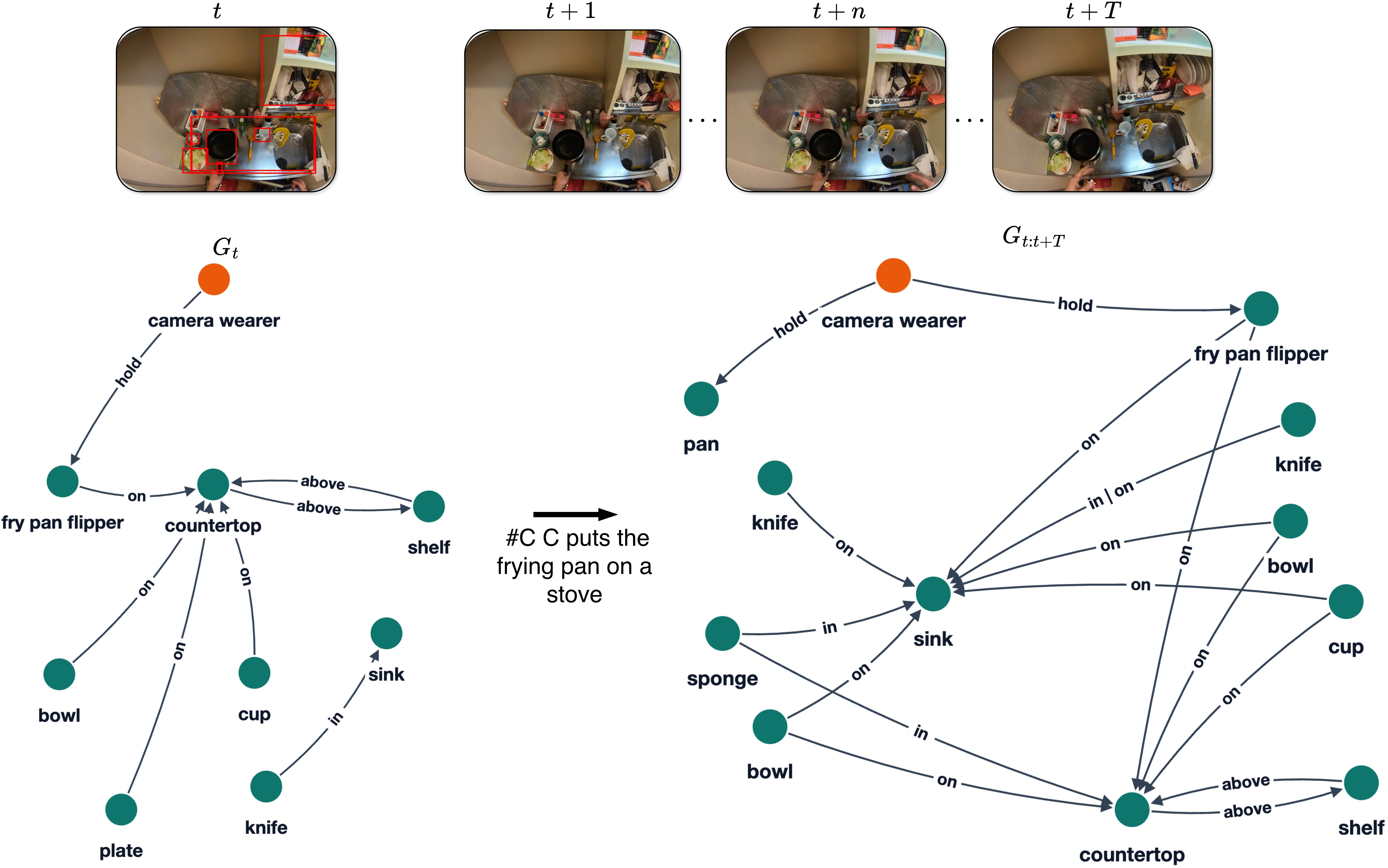
Figure 4: Consolidated scene graphs capture multiple object instances present across temporal windows, beyond single-frame detection.
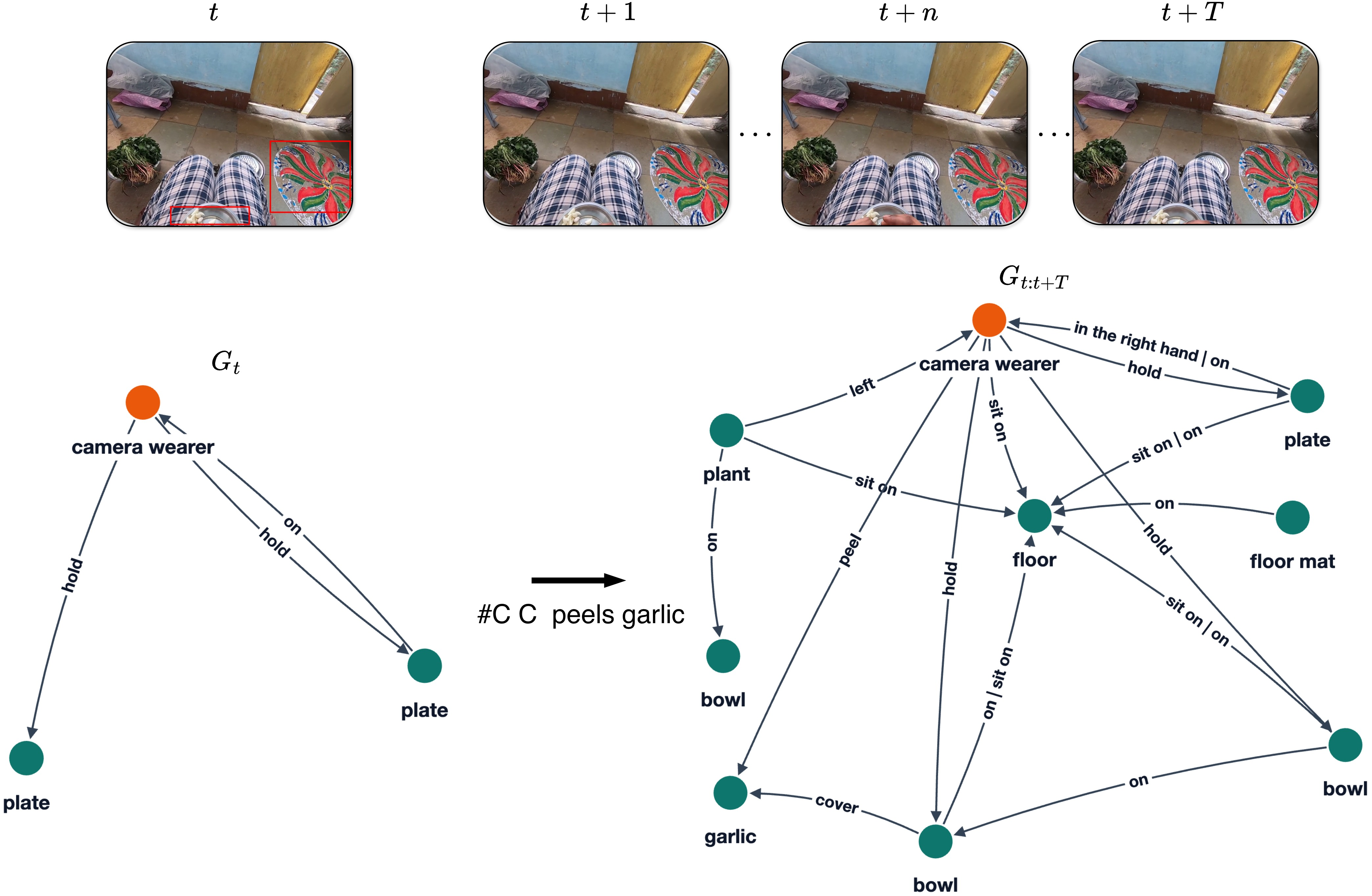
Figure 5: Temporal aggregation reveals objects and relations evolving over the full trajectory of an action, enrichment absent in actt3.
Experimental Evaluation
Long-Horizon Reasoning and Retrieval
- EgoSchema Benchmark: Graph-based representations yield nearly equivalent performance (66.0%) to frame-level visual input (72.8%) on diagnostic long-range video question answering, confirming lossless abstraction for reasoning (2607.02425).
- EgoMCQ and EgoCVR Retrieval Tasks: GLEN graph embeddings demonstrate competitive or better retrieval accuracy compared to video-language baselines, supporting both inter- and intra-video settings.
Scene Evolution and A-GEF
- A-GEF Benchmark: GLEN substantially surpasses both static and LLM-based baselines in triplet Recall@K, achieving up to 48.49% R@100, outperforming LLMs by more than 4×, validating the need for explicit, structured scene evolution models.
- EXPLORE-Bench: On long-horizon, multi-step reasoning tasks, GLEN outperforms or matches large-scale multimodal LLMs in object-centric metrics and achieves competitive relation accuracy, without any task-specific finetuning.
Structural Analysis
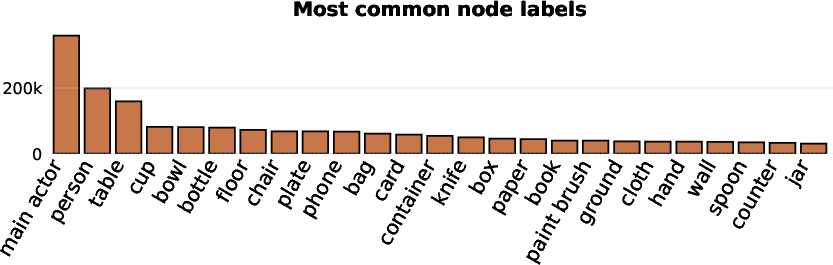
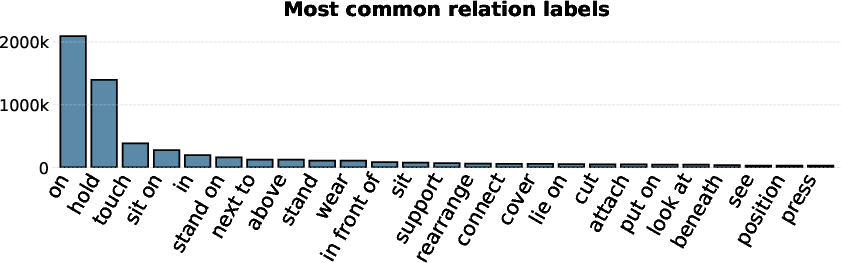
Figure 6: Node and edge label distributions in SG-Ego-Edit illustrate semantic granularity and long-tailed coverage.
Implications and Future Directions
The agenda set by this work is twofold:
- Interpretable Video Understanding: The explicit, compositional, and editable nature of scene graphs directly supports causal, relational, and counterfactual reasoning tasks—facilitating analysis not only of “what” happens, but “how” and “why” activity transforms the scene.
- Bridging Perception and Action: Extending GLEN with spatial prediction components can yield actionable, structured world models for robotics, enabling agents to reason about and plan scene transitions in a grounded manner. Structured representations provide richer supervisory signals for imitation and policy learning, improving sample efficiency and real-world transfer.
The graph-edit formulation also opens avenues for research on controllable scene manipulation, activity-conditioned simulation, and robust, inherently explainable embodied AI models.
Conclusion
This work advances the field by unifying scene graph-based structure, language grounding, and temporal prediction into a cohesive, activity-driven framework for egocentric video understanding. The strong empirical results across reasoning, retrieval, and forecasting demonstrate that explicit, structured representations—when properly aligned with language and optimized for activity-conditioned evolution—can match or exceed monolithic end-to-end models both in accuracy and interpretability. Future research should further investigate hybridized methods, scalable graph construction, and their integration into closed-loop embodied learning systems.