- The paper introduces NeuFS, which leverages internal neuron activations to enhance active few-shot learning by selecting diverse and informative samples.
- It employs dual criteria—activation pattern clustering and low neuron consensus—to identify challenging examples and reduce annotation costs.
- Empirical results show NeuFS outperforms traditional methods, achieving significant gains in accuracy and macro-F1 on benchmarks like Qwen3-4B.
Neuron-Aware Active Few-Shot Learning for LLMs: An Expert Review
Motivation and Problem Context
LLMs exhibit diminished effectiveness in specialized domains due to their limited adaptation capacity without expensive fine-tuning or large annotated datasets. Active Few-Shot Learning (AFSL) aims to address this by judiciously selecting informative, diverse data points for annotation and use as in-context demonstrations, thus reducing human labeling cost while promoting strong downstream performance. However, prevailing AFSL techniques depend heavily on output-level proxies—entropy, semantic similarity, or dense embedding spaces—failing to account for the layerwise internal network dynamics vital for exposing model knowledge gaps and hallucination-prone exemplars.
The NeuFS Approach: Leveraging Internal Neuron Dynamics
NeuFS (Neuron-Aware Active Few-Shot Learning) advances AFSL by leveraging the internal states of LLMs—specifically, neuron activation patterns within feed-forward layers—rather than typical output-level proxies. The framework is designed around two complementary principles:
- Diversity via Activation Pattern Clustering: Select demonstrations that activate distinct subsets of model neurons, thereby ensuring broad knowledge coverage and minimizing redundancy.
- Informativeness via Neuron Consensus: Identify samples associated with low neuron consensus as these correspond to ambiguous, hallucination-prone queries, according to prior evidence linking high neuron activation diversity with model uncertainty and error (2607.02423).
Immediately after introducing these principles, the authors distill their workflow into a pipeline that sequentially extracts activation patterns, quantifies per-neuron contributions to model predictions, clusters samples by discrete activation indices (using Jaccard similarity and K-Medoids), and prioritizes high-uncertainty samples for selection.
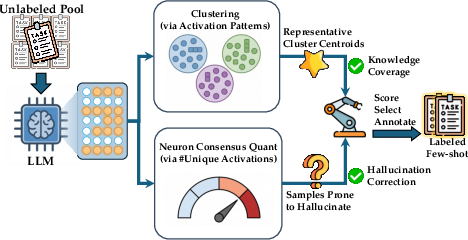
Figure 1: Neuron-Aware AFSL, which identifies informative and diverse few-shot samples for annotation by leveraging internal activation patterns for coverage and targeting hallucination-prone examples via consensus.
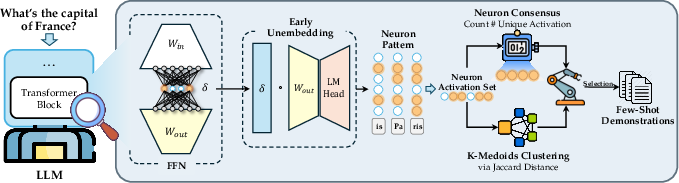
Figure 2: Overview of the NeuFS pipeline: Activation extraction from FFNs, early unembedding for neuron contribution scoring, consensus quantification, and cluster-based sample selection.
Methodology: Extraction, Quantification, and Dual-Criteria Selection
Neuron Activation Identification
The framework traces neuron activations across FFNs during candidate sample generation. Using early unembedding, it identifies which neurons meaningfully contribute to each token prediction, filtering by a dynamically determined threshold that retains the most influential activations globally. This produces a binary, sparse index set per sample, serving as an interpretable proxy for task-specific knowledge circuits.
Dual-Criteria Sample Selection
NeuFS merges two internally derived metrics to guide selection:
- Activation Pattern Clustering: By clustering the discrete sets of activated neurons (using Jaccard distance), it ensures selection of demonstrations that collectively cover a wide spectrum of the LLM’s factual knowledge.
- Neuron Consensus Quantification: Quantifies the count of unique, valid activations across a sample. Low consensus (larger unique sets) signals higher model uncertainty and likely hallucinations. These challenging samples are prioritized for inclusion, as prior research shows demonstrations with low neuron consensus induce measurable improvement in inference (2607.02423).
A weighted scoring function (τ) seamlessly trades off informativeness and representativeness, with optimal values empirically established in the ablation studies.
Empirical Results and Analysis
Benchmarking Against Baselines
Experiments across reasoning (MMLU-Pro), educational feedback classification, and open-domain question classification (TREC) confirm NeuFS’s superiority over AFSL baselines built upon random sampling, entropy maxima, and embedding-based cluster methods. NeuFS achieves the highest or second-highest test accuracy and macro-F1 in nearly all settings—most notably on Qwen3-4B where accuracy reaches 0.452, well above embedding- or entropy-based competitors.
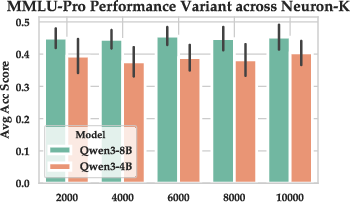
Figure 3: Ablation of activation threshold sparsity hyperparameter (k); NeuFS remains robust except for small models, which exhibit higher sensitivity.
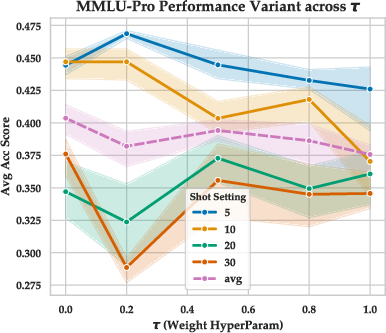
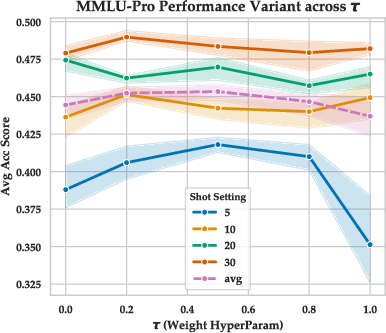
Figure 4: Selection performance for Qwen3 4B across different scoring trade-offs, confirming the optimal setting for diversity/consensus weighting.
This advantage is most pronounced on complex, reasoning-heavy benchmarks, highlighting the central claim that internal neuron-derived features encode granular knowledge coverage and model uncertainty with higher fidelity than output proxies.
On the Predictive Value of Neuron Consensus
Statistical validation further reveals a strong negative correlation between the number of unique neuron activations and prediction accuracy—incorrect predictions reliably activate more unique neurons than correct ones, as confirmed via two-sample t-tests (p<0.001). Selecting few-shot demonstrations with low consensus yields substantial accuracy gains, corroborated by strong positive correlation coefficients (r=0.6664,p<0.001).
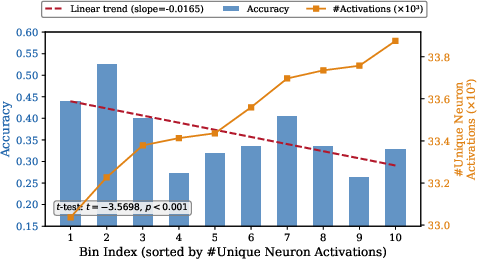
Figure 5: Relationship between number of unique neuron activations and prediction accuracy; accuracy declines as activation diversity rises.
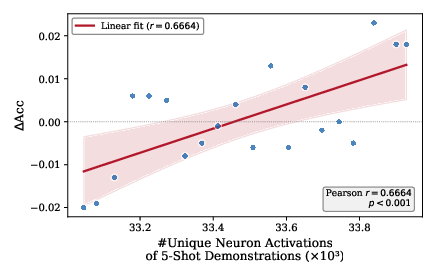
Figure 6: Higher demonstration neuron activation diversity correlates positively with downstream inference improvement.
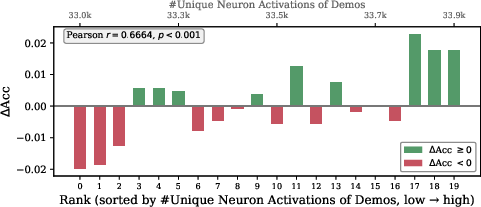
Figure 7: Binned analysis illustrates improved accuracy (ΔAcc) obtained when few-shot examples are chosen among those with greater neuron activation uniqueness.
Representation Study
NeuFS outperforms both encoder-based and decoder-based dense representations (e.g., SimCSE, Qwen-Embedding): the gains are consistent across shot sizes and datatypes, affirming that sparse, neuromorphic feature selection more directly targets knowledge circuits relevant for the LLM’s behavior than semantic or probabilistic distances.
Complimentary Linguistic/Baseline Variants
Linguistic feature augmentation and uncertainty propagation methods (e.g., FastVoteK, Patron) achieve competitive results on specific datasets but lag in generalizability compared to neuron-aware selection.
Implications and Directions for Future Research
NeuFS demonstrates that LLM internal states can be directly exploited to design principled, model-centric data selection algorithms for AFSL and ICL, leading to measurable performance improvements. The demonstrated robustness of the approach across domains and architectures—without reliance on annotated similarity spaces or heuristics—strongly motivates further study of internal activation signatures for broader adaptation problems, including few-shot editing, continual learning, and dynamic demonstration construction.
Practically, NeuFS's need for internal model access limits its applicability to open-weight LLMs and may pose challenges regarding computational cost at scale. However, its tight coupling to model knowledge structures enables more efficient annotation pipelines, potentially reducing required data labeling and engineering overhead.
Future avenues include refining activation pattern metrics via advanced mechanistic interpretability (e.g., sparse autoencoders, monosemanticity), extending to black-box settings via proxy access to neuron-related signals, and generalizing dual-criteria selection paradigms to other prompt selection or active retrieval scenarios.
Conclusion
NeuFS presents a compelling and rigorously validated shift away from output-centric AFSL towards adaptive, neuron-driven demonstration selection. Its performance, theoretical underpinnings, and ablation insights underscore the value of leveraging internal model dynamics—not just as interpretability artifacts, but as robust substrates for automated data selection and active learning in LLMs (2607.02423). Future work should further bridge mechanistic understanding with practical AFSL algorithms to realize more controllable, efficient, and reliable LLM adaptation workflows.