- The paper demonstrates that the linear, mean-shear-coupled term saturates, contributing only a finite offset to wall-pressure variance.
- Experimental measurements of inner-scaled velocity gradients reveal Reynolds number invariance in the near-wall region with classical inertial layer decay.
- Results indicate that the logarithmic increase in wall-pressure variance is solely due to the nonlinear source linked to inertial-layer vortical structures.
Inner-Scaled Linear Contributions to Wall-Pressure Variance at High Reynolds Number
Background and Theoretical Context
The scaling behavior of wall-pressure fluctuations in canonical turbulent wall flows is central in wall-turbulence theory and models for surface-borne noise, drag, and flow-structure interaction. For turbulent flows in pipes, channels, and boundary layers, the variance of the inner-scaled fluctuating wall pressure, ⟨p2⟩+, is found to increase logarithmically with the friction Reynolds number δ+, i.e.,
⟨p2⟩+=B+Alnδ+.
This scaling law has been widely observed but its mechanistic origins remain debated, specifically whether both the linear (mean-shear-coupled) and nonlinear (quadratic in fluctuations) terms in the pressure Poisson source contribute to the observed growth or whether only one term is responsible for the lnδ+ trend.
The pressure fluctuation field in wall turbulence is governed by a Poisson equation in which the source decomposes into a linear component L=2Ωz∂xv (mean spanwise vorticity Ωz coupled to streamwise gradient of wall-normal velocity) and a nonlinear remainder Q comprising quadratic enstrophy and strain fluctuations. The elliptic nature of the mapping from source to wall pressure implies the spatial structure and scaling of these source terms control the Reynolds-number trends in ⟨p2⟩+.
Key Experimental and Analytical Advances
This work presents high-Reynolds-number, simultaneous velocity and velocity-gradient measurements in both turbulent boundary layers (ZPG) and pipe flows using a single eight-sensor hot-wire probe system, up to δ+∼104 in pipes. Crucially, these experiments access the statistics of (∂xv)+, the streamwise gradient of wall-normal velocity in wall units, over a wide Reynolds-number range and directly probe the inner-scaled invariance (or lack thereof) of the linear pressure source.
Collapse of the δ+0 variance profiles across Reynolds number is demonstrated, with decay rates in the inertial layer closely matching δ+1, consistent with classical inertial-layer scaling and local isotropic dissipation predictions. When combined with the known scaling of the mean spanwise vorticity (δ+2 in the log layer), this yields for the linear source δ+3 a wall-normal decay of the form δ+4 in the inertial layer, implying rapid attenuation with distance from the wall.
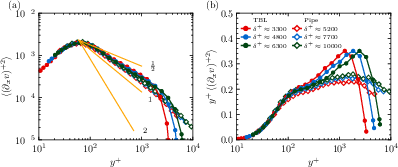
Figure 1: Inner-scaled variance profiles of δ+5 in turbulent boundary layer and pipe flow, showing Reynolds number invariance and the inertial scaling regime.
Mechanistic Implications for Pressure Variance Growth
By exploiting the exponential attenuation in the elliptic Green's function that couples sources to wall pressure, it is shown that the overall wall pressure contribution from the linear source saturates, at high Reynolds numbers, to a finite offset δ+6. The key sufficient condition is that the variance of δ+7 decays with an exponent δ+8 in the inertial region; the data support δ+9. Therefore, the ⟨p2⟩+=B+Alnδ+.0 growth in ⟨p2⟩+=B+Alnδ+.1 cannot be attributed to the linear source, but must reside in the nonlinear source ⟨p2⟩+=B+Alnδ+.2, which, according to previous work, is concentrated in inertial-layer vortical fissures whose wall-normal extent grows as ⟨p2⟩+=B+Alnδ+.3 (Massey et al., 20 Nov 2025).
A structural link connects the two terms: the depletion of near-wall mean spanwise vorticity feeds the generation of fluctuating enstrophy through vortex stretching, energizing the same inertial-layer structures (fissures) responsible for the nonlinear source's growth. The linear contribution is confined to the buffer and near-wall region, vanishing as a fraction of the total with increasing ⟨p2⟩+=B+Alnδ+.4. In contrast, the nonlinear term accumulates over the logarithmically deepening inertial layer, aligning the origins of both the ⟨p2⟩+=B+Alnδ+.5 scaling of wall pressure variance and the velocity edge.
Numerical Findings and Quantitative Trends
- The experimentally observed profiles of ⟨p2⟩+=B+Alnδ+.6 show distinct collapse in the buffer and inertial layer, exhibiting an envelope nearly invariant to Reynolds number and spatial location in the inertial regime.
- The compensated (premultiplied) profile, ⟨p2⟩+=B+Alnδ+.7, forms a plateau at high Reynolds number, supporting the inner-scaling hypothesis.
- The saturation rate of the linear-source wall-pressure variance contribution with Reynolds number is established as algebraic, ⟨p2⟩+=B+Alnδ+.8, with empirically ⟨p2⟩+=B+Alnδ+.9.
- Deviations at large lnδ+0 due to outer-region influences are suppressed in the wall-pressure mapping due to Green's function weighting.
- The spectral content of lnδ+1 at wall-attached wavelengths shows minimal Reynolds-number dependence, confirming the lack of emergent large-scale contributions with increasing lnδ+2.
Practical and Theoretical Implications
This work provides direct experimental evidence that the Reynolds-number-dependent growth in inner-normalized wall-pressure variance originates from the nonlinear component of the pressure Poisson source, and not from the mean-shear-coupled linear term. The inner-scaling of the linear term's statistics and its spatial confinement to the near-wall has broader implications for wall-pressure modeling, surface noise predictions, and flow control strategies that rely on sectoral (linear/nonlinear) decomposition of wall turbulence physics. The findings reinforce the conceptual separation between inner-scaled, Reynolds-number-invariant mechanisms and inertial-layer processes whose increasing extent underlies the observed logarithmic trends in wall-pressure and velocity statistics.
The structural vorticity depletion and subsequent accumulation of fluctuating enstrophy in the inertial layer establish a mechanistic continuity between the near-wall and inertial regions, which is pivotal in developing unified wall turbulence theories and modeling high-Reynolds-number flows.
Future directions include:
- Source-resolved DNS or experimental decomposition of wall-pressure variance at even higher lnδ+3 to conclusively observe the predicted plateau for the linear source.
- Refinement of nonlinear source models to incorporate the detailed spatial and spectral organization evidenced here.
- Leveraging these results in predictive frameworks for wall-bounded turbulence, especially for flows where pressure fluctuations are critical for industrial applications or fundamental turbulence theory.
Conclusion
This study rigorously demonstrates that the inner-scaled linear source term in the pressure Poisson equation, responsible for wall-pressure fluctuations in canonical wall turbulence, contributes only a Reynolds-number-independent offset to the wall-pressure variance as lnδ+4. The logarithmic growth of lnδ+5 with Reynolds number must therefore be attributed exclusively to the nonlinear (quadratic) component of the source, associated with the inertial-layer and its evolving vorticity structure. These results place a strong mechanistic constraint on physical models for wall pressure and reinforce the dominant role of inertial-layer organizations (such as vortical fissures) in generating wall-pressure variance growth at high Reynolds number (2607.02395).