- The paper proposes a static wired architecture that shares phase-shifters among antennas, achieving up to 62.5% reduction in hardware with minimal performance loss.
- It employs a combinatorial topology optimization to design the antenna grouping, ensuring near-coherent beamforming gain even with significant phase-shifter reductions.
- Simulations across single- and multi-RF-chain scenarios show rapid convergence and negligible additional transmit power, highlighting its practicality for cost-sensitive applications.
Hybrid beamforming architectures are indispensable in high-frequency (mmWave, THz) multi-antenna systems, where fully digital solutions are infeasible due to prohibitive costs and physical constraints on RF chain count and associated analog hardware. Sub-connected hybrid architectures offer a better area and power trade-off than fully connected solutions but remain limited by the requirement of dedicated phase-shifters (PSs) per antenna. The high PS count results in excess layout area, wiring and control complexity, and thermal management issues, particularly in compact or densely integrated arrays.
To radically shift this cost-performance paradigm, the paper "Ultra-Low-Cost Hybrid Beamforming: A New Static-Connection Architecture with Sparse Phase-Shifter Sharing" (2607.02393) proposes a static-connection sub-connected architecture in which multiple antennas within each sub-array share PSs through an optimized, once-fixed, connection matrix. Crucially, this static wiring is optimized offline leveraging spatial statistics of service directions, and only the phases of a reduced set of PSs and the digital precoder are dynamically adjusted during operation. The central design variable is now the grouping of antennas to shared PSs—a combinatorial topology optimization problem—rather than minor tweaks to the analog hardware or heavy switch network reconfiguration.
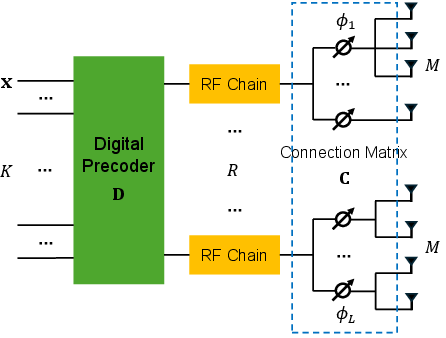
Figure 1: Illustration of the new static-connection architecture with sparse PSs for sub-connected hybrid beamforming.
Static Sparse Phase-Shifter Architecture
In the proposed architecture, an RF chain drives a subarray where M antennas are grouped and connected to L PSs (L<M), each possibly controlling more than one antenna. The PS-to-antenna wiring is described by a binary connection matrix, optimized offline based on representative user directions and channel statistics. Importantly, this design entirely avoids dynamic switch networks, thus eliminating real-time reconfigurability, routing control, and associated parasitics.
Each antenna is connected to exactly one PS, each PS to at least one antenna, and each PS is uniquely assigned to a single subarray. The analog beamforming matrix becomes block-diagonal, with each block aggregating the effect of the shared PSs applied to the antenna groupings. This structure decouples hardware configuration (done once at design time) and instantaneous beam control (performed by digital baseband and adaptive PS phase shifts).
Algorithmic Design Methodology
Two scenarios are addressed: single-RF-chain (single subarray, e.g., for sequential beam switching) and multi-RF-chain (multiuser MISO downlink).
Single-RF-Chain Scenario:
The critical problem reduces to selecting antenna groupings (i.e., the connection matrix) to collectively maximize the achievable array gain for a finite set of candidate transmission directions. For each configuration, optimal per-user PS phase shifts are computed in closed-form to maximize the received SNR.
Analytical results reveal:
- Grouping antennas with similar steering phases under a shared PS achieves near-coherent gain.
- In certain structured scenarios (e.g., when steering phase evolution per AoD is limited or exhibits cycling), one can guarantee no loss in array gain despite aggressive PS sharing.
- Generally, array gain is a monotonically nondecreasing function of the PS count, but practical losses are small until the PS count becomes very low.
For joint optimization over multiple users (beam switching), a mixed-integer convex program (MICP) approach is proposed, leveraging convex surrogates for the SNR constraints and branch-and-bound solvers. The method converges rapidly in few iterations.
Multi-RF-Chain Scenario:
The problem generalizes to a mixed discrete-continuous optimization: analog connection and assignment matrices, PS phase shifts, and digital precoding vectors are all coupled under SINR and power constraints. The paper proposes a QoS-majorization-minimization (MM) framework alternating between:
- Exact digital precoder updates via uplink--downlink duality
- Unit-modulus MM PS phase-shifter optimization
- MILP-based PS connection and assignment updates using MM-derived linear surrogates over the neighborhood of the current assignment with guaranteed improvement
This block coordinate strategy exploits problem structure for efficient convergence, with each step either closed-form or tractable via standard solvers.
Numerical Results and Insights
Extensive simulations are presented for both single- and multi-RF-chain cases, with realistic mmWave settings and LoS channel models. Benchmarks include conventional full-PS sub-connected architectures, random and deterministic (adjacent/cyclic) static PS grouping strategies.
Key observations:
- PS-count reductions of up to 37.5% (single-RF) and 62.5% (multi-RF) are achieved with negligible additional transmit power (e.g., <1 dB loss for >30% PS reduction).
- Proposed optimized static grouping avoids deep nulls and grating lobes prevalent with deterministic patterns, which can cause catastrophic array gain collapse for certain service directions.
- Increasing the number of candidate directions (users) degrades performance only slowly, as the optimized connection topology can maintain strong array gain over all generic directions, provided PS count is not minimal.
- Compared to deploying more PSs with suboptimal connections, optimized topologies with fewer PSs deliver superior performance, confirming the premise that connection topology, not just PS count, is the limiting analog-domain DoF.
- The algorithms demonstrated rapid convergence (MICP: <4 iterations, QoS-MM: dozens of iterations for large systems) and feasible runtimes on commodity hardware.
Theoretical and Practical Implications
The work fundamentally recasts sparse-hardware hybrid beamforming as a topology optimization problem, rather than simply a hardware reduction exercise. The insight is that analog-domain DoF preservation depends on both the count and arrangement of PSs—optimal grouping allows aggressive hardware simplification without severe beam management degradation. This makes large-scale arrays with minimal PS cost practical for static/fixed service environments, FWA, industry-specific deployments, and other scenarios where angular user distribution can be captured during initial design.
From an implementation perspective, the approach removes the need for high-speed switch networks, elaborate control signaling, and complex calibration, which have traditionally plagued hardware-efficient analog networks. Static wiring, once determined via offline optimization, is compatible with high-volume low-cost manufacturing.
Future Directions
Potential extensions include:
- Robust topology optimization under channel uncertainty or with statistical CSI, to ensure array gain across environmental variations.
- Integration with wideband or near-field architectures, where steering phase behavior is more complex.
- Hardware-in-the-loop validation and co-optimization with layout/routing constraints and real circuit nonidealities.
- Merging with machine learning or GNN frameworks for large-scale topology exploration over massive candidate user sets or environments.
- Adaptation to frequency-selective or multi-cell systems with inter-array cooperation.
Conclusion
By elevating PS assignment and connection matrix design to the focal optimization variable, this static sparse-PS sharing architecture achieves order-of-magnitude savings in analog hardware without significant loss in beamforming or spatial multiplexing capability, provided connection topologies are judiciously optimized. This work motivates the re-examination of hardware-efficient hybrid beamforming as a static spatial topology engineering problem—a direction with substantial implications for next-generation, cost-sensitive, large-array wireless systems.