- The paper shows the breakdown of the SSB ansatz by revealing KPZ scaling (z=3/2) in charge transport instead of classical diffusion.
- It employs an analytical mapping to an asymmetric XXZ chain and confirms predictions with TEBD simulations showing t^(-2/3) decay in correlations.
- The study underscores the critical impact of initial states and microscopic operator structure in defining non-equilibrium universality classes.
Kardar-Parisi-Zhang Dynamics in the Open Integrable B3 Model: A Critical Analysis Beyond the SSB Ansatz
Introduction and Context
Non-equilibrium dynamics in quantum many-body systems exhibit universal scaling behaviors, often captured by hydrodynamic descriptions. In open quantum systems governed by Lindblad dynamics, significant effort has gone into understanding such universality, especially for charge transport. The spontaneous symmetry breaking ansatz (SSBA) has recently provided a powerful, phenomenological framework to generalize diffusive transport across a variety of systems, predicting z=2 diffusive scaling in the majority of open quantum scenarios. However, its limitations, especially in integrable settings with nontrivial interactions and initial conditions, remain less explored.
This work analyzes the open Yang-Baxter integrable B3 model, exposing the breakdown of SSBA and the emergence of Kardar-Parisi-Zhang (KPZ) scaling (z=3/2) in charge transport. The results clarify the role of microscopic operator structure and initial states in defining transport universality classes beyond naive SSB-based expectations.
Theoretical Foundation and Model Structure
The system of interest is a periodic spin-21 chain described by a Lindblad master equation,
dtdρ=j∑(−i[hj,j+1,ρ]+Dj,j+1[ρ]),
where the jump operators and Hamiltonian possess U(1) symmetry, ensuring charge conservation. The Choi isomorphism maps this quantum channel evolution onto a pair of interacting non-Hermitian spin chains; the resulting Liouvillian decomposes into "single-chain" and "inter-chain" contributions.
SSBA employs a Feynman-Bijl variational principle, constructing long-wavelength low-energy Nambu-Goldstone excitations in the doubled Hilbert space. It predicts diffusion—i.e., correlation spreading with Cρ,j(t)∼t−1/2—for generic cases where local Lindbladian structure does not yield anomalous processes.
Breakdown of SSBA and Emergence of KPZ Scaling
The authors rigorously demonstrate the failure of SSBA in the B3 model via both analytical and numerical arguments. Charge transport here is governed not by inter-chain coupling (as captured by SSBA), but by decoupled asymmetric XXZ chain dynamics found in single-chain terms of the Liouvillian, provided the system is initialized in an appropriate quantum state. The standard variational subspace of SSBA neglects these terms due to their matrix element structure. Thus, for initial conditions that render inter-chain couplings dynamically irrelevant, the decoupled chains dominate and charge transport exhibits KPZ scaling (G(0,t)∼t−2/3), not diffusion.
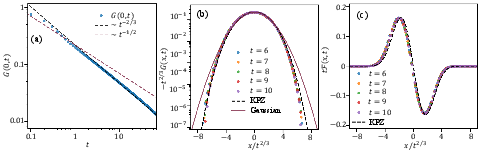
Figure 1: Numerical evaluation of charge transport in the B3 model, with clear deviation from diffusive (t−1/2) scaling and alignment with KPZ (t−2/3) signature.
The explicit connection between the B3 model and a pair of interacting asymmetric XXZ chains enables identification of the KPZ scaling regime, irrespective of the sign of the hopping rate γ−1. Even negative rates retain the KPZ universality via positivity of the diffusion constant, as deduced from approximate mean-field analysis and Bethe ansatz solutions for the effective single-chain Hamiltonian.
Numerical Evidence and Component Analysis
Time-evolving block decimation (TEBD) simulations for z=3/20 spins and bond dimension z=3/21 confirm the theoretical predictions. Charge and current autocorrelation functions exhibit clear z=3/22 decay and collapse onto the universal KPZ scaling function under appropriate rescaling. Detailed decomposition separates the contributions of single-chain and two-chain processes. The single-chain Green's functions z=3/23 and z=3/24 follow KPZ scaling, dominating the long-time behavior, while the two-chain component z=3/25 decays more rapidly as z=3/26 and becomes negligible.
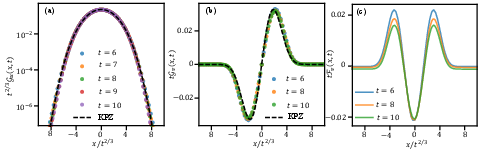
Figure 2: Decomposition of the charge and current transport into single-chain and inter-chain components, highlighting the dominant KPZ character of the single-chain channel.
Importantly, the spectral gap analysis shows that the full Liouvillian retains diffusion-like scaling (z=3/27 gap) as seen in the SSBA variational space. However, the physical charge transport is controlled by the gap of the single-chain (asymmetric XXZ) sector, which closes as z=3/28, confirming the z=3/29 dynamical exponent—a concrete contradiction of the SSBA-based phenomenological prediction.
Analytical Derivation of the KPZ Channel
The mapping to an effective asymmetric XXZ chain allows for analytical tracking of the transport process from microscopic parameters through to the mesoscopic KPZ channel. Under the Choi isomorphism and an appropriate initial condition, the time evolution of observables reduces to dynamics under a non-Hermitian XXZ Hamiltonian. Expansion of the corresponding Heisenberg-Langevin equation reveals, at the coarse-grained level, the structure of the Burgers equation—cornerstone of the KPZ universality class—and the connection to classical stochastic processes (e.g., ASEP).
The analytical Bethe ansatz analysis, valid for both positive and negative hopping rates, confirms that the spectral gap closes as 210, validating the numerical observations and the heuristic mean-field approaches.
Theoretical and Practical Implications
This work demonstrates a sharp separation between spectral features captured by conventional SSB-based phenomenology and the actual dynamical universality class experienced by physical charges in some open quantum systems. The presence of underlying integrability and a suitable choice of initial state can render the inter-chain (dissipative) coupling irrelevant to actual physical transport, causing the SSBA prediction to fail and allowing non-diffusive behavior (KPZ scaling) to emerge even in open, dissipative environments.
From a practical perspective, the identification of negative-rate Markov processes as effective descriptions of quantum open-system dynamics provides new tools for both analytical understanding and experimental realization, especially as platforms such as Rydberg atom arrays mature. The finding that KPZ universality can dominate over diffusive spectra in open settings suggests a broader set of systems where classical KPZ fluctuations can be realized and probed.
Conclusion
Through detailed microscopic analysis and high-precision numerics, this study demonstrates that KPZ universality, not classical diffusion, governs charge transport in the integrable open B3 model beyond the regime accessible to the spontaneous symmetry breaking ansatz. This exposes the limitations of phenomenological SSB-based approaches and motivates a more nuanced theory of emergent hydrodynamics in open quantum systems. Open problems include extending the analytic treatment of the non-single-chain contributions, exploring different initial states, and systematic characterization of open quantum models exhibiting nontrivial universality classes. The formal analogy with classical statistical dynamics opens new avenues for cross-disciplinary understanding and experimental investigation.