- The paper presents a novel block preconditioning strategy that achieves mesh-independent GMRES convergence for high-order SBM discretizations of the Stokes problem.
- It adapts classical preconditioner concepts by approximating the velocity block and replacing the pressure Schur complement with a pressure mass matrix.
- Numerical experiments demonstrate that discontinuous pressure formulations yield robust performance while continuous schemes require stricter inner solver accuracy.
Block Preconditioning for Shifted Boundary Method Discretisations of the Stokes Problem
Introduction and Motivation
The Shifted Boundary Method (SBM) is a high-utility technique in computational fluid dynamics for managing non-body-fitted grids, particularly suitable for geometrically complex or evolving domains. In classic finite element methods (FEM) for incompressible Stokes flow, domains require boundary-fitted meshes, an obstacle for practical workflows involving intricate or moving boundaries. SBM circumvents this by shifting boundary conditions to a “surrogate” boundary coincident with the background mesh and compensating for this shift with Taylor-based corrections, preserving optimal accuracy.
While SBM is robust in terms of geometric flexibility, it introduces significant algebraic complexity: the associated linear systems for the Stokes equations are non-symmetric and indefinite due to the application of boundary corrections, complicating the design of scalable solvers. This paper addresses the lack of robust iterative solvers for the SBM–Stokes system by developing and analyzing a block preconditioner suited for high-order SBM discretizations. The focus is on establishing mesh-independent convergence for iterative solvers via a tailored preconditioning strategy.
The SBM builds upon the unfitted mesh paradigm, where geometric boundaries are defined implicitly and enforced weakly using Nitsche-type techniques. The mathematical core employs a surrogate boundary, Γ′, lying on mesh faces, with boundary data extended from the true boundary, Γ, using a Taylor expansion of appropriate order. Weak enforcement is realized using augmented variational forms, leading to non-symmetric algebraic systems in the discrete setting.
For the Stokes problem, the saddle-point system is constructed with a high-order mixed FEM pairing (e.g., Qk/Qk−1, discontinuous or continuous pressure). The velocity block includes SBM-specific boundary corrections, while the pressure block is adapted to the embedded domain. Importantly, the discrete operator is not symmetric and requires appropriate stability properties, notably a discrete inf-sup condition analogous to the Ladyzhenskaya–Babuška–Brezzi condition.
Block Preconditioning Strategy
Classical preconditioners for body-fitted Stokes discretizations, such as block diagonal or block triangular forms, guarantee mesh-independent convergence for Krylov methods provided spectral equivalence between the preconditioner’s blocks and the system’s natural operators. For SBM, this idea is adapted:
- The velocity block is approximated (in numerical experiments, via direct solves; the theory accommodates geometric multigrid).
- The pressure Schur complement is replaced by the pressure mass matrix.
- A block upper-triangular preconditioner is constructed:
P=[ABT −M]
with A the (possibly inexactly inverted) velocity block and M the pressure mass matrix.
The crucial observation is that while the SBM system is non-symmetric, the non-symmetric terms are O(hζ)-small perturbations (with h mesh size), vanishing as the grid resolves boundary features. Field-of-values (FOV) analysis provides the convergence rate guarantee for preconditioned GMRES; mesh-independent contraction for residuals is established theoretically under sufficient resolution and numerically confirmed.
Numerical Experiments and Results
The preconditioning technique is evaluated on two domain arrangements:
- Arrangement 1: single embedded circular obstacle.
- Arrangement 2: three closely spaced embedded circles, introducing challenging, under-resolved gaps at coarse mesh levels.
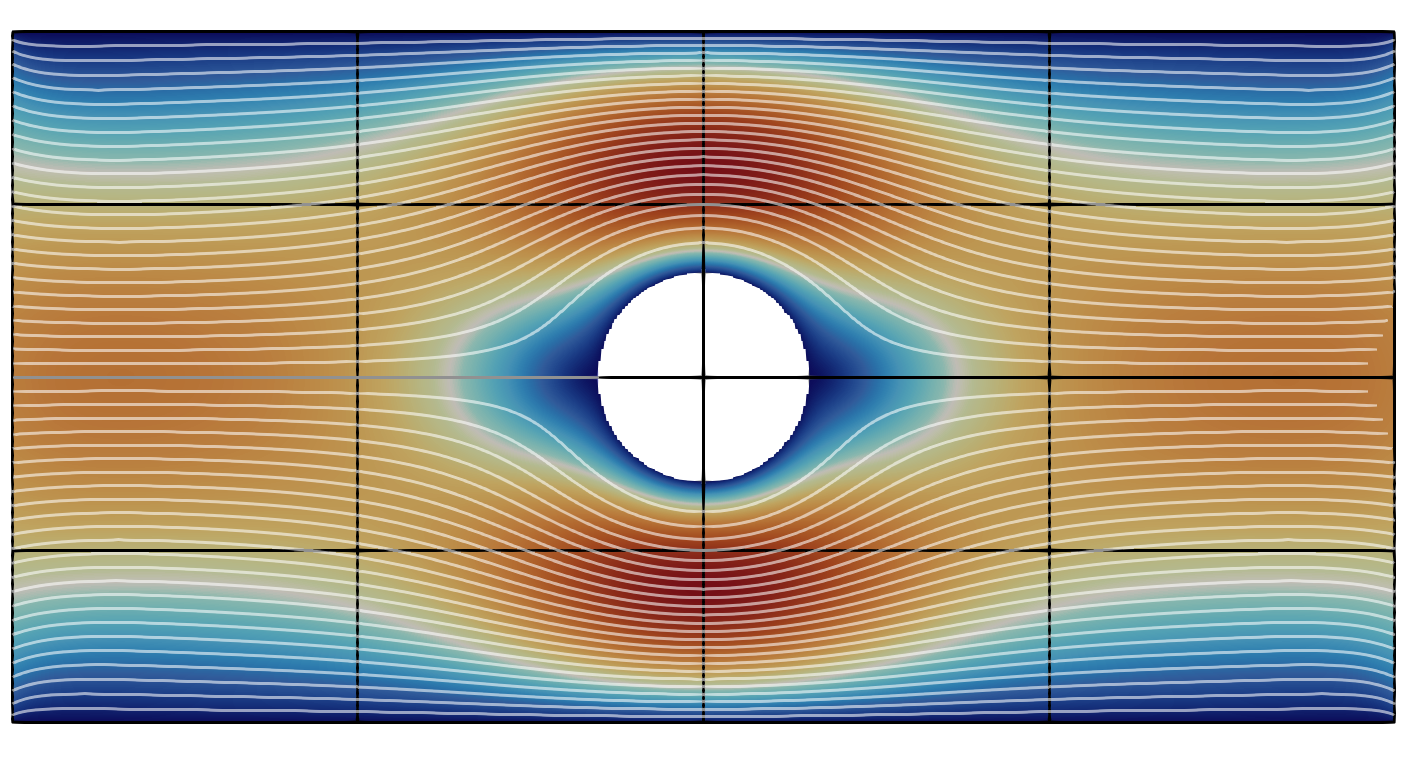
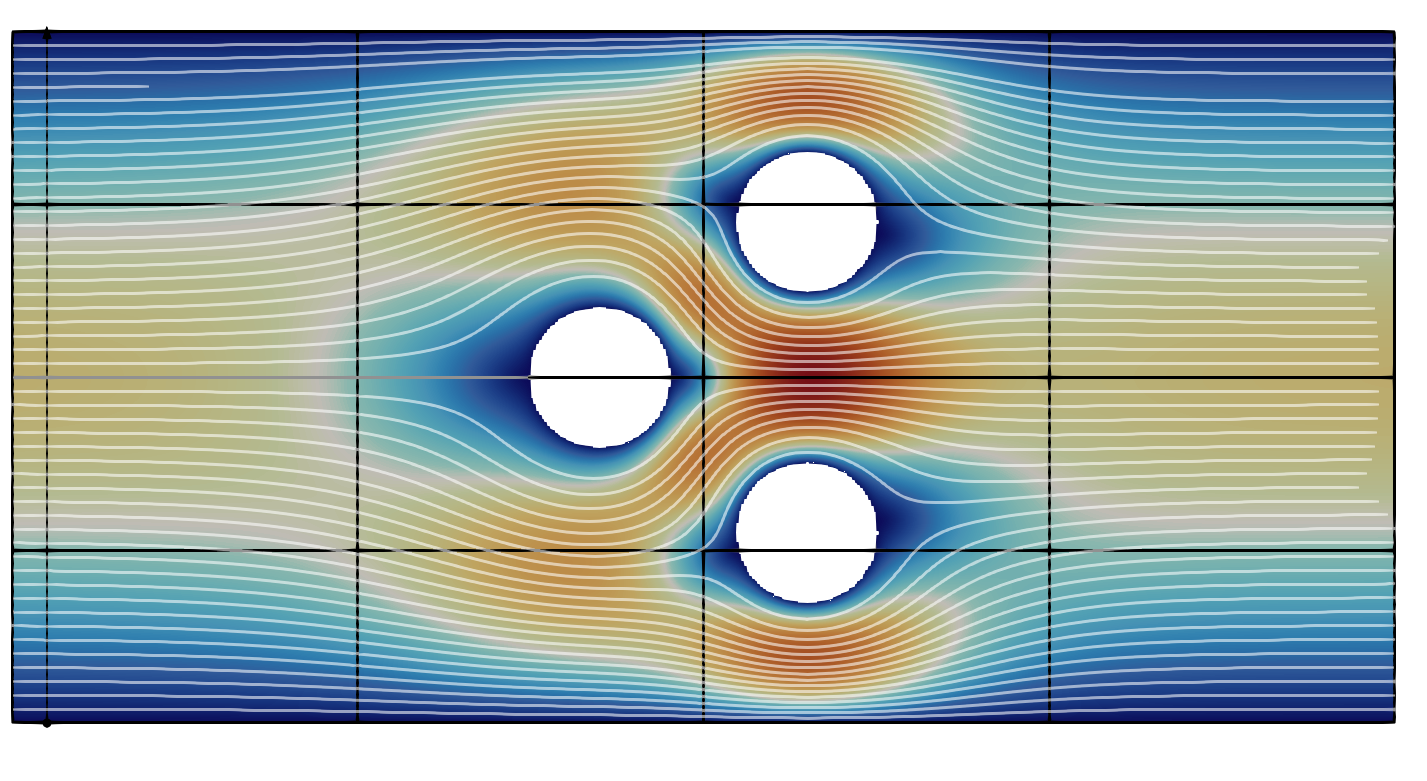
Figure 2: Two arrangements (single and triple embedded circles) and corresponding Stokes solutions computed using high-order SBM. Arrangement 2 features narrow channels yielding intricate local flow structures and challenging mesh resolution requirements.
Iteration counts for preconditioned GMRES (and FGMRES for inexact velocity solves) under uniform mesh refinement display several salient phenomena:
- Discontinuous Pressure (Qk/Q0 or Qk/Q1 with DG pressure): Consistently low, mesh-independent iteration counts once the mesh resolves all geometrical features; jumps in iteration count only appear in the pre-asymptotic, under-resolved regime and vanish under further refinement.
- Continuous Pressure (Taylor–Hood): Higher sensitivity to geometric features, especially in the presence of closely spaced boundaries (Arrangement 2) and for higher polynomial degrees. Iteration counts can increase substantially, and in certain high-order/complex settings, convergence may not be attained with a modest number of outer iterations.
- Symmetric vs. Non-Symmetric Gradient Forms: For continuous pressure, symmetric formulations yield improved convergence properties, particularly mitigating the performance degradation in under-resolved settings.
A notable point is that strong mesh-independent convergence is confirmed for DG pressure formulations and adequately resolved grids, supporting the theoretical FOV analysis, which asserts that the non-symmetric perturbations become negligible as the mesh is refined.
When utilizing inexact velocity solvers (shy-patch geometric multigrid applied as a preconditioner in the inner solve), the block preconditioner’s effectiveness is highly sensitive to the quality of the inner solve. Sufficient inner iterations or smoothing steps are required to meet the energy-norm contraction threshold posited in the theory; otherwise, the outer iterations may stagnate or fail, particularly under restart. This contrasts with body-fitted Stokes solvers, in which block preconditioners exhibit more tolerance to inexact velocity block solves.
Theoretical Analysis
The paper conducts a rigorous field-of-values (FOV) analysis for the SBM–Stokes system, establishing that the non-symmetric terms, induced by the Taylor corrections at the surrogate boundary, act as small perturbations to the canonical symmetric saddle-point operator. Provided the mesh is sufficiently fine to resolve all geometric features (with Γ0 for sufficiently small Γ1), FOV arguments guarantee that preconditioned GMRES converges at a uniform, mesh-independent rate.
Furthermore, the theoretical results analyze the implications of inexact velocity block solvers, formalizing the error contraction requirement that ensures outer iteration robustness. The analysis underscores the necessity for inner solvers to deliver energy-norm contractions with constants sufficiently below Γ2 to maintain rapid outer convergence.
Implementation Details and Practical Implications
The implementation leverages deal.II’s high-order FEM and SBM infrastructure. Key points include:
- Efficient algebraic assembly using surrogate boundary identification and high-order shape function evaluation at projected points.
- The hybrid block preconditioner—using direct or advanced geometric multigrid for the velocity block and exact mass matrix inversion for the pressure block—is demonstrated to be robust and efficient in practice for unfitted SBMs.
- Handling of inactive degrees-of-freedom ensures stability for both direct solvers and iterative methods, despite the non-body-fitted domain tessellation.
- The geometric complexity (notably Arrangement 2) exposes the necessity for mesh resolution; the block preconditioner cannot compensate for geometric aliasing or severely under-resolved interfaces.
Conclusions
The study provides the first thorough analysis and demonstration of block preconditioning for the saddle-point systems resulting from SBM discretizations of the Stokes equations (2607.02336). Strong numerical evidence confirms that for discontinuous-pressure SBM formulations, the block upper-triangular preconditioner yields mesh-independent convergence in preconditioned GMRES after the mesh resolves all geometric details. Continuous-pressure schemes or higher polynomial orders exhibit increased sensitivity, suggesting further stabilization or enhanced Schur complement approximations may be needed for demanding configurations.
The FOV analysis, supported by empirical iteration counts, pinpoints the primary sources of preconditioning challenge in the SBM context: under-resolved geometry and the requirement for high-quality (energy-norm) contraction in inexact velocity block solves. In practice, careful management of solver and preconditioner parameters is critical when rich geometric features or high-order discretizations are involved.
Extension to fully scalable solvers with fully matrix-free and parallelizable infrastructure is a clear avenue for future work, especially leveraging recently developed multigrid and patch smoother techniques for SBM [wichrowski2025geometric, shypatch]. The methodology enables large-scale, high-fidelity simulations of incompressible flow over highly complex or dynamic domains without the burden of mesh generation, broadening SBM’s utility in computational mechanics.
References
- (2607.02336)
- Wichrowski, M. et al., "A Geometric Multigrid Preconditioner for Discontinuous Galerkin Shifted Boundary Method" [wichrowski2025geometric]
- Wichrowski, M., Ajith, A., "A Geometric Multigrid Preconditioner for Shifted Boundary Method" [shypatch]
- Main, A., Scovazzi, G., "The shifted boundary method for embedded domain computations. Part I: Poisson and Stokes problems."
- Atallah, N.M., Canuto, C., Scovazzi, G., "Analysis of the shifted boundary method for the Stokes problem."
- Mardal, K.-A., Winther, R., "Preconditioning discretizations of systems of partial differential equations."