- The paper introduces a unified variational formulation for finite-strain elasticity that integrates energy minimisation and automatic differentiation, achieving model-independence.
- It employs Nitsche-type boundary enforcement and ghost penalty stabilization to ensure cut-independent coercivity and optimal conditioning on unfitted meshes.
- The study details the impact of corner singularities on convergence rates and demonstrates that local mesh grading is vital for restoring optimal performance.
Unified CutFEM for Finite-Strain Elasticity: Model-Independence, Energy Framework, and Singularities
This essay presents a detailed technical summary and analysis of "A Unified CutFEM Formulation for Finite-Strain Elasticity: Energy Minimisation and Corner Singularities" (2607.02334). The work proposes a fully variational, model-independent Cut Finite Element Method (CutFEM) for finite-strain elasticity problems, with an emphasis on energy minimization, the role of automatic differentiation (AD), and confronting the approximation limits imposed by corner singularities at boundary-condition junctions. The formulation integrates weak boundary imposition and stabilization directly at the energy level, enabling consistent and flexible handling of nonlinear material models.
Finite-strain elasticity requires addressing the geometric and material nonlinearities inherent to large deformations. Traditional finite element approaches are limited by cumbersome mesh generation for complex geometries and laborious (often error-prone) manual derivation of consistent linearizations for Newton-type solvers. This work proposes a unified variational approach:
- Energy Functional Assembly: The discrete variational problem is constructed from an augmented energy functional. This functional combines the hyperelastic bulk energy, Nitsche-type boundary terms for weakly imposing Dirichlet conditions, and ghost-penalty stabilization. Boundary imposition and stabilization thus enter not as ad-hoc terms but as first (residual) and second (tangent) variations of the energy.
- Automatic Differentiation: All constitutive tensor derivations—the first Piola–Kirchhoff stress and the fourth-order elasticity tensor—are computed via automatic differentiation (AD) from the scalar strain energy density Ψ. This enables model-independence: new hyperelastic models require only supplying a new Ψ, with all tangent/residual updates automatic.
This paradigm ensures the residuals and tangents are exact variations of the chosen energy (up to a carefully-justified, negligible omission of higher-derivative boundary terms in the tangent).
Nitsche-Type Boundary Enforcement and Ghost Penalty Stabilization
CutFEM operates on “unfitted” meshes: the computational grid does not conform to the (possibly complex or evolving) domain boundary ∂Ω. To address this, and the “small cut” ill-conditioning common in unfitted approaches, the method employs:
- Nitsche's Method: Boundary conditions are imposed weakly by augmenting the energy with consistency and penalty terms. The penalty parameter and material-dependent scaling are critical for ensuring cut-independent coercivity, even under large material stiffness variations.
- Ghost Penalty: Stabilization is provided by penalizing jumps in normal derivatives across faces sharing at least one cut cell. This ensures uniform conditioning (preventing the system matrix from degenerating when small parts of elements are inside the physical domain).
The implementation distinguishes standard integration over interior elements from specialized quadrature (utilizing level sets) for cut elements.
Theoretical Analysis: Stability, Conditioning, and Convergence
The paper rigorously analyzes the linearized problem at each Newton step, leading to several key results:
- Cut-Independent Coercivity and Continuity: The assembly ensures that, under general assumptions (uniform material ellipticity, mild mesh regularity), the bilinear form is coercive and continuous with constants independent of how the geometry cuts the mesh.
- Condition Number Control: The system matrix's condition number remains O(h−2), unaffected by the position of ∂Ω relative to the mesh.
- Newton Method Energy Descent: The damped Newton iteration is a descent method for the total energy, enabling robust nonlinear solves without excessive sub-stepping, even when load continuation is necessary.
The convergence theorem leverages the Brezzi–Rappaz–Raviart framework and asserts quasi-optimal convergence rates for regular (corner-free) problems, with detailed attention to the effect of neglected third-derivative boundary terms, which are proven asymptotically negligible.
Numerical Experiments: Convergence and Corner Singularities
The numerical section validates both the theoretical predictions and the implementation's flexibility with different hyperelastic models.
- Smooth Domains: On a disc geometry with no corners (and pure Dirichlet conditions), both the compressible neo-Hookean and split isochoric–volumetric neo-Hookean models achieve the optimal L2 rate of O(hp+1) for p=1,2,3, matching the matching body-fitted discretization.
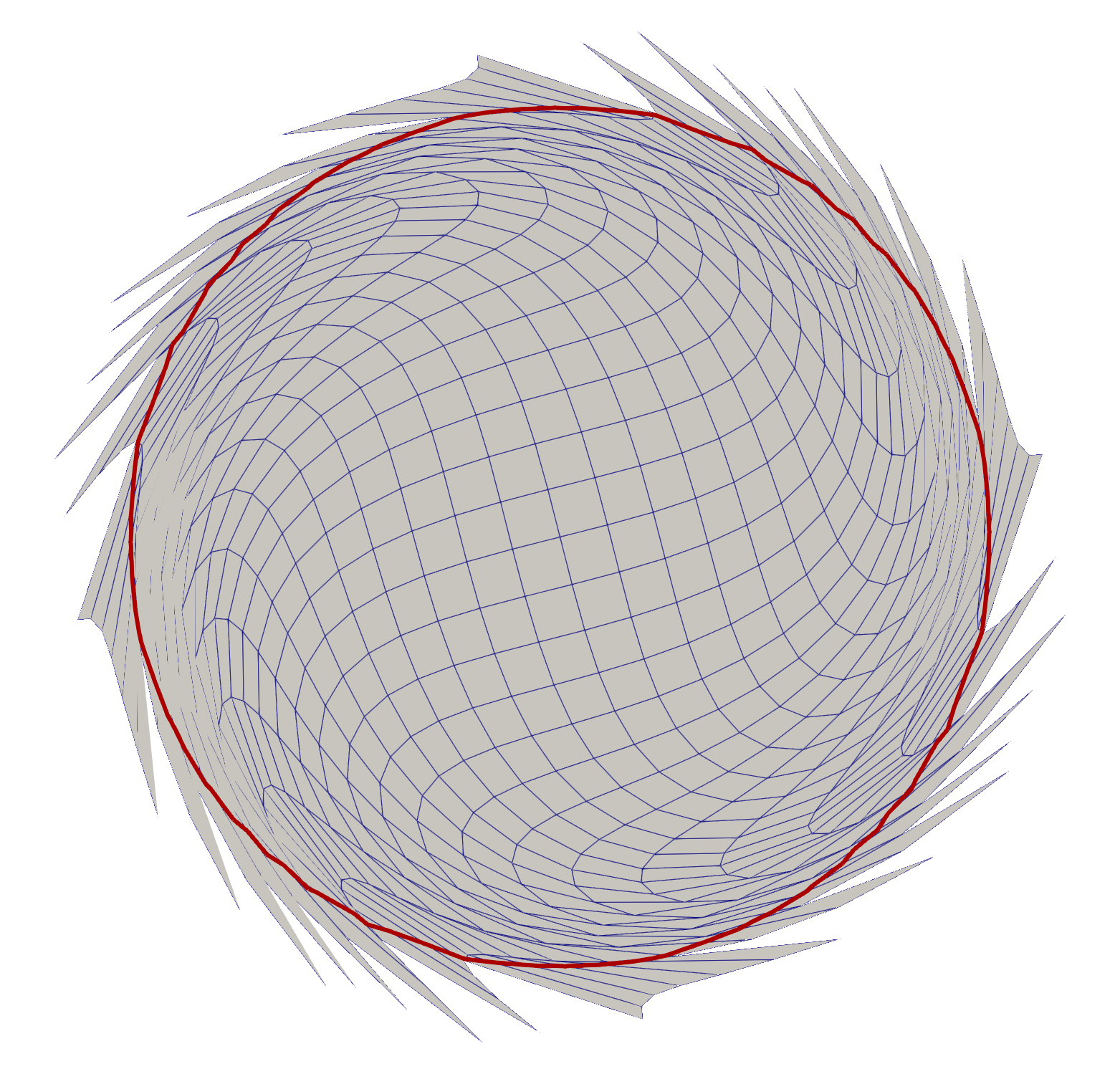
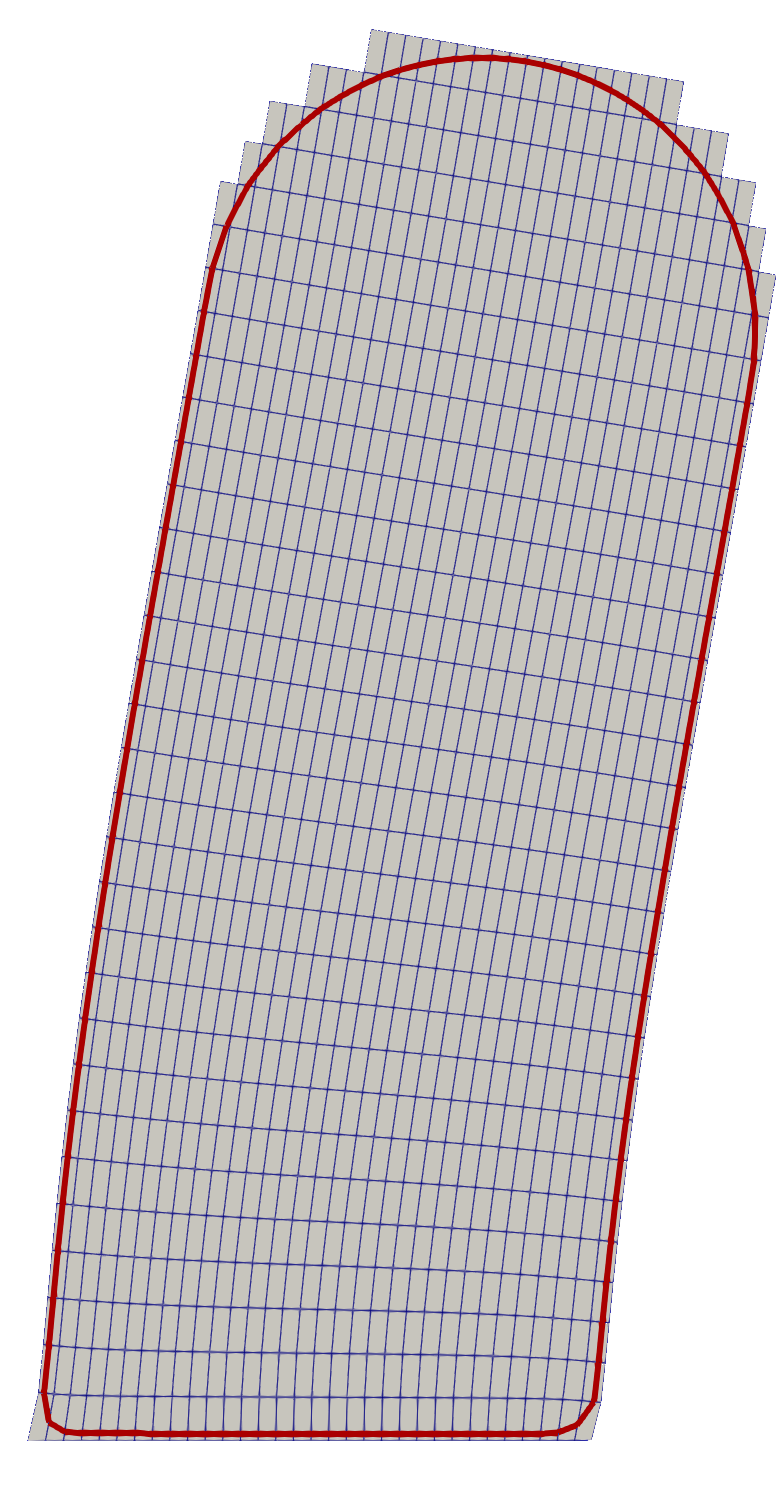
Figure 2: Problem geometries in deformed configurations for disc (left) and pole (right), demonstrating the flexibility of the CutFEM formulation for both simple and singularity-prone domains.
- Domains with Corners (Pole Problem): For a pole-shaped domain, the convergence rate is sharply limited by the presence of boundary-condition junctions (Dirichlet–Neumann and Dirichlet–Dirichlet corners). For mixed conditions at a straight boundary, the L2 convergence plateaus at O(h2λ), where Ψ0 is given by the Kolosov–Muskhelishvili equations, and is strictly less than Ψ1 for nearly incompressible materials. This plateau is independent of polynomial degree—higher-order elements offer no advantage unless the corner singularity is resolved.
Quantitative Analysis of Corner Singularities
A distinguishing contribution of the work is its detailed treatment of the fundamental accuracy barrier at boundary-condition junctions. The singular exponent Ψ2, and thus the convergence cap, are characterized analytically as a function of corner opening angle and Poisson ratio. The lower bound on attainable error is shown to be universal across fitted and unfitted methods on quasi-uniform meshes: no choice of stabilization, quadrature, or mesh alignment can remove it.
- Material Dependency: For typical engineering materials (Poisson ratio Ψ3 near Ψ4), the singularity is relatively strong (Ψ5), explaining why first-order accuracy dominates in practical computations unless special local refinement is used.
- Universal Limitation: The effect persists regardless of mesh type, cut position, or polynomial degree—inherent in the solution regularity, not the discretization details.
Remedy: Local Mesh Grading for Singular Points
The only way to restore optimal convergence in the presence of singularities is via local mesh refinement (grading) towards the corner/junction. The theoretical analysis and numerical tests demonstrate:
- With appropriate radial grading, CutFEM inherits the optimal rate from the corresponding body-fitted mesh.
- The requirements on grading are identical to those in the fitted case—the CutFEM stabilization, ghost penalty, and Nitsche terms coordinate seamlessly with local size to preserve cut-independence in constants and convergence.
- Adaptive refinement, though not fully explored here, is suggested as a natural and practical means to achieve such grading automatically—this would further generalize the result in three dimensions.
Implications and Future Directions
This unified CutFEM formulation, rooted in a strictly variational framework and leveraging automatic differentiation for all constitutive operations, offers several practical and theoretical advantages:
- Model-Independence: Changing material models is reduced to changing a scalar energy function, with all tangents and residuals updated automatically.
- Robustness to Mesh/Geometry Position: Conditioning and convergence rates are preserved regardless of how the physical domain intersects the mesh.
- Corner Singularities: The work sharply separates limitations intrinsic to the PDE solution (singularities at edges/corners) from any numerical artifacts, providing precise guidance on when and how to apply local refinement.
- Path for Adaptive Methods: The reduction argument sets the stage for a complete analysis of adaptive CutFEM methods.
In future, adaptive refinement strategies, analysis and algorithms for three-dimensional domains (where junctions are curves/surfaces), and application to complex coupled multiphysics problems open promising directions, especially leveraging the flexibility and generality of the energy-based, AD-driven implementation.
Conclusion
This work establishes a rigorously justified, practically flexible CutFEM formulation for finite-strain elasticity. The energy-only, AD-enabled architecture, comprehensive cut-independent theoretical guarantees, and sharp analysis of singularity-induced accuracy limitations collectively support its suitability for nonlinear mechanics on complex, evolving geometries. The legacy of approximation theory for singular domains is explicitly inherited, and the approach is positioned as a robust, extensible foundation for both future methods development and demanding multiphysics applications (2607.02334).