- The paper introduces time-reversal protocols in cavity QED that enable reversible control of entanglement for enhanced quantum metrology.
- It details the SATIN protocol where time-reversed dynamics amplify weak phase signals, achieving near-Heisenberg-limited sensitivity even with projection noise.
- The study contrasts measurement-based and coherent entanglement methods, emphasizing robust interaction-based readout to overcome the standard quantum limit.
Time-Reversal and Reversible Dynamics in Cavity QED for Quantum Metrology
Introduction and Motivation
The review "Time-Reversal and Reversible Dynamics in Cavity QED for Quantum Metrology" (2607.02320) addresses the utilization of time-reversed many-body dynamics—primarily realized in optical cavity QED—for quantum-enhanced metrology. The central theme is that while entanglement generation is a necessary ingredient for overcoming the standard quantum limit (SQL), the extraction and decoding of quantum advantage encoded in complex many-body states is an equally central challenge. The paper systematically develops how coherent interactions in cavity QED facilitate both entanglement generation and subsequent information decoding, with a focus on interaction-based readout, time-reversal protocols such as SATIN, and their generalizations.
Cavity-Mediated Entanglement and Reversible Many-Body Dynamics
Cavity QED platforms exhibit two principal entanglement-generation mechanisms: dissipative (measurement-induced) and coherent (Hamiltonian-based) processes. Measurement-based protocols utilize quantum non-demolition (QND) detection of collective observables and are highly robust, yet introduce irreversible information loss to the environment, precluding exact time reversal. In contrast, unitary, cavity-mediated interactions—such as one-axis twisting (OAT) implemented via spin-dependent ac Stark shifts—produce many-body entanglement through coherent nonlinear evolution, providing a natural foundation for reversible metrology.
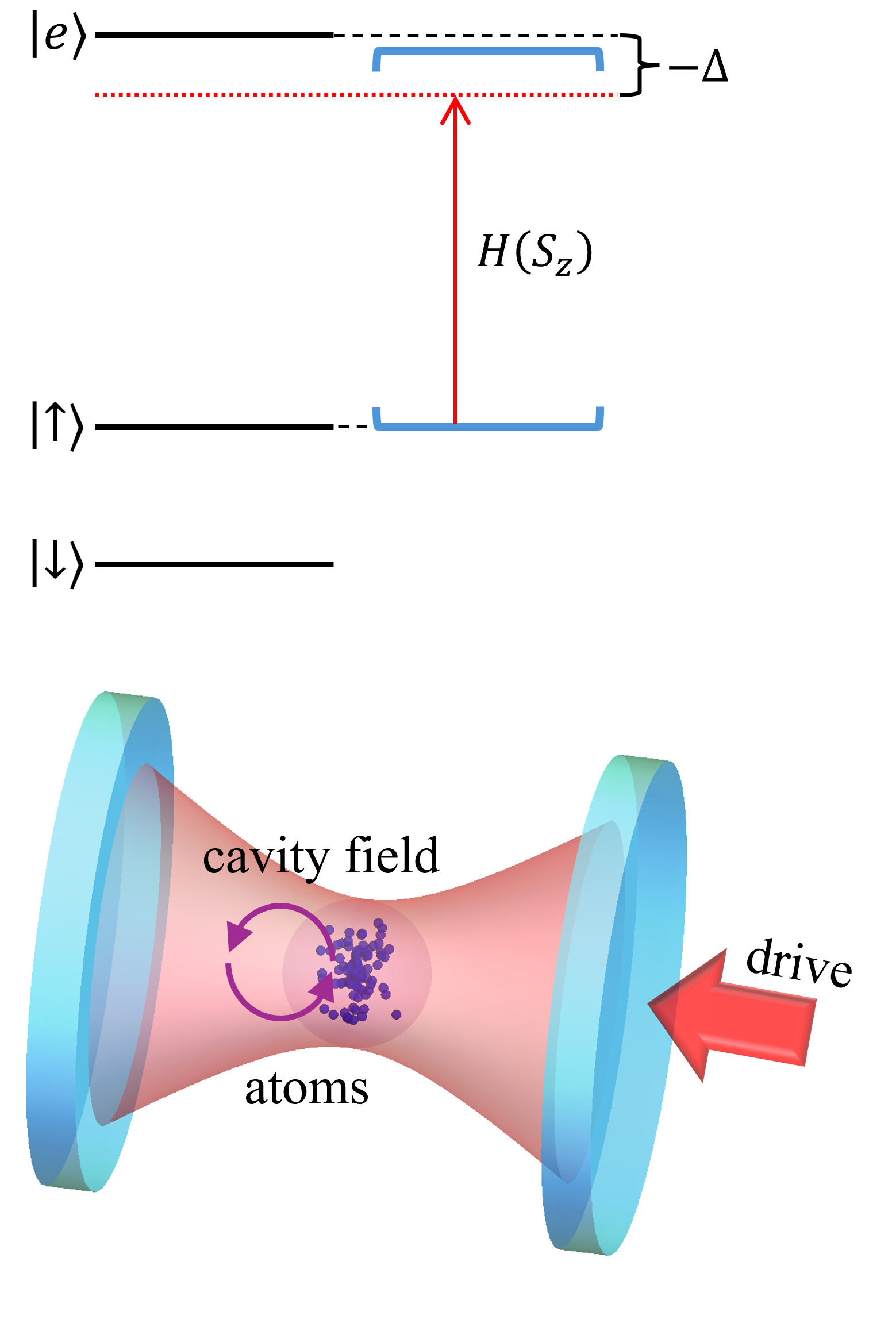
Figure 1: Cavity-mediated one-axis twisting generates coherent, reversible many-body entanglement via population-dependent ac Stark shifts in an optical cavity.
Central to these protocols is the experimental ability to reverse the sign of the cavity-mediated interaction—for instance, by switching the detuning of the probe light. This enables dynamic control over the effective Hamiltonian, permitting time-reversed evolution of the collective spin and thus the implementation of Loschmidt echoes or interaction-based readout schemes.
From Loschmidt Echoes to Metrological Time-Reversal Protocols
A critical conceptual distinction developed in the review is between Loschmidt echoes—protocols probing reversibility and decoherence by quantifying revival fidelity—and protocols that use reversed dynamics as a metrological resource. In the latter, the backward evolution serves to read out an encoded parameter (such as a weak phase) from a complex many-body state, facilitating robust extraction of metrological information with realistic detection noise.
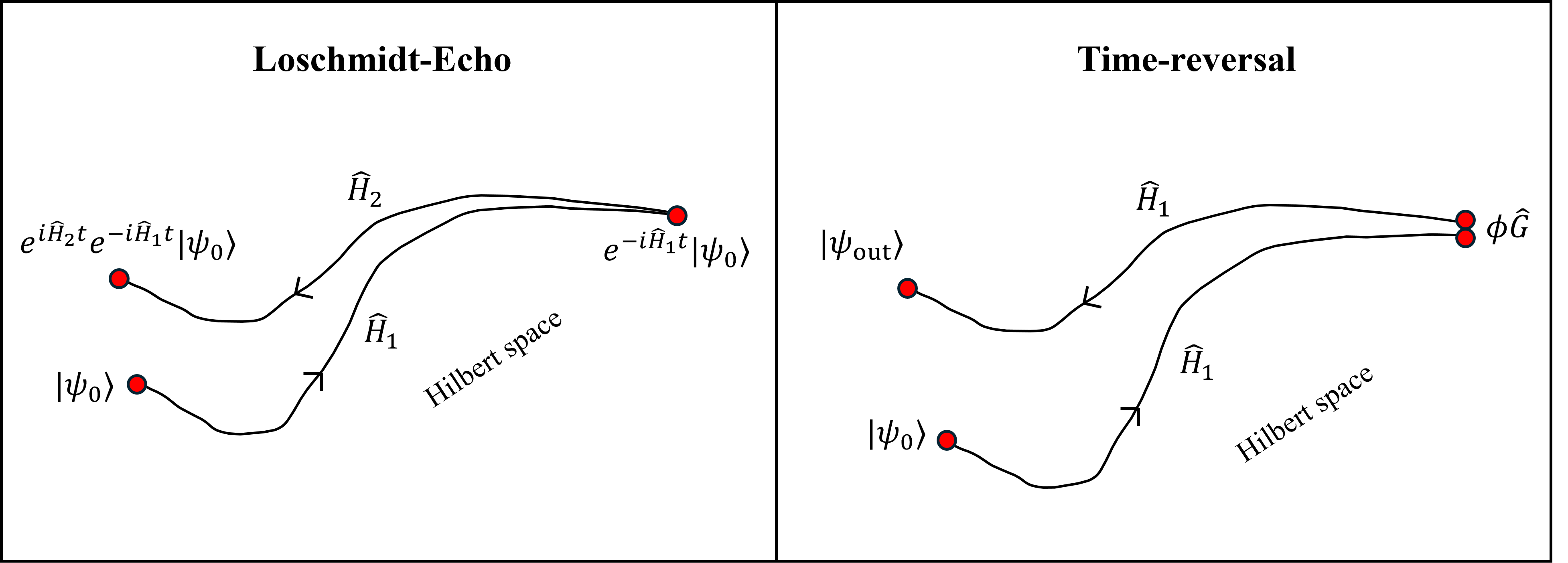
Figure 2: The Loschmidt echo quantifies reversibility and decoherence, while metrological time reversal leverages reversibility as a tool for signal extraction.
These two classes of protocols share mathematical similarity, but differ fundamentally in purpose. Practically, the review emphasizes that the metrological application is not sensitive to perfect fidelity recovery, but rather to the ability to amplify a weak signal into an experimentally accessible observable.
The SATIN Protocol: Signal Amplification Through Time-Reversed Interaction
A paradigmatic realization discussed is the SATIN protocol, where an initial OAT evolution creates a non-Gaussian entangled state of the collective spin, after which a small phase is encoded before reversing the interaction dynamics. The final time-reversed evolution serves not to restore the initial state, but to transform the weak phase encoding into a large displacement of a collective observable (e.g., Sy), amplifying the metrological signal and allowing Heisenberg-limited scaling even with projection-noise-limited detection.
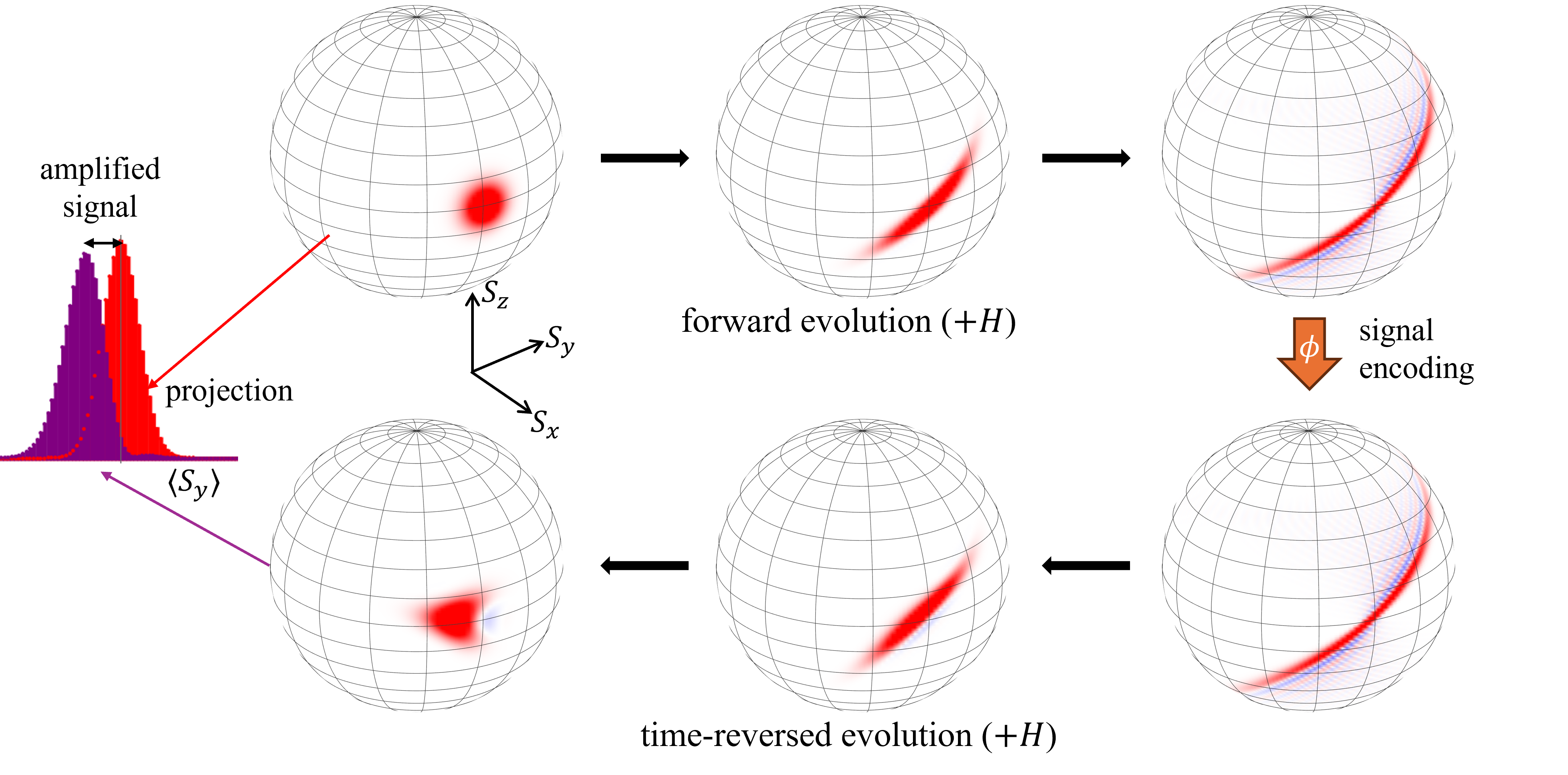
Figure 3: Schematic of the SATIN protocol: sequence of OAT entanglement, phase encoding, and reversed OAT for amplified readout.
An essential numerical claim is that the protocol allows near-Heisenberg-limited sensitivity even when the final measurement noise is only at the SQL. Analytical results presented (e.g., the scaling of achieved gain with detection noise and system size) strongly support this. The data show that, for N=1000 atoms and moderate detection noise, the gain achieved using SATIN far outperforms direct detection.
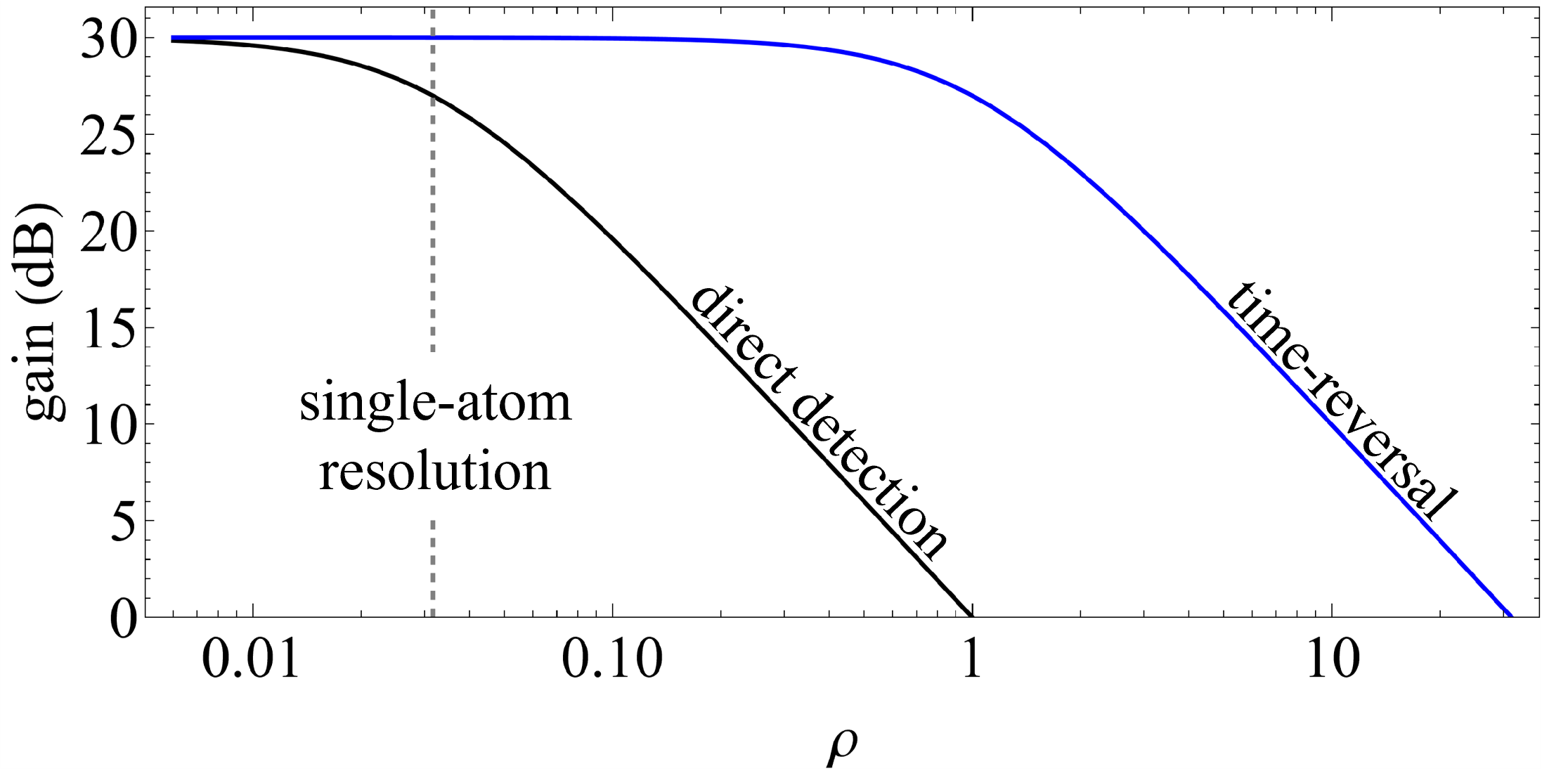
Figure 4: Measured gain as a function of normalized detection noise ρ for N=1000; blue curve: SATIN, black curve: direct detection.
Beyond Time Reversal: General Interaction-Based Readout and Practical Implementations
The review connects time reversal to the broader family of interaction-based readout (IBR) protocols. While SATIN is realized with U2=U1†, the general theory—supported by [Nolan et al. 2017, Haine 2018]—shows that the optimal post-encoding interaction may not precisely invert the initial dynamics. Instead, U2 can be tailored to the detection noise or decoherence landscape. Experimental implementations include quantum phase magnification and twist-and-turn protocols in both cavity QED and trapped-ion architectures.
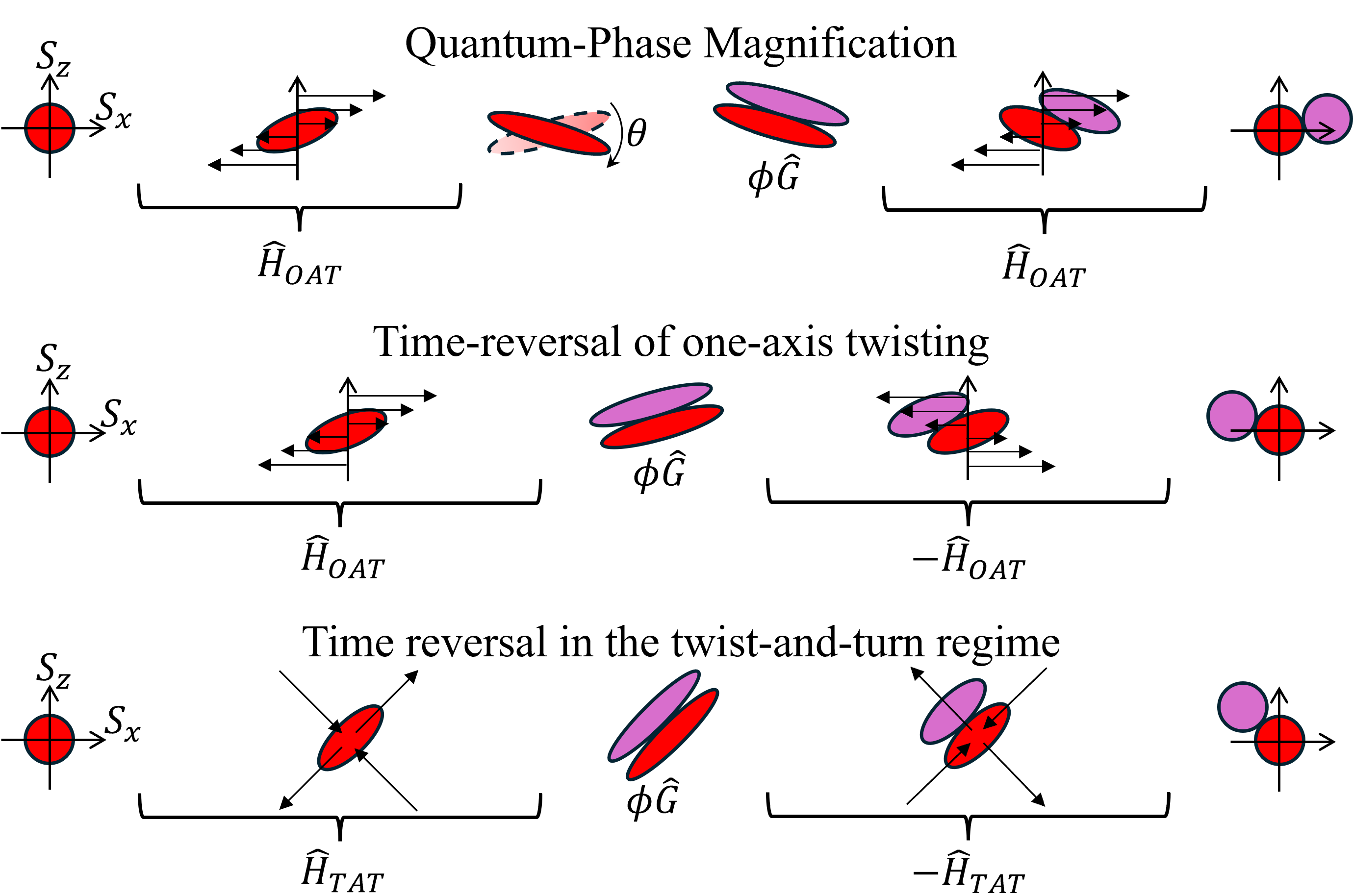
Figure 5: Comparison of phase magnification and time-reversal protocols: OAT with rotation (top), SATIN (middle), and more general collective dynamics (bottom).
The review discusses limitations and robustness: exact time reversal is primarily limited by dissipation, technical noise, and imperfections in Hamiltonian control. Generalized IBR methods, including asymmetric and partial untwisting, can mitigate these limitations under experimental constraints.
A summary of experimental implementations is provided, spanning quantum phase magnification [Hosten et al.], direct Hamiltonian reversal in Yb cavities [Colombo et al.], and phonon-mediated twisting echoes in trapped ions [Gilmore et al.]. The collected results establish that the practical advantage of these protocols is the robust translation of complex, fragile quantum resources into accessible metrological signals.
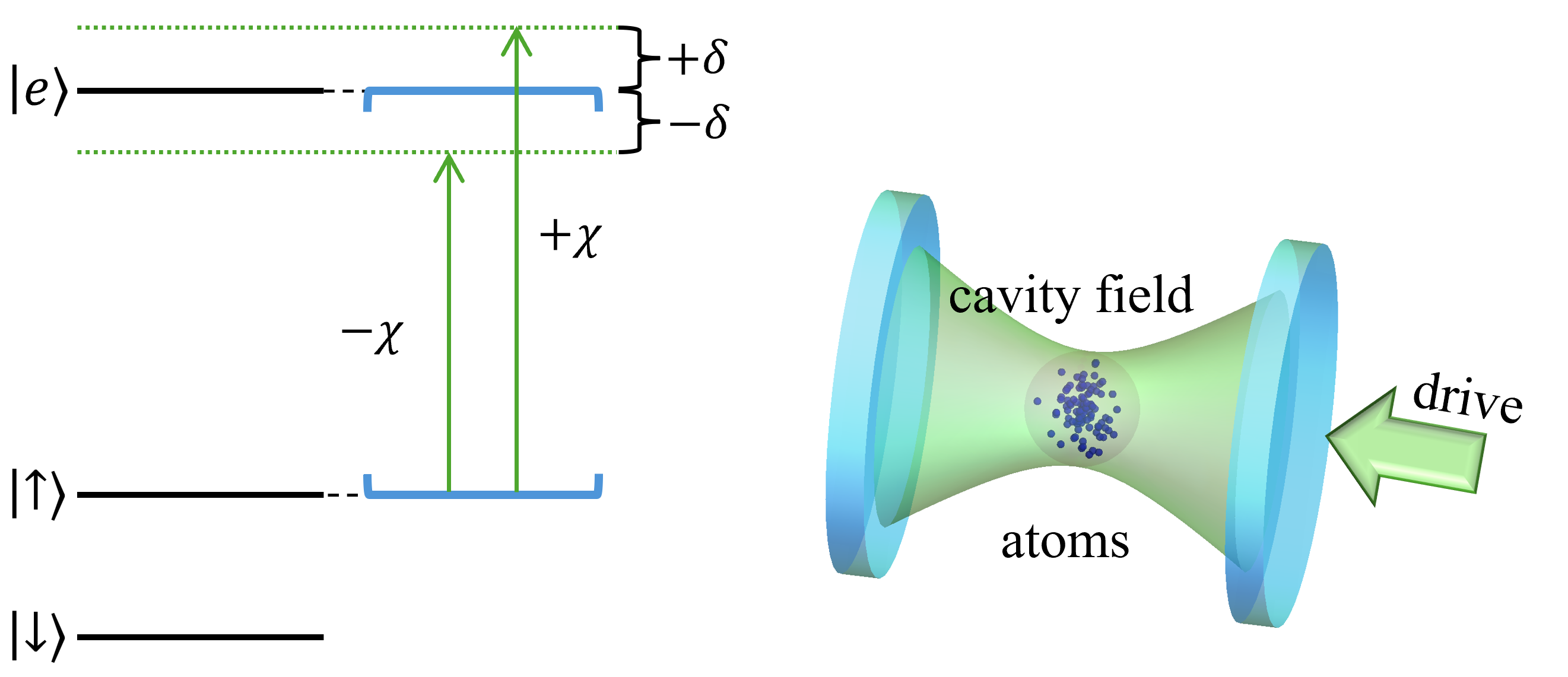
Figure 6: Yb cavity-QED implementation of SATIN: reversal of OAT dynamics by switching probe detuning, enabling amplified parameter readout at SQL-limited detection.
Notably, the reported experimental gains reach $6.8(4)$ dB below the SQL (Yb protocol) and 8.8±0.4 dB (trapped ions), with sensitivity limited primarily by cavity and detection noise, dissipative scattering, and imperfect control of interaction sign and duration.
Outlook: Reversible Many-Body Dynamics as a Metrological Resource
The review articulates that reversible many-body dynamics, enabled by coherent collective interactions and robust Hamiltonian control, are emerging as a distinct quantum resource. Theoretically, the interplay between optimal readout and decoherence is being elucidated, with new directions including decoding of highly non-Gaussian states, scrambling-enhanced metrology, and platform-independent protocols for signal amplification and noise robustness. The extension of these protocols to Rydberg arrays, dipolar gases, and solid-state ensembles is identified as a frontier.
The findings imply that future advances in quantum sensing will require joint optimization of both entanglement generation and information decoding. Decoding strategies tailored to complex noise environments, non-Gaussian resource states, and scalable hardware are projected to be critical for realizing the full quantum advantage in atomic clocks, interferometers, and precision sensors.
Conclusion
This review establishes a rigorous and comprehensive framework for interaction-based readout and reversible dynamics in quantum metrology. It consolidates theoretical developments, clarifies key distinctions between reversibility for diagnosis and for metrological readout, and synthesizes strong practical results from cavity QED, trapped ions, and related platforms. The review argues that as many-body quantum systems grow in complexity, the ability to control and reverse collective dynamics will be as essential for quantum-enhanced sensing as the generation of entanglement itself. Reversible many-body dynamics should thus be considered a core resource in next-generation quantum metrology.

