- The paper presents an integrated spatial speech perception pipeline that combines SSL, DSE, and ASR to achieve robust performance in complex acoustic environments.
- The study evaluates classical versus learning-based methods, highlighting trade-offs in latency, noise robustness, and overall recognition accuracy.
- It discusses joint training and end-to-end optimization strategies to better align enhancement quality with downstream ASR reliability in real-world applications.
Survey of Spatial Speech Perception Systems
Spatial speech perception is essential for robust auditory intelligence in complex acoustic environments, encompassing SSL for spatial awareness, DSE for interference suppression, and ASR for semantic interpretation. The paper "Spatial Speech Perception Systems: A Survey of Sound Source Localization, Directional Enhancement, and Speech Recognition" (2607.02296) serves as a comprehensive synthesis of these domains and their integration in real-world processing pipelines.
Integrated Spatial Speech Perception Pipeline
The survey delineates spatial speech perception as an integrated pipeline: SSL provides DOA and spatial cues from microphone arrays; DSE leverages these cues for directionally selective filtering; ASR forms the semantic back end, converting enhanced signals to text or intent representations.
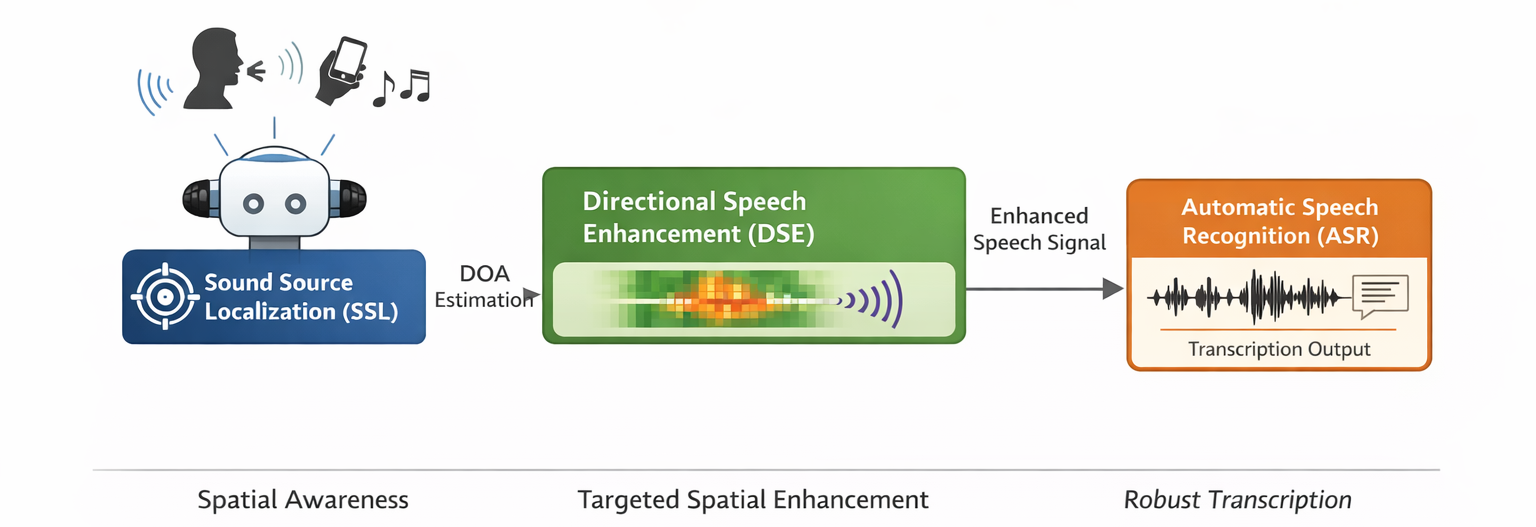
Figure 1: A spatial speech perception pipeline integrates SSL, DSE, and ASR sequentially to transform multichannel acoustic input into reliable linguistic output.
This architecture models how machine audition can parallel human cocktail-party competence, exploiting spatial and temporal cues to focus on target speech in adverse conditions. While each module has developed independently—with traditional SSL relying on TDoA and cross-correlation, DSE on beamforming, and ASR shifting from GMM-HMM to large-scale end-to-end models—real-world systems require their tight coupling.
Sound Source Localization: Algorithms and Trade-offs
Classical SSL methods (GCC-PHAT, SRP-PHAT, MVDR, MUSIC) offer interpretable and computationally efficient solutions, but performance degrades under reverberation, heavy interference, or multiple sources. Learning-based SSL (CNN, CRNN, Transformer/attention mechanisms) has demonstrated improved spatial discrimination and robustness, particularly in multi-speaker and challenging environmental conditions, at the expense of computational cost and training data demands.
The paper systematically reviews advances such as:
- DSVD-PHAT and GEVD/GSVD-MUSIC for fast, robust DOA estimation in noise-dominated or dynamic scenarios.
- CNN-GCCFB and hybrid networks for learning spatial features in robotic and wearable configurations.
- Transformer architectures extending broadband spatial modeling to arbitrary array geometries.
While analytical methods have clear latency bounds and failure modes, learning-based systems promise higher recognition accuracy in challenging scenes, though they require careful system-level evaluation regarding real-time constraints and generalization.
Directional Speech Enhancement: Filtering, Masking, and DOA Conditioning
DSE methods fall into three principal categories:
- Filtering-based: Classical beamformers (MVDR, GSC) and neural beamformers (FaSNet) that directly exploit array geometry and spatial covariance. These deliver low latency and interpretable control but depend on accurate upstream spatial estimation.
- Masking-based: Deep clustering, Deep Attractor Networks, and JNF-type models operate in time-frequency space, excelling in separation but with increased inference latency and less directional specificity.
- DOA-conditioned Enhancement: State-of-the-art models (DRN, CDUNet, MIDEANet) incorporate explicit DOA or spatial region embeddings into network architectures, enabling flexible, target-aware enhancement—crucially dependent on SSL accuracy.
The survey underscores that enhancement quality alone (e.g., improvements in SI-SDR, PESQ) may not align with downstream ASR reliability—enhancement-induced artifacts and spatial inconsistencies can hinder recognition despite perceptual improvements.
ASR Evolution and Architectures
ASR has undergone paradigmatic shifts:
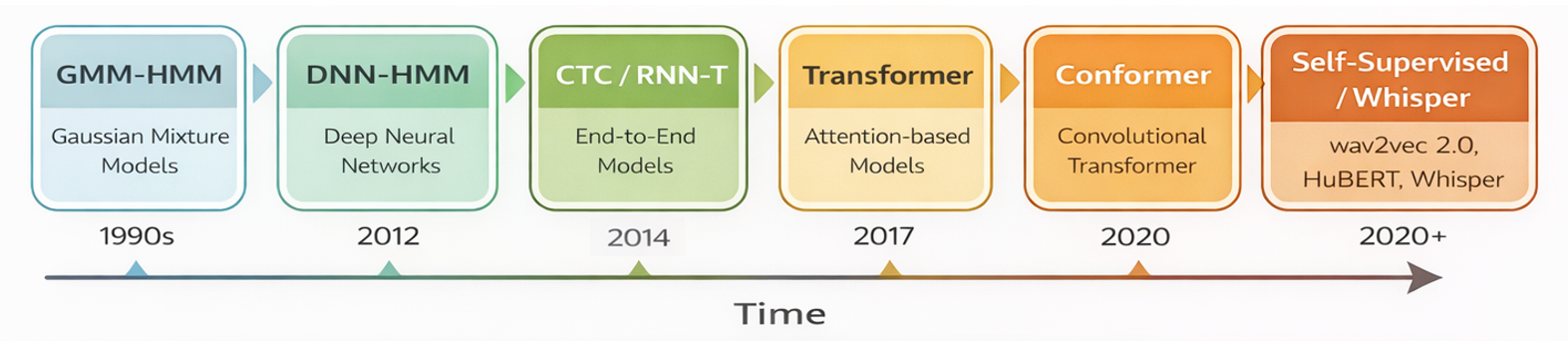
Figure 2: Historical development of ASR architectures from hybrid GMM-HMM and DNN-HMM toward RNN-T, Transformer, and Conformer models, culminating in large-scale self-supervised and multitask-trained frameworks.
- Hybrid systems (GMM-HMM, DNN-HMM): Require feature engineering (e.g., MFCCs) and complex decoding pipelines; real-time but less robust under far-field, noise, or overlapped speech.
- End-to-end architectures (CTC, RNN-T, attention/Transformer, Conformer): Direct mapping from audio to text, supporting sequence-to-sequence modeling, context learning, and transfer.
- Self-supervised/pretrained models (wav2vec 2.0, data2vec, Whisper): Exhibit enhanced noise robustness, multilinguality, and generalized recognition—even with limited in-domain training data.
Streaming (RNN-T, Conformer-T) and chunk-based ASR enable low-latency deployment; however, recognition performance and latency must be balanced against resource constraints, especially for edge and embedded applications.
System-level Evaluation and Numerical Results
The survey presents a robust framework for pipeline evaluation: not simply measuring angular error, SI-SDR, or WER in isolation, but quantifying end-to-end performance (total latency, robustness across SNRs, task recognition reliability). Noteworthy quantitative insights include:
- SSL latency: Analytical methods achieve sub-10ms processing, while hybrid/learning-based may require up to several hundred ms depending on architecture and hardware.
- Noise robustness: Some classical and hybrid SSL approaches maintain accurate DOA estimation down to -10 dB SNR; Whisper-based ASR models achieve intelligible recognition at SNRs as low as -5 dB with enhancement pre-processing.
- ASR real-time factor (RTF): State-of-the-art RNN-T and Conformer-based streaming ASR achieve sub-200 ms end-to-end latency per utterance on modern GPUs, validating their deployment for interactive systems.
The authors highlight that improvements in one stage (e.g., lower angular error in SSL) may not propagate to recognition improvement if not evaluated in a system-oriented manner—signal-level gains do not always imply lower WER.
Pipeline Integration and Application Implications
Three primary integration strategies are discussed:
- Multitask and joint learning: MSDET, DBNet, JointNet, and similar architectures align SSL and enhancement via shared representations or explicit DOA-conditioned filtering, improving robustness and interpretability at the cost of increased complexity and sensitivity to upstream errors.
- Recognition-driven pipelines: D-ASR and variants couple localization, enhancement, and recognition in an end-to-end trainable fashion, directly optimizing the pipeline for ASR reliability. Embodied approaches capitalize on robotic actuation for physical sensor geometry reconfiguration, closing the perception--action loop.
- Real-time, application-constrained: Systems demonstrably running with <30ms end-to-end latency are feasible for hearing aids, smart speakers, or embedded robot audition.
Applications in hearing assistance, human-robot interaction, domestic/smart environments, teleconferencing, and wearables each impose unique latency, memory, spatial resolution, and robustness constraints. The paper discusses domain-specific trade-offs and system design choices.
Challenges, Contradictory Claims, and Future Directions
Notable highlights and challenges include:
- Quality–robustness discrepancy: Signal-level enhancement is not consistently correlated with recognition reliability; in some cases, enhancement may even worsen WER due to artifact introduction or spatial cue mismatch.
- Benchmarking and reporting gaps: Standardization in pipeline-level benchmarks, latency, and robustness reporting is lacking, obstructing fair comparison and progress evaluation.
- Scalability to dynamic, unconstrained scenarios: Most current systems are not fully scalable to dynamic multi-speaker, far-field, reverberant environments with open-vocabulary ASR.
The paper calls for:
- Perception-aware, task-oriented enhancement objectives aligned with downstream ASR.
- Uncertainty-aware spatial modeling, where SSL and DSE propagate distributions or multiple hypotheses.
- Joint causal, low-latency, and resource-efficient designs for edge and embedded deployment.
- Multimodal fusion (audio–visual), active sensing, and situational awareness as future research priorities.
- Comprehensive, open-access benchmarks that permit pipeline-level, real-world evaluation.
Conclusion
Spatial speech perception encompasses a tightly integrated SSL–DSE–ASR pipeline bridging spatial sensing with robust voice-driven interaction. The survey offers an exhaustive and technically rigorous synthesis of core component methods, integrated architectures, practical constraints, and open challenges. Delivering robust, real-time, and application-adaptive speech perception in unconstrained acoustic environments remains a central objective and requires co-optimized, perception-aware approaches spanning array processing, neural modeling, and system-level design. The implications span assistive technologies, robotics, smart environments, and multimodal AI, charting a clear trajectory for future research in spatial auditory intelligence.