- The paper demonstrates that incorporating spinor degrees and TE–TM coupling significantly enriches the phase diagram, yielding persistent particle currents and hidden spin currents.
- Analytical and numerical methods uncover distinct equilibrium phases in dimer, triangular, square, and polygonal geometries with clear bond-resolved current signatures.
- Findings provide a roadmap for experimental mapping of current states in polariton lattices, highlighting implications for quantum simulations and spintronic devices.
Josephson and Spin Currents in Coupled Polariton Condensates
This paper provides a comprehensive theoretical analysis of particle and spin current formation in networks of tunnel-coupled exciton-polariton condensates with explicit spinor (two-component) structure. The investigation targets closed geometries—plaquettes and regular polygonal rings—where the interplay of spin-conserving tunneling, TE–TM-induced spin-flip processes, Zeeman splitting, and nonlinear interactions leads to a diverse array of equilibrium steady states. The work emphasizes the diagnostic value of bond-resolved particle currents, in-plane and out-of-plane (Stokes space) spin currents, and how these quantities co-define distinct equilibrium phases across representative geometries, from minimal (triangle, square) to larger rings.
The authors highlight that the inclusion of spinor degrees of freedom and TE–TM coupling substantially enriches the phase diagram compared to scalar models. Notably, the analysis reveals regimes with persistent particle currents, hidden spin currents (where the net particle flow is zero but spin currents circulate), and intricate bond-dependent spin-current patterns, which can be probed experimentally via polarization-resolved emission.
Model: Conservative Spinor Hamiltonian and Currents
The system is described using a mean-field, conservative Hamiltonian for N coupled polariton condensates, incorporating site-local polariton-polariton interactions (U), Zeeman splitting (ΔZ), and both spin-conserving (J) and TE–TM-induced spin-flip (δJ) tunneling. The tunneling matrix Tjl encodes geometric bond orientation via the relevant Stokes components, and spinor condensate fields Ψj,± (circular polarization basis) are employed.
The key observables are:
- Particle current Il→j: quantifying net polariton transport between adjacent sites.
- Spin current Jl→j: decomposed into transport (carried spin) and interfacial ‘torque’ terms (spin conversion at junctions via TE–TM coupling).
- Winding numbers (W+,W−): for the two circular components, capturing the topology of phase configurations.
- Branch-invariant metric U0: measuring the global common-phase coherence.
Symmetry considerations allow analysis to be restricted to U1, U2.
Analytical Results: Minimal Geometries
Dyad (Dimer)
For two coupled condensates, the ground-state configuration is always phase-locked with null net particle current, but a pure in-plane spin current can persist, entirely due to compensating Zeeman and interaction-induced pseudospin precession. No robust macroscopic particle flow is realized in the dimer.
Equilateral Triangle
Three main equilibrium phases (I–III) are analytically classified:
- Phase I (Asymmetric): Only realized for U3 (ferromagnetic coupling). One site differs in its circular polarization and phase, resulting in uniform particle current but a bond-asymmetric spin-current pattern.
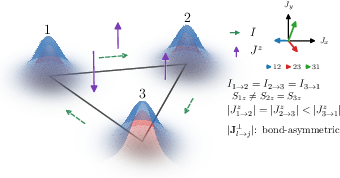
Figure 1: Schematic of the asymmetric triangular state, illustrating bond-asymmetric spin-current texture and uniform circulating particle flow.
- Phase II (Semi-vortex): Only one circular component has a U4 phase winding. Both particle and out-of-plane spin currents are uniform and persist even at U5, driven by the winding of the spin component.
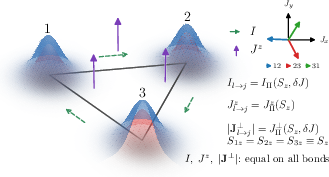
Figure 2: Schematic of the semi-vortex triangular state demonstrating uniform particle and U6-spin current along all bonds.
- Phase III (Hidden-vortex): Both circular components wind with opposite chiralities. Particle current is proportional to the polarization U7 and Zeeman field, while out-of-plane spin current U8 is uniform. The in-plane spin current rotates from bond to bond with fixed amplitude.
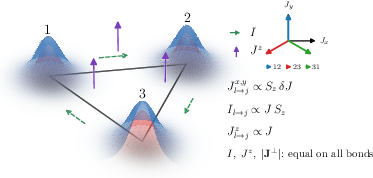
Figure 3: Schematic of the hidden-vortex triangular state, showing counter-circulating phase windings in the two circular components and uniform U9-spin current.
Detailed current maps demonstrate how these three phases partition the parameter space ΔZ0, with sharp boundaries and distinct signatures in ΔZ1.
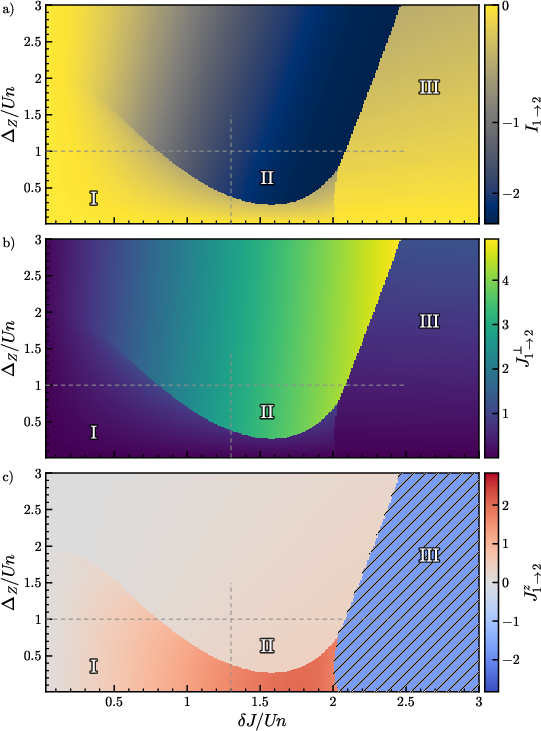
Figure 4: Ground-state current maps for a triangle, capturing the distinct current patterns of phases I–III as function of TE–TM coupling and field.
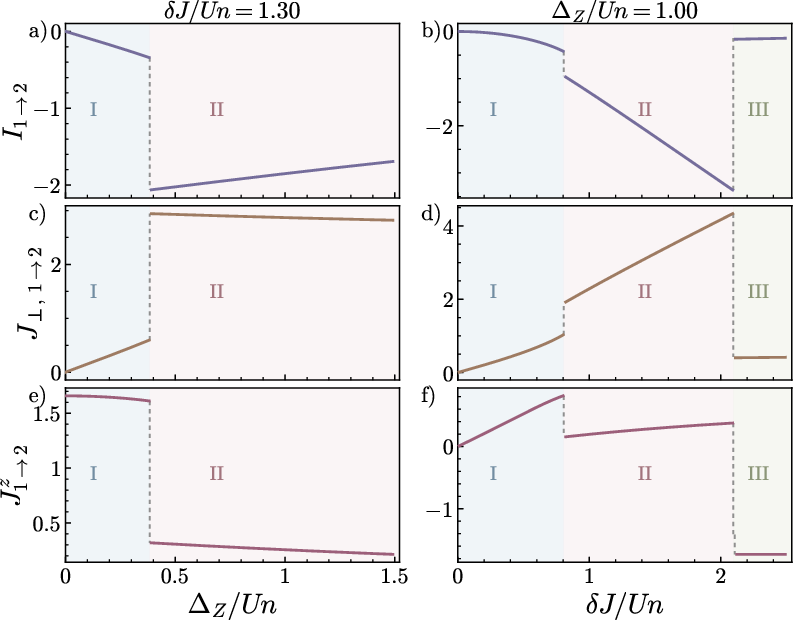
Figure 5: One-dimensional cuts of the current maps illustrating abrupt phase transitions as the system parameters are varied.
Square Plaquette
In a four-site ring, three analytical phases arise:
- Phase I: Bond-staggered, torque-induced spin current with zero particle current.
- Phase II: Bond-asymmetric spin transport, again with vanishing net particle current; ΔZ2 alternates sign on bonds.
- Phase III: Manifold with free polarization angle; includes representatives with uniform circulating particle and ΔZ3-spin currents when ΔZ4.
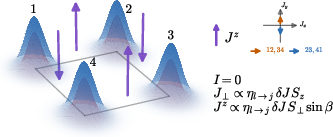
Figure 6: Square-plaquette Phase I with staggered spin currents and strictly zero particle transport.
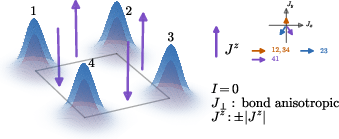
Figure 7: Bond-asymmetric spin transport in Square-plaquette Phase II, where net particle current remains null.
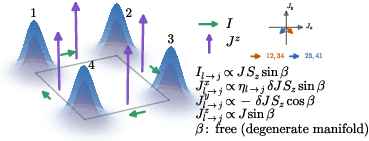
Figure 8: Square-plaquette Phase III representative (ΔZ5) featuring circulating particle and ΔZ6-spin currents.
Numerical exploration corroborates analytic predictions, and current maps delineate phase domains.
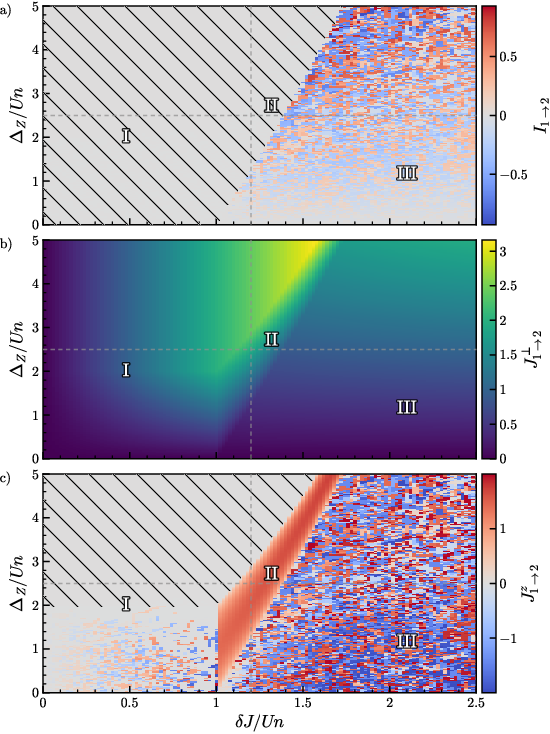
Figure 9: Current maps for the square, demonstrating phase boundaries between bond-staggered, bond-asymmetric, and circulating-current regimes.
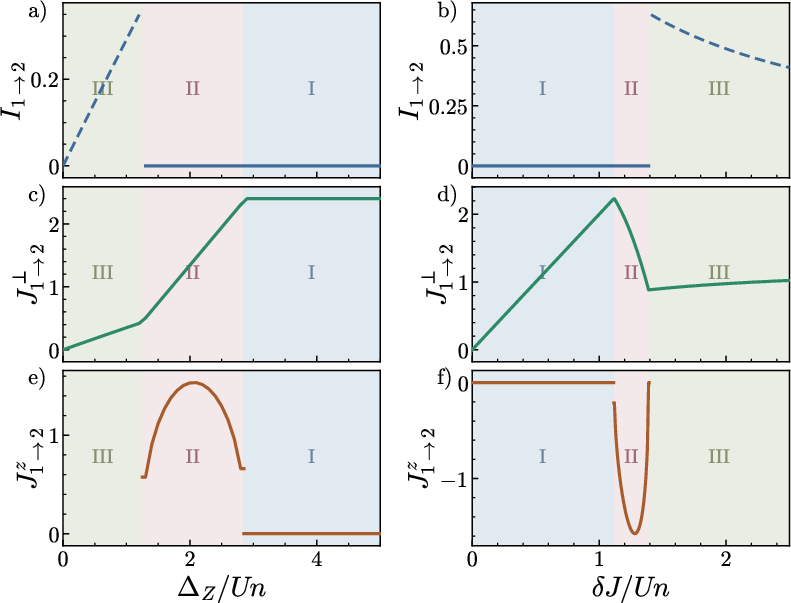
Figure 10: Line cuts through the square phase diagram, highlighting the phase-dependent structure of bond currents.
Large Polygonal Rings: Numerical Characterization and Finite-ΔZ7 Scaling
For ΔZ8, full analytic treatment becomes infeasible. The study utilizes numerical minimization in combination with current diagnostics, winding numbers, and the common-phase coherence metric. Results reveal three robust macroscopic phases across all ΔZ9:
- A: Hidden-vortex-like/chiral circulation—uniform J0 and, with nonzero J1, a nearly uniform particle current (winding J2).
- B: Semi-vortex-like—large, nearly uniform in-plane spin-current response, suppressed J3, characterized by winding with one nontrivial component (e.g., J4); common-phase coherence is low.
- C: Bond-textured/asymmetric—weak particle transport, highly bond-dependent J5, and zero winding.
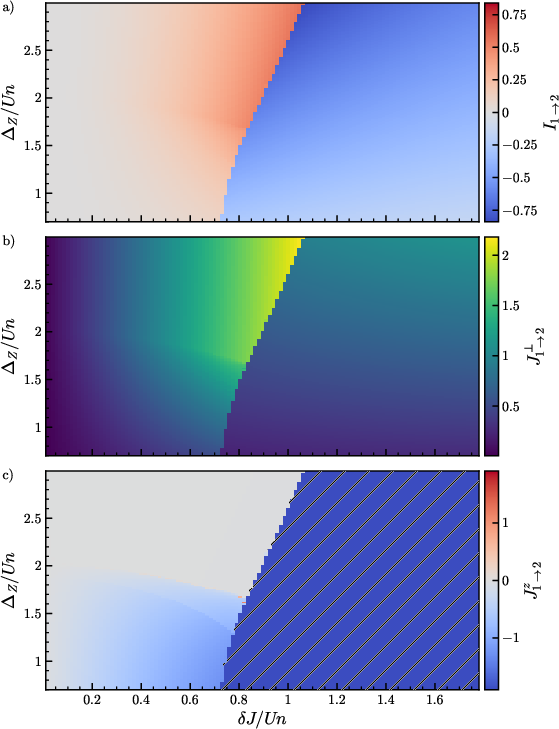
Figure 11: Current maps for a pentagonal ring, delineating the chiral, semi-vortex-like, and bond-textured domains.
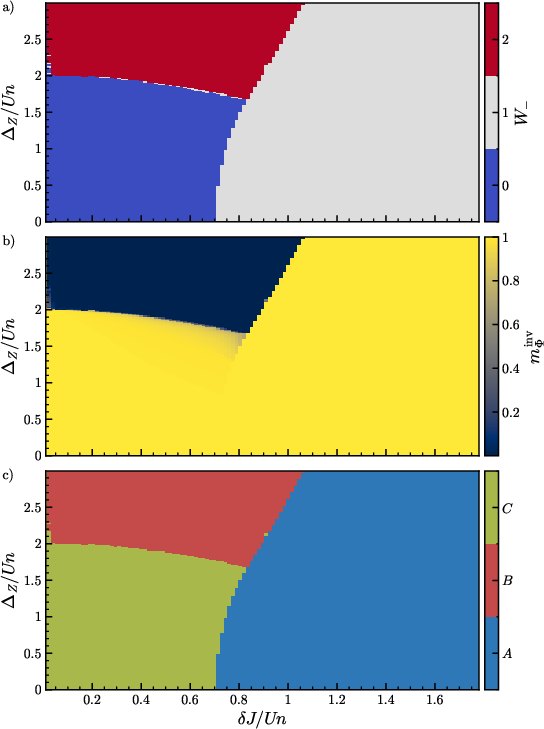
Figure 12: Phase diagram for a pentagon, categorized by winding numbers and common-phase coherence.
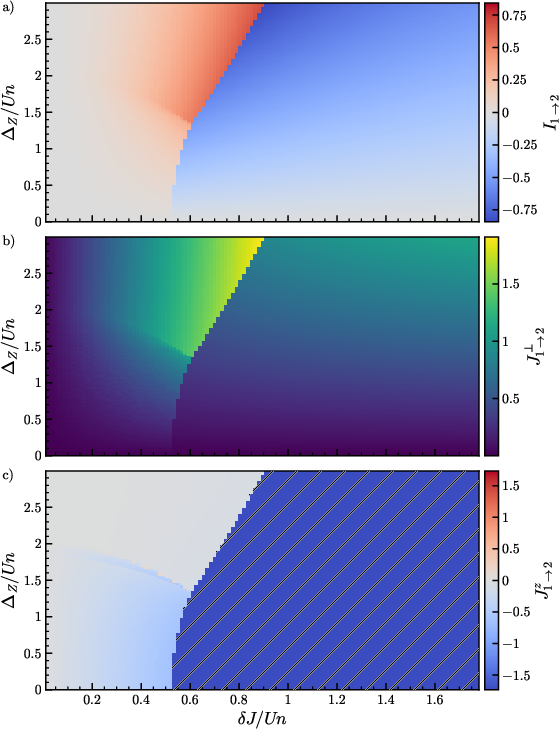
Figure 13: Current maps for a hexagonal ring, further reinforcing the three-phase structure across increasing J6.
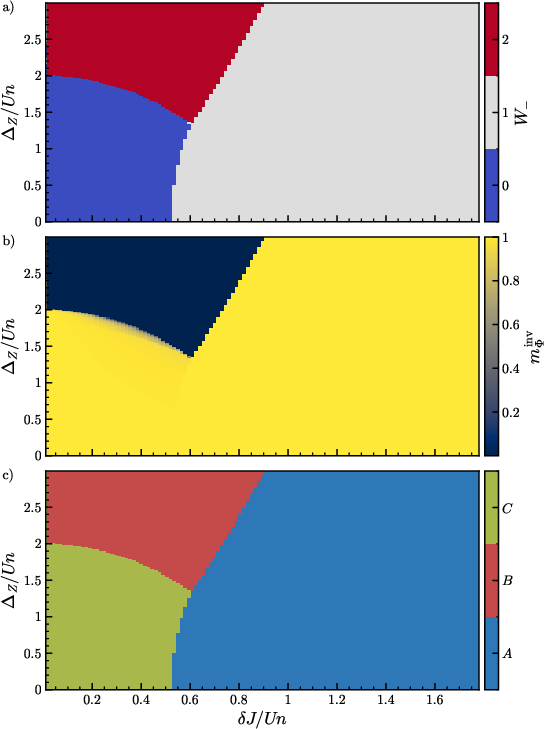
Figure 14: Metric diagnostics for the hexagonal ring, mapping the topological and coherence properties.
Crucially, the critical value of TE–TM spin-flip coupling (J7) at which the chiral phase appears is shown to scale with the effective geometric parameter J8 associated with the double-angle structure of TE–TM interaction.

Figure 15: Overlay of dominant phase boundaries for J9–δJ0: (a) unscaled and (b) after applying the geometric rescaling, the collapse of the A–B border is evident.
(Figures 16 and 17)
Figure 16: Out-of-plane spin-current maps for δJ1–9; Figure 17: compact phase diagrams for δJ2–9, confirming persistence of macroscopic phase taxonomy.
The finite-δJ3 trends reveal convergence toward a continuum-ring limit, with the phase portrait for large rings well described by rescaled parameters, substantiating the universality and robustness of the detected current regimes.
Implications and Outlook
The direct connection established between equilibrium phase structure and measurable particle/spin currents enables sharp experimental discrimination between distinct macroscopic states in polariton ring graphs. Notably, the identification of hidden spin currents and torque-driven spin conversion phenomena is particularly relevant for spintronics-oriented device architectures exploiting persistent pure spin flows. The current approach demonstrates that persistent Josephson-like currents and nontrivial spin textures are robust features of equilibrium configurations, determined entirely by Hamiltonian minimization without any gain–loss or non-equilibrium drive.
Practically, this motivates experimental efforts towards current-resolved mapping in polariton lattices, leveraging polarization-sensitive emission channels. On a theoretical front, the methodology is readily extensible to more complicated network topologies, disordered graphs, synthetic gauge fields, and configurations with higher spin multiplicity. Moreover, as the current analysis is restricted to conservative, equilibrium systems, the stability and dynamical accessibility of the identified current states in driven-dissipative regimes—relevant for real devices—remains quantitatively open, as does the impact of higher-order nonlinearities and quantum fluctuations.
Conclusion
This study elucidates the structure of particle and spin currents in tunnel-coupled spinor polariton networks of various topologies, combining analytic solutions for minimal geometries and numerical phase diagnostics for larger rings. The partitioning of phase space into distinct current regimes—chiral hidden-vortex circulation, semi-vortex in-plane spin transport, and bond-textured weak-current states—is shown to be universal across finite δJ4 and to converge systematically with increasing system size after suitable geometric rescaling. These results deliver a detailed road map for the control and detection of complex spin and particle current patterns in polariton condensate lattices, with direct implications for quantum simulation, topological photonics, and spintronic device applications. The extension to non-equilibrium and driven polariton graphs constitutes a substantial direction for future research.
Reference: "Josephson and Spin Currents in Coupled Polariton Condensates" (2607.02265)